Strive Increases Its Corporate Bitcoin Reserve to 20,000 Bitcoins

cryptonews.ruPublished on 2026-07-28Last updated on 2026-07-28

Abstract

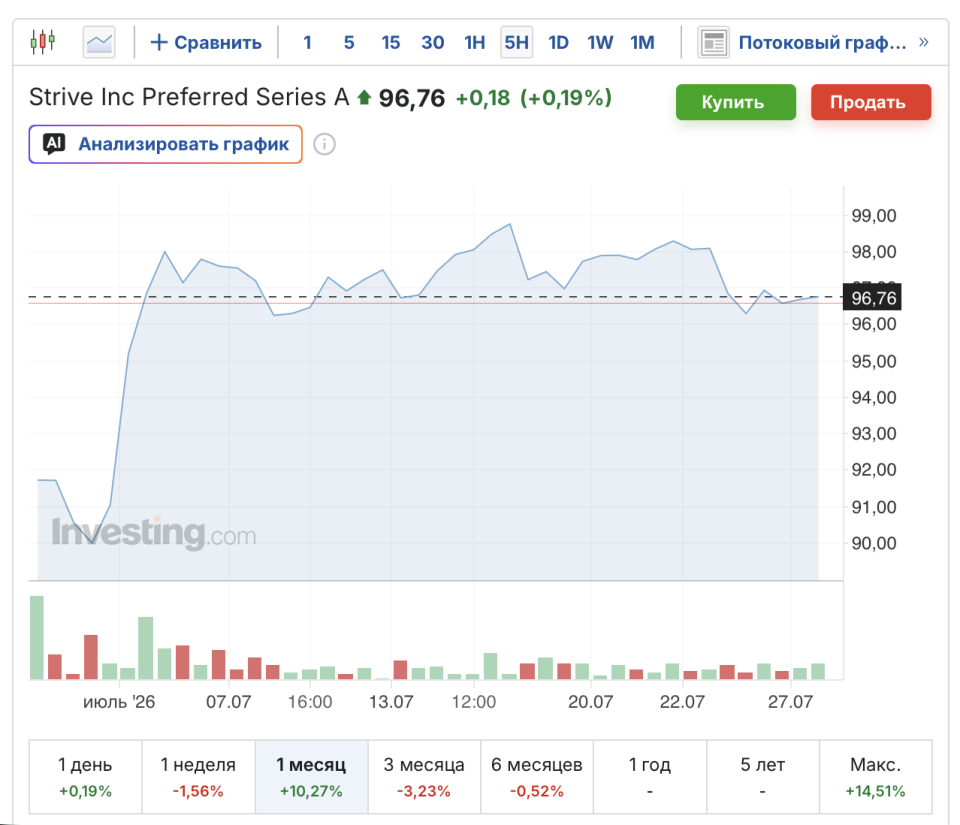
Strive has increased its corporate Bitcoin reserve to 20,000 BTC. Between July 20-24, the company acquired 79 bitcoins for approximately $5.2 million at an average price of $65,723 per coin, bringing the total value of its holdings to around $1.3 billion at current prices. The funding primarily comes from the issuance of its SATA preferred perpetual shares, whose dividend yield was recently raised to about 13%. This marks the fourth consecutive week of Strive increasing its Bitcoin reserves. Since May, the company has added approximately 3,264 BTC to its portfolio through market purchases and corporate deals. Consequently, SATA shares have risen by over 10% in the past month. A major purchase this year occurred in May, when Strive bought more than 2,500 BTC for about $185.2 million at an average price of $74,092 per coin. Subsequent smaller purchases were made at lower prices. Year-to-date, Strive has increased its holdings by 3,780 BTC. The company now ranks seventh among public companies by Bitcoin treasury size, positioned between Bullish and Elon Musk's SpaceX. Strive's ongoing acquisitions contrast with the largest corporate holder, Strategy, which has paused its Bitcoin purchases for a month and recently conducted its first buyback of preferred shares.

From July 20th to 24th, Strive acquired 79 bitcoins for approximately $5.2 million. The average purchase price, including fees, was $65,723 per coin. At current market prices, the value of these assets is approximately $1.3 billion. The primary funding source was the issuance of SATA preferred perpetual shares. Recently, the company increased the dividend yield on these shares to about 13% and stated that it continues to direct funds raised from the sale of these securities towards increasing its corporate bitcoin reserve.

Strive has been increasing its holdings of the leading cryptocurrency for the fourth consecutive week. Since May, the company has added about 3,264 $BTC to its portfolio—some of the coins were purchased on the market, and some were obtained through corporate deals. Amid this activity, the price of SATA securities has risen by more than 10% over the past month.
One of Strive's largest purchases this year occurred in May: the company acquired over 2,500 $BTC for approximately $185.2 million at an average price of about $74,092 per coin. A few weeks later, it bought an additional 73 $BTC, but at an average price of $63,646. From June 15th to 21st, Strive bought 759 $BTC, and a week later purchased another 17.76 $BTC. In total, since the beginning of the year, the company has increased its holdings by 3,780 $BTC.

Currently, Strive ranks seventh among public companies in terms of bitcoin reserves—it trails Bullish but surpasses Elon Musk's SpaceX, according to data from Bitcoin Treasury.

Strive's bitcoin purchases are occurring against the backdrop of a pause in acquisitions by the largest corporate holder of the leading cryptocurrency—Strategy. That company has not bought bitcoins for a month now, and recently conducted its first-ever buyback of its preferred shares.

end-content

Trending Cryptos

Related Questions

QHow many bitcoins did Strive purchase from July 20 to July 24, and what was the total approximate cost?

AStrive purchased 79 bitcoins at a total cost of approximately $5.2 million during that period.

QWhat is the primary source of funds for Strive's recent bitcoin acquisitions?

AThe primary source of funds is the issuance of SATA (Strive's preferred perpetual shares).

QWhat is Strive's current ranking among public companies in terms of bitcoin holdings, and which companies is it positioned between?

AStrive currently ranks seventh among public companies for bitcoin holdings. It trails behind Bullish but surpasses SpaceX led by Elon Musk.

QWhat major purchase of bitcoin did Strive make in May of this year in terms of quantity and value?

AIn May, Strive made one of its largest purchases of the year, acquiring over 2,500 bitcoins for approximately $185.2 million.

QWhat significant action has the largest corporate bitcoin holder, Strategy, taken recently regarding its holdings or shares?

AStrategy, the largest corporate bitcoin holder, has not purchased any bitcoin for a month and recently conducted its first-ever buyback of its preferred shares.

Related Reads

Microsoft CEO Satya Nadella's Latest Warning: Betting Entirely on a Single AI Model Hands Over a Company's Lifeblood

Microsoft CEO Satya Nadella warns that companies relying solely on a single AI model could jeopardize their survival. He argues that over-dependence leads to "vendor lock-in," where businesses risk ceding control over their core data, memory, contextual history, and AI usage patterns. This dependence essentially outsources a company's critical thinking and operational know-how to an external provider. The deeper a company integrates with one AI system—feeding it prompts, internal data, and workflows—the more it reveals its unique business methods and competitive edge. This accumulated knowledge could become accessible to the AI supplier. Furthermore, switching providers becomes extremely costly and complex, as companies would need to rebuild their entire AI-augmented workflow, memory, and tool integrations from scratch. Nadella's solution is "decoupling." Companies should separate their proprietary data, memory, and control layer (or "harness") from the underlying AI models. By retaining metadata from every AI interaction, businesses can preserve their operational "brain" or institutional knowledge. This allows them to flexibly use different AI models (e.g., from OpenAI, Anthropic, Microsoft) for specific tasks without losing their accumulated expertise. The core idea: companies can rent the smartest models available, but they must keep their own "brain" and operational control firmly in-house.

marsbit29m ago

Microsoft CEO Satya Nadella's Latest Warning: Betting Entirely on a Single AI Model Hands Over a Company's Lifeblood

marsbit29m ago

Miners Advised Not to Buy GPUs for AI and to Focus on Infrastructure

A founder at an energy investment forum advises bitcoin miners not to purchase GPUs for AI themselves, but to instead focus on infrastructure like power and data center space. Mike Alfred of Alpine Fox stated that while AI infrastructure demand is a long-term, 20-30 year trend, it presents a key choice for miners. The first, riskier model involves owning and operating GPUs, which requires financing expensive hardware that quickly becomes obsolete. The second, more conservative model is akin to real estate: providing colocation services where clients bring their own servers, and the miner sells space, power, cooling, and water. Alfred noted this model is easier to finance. Most existing bitcoin mining sites are difficult and expensive to convert for AI, as AI data centers require far higher construction costs, redundant fiber connections, backup power, complex cooling, and near 100% uptime. A hybrid model, where mining acts as a flexible load to use excess power during AI data center construction or from generation facilities, was discussed. However, participants concluded this is only viable with very cheap power; otherwise, developers are better off focusing solely on AI. Miners are increasingly being evaluated for their available power capacity and project portfolios rather than just bitcoin output. Panelists also warned of risks in the AI sector, predicting at least one major default or contract breach among AI tenants, lenders, or landlords before bitcoin's next halving in 2028.

cryptonews.ru38m ago

Miners Advised Not to Buy GPUs for AI and to Focus on Infrastructure

cryptonews.ru38m ago

Millisecond 'Pay-to-Cut': How Did Hyperliquid's Priority Fee Turn into a Multi-Million Dollar Business?

"Millisecond 'Paid Queue-Jumping': How Hyperliquid's Priority Fee Became a Multi-Million Dollar Annual Business" In traditional finance, high-frequency trading firms spend millions on infrastructure for millisecond advantages. Hyperliquid has translated this race onto the blockchain with its "Priority Fee" system, creating an open economic game for speed. This system auctions two types of priority: **Gossip Priority** for faster data feeds (via a Dutch auction every 3 minutes), and **Order Priority** for front-of-queue trade execution (users bid a fee for lower latency). This converts a hardware race into a transparent, market-priced mechanism. Since launch, this feature has generated over $5M in protocol revenue. Projected annualized buybacks from this income exceed $30M, accounting for ~7% of total protocol revenue. The demand stems from large traders and market makers on Hyperliquid, for whom milliseconds can mean the difference between profit/loss or avoiding liquidation. Market makers pay these fees as "protection" to ensure their orders execute first, which in turn improves liquidity for all users. Crucially, Hyperliquid internalizes Maximum Extractable Value (MEV) that typically leaks to external validators or searchers, creating a new revenue stream beyond trading fees. The mechanism also strengthens HYPE's tokenomics. While 97% of trading fees fund secondary market buybacks (via the Assistance Fund), Priority Fees are **directly burned**, adding a second deflationary engine. Furthermore, fees for order priority are deducted from users' undelegated HYPE balances, encouraging large traders to hold and lock up tokens, reducing circulating supply. However, a key challenge remains: balancing the speed needs of institutional players with fair market access for retail users, as those who cannot pay high fees may suffer worse slippage during volatility. In summary, Hyperliquid's Priority Fee is a novel model that monetizes latency, captures MEV for the protocol, and enhances its native token's value through burning and lock-ups.

marsbit43m ago

Millisecond 'Pay-to-Cut': How Did Hyperliquid's Priority Fee Turn into a Multi-Million Dollar Business?

marsbit43m ago

Trading

Spot

Hot Articles

What is $BITCOIN

DIGITAL GOLD ($BITCOIN): A Comprehensive Analysis Introduction to DIGITAL GOLD ($BITCOIN) DIGITAL GOLD ($BITCOIN) is a blockchain-based project operating on the Solana network, which aims to combine the characteristics of traditional precious metals with the innovation of decentralized technologies. While it shares a name with Bitcoin, often referred to as “digital gold” due to its perception as a store of value, DIGITAL GOLD is a separate token designed to create a unique ecosystem within the Web3 landscape. Its goal is to position itself as a viable alternative digital asset, although specifics regarding its applications and functionalities are still developing. What is DIGITAL GOLD ($BITCOIN)? DIGITAL GOLD ($BITCOIN) is a cryptocurrency token explicitly designed for use on the Solana blockchain. In contrast to Bitcoin, which provides a widely recognized value storage role, this token appears to focus on broader applications and characteristics. Notable aspects include: Blockchain Infrastructure: The token is built on the Solana blockchain, known for its capacity to handle high-speed and low-cost transactions. Supply Dynamics: DIGITAL GOLD has a maximum supply capped at 100 quadrillion tokens (100P $BITCOIN), although details regarding its circulating supply are currently undisclosed. Utility: While precise functionalities are not explicitly outlined, there are indications that the token could be utilized for various applications, potentially involving decentralized applications (dApps) or asset tokenization strategies. Who is the Creator of DIGITAL GOLD ($BITCOIN)? At present, the identity of the creators and development team behind DIGITAL GOLD ($BITCOIN) remains unknown. This situation is typical among many innovative projects within the blockchain space, particularly those aligning with decentralized finance and meme coin phenomena. While such anonymity may foster a community-driven culture, it intensifies concerns about governance and accountability. Who are the Investors of DIGITAL GOLD ($BITCOIN)? The available information indicates that DIGITAL GOLD ($BITCOIN) does not have any known institutional backers or prominent venture capital investments. The project seems to operate on a peer-to-peer model focused on community support and adoption rather than traditional funding routes. Its activity and liquidity are primarily situated on decentralized exchanges (DEXs), such as PumpSwap, rather than established centralized trading platforms, further highlighting its grassroots approach. How DIGITAL GOLD ($BITCOIN) Works The operational mechanics of DIGITAL GOLD ($BITCOIN) can be elaborated on based on its blockchain design and network attributes: Consensus Mechanism: By leveraging Solana’s unique proof-of-history (PoH) combined with a proof-of-stake (PoS) model, the project ensures efficient transaction validation contributing to the network's high performance. Tokenomics: While specific deflationary mechanisms have not been extensively detailed, the vast maximum token supply implies that it may cater to microtransactions or niche use cases that are still to be defined. Interoperability: There exists the potential for integration with Solana’s broader ecosystem, including various decentralized finance (DeFi) platforms. However, the details regarding specific integrations remain unspecified. Timeline of Key Events Here is a timeline that highlights significant milestones concerning DIGITAL GOLD ($BITCOIN): 2023: The initial deployment of the token occurs on the Solana blockchain, marked by its contract address. 2024: DIGITAL GOLD gains visibility as it becomes available for trading on decentralized exchanges like PumpSwap, allowing users to trade it against SOL. 2025: The project witnesses sporadic trading activity and potential interest in community-led engagements, although no noteworthy partnerships or technical advancements have been documented as of yet. Critical Analysis Strengths Scalability: The underlying Solana infrastructure supports high transaction volumes, which could enhance the utility of $BITCOIN in various transaction scenarios. Accessibility: The potential low trading price per token could attract retail investors, facilitating wider participation due to fractional ownership opportunities. Risks Lack of Transparency: The absence of publicly known backers, developers, or an audit process may yield skepticism regarding the project's sustainability and trustworthiness. Market Volatility: The trading activity is heavily reliant on speculative behavior, which can result in significant price volatility and uncertainty for investors. Conclusion DIGITAL GOLD ($BITCOIN) emerges as an intriguing yet ambiguous project within the rapidly evolving Solana ecosystem. While it attempts to leverage the “digital gold” narrative, its departure from Bitcoin's established role as a store of value underscores the need for a clearer differentiation of its intended utility and governance structure. Future acceptance and adoption will likely depend on addressing the current opacity and defining its operational and economic strategies more explicitly. Note: This report encompasses synthesised information available as of October 2023, and developments may have transpired beyond the research period.

1.1k Total ViewsPublished 2025.05.13Updated 2025.05.13

What is $BITCOIN

Discussions

Welcome to the HTX Community. Here, you can stay informed about the latest platform developments and gain access to professional market insights. Users' opinions on the price of BTC (BTC) are presented below.

活动图片