More Bitcoin Investors Slip Into Unrealized Losses Following Recent Selloff – Here Are The Numbers

bitcoinistPublished on 2026-06-06Last updated on 2026-06-06

Abstract

Bitcoin's recent selloff, pushing prices toward $60,000, has led to a significant increase in investor unrealized losses. Data shows the percentage of Bitcoin supply held at a profit has fallen to about 55%, approaching a critical low. Market analysts describe this as a distribution phase, indicating a potential large-scale transfer of holdings. Despite massive accumulation by entities like MicroStrategy and ETFs, removing over 1.2 million BTC from circulation, strong selling pressure persists, keeping prices subdued and testing key market support levels.

Bitcoin’s recent pullback has significantly flipped the sentiment across the market, with many predicting a more sustained downward performance toward the $60,000 price mark. Following this sharp decline, more investors are now underwater as BTC’s holders’ profitability strongly declines.

Bitcoin’s Sharp Decline Leaves More Holders Underwater

Given its persistent downward trend over the past weeks, the Bitcoin market dynamics are starting to see one of its most crucial changes in this cycle. One area that has significantly felt the heat of this ongoing bearish action is the holder profitability.

Currently, unrealized losses across the BTC market are experiencing a notable rise, underscoring the heightened pressure that volatility is placing on investors. CryptoQuant’s verified author and market expert, Darkfost, shared that BTC’s price has posted a 12.5% correction over the past week, pushing more investors into unrealized losses.

This increase in unrealized losses implies that many investors who entered the market during the most recent surge are now below their purchase cost as prices decline from recent highs. A sustained rise in this trend could trigger a shift in investors’ sentiment and behavior, leading to increased caution, reduced risk appetite, and a potential capitulation among some weak traders.
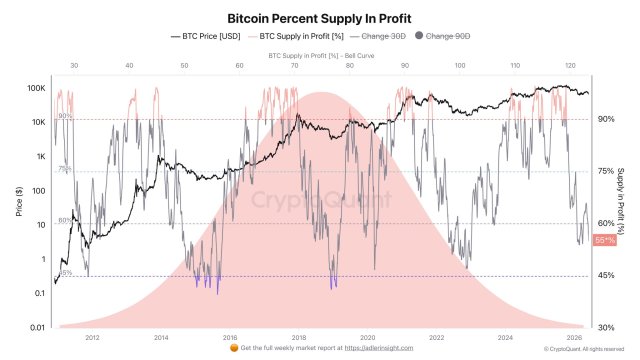
Source: Chart from Darkfost on X

According to fresh data, the percentage of supply held in profit has now fallen to about 55%, which is considered a notably low level. However, this level is still slightly above those seen in previous bear market cycles. In the past, bear markets were able to lower this indicator below 50%, indicating that the market was dominated by unrealized losses.

As seen on the chart, this key metric dropped to 53% in February this year. With the rate at which this metric is dropping now, Darkfost believes it will breach the 50% mark sooner than expected. While this remains a bearish development in the short term, especially for those with a long-term vision, this type of period has persistently represented profitable opportunities in the past.

Market Structure Showing A Massive Change Of Hands

Following his examination of this current market structure, Ki Young Ju, the founder of CryptoQuant, has declared this period a distribution phase that feels like a massive change of hands. At the time of the post, BTC’s investors’ average cost basis was around $53,000, which is crucial for the market. This is because bear markets have historically only ended when the price dropped below the realized price.

Given the institutional inflows and Michael Saylor’s Strategy barely selling any BTC, the founder believes that the level would be hard to revisit. However, current price action suggests unusually strong sell pressure that could push BTC to this level.

Since January 2023, MSTR has bought over 711,206 BTC and sold only 32 BTC, removing 711,174 BTC from circulation. Furthermore, ETFs absorbed 509,102 BTC, and MSTR purchased 650,706 BTC while the price was also at $63,000 in March 2024. Combined, that’s over 1,240,808 BTC removed from circulation, but the price is back at the same level.

Moving to exchanges reserves, about 2.7 million BTC are being held in addition to Satoshi’s estimated 1 million BTC holdings. Nearly half of exchange reserves, or more Bitcoin than Satoshi’s stack, have been consumed, and the price has not changed.

BTC trading at $61,899 on the 1D chart | Source: BTCUSDT on Tradingview.com

Trending Cryptos

Related Questions

QAccording to the article, what is the current percentage of Bitcoin supply held in profit, and why is this level significant?

AThe current percentage of Bitcoin supply held in profit has fallen to about 55%. This is significant because it's considered a notably low level, and it is close to breaching the 50% mark, a threshold which historically indicated a market dominated by unrealized losses during previous bear cycles.

QWhat does CryptoQuant founder Ki Young Ju declare about the current Bitcoin market structure?

AKi Young Ju declares the current period a distribution phase that feels like a massive change of hands.

QWhat is the mentioned average cost basis for BTC investors, and what is its historical relevance?

AThe average cost basis for BTC investors was around $53,000 at the time of the analysis. This is historically relevant because bear markets have typically only ended when the price dropped below the realized price (a metric closely related to the average cost basis).

QHow much Bitcoin have ETFs and MicroStrategy collectively removed from circulation since January 2023, according to the article?

AAccording to the article, ETFs have absorbed 509,102 BTC and MicroStrategy has purchased 650,706 BTC (after accounting for minimal sales), collectively removing over 1,240,808 BTC from circulation.

QWhat key effect has Bitcoin's recent 12.5% price correction had on investors?

AThe recent 12.5% price correction has pushed more Bitcoin investors into a state of holding unrealized losses, meaning their current holdings are valued below their original purchase cost.

Related Reads

A Serious Threat is Looming for Bitcoin (BTC) and Cryptocurrencies: They Could Be the First Target!

The rapid advancement of quantum computing poses a serious threat not only to cryptocurrencies but to the entire encryption system, including banking. However, experts warn that the cryptocurrency market might be the first sector to suffer from this transformation. As predictions of a 'Q-Day' approach, the slow governance processes of cryptocurrencies, rather than their cryptography, could become the biggest obstacle to defending against quantum attacks. Quantum Xchange CEO Eddy Zervigon has compared cryptocurrencies to "canaries in the coal mine," stating that the first successful quantum-powered cyberattack is likely to target decentralized blockchain networks. While a cryptographically relevant quantum computer capable of breaking the elliptic curve cryptography underlying Bitcoin's signatures and banking security does not yet exist, work by giants like Microsoft, IBM, and Google suggests the threat is nearer than previously thought. The industry consensus estimates such a computer could emerge around 2029. Supporting this view, recent Google research indicates the number of physical qubits needed to break the cryptographic systems protecting Bitcoin and Ethereum has decreased by about 20 times compared to prior estimates, highlighting the accelerated danger. Zervigon concludes that Bitcoin's greatest risk lies not in its current cryptographic system, but in the slow pace of implementing major network upgrades.

cryptonews.ru33m ago

A Serious Threat is Looming for Bitcoin (BTC) and Cryptocurrencies: They Could Be the First Target!

cryptonews.ru33m ago

Crypto Outperforming Stocks: How Digital Assets Are Withstanding Macroeconomic Pressure

Crypto Outperforms Stocks Amid Macro Pressure Trading firm QCP Capital's report analyzes the divergent performance of crypto and stock markets ahead of the July 29 FOMC meeting. While major US stock indexes showed mixed results, with tech weakness pressuring the Nasdaq, crypto assets like Bitcoin (up ~11.6% in July) and Ethereum (up ~24.6%) have outperformed despite a challenging macro backdrop, including rising Treasury yields and risk-off sentiment. Key focus points include the upcoming Fed decision and commentary from Chair Kevin Warsh, which could signal the regulator's stance on inflation and growth. Spot Bitcoin and Ethereum ETFs saw a net outflow of ~$311 million on July 24, ending a seven-day inflow streak, highlighting shifting institutional sentiment. Option market data reveals increased demand for downside protection, indicating caution, though constructive long-term positioning remains. Implied volatility for Ethereum trades at a premium to Bitcoin, and perpetual funding rates stay positive. The week's key events are the FOMC decision, Treasury yield movements, ETF flow trends, and US regulatory developments like the CLARITY Act. The market balances crypto's resilience against growing option market caution, with the Fed's decision poised to tip the scales. Analysis compares the current Fed pause to historical rate-cutting cycles, questioning whether crypto's strength can persist if monetary policy tightening persists.

cryptonews.ru43m ago

Crypto Outperforming Stocks: How Digital Assets Are Withstanding Macroeconomic Pressure

cryptonews.ru43m ago

Trading

Spot

Hot Articles

What is $BITCOIN

DIGITAL GOLD ($BITCOIN): A Comprehensive Analysis Introduction to DIGITAL GOLD ($BITCOIN) DIGITAL GOLD ($BITCOIN) is a blockchain-based project operating on the Solana network, which aims to combine the characteristics of traditional precious metals with the innovation of decentralized technologies. While it shares a name with Bitcoin, often referred to as “digital gold” due to its perception as a store of value, DIGITAL GOLD is a separate token designed to create a unique ecosystem within the Web3 landscape. Its goal is to position itself as a viable alternative digital asset, although specifics regarding its applications and functionalities are still developing. What is DIGITAL GOLD ($BITCOIN)? DIGITAL GOLD ($BITCOIN) is a cryptocurrency token explicitly designed for use on the Solana blockchain. In contrast to Bitcoin, which provides a widely recognized value storage role, this token appears to focus on broader applications and characteristics. Notable aspects include: Blockchain Infrastructure: The token is built on the Solana blockchain, known for its capacity to handle high-speed and low-cost transactions. Supply Dynamics: DIGITAL GOLD has a maximum supply capped at 100 quadrillion tokens (100P $BITCOIN), although details regarding its circulating supply are currently undisclosed. Utility: While precise functionalities are not explicitly outlined, there are indications that the token could be utilized for various applications, potentially involving decentralized applications (dApps) or asset tokenization strategies. Who is the Creator of DIGITAL GOLD ($BITCOIN)? At present, the identity of the creators and development team behind DIGITAL GOLD ($BITCOIN) remains unknown. This situation is typical among many innovative projects within the blockchain space, particularly those aligning with decentralized finance and meme coin phenomena. While such anonymity may foster a community-driven culture, it intensifies concerns about governance and accountability. Who are the Investors of DIGITAL GOLD ($BITCOIN)? The available information indicates that DIGITAL GOLD ($BITCOIN) does not have any known institutional backers or prominent venture capital investments. The project seems to operate on a peer-to-peer model focused on community support and adoption rather than traditional funding routes. Its activity and liquidity are primarily situated on decentralized exchanges (DEXs), such as PumpSwap, rather than established centralized trading platforms, further highlighting its grassroots approach. How DIGITAL GOLD ($BITCOIN) Works The operational mechanics of DIGITAL GOLD ($BITCOIN) can be elaborated on based on its blockchain design and network attributes: Consensus Mechanism: By leveraging Solana’s unique proof-of-history (PoH) combined with a proof-of-stake (PoS) model, the project ensures efficient transaction validation contributing to the network's high performance. Tokenomics: While specific deflationary mechanisms have not been extensively detailed, the vast maximum token supply implies that it may cater to microtransactions or niche use cases that are still to be defined. Interoperability: There exists the potential for integration with Solana’s broader ecosystem, including various decentralized finance (DeFi) platforms. However, the details regarding specific integrations remain unspecified. Timeline of Key Events Here is a timeline that highlights significant milestones concerning DIGITAL GOLD ($BITCOIN): 2023: The initial deployment of the token occurs on the Solana blockchain, marked by its contract address. 2024: DIGITAL GOLD gains visibility as it becomes available for trading on decentralized exchanges like PumpSwap, allowing users to trade it against SOL. 2025: The project witnesses sporadic trading activity and potential interest in community-led engagements, although no noteworthy partnerships or technical advancements have been documented as of yet. Critical Analysis Strengths Scalability: The underlying Solana infrastructure supports high transaction volumes, which could enhance the utility of $BITCOIN in various transaction scenarios. Accessibility: The potential low trading price per token could attract retail investors, facilitating wider participation due to fractional ownership opportunities. Risks Lack of Transparency: The absence of publicly known backers, developers, or an audit process may yield skepticism regarding the project's sustainability and trustworthiness. Market Volatility: The trading activity is heavily reliant on speculative behavior, which can result in significant price volatility and uncertainty for investors. Conclusion DIGITAL GOLD ($BITCOIN) emerges as an intriguing yet ambiguous project within the rapidly evolving Solana ecosystem. While it attempts to leverage the “digital gold” narrative, its departure from Bitcoin's established role as a store of value underscores the need for a clearer differentiation of its intended utility and governance structure. Future acceptance and adoption will likely depend on addressing the current opacity and defining its operational and economic strategies more explicitly. Note: This report encompasses synthesised information available as of October 2023, and developments may have transpired beyond the research period.

1.1k Total ViewsPublished 2025.05.13Updated 2025.05.13

What is $BITCOIN

Discussions

Welcome to the HTX Community. Here, you can stay informed about the latest platform developments and gain access to professional market insights. Users' opinions on the price of BTC (BTC) are presented below.

活动图片