Author: Gu Yu, ChainCatcher
On June 23, the long-questioned Ethereum ecosystem welcomed two significant announcements.
First, several former Ethereum Foundation researchers established an independent nonprofit organization, Ethlabs, with major funding support from key ETH holders such as Bitmine and SharpLink. According to its introduction, Ethlabs' early work will focus on key requirements for large-scale institutional on-chain adoption, including faster settlement speeds, native asset issuance, cross-chain transactions based on robust infrastructure, mainnet capacity scaling, and foundational research supporting ETH's monetary properties.
Soon after, the Ethereum Foundation announced it had completed a restructuring lasting several months, laying off 54 people, approximately 20% of its previous workforce. This adjustment continues the "Lean Ethereum" strategic transformation, repositioning the Ethereum Foundation as a lighter-weight protocol governance and maintainer, rather than the primary core builder.
With one stepping forward and the other stepping back, Ethereum is sending a clear signal: the Foundation is proactively yielding ground, with ecosystem organizations taking on more execution responsibilities. Ethereum is no longer attempting to have a centralized nonprofit organization oversee the roadmap, development, promotion, and adoption entirely.
For Ethereum, this may be the most important governance correction in the past decade.
Over the past year, external criticism of Ethereum has extended beyond ETH's price performance to target its organizational efficiency, strategic articulation, and ecosystem mobilization capabilities. Ethereum had at times appeared overly "correct," overly slow, and overly reliant on the implicit endorsement of the Foundation and Vitalik.
Today's two changes precisely respond to these criticisms: Ethereum is not directionless; it is attempting to change the way direction is generated.
I. Ethlabs Gains Ecosystem Support, but Vitalik is Absent
The establishment of Ethlabs first signifies the emergence of a new organization within the Ethereum ecosystem that is closer to an "industrialized execution layer."
Unlike traditional research institutions, Ethlabs' goal is not merely to propose new cryptographic directions or long-term roadmaps but to more explicitly address practical issues like institutional on-chain adoption, financial asset issuance, cross-chain transactions, mainnet capacity, and ETH's monetary properties. These issues correspond to Ethereum's core anxieties in recent years: it remains the most important smart contract network, but its advantages in real institutional adoption, on-chain financial scale, and user experience are not as solid as the market imagines.
Ethereum does not lack research or vision. What it lacks is the intermediate layer that translates research into market adoption. This is precisely the significance of Ethlabs' emergence.
Among the list of supporters on Ethlabs' official website, one can see many high-influence figures within the Ethereum ecosystem, including several important figures from the Ethereum Foundation, investors from VCs like Dragonfly and Electric Capital, and ecosystem contributors from Base, Flashbots, Uniswap. It is worth noting, however, that Vitalik is not on this list of supporters.
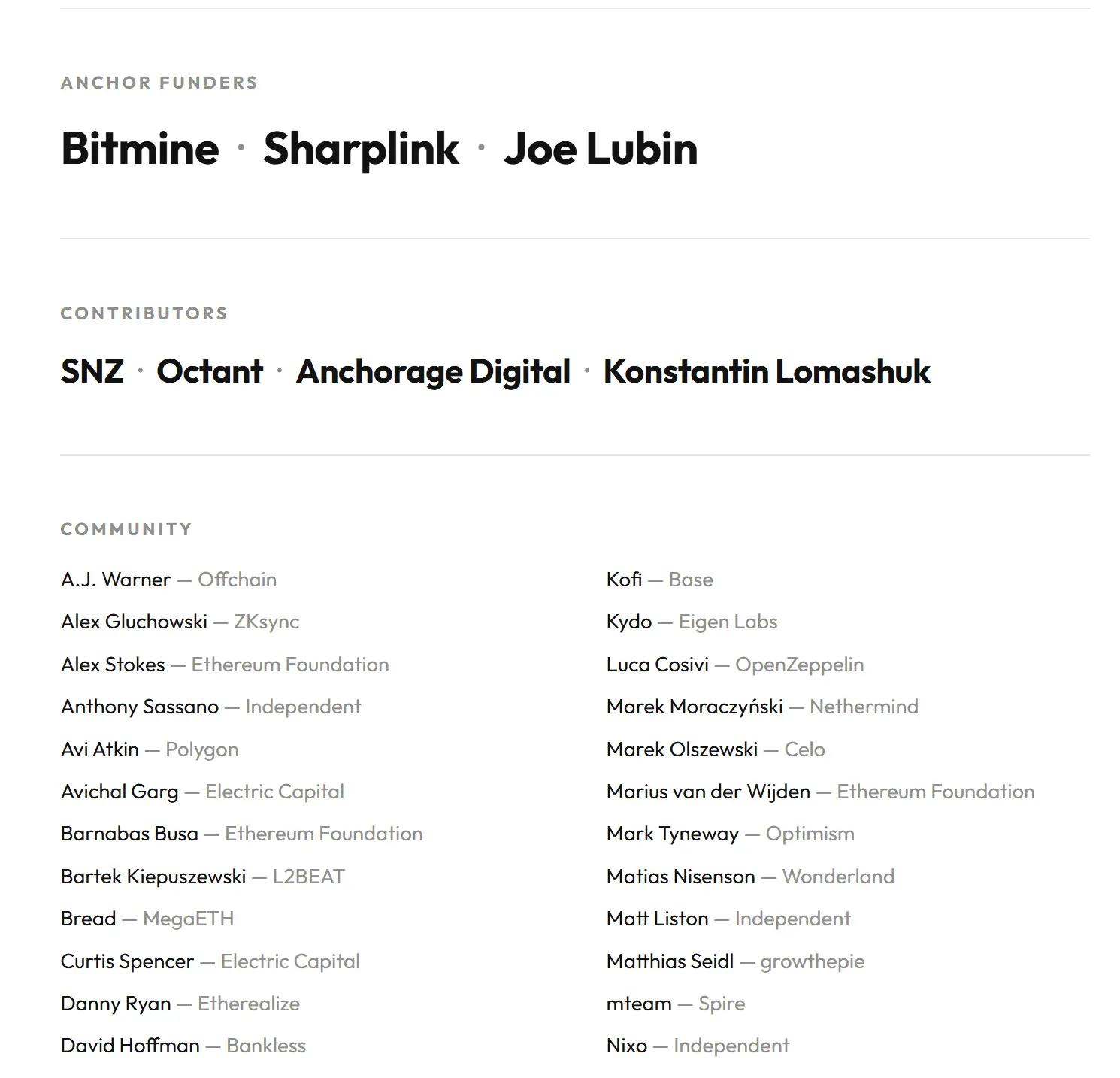
This does not necessarily mean Vitalik disagrees with Ethlabs. On the contrary, a more reasonable understanding is that he is intentionally avoiding forming too strong a personal endorsement or path interference for this new organization.
For many years, Vitalik has held immense symbolic significance for the Ethereum ecosystem. He has proposed many forward-looking directions like soulbound tokens, DeSoc, privacy, account abstraction, and public goods funding, but not many have achieved large-scale market adoption.
The issue is not that these directions lack value, but that when every expression by Vitalik is viewed by the market as "the next phase narrative for Ethereum," the entire ecosystem can fall into a kind of implicit dependency, mistakenly investing excessive time and capital costs.
So far this year, Vitalik has only published 2 articles on his official blog, whereas he previously published at least 15 articles annually. This change itself is noteworthy. It does not represent a decline in Vitalik's influence over Ethereum but rather appears to be an active restraint: letting Ethereum gradually shift from "founder-driven public narrative" to a "technical network driven by multiple organizations, teams, and stakeholders."
If Ethlabs is to take on stronger institutional, financial, and execution functions, it cannot be merely an extension of Vitalik's will. It must prove it can gain ecosystem trust without the founder's direct endorsement and respond to the market with tangible results.
II. The New Structure and Positioning of the Ethereum Foundation
As Ethlabs steps forward, the Ethereum Foundation is stepping back.
For a long time, although nominally just a nonprofit supporting the Ethereum ecosystem, the Ethereum Foundation has in practice long played multiple roles: strategic coordinator, research funder, protocol roadmap setter, and cultural center. It has been unwilling to become a traditional corporate headquarters yet has taken on similar functions on many critical issues.
This structure once helped Ethereum maintain neutrality and decentralization but also brought side effects: slow decision-making, ambiguous communication, unclear responsibility boundaries. The outside world both hoped the Foundation would provide clearer strategy and criticized it for having too much influence.
Simultaneously, internal disagreements within the Ethereum Foundation have been reported. According to a previous report by The Guardian, there were clear disagreements within the Ethereum Foundation regarding strategic direction, leadership changes, and institutional adoption, with tensions also existing in the community between the "cypherpunk faction" and the "pragmatic business faction"; the Foundation's appointment of Hsiao-Wei Wang and Tomasz Stańczak as co-executive directors in March 2025 was also seen as a compromise between these two cultures.
However, it became clear that after both executive directors left their posts, the Foundation's 2025 team restructuring was declared a failure. Key figures like Josh Stark, Trenton Van Epps, and Dankrad Feist left successively. Coupled with persistently low token prices and growing skepticism, the Ethereum Foundation had to restructure again.
After this restructuring, the Ethereum Foundation split its organization into clusters such as the protocol layer, access layer, user layer, community layer, and institutional layer, and laid off 54 people, about 20% of its previous workforce. This is not a simple cost-cutting and efficiency improvement, but a contraction of boundaries: the Foundation is repositioning itself as a lighter-weight protocol governance and maintainer, rather than the primary builder for all directions in the ecosystem.
In fact, besides Ethlabs, multiple other nonprofit organizations like Ethereum Applications Guild, The Ethereum Economic Zone, and Argot Collective have emerged within the Ethereum ecosystem over the past year. They contribute from different angles, such as promoting applications, Rollup collaboration, and maintaining Solidity.
"The privilege to manage Ethereum should not be monopolized but carefully shared with those committed to building self-sovereign infrastructure, whether they are old friends or newcomers," the Ethereum Foundation clearly stated in its latest post.
III. Turning "Correct" into "Effective"
In the past, Ethereum's advantages came from its developer community, DeFi liquidity, L2 ecosystem, and protocol security. But over the past two years, these advantages have not fully translated into ETH's market performance. The community's criticism of the EF is, in essence, a form of "shareholder anxiety."
Enterprise Ethereum Alliance Chairman Paul Brody once commented that the Ethereum community, to some extent, behaves like ordinary shareholders, "They want a return on investment." This statement is harsh but true.
A month ago, Bankless co-founder Ryan Sean Adams tweeted, "Ethereum's future can no longer rely on the Ethereum Foundation (EF). The EF is important, but Ethereum needs new institutions to step in and fill the gaps. We need an organization that truly wants the Ethereum asset (ETH) to win—for its quantity to grow—and that dares to speak out and execute effectively. The EF is not that, and never will be."
Now, Ethlabs emerges, carrying the expectations of major ETH holders Bitmine, SharpLink, and the broader token-holding community. These two companies hold a combined total of over 6 million ETH. Their demand for Ethereum is clearly not just about whether the technical roadmap continues to advance, but whether ETH can deliver substantial returns for their shareholders.
This inherently differs from the Ethereum Foundation's positioning. The EF must maintain credible neutrality; it cannot directly serve ETH's price like a listed company, nor can it simplify protocol governance to maximizing token holder interests. But new organizations like Ethlabs can take on more explicit market-oriented functions.
In other words, the EF is responsible for keeping Ethereum "correct," while Ethlabs needs to prove Ethereum remains "effective."
Ethereum could previously respond to market skepticism with "long-termism." But when Hyperliquid captures the derivatives narrative, Solana captures the meme narrative, and Bitcoin captures the asset narrative, Ethereum must prove it is not only the most secure smart contract platform but also the network most capable of hosting the next wave of on-chain financial expansion.
Of course, this shift is not without risks. Ethlabs receiving support from major ETH holders and institutionalized forces may raise new concerns about "whether Ethereum is moving from Foundation centralization to whale centralization." Institutional adoption may also create tension with Ethereum's original cypherpunk spirit.
But for Ethereum today, the greater risk is not turning too fast, but continuing to linger between technical correctness and organizational sluggishness.
The market ultimately will not reward vision alone, nor will it reward a stance of decentralization alone. It will reward networks that can maintain credible neutrality while continuously attracting capital, applications, developers, and institutions.
The establishment of Ethlabs and the Foundation's restructuring are key steps Ethereum is taking in that direction.