Could Solana Be The Best Spot Trading Market Globally? This Crypto Pundit Thinks So

bitcoinistPublished on 2026-06-06Last updated on 2026-06-06

Abstract

Despite ongoing market volatility pushing Solana's price to around $68, crypto pundit Chase, a Solana mobile employee, expresses strong optimism. He argues that after evaluating market structure, Solana has the infrastructure to become the world's best spot trading market and is likely to generate more revenue than any other blockchain. He emphasizes that expanding its retail and trader ecosystem is key for growth. Supporting this view, Solana's network shows robust activity, with its Total Capital Generated (TCG) reaching a new weekly high of $73.6 million. Furthermore, Solana has overtaken Ethereum to become the leading blockchain by tokenized stock market cap, which surged over 54% to $724.1 million recently. At the time of writing, SOL was trading at $64, down nearly 9% in a day.

Heavily haken by ongoing volatility, Solana and its broader market are facing heightened downside pressure, pushing its price to the $68 mark. Despite how bearish SOL has turned out over the past few months, robust optimism continued to be expressed toward the leading altcoin and its market capability.

Solana’s Market Structure Draws Bold Endorsement

After conducting an extensive review of market structure, a crypto pundit has made an audacious comment on Solana’s market coverage and infrastructure. The evaluation from Chase, a Solana mobile employer, may identify the altcoin’s robust, growing ecosystem as the primary driver of its growing allure.

In his view, Solana has the infrastructure to be the best spot market in the entire world. In addition, the network is likely to produce more revenue than any blockchain in the world.

As rivalry among the main blockchain networks heats up, Solana has made a name for itself as a hub for capital formation and trade. “Getting more people on-chain and off CEX is how you do it,” Chase stated. According to the pundit, SOL has the assets, the breads, and liquidity, but most people do not know that it is the best place to trade spot markets yet.

For those trading outside the network, Chase believes they are never going to grow without expanding SOL’s retail and trader ecosystem. Ultimately, this audacious assertion is probably going to spark more discussion in the cryptocurrency sector as participants continue to assess which networks are most likely to control the upcoming stage of the adoption of digital assets.

Solana’s network and its ecosystem continue to demonstrate robust growth and strength. In terms of TCGs (Total Capital Generated), SOL has reached yet another crucial milestone. Zensei reported that the TCGs weekly pack volume recently surged to $73.6 million, marking its all-time high, and underscoring the network’s accelerating economic activity.
Source: Chart from Zensei on X

A surge to a new record for capital generation demonstrates the network’s growing usefulness and capacity to support rising activity levels. This growth was led by Collector Crypt as well as the strong contributions from the phygital. Looking at the chart, both continue to attract significant activity on the Solana network, which remains the undisputed king of on-chain TCGs.

A New Leader In Tokenized Stocks Market Cap

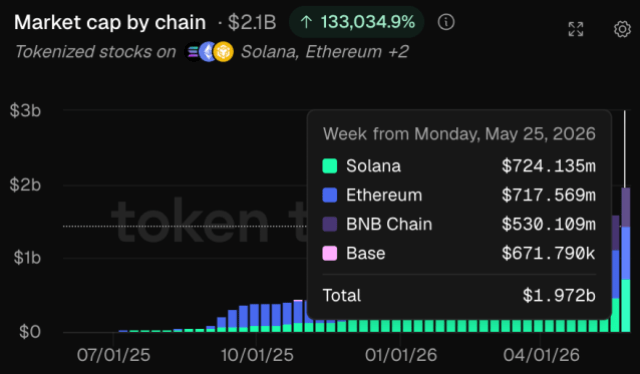
Another key area of the market where Solana is demonstrating strong dominance is the volume of tokenized stocks. According to Zensei, the network is the new king of tokenized stocks, overshadowing the likes of Ethereum.

Data shows that SOL has overtaken Ethereum to become the number 1 chain by tokenized stock market cap. Over the past week, the market grew from $469.9 million to $724.1 million, representing an increase of over 54%. The market has spoken, and more capital is opting for Solana when it comes to tokenized equities. At the time of writing, the SOL price was trading at $64, dropping by almost 9% over the past day.

SOL trading at $64 on the 1D chart | Source: SOLUSDT on Tradingview.com

Related Questions

QAccording to the article, what specific milestone has Solana's network recently achieved in terms of Total Capital Generated (TCGs)?

ASolana's weekly Total Capital Generated (TCGs) pack volume recently surged to $73.6 million, marking its all-time high.

QWhich crypto pundit made the audacious comment that Solana has the infrastructure to be the best spot market in the world, and what is their affiliation?

AThe comment was made by Chase, who is identified as a Solana mobile employer.

QIn what key area of the market has Solana reportedly overtaken Ethereum to become the number one chain, according to data cited in the article?

ASolana has overtaken Ethereum to become the number one chain by tokenized stock market cap.

QWhat does the pundit Chase suggest is necessary for growth for those trading outside the Solana network?

AChase believes that for those trading outside the network, they are never going to grow without expanding SOL's retail and trader ecosystem.

QWhat was the reported price of Solana (SOL) at the time of writing the article, and what was its daily percentage change?

AAt the time of writing, the SOL price was trading at $64, representing a drop of almost 9% over the past day.

Related Reads

Agents Take Over Traffic Distribution Power: What Are Tencent, ByteDance, and Alibaba Competing For?

In the race to dominate the AI era's entry point, China's tech giants—Tencent, ByteDance, and Alibaba—are aggressively deploying AI Agents to control the future of traffic distribution. Alibaba is pursuing a dual-track "closed loop + openness" strategy. Its Qianwen app is evolving into a super-Agent integrated across its ecosystem (Taobao, Alipay, etc.) to handle complex tasks like travel planning. Concurrently, it is opening its platform to external brands (Luckin Coffee, KFC) and has launched a B2B Agent platform, "Wukong," targeting enterprise automation. Its other flagship, Quark, aims to be an "AI super search box" for information and tasks. ByteDance is executing an omnipresent "sprawl strategy." Its Doubao app boasts over 300 million monthly active users and is evolving into a default AI entry point for daily life, with plans for paid versions and e-commerce integration. Its core weapon is the Kouzi platform, a visual "AI assembly factory" for developers to build custom Agents. ByteDance is also pushing hardware integration, collaborating on AI phones and developing smart glasses to embed Doubao everywhere. Tencent is playing its long-held "ultimate card" by quietly embedding an AI Agent directly into WeChat. This Agent, accessible via a swipe, can understand user commands and automatically execute tasks by calling upon WeChat's millions of mini-programs (e.g., finding and ordering coffee). This leverages WeChat's unparalleled 1.4-billion-user ecosystem to position the app as an AI-powered "service operating system," a move that could dramatically reshape the competitive landscape. The core battleground is shifting from competing for "user screen time" to competing to be the "default execution layer" for user intent. The business model is evolving from an "attention economy" to an "intent economy," where the Agent that can most efficiently fulfill a user's need gains control over service access and token flow. This represents a fundamental change in how users connect with digital services, making the fight for the Agent入口 (entry point) a pivotal moment for redefining industry leadership in the AI age.

marsbit1h ago

Agents Take Over Traffic Distribution Power: What Are Tencent, ByteDance, and Alibaba Competing For?

marsbit1h ago

From Banning Doubao to Embracing Honor: Why Did WeChat Suddenly 'Change Its Face'?

The article explores the sudden shift in WeChat's strategy towards AI assistants from mobile phone manufacturers, transitioning from strict opposition to active collaboration. For over a year, WeChat fiercely resisted attempts by phone AI assistants (like ByteDance's Doubao in late 2025) to control its features via GUI automation ("simulated clicking"), citing security and data control concerns. This stance created a significant barrier for system-level AI integration. Now, Tencent has initiated A2A (Agent-to-Agent) partnerships with major phone brands like Honor, Xiaomi, OPPO, and vivo. This model allows a phone's system AI (e.g., Honor's YOYO) to parse a user's voice command and send a structured request directly to WeChat's own internal AI agent via secure APIs. WeChat then executes the action (e.g., sending a message) and returns the result. The article attributes Tencent's "change of face" to strategic pressure. While leading in social app usage, Tencent trails rivals like ByteDance and Alibaba in standalone AI app popularity. WeChat, with its vast mini-program ecosystem, is Tencent's key asset for an AI comeback. The upcoming WeChat AI agent aims to handle tasks like booking and payments within the app. However, phone system assistants remain the primary AI entry point for most users. The A2A collaboration allows Tencent to extend WeChat's AI reach to this crucial system layer while maintaining control over its core functions and data. For phone manufacturers, embracing A2A is a pragmatic move. The GUI route proved unviable due to WeChat's blocks. A2A offers a compliant path to integrate a vital service, enhancing their AI assistants' usefulness. It allows them to focus on developing their own AI ecosystems for other services while cooperating on WeChat access. The collaboration is framed as a mutual, strategic necessity: Tencent gains a distribution channel, and manufacturers gain a key functionality. The partnership relies on a "dual authorization" mechanism for security, requiring both user and app consent for each action. While questions about long-term data privacy practices remain, experts note A2A is more secure and compliant than GUI automation. Ultimately, this cooperation is seen as a tentative, calculated truce. Tencent's long-term goal is to make WeChat an AI-powered "service OS." Phone manufacturers aim to make their system AI the central user interface. Their paths may converge or clash in the future, but for now, the A2A deal represents the opening chapter in the battle for the AI-era user入口, driven by necessity and strategic calculus on both sides.

marsbit2h ago

From Banning Doubao to Embracing Honor: Why Did WeChat Suddenly 'Change Its Face'?

marsbit2h ago

On-Chain Figures on the Eve of Kickoff: 1.6 Billion Traded Before the World Cup Even Begins

"On-Chain Numbers on the Eve of the World Cup: $1.6 Billion Traded Before Kick-off" Analysis of on-chain markets before the 2026 FIFA World Cup reveals significant crypto integration into football. The most striking figure is the approximately **$1.6 billion** in total trading volume on the single "World Cup Winner" contract on the Polymarket prediction market platform, accumulated before a single match was played. This represents explosive growth for a sector whose annual volume surged from ~$16B in 2024 to ~$64B in 2025. The ecosystem is maturing beyond speculation. Key developments include: 1) **Infrastructure upgrades** like Polymarket's migration to native, regulated USDC stablecoin for settlements; 2) **Reliable data oracles**, such as Chainlink, being used to resolve real-world match outcomes on-chain; and 3) **Official recognition**, with FIFA appointing its first-ever "Prediction Markets" partner. Over 100 contracts now cover everything from the outright winner to individual match results and even non-sporting risks like venue relocation. This evolution marks a fundamental shift. While crypto firms are absent from FIFA's top-tier sponsor list, the technology has deeply penetrated the tournament's financial and predictive infrastructure through regulated stablecoin settlements, decentralized oracles, and new official partnership categories. The regulatory landscape remains complex and varies by jurisdiction, but on-chain markets for the World Cup are already a multi-billion-dollar reality.

marsbit3h ago

On-Chain Figures on the Eve of Kickoff: 1.6 Billion Traded Before the World Cup Even Begins

marsbit3h ago

Trading

Spot
Futures

Hot Articles

Discussions

Welcome to the HTX Community. Here, you can stay informed about the latest platform developments and gain access to professional market insights. Users' opinions on the price of SOL (SOL) are presented below.

活动图片