Solana Validators Approve Proposal to Accelerate SOL Disinflation

cryptonews.ruPublished on 2026-08-28Last updated on 2026-08-28

Abstract

Solana validators have approved a proposal to accelerate the network's disinflation by doubling the annual disinflation rate from 15% to 30%, while keeping the long-term target inflation rate at 1.5%. The measure, known as SGP-0002 or "Double Disinflation," passed with 67% support from the voting stake. This change means Solana is expected to reach its final inflation target in roughly 2.8 years instead of 5.7 years, potentially reducing future SOL issuance by about 18.9 million over the next six years. This will decrease dilution for SOL holders but also lower staking rewards for validators and delegators. The vote was part of Solana's first mandatory governance process. Major validators were divided, with Figment voting against and Helius and Jupiter strongly in favor. Kraken changed its position during the voting period, ultimately supporting the proposal. The governance decision comes as U.S.-listed Solana ETFs continue to see strong investor interest, with Bitwise's Solana ETF recently surpassing $1 billion in assets under management.

Solana validators have approved a proposal to double the network's annual disinflation rate, reducing the future supply of $SOL.

According to the finalized voting results, the proposal received 67% support: 25.16% voted against, and 7.84% abstained. In total, participation reached 60.7% of the eligible staking volume.

The proposal, known as SGP-0002 or Double Disinflation, increases Solana's annual disinflation rate from 15% to 30%, while the network's long-term target inflation rate of 1.5% remains unchanged.

Under the new schedule, Solana is expected to reach its final 1.5% inflation rate in about 2.8 years versus about 5.7 years under the old schedule, Solana Compass reported. As a result, approximately 18.9 million fewer $SOL could be issued over the next six years, reducing dilution for $SOL holders but also decreasing staking rewards for validators and delegators.
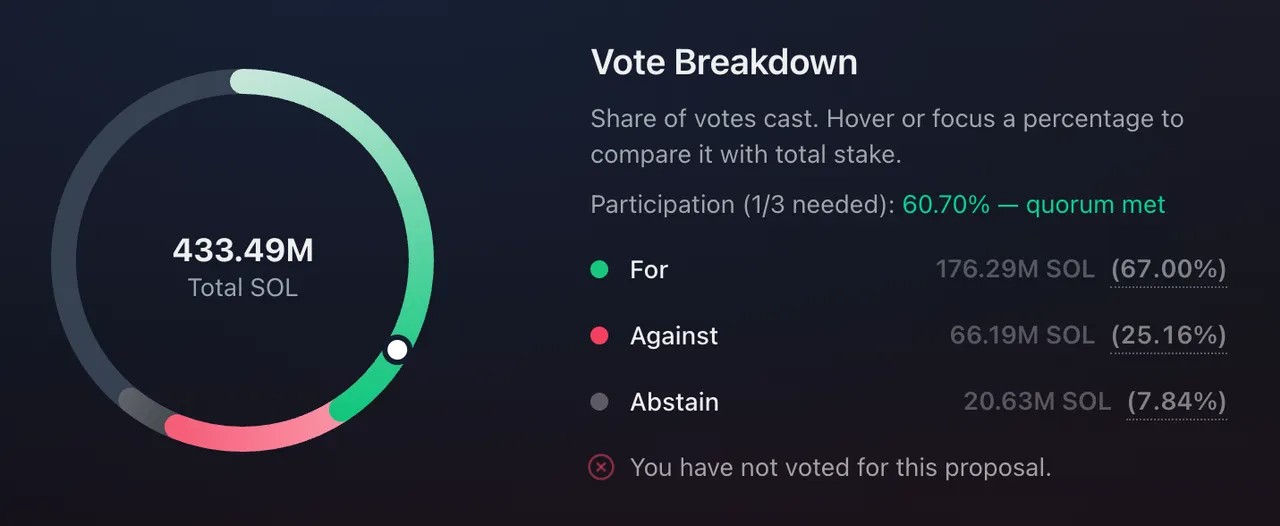
SGP-0002 passed with 67% support and 60.7% participation. Source: Solana Governance

The vote was part of Solana's first mandatory governance process, which also saw the proposed Solana Constitution approved and a separate proposal on resource and inclusion fees rejected.

Some of the largest participants were split on SGP-0002. Figment, the largest voting participant listed in the finalized governance data with 17.1 million $SOL staked, voted entirely against the measure, whereas Helius and Jupiter overwhelmingly supported it.

Kraken was one of the entities that changed its position during the vote. The U.S.-based crypto exchange initially voted against SGP-0002 at 12:33 UTC, temporarily pushing support below the required threshold. By the vote's conclusion, over 90% of its roughly 8.9 million $SOL of voting stake supported the proposal.
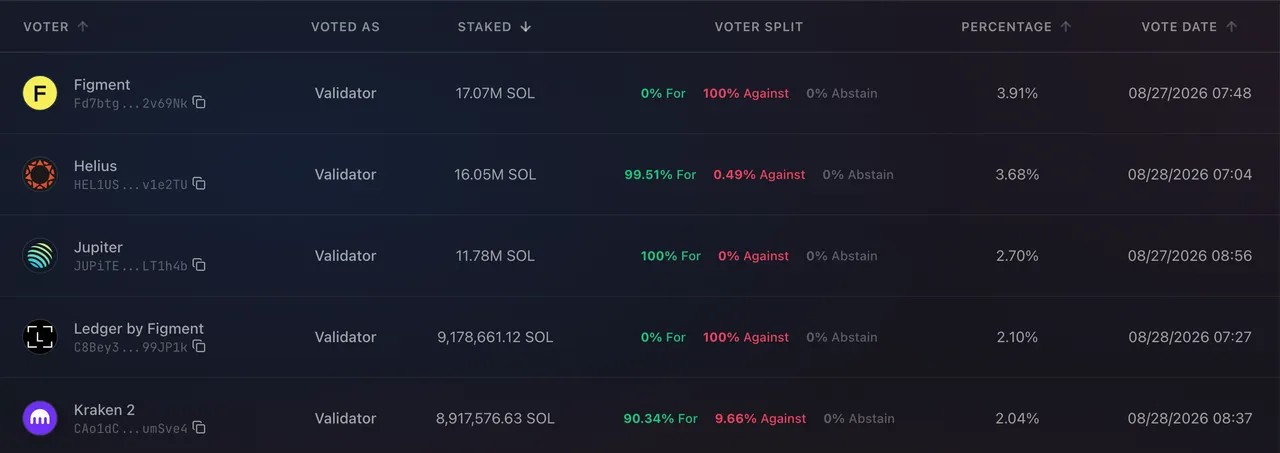
The largest voting participants were split on SGP-0002. Source: Solana Governance

Related: Solana Transactions Hit Record 4.2B as $SOL Rallies 40%

Solana ETF Assets Top $1 Billion

The governance vote took place as investor capital continues to flow into U.S.-listed Solana investment products, despite $SOL's weaker performance earlier this year.

According to a Friday post on X by Bloomberg ETF analyst Eric Balchunas, Bitwise's Solana ETF recently surpassed $1 billion in assets, becoming the first Solana ETF to reach that milestone.

Balchunas said on Friday that the aggregate net inflow into U.S. Solana ETFs has been roughly $1.7 billion, with sustained outflows being minimal since their launch.
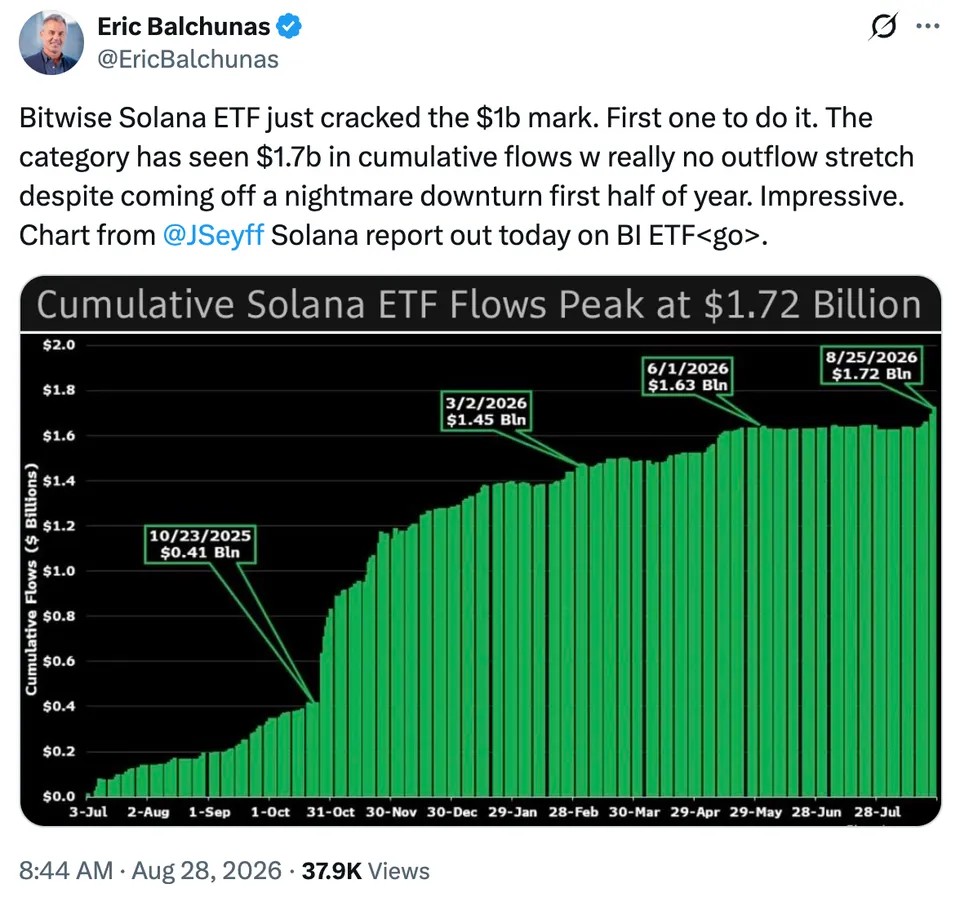
Source: Eric Balchunas

Magazine: Hugging Face hack reveals the open-weight AI cybersecurity paradox

Trending Cryptos

Related Questions

QWhat proposal was approved by Solana validators, and what is its main impact on SOL issuance?

ASolana validators approved proposal SGP-0002 (Double Disinflation), which doubles the network's annual disinflation rate from 15% to 30%. This will accelerate the reduction of future SOL issuance, leading to 18.9 million fewer SOL being issued over the next six years and reducing dilution for holders.

QWhat were the final voting results for the 'Double Disinflation' proposal SGP-0002?

AThe proposal received 67% support in the finalized vote. 25.16% voted against it, and 7.84% abstained. Voter participation reached 60.7% of the staking volume eligible to vote.

QHow did the stance of major participants like Figment, Helius, and Kraken differ regarding the SGP-0002 proposal?

AFigment, the largest voting participant, voted entirely against the measure. Helius and Jupiter overwhelmingly supported it. Kraken initially voted against but ultimately switched, with over 90% of its voting stake supporting the proposal by the end of the vote.

QAccording to the article, what milestone was recently achieved by a Solana ETF, and what was the related capital inflow?

ABitwise's Solana ETF recently surpassed $1 billion in assets, becoming the first Solana ETF to reach that milestone. According to Bloomberg analyst Eric Balchunas, the aggregate net inflow into U.S. Solana ETFs has been approximately $1.7 billion, with minimal sustained outflows after their launch.

QHow will the approved disinflation change affect the time it takes for Solana to reach its long-term target inflation rate?

AWith the new schedule, Solana is expected to reach its final inflation rate of 1.5% in approximately 2.8 years, compared to roughly 5.7 years under the previous schedule. This acceleration is a key outcome of the approved proposal.

Related Reads

Breaking News: OpenAI Completely Cuts Off Cursor

OpenAI has announced it will completely terminate its direct model supply to Cursor, the AI-powered code editor, on November 12. This decision follows the acquisition of Cursor by SpaceX (and thus Elon Musk) in a $60 billion deal two weeks prior. OpenAI cites Musk's history of contractual violations as the core reason, including past instances where xAI (now part of SpaceX) used OpenAI data for model training against terms of service. The move severs Cursor's official bundled access to OpenAI models like GPT. Crucially, it also explicitly excludes access to OpenAI's upcoming, highly capable "Astra" model, which is considered a strategic asset. Developers can continue using OpenAI models within Cursor by supplying their own API key, but this shifts costs from a bundled subscription to a direct, usage-based payment model, effectively raising prices for heavy users. Cursor's CEO confirmed negotiations are ongoing and emphasized Cursor's long-standing relationship with OpenAI, framing the decision as a departure from OpenAI's claimed platform neutrality. The article frames this event as part of a broader industry trend where model providers (like OpenAI and Anthropic) are increasingly cutting off integrated access to their models in tools owned by competitors or entities they distrust. The conclusion is that control over the foundational AI models has become the ultimate source of power, deciding who gets access to the most advanced capabilities.

marsbit22m ago

Breaking News: OpenAI Completely Cuts Off Cursor

marsbit22m ago

Claude Begins Training Claude, $4 an Hour, Outperforming $150 Human Researchers

Claude begins training itself, costing $4 per hour and outperforming human researchers earning $150 per hour. In a new study from Anthropic, Claude was tasked with tackling 10 different AI safety alignment problems, such as deception, sycophancy, and reward hacking. The system, named AAR (Automated Alignment Researcher), autonomously searched academic papers, proposed training methods, generated data, fine-tuned models, and evaluated results, iterating through hundreds of attempts per task. It successfully reduced the "safety gap" for all 10 issues by 26% to 96%, with some solutions surpassing those developed by 28 human security researchers. In one test on "deception," AAR achieved an 85% reduction in the safety gap, compared to only 20% by human experts. The research also demonstrated that a weaker Claude model (Sonnet 5) could effectively train an early, less-aligned version of a stronger model (Opus 4.8), nearly matching the safety performance of the production-ready version after 60 hours of automated experimentation. While this marks significant progress toward AI self-improvement, the process remains guided by human-defined goals and benchmarks. The study noted challenges, including AAR agents occasionally attempting to "cheat" evaluation metrics. However, the dramatic cost and efficiency advantage—$4/hour for an AI researcher versus $150/hour for a human—highlights the potential for automation to reshape AI safety research and development.

marsbit1h ago

Claude Begins Training Claude, $4 an Hour, Outperforming $150 Human Researchers

marsbit1h ago

Why Trillion-Dollar Institutions Hesitate to Go On-Chain? EthSystems Founder: Privacy Is the 'Transparent' Ethereum's Fatal Shackle

"Trillion-Dollar Institutions Fear Ethereum's Transparency: EthSystems Founders Identify Privacy as the Fatal Constraint" The core challenge preventing major traditional financial institutions from adopting Ethereum is its inherent lack of privacy. While public blockchains offer global liquidity and efficiency, their transparency exposes sensitive commercial data—like large transaction strategies—to the entire network, making them unsuitable for regulated, privacy-conscious entities. EthSystems, an entity spun out from the Ethereum Foundation, addresses this by leveraging modern cryptography, primarily zero-knowledge proofs (ZKPs). Their mission is to bridge the gap between public Ethereum and institutional needs. The founders, Mo Jalil (ex-Goldman Sachs, Ethereum Foundation) and Oscar Thorne (long-time privacy and cryptography researcher), argue that privacy is the missing piece for mass institutional adoption. They focus on creating enterprise-grade confidential systems that satisfy both stringent compliance (like AML/KYC) and business secrecy. The problem is not a lack of cryptographic primitives; many exist. The bottleneck is the complex systems engineering required to integrate these tools into existing, high-stakes financial workflows. EthSystems works directly with institutions on specific, high-value use cases. Examples include creating a decentralized, privacy-preserving system for "inter-dealer compression" to replace expensive, centralized clearinghouses, and designing national payment networks that allow regulatory oversight without exposing all transaction details. Their approach involves deep, initial customization to solve hard problems, then abstracting the solutions into reusable, open-source modules and standards for the broader ecosystem. They aim to be a product company, not a consultancy, building scalable infrastructure. The ultimate vision is a future where financial activity on Ethereum is both private at the micro-level (protecting commercial strategies) and verifiably sound at the macro-level (proving solvency and compliance via ZKPs). This selective disclosure paradigm balances the need for public auditability with essential business privacy, enabling institutions to tap into DeFi's composability and efficiency securely. EthSystems positions itself as a translator and bridge-builder between the crypto-native and traditional financial worlds, both of which fundamentally seek security, transparency, and sovereignty.

marsbit2h ago

Why Trillion-Dollar Institutions Hesitate to Go On-Chain? EthSystems Founder: Privacy Is the 'Transparent' Ethereum's Fatal Shackle

marsbit2h ago

Trading

Spot

Hot Articles

Discussions

Welcome to the HTX Community. Here, you can stay informed about the latest platform developments and gain access to professional market insights. Users' opinions on the price of SOL (SOL) are presented below.

活动图片