An employee, heeding the company's call, dove headfirst into the world of Vibe Coding and diligently crafted a pixel-style brainrot FPS game.
Before he could even finish feeling pleased with himself, he glanced over inadvertently.
Holy crap, this thing cost me 81,267 dollars in tokens (equivalent to 550,000 RMB)???
Didn't I just cause a colos!sal! dis!aster!
(At this point, one must loudly emit the voice of Madam Wang from *The Story of Minglan*.mp3)
The boss only encouraged everyone to do Vibe Coding, he didn't tell me to Spend Money in huge handfuls!
The company was also speechless, and could only tearfully share it, hoping everyone passing by would come play this little game, treating the $80,000 bill as marketing expenses for people to get to know our company through the game.
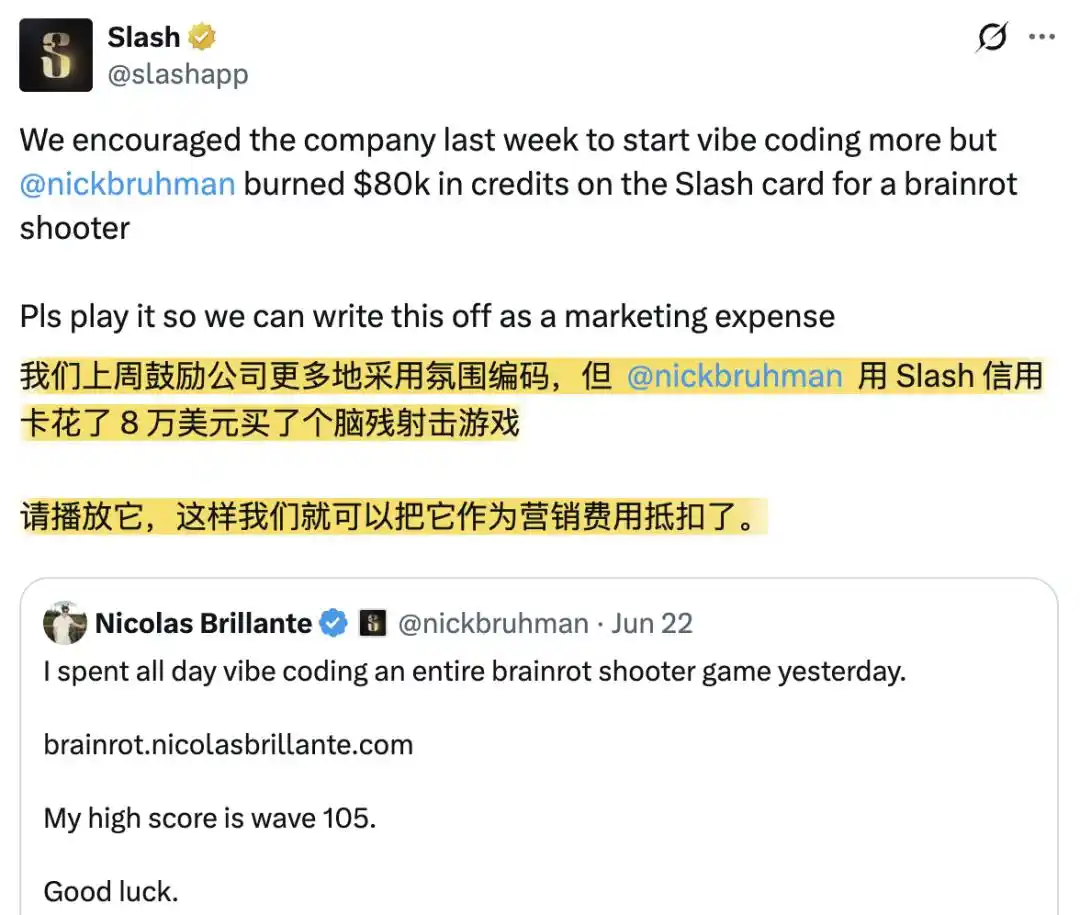
Things having come to this...
Hey, how is there still a plot twist?
Within 48 hours of launch, the game attracted 6,912 players, with a cumulative playtime of 8,986 hours, and 3 brands proactively inquired about advertising cooperation.
The original "expense incident" was quickly rebranded by the company as a "strategic project."

Did you think the story ended here?
There's something even more exciting.
The employee later announced happily on X, this brainrot mini-game that burned $80,000 has already brought the company $100 million in new AUM (Assets Under Management).
Approximately 700 million RMB.
Calculating it this way, that initial AI bill enough to get someone fired on the spot actually had a return rate exceeding 1200 times.
This is a case of "a blessing in disguise," where in the end the lost horse not only came trotting back by itself but brought a whole team of horses behind it.
$80,000, Just to Vibe Out a Brainrot Mini-Game
The name of this American company is Slash, a corporate financial services firm primarily offering commercial bank accounts, corporate cards, capital management, and other services to businesses.
Shortly before the incident, Slash had just announced that assets under management on its platform surpassed $1 billion.
Simultaneously, the company was also actively promoting AI use internally among employees, especially encouraging everyone to try out Vibe Coding, which is currently taking the global programmer community by storm.
Vibe Coding is all about "you don't need to know how to code, but you must dare to make demands."
So, Slash's Head of Strategic Operations, Nicolas Brilliante (affectionately called Nick here), was eager to try and Vibe out a small game.
The game was ultimately named *Brainrot Shooter*.
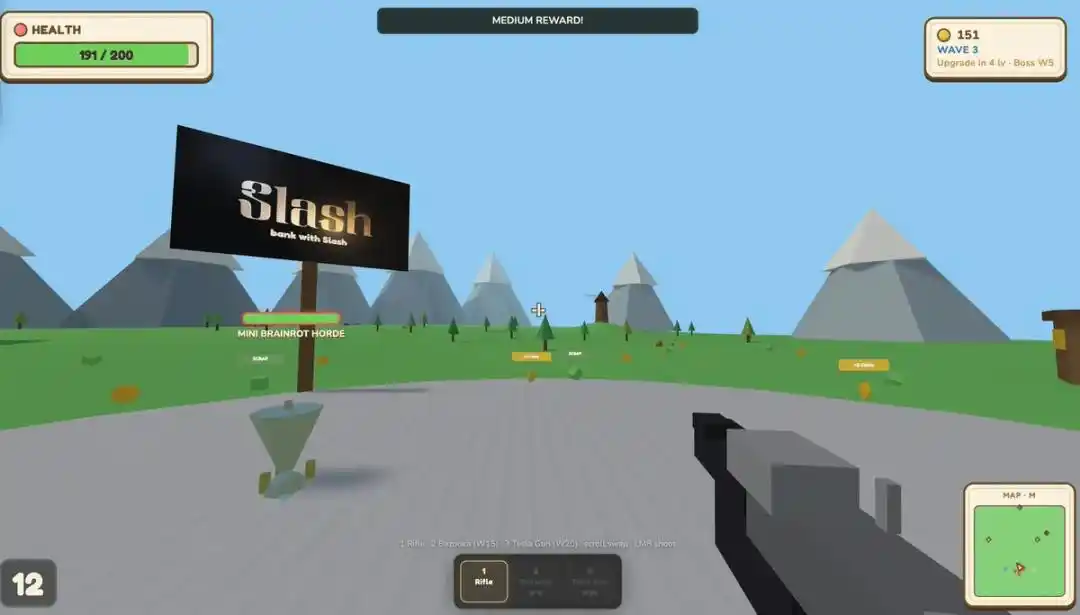
It uses a first-person shooter gameplay style, with maps made of pixel blocks, slightly reminiscent of *Minecraft*. Players run around the map with a weapon, chasing and shooting at internet brainrot characters like Skibidi Toilet, Tung Tung Tung Sahur, etc.
How should I put this... From graphics, gameplay to development scale, it's closer to a quickly assembled web demo.
Put it in a game store, and it's probably the level where players can guess the entire gameplay just by reading the name.
But Nick, with tears in his voice, said this thing caused him to inexplicably spend $81,267 in AI Credits in a week, like running water.
He also joked self-deprecatingly to the onlooking netizens that it was indeed an accident; he had underestimated his own abilities.
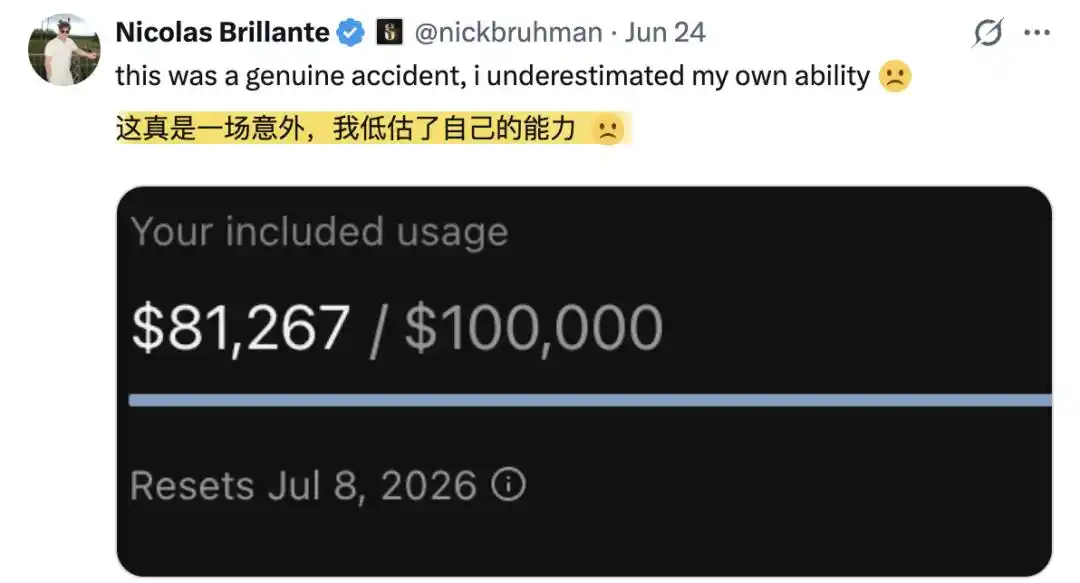
Not the ability to develop games, mind you, but the ability to burn tokens.
Oh, what a thrill~
The news quickly spread. Onlookers commented that they had made much more complex games, so how could it possibly cost $80,000.
Some serious bystanders even calculated for Slash, believing that even if the employee used the most expensive models entirely, having AI work non-stop for a week could hardly explain such an exaggerated expense.
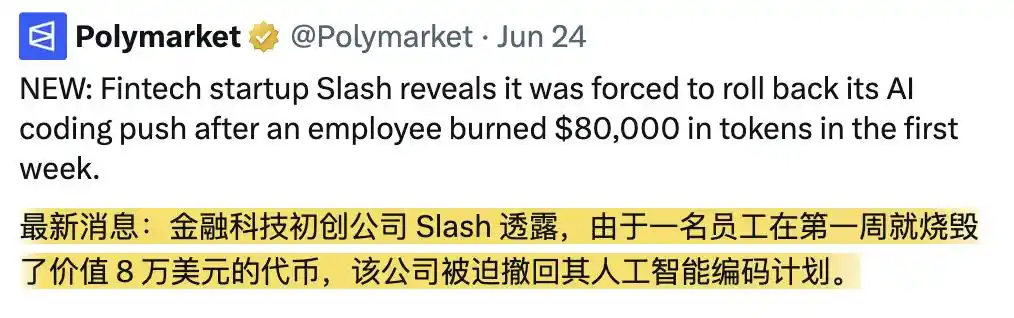
Besides concerned citizens, the prediction market Polymarket also came to watch, suggesting Slash might reconsider its internal AI programming strategy because of this incident.
What to do? What could be done??
This world is just so absurd.
This kind of disaster, the people/companies that cause it aren't actually that rare.
In December last year, Uber pushed AI coding tools like Claude Code and Cursor to all its engineers, encouraging Vibe Coding, and ended up burning through the annual budget in 4 months.
Other companies are also gradually catching on.
On July 1st, UBS analysts wrote in a report: "Based on conversations with over a dozen corporate IT executives over the past few weeks, 60% of enterprises are now, in some way, limiting AI spending by setting up certain guardrails."
A Sudden Twist, Accident Transforms into a Success Story
At that time, many spectators had just one question: Nick, when exactly are you getting fired? Waiting online, quite eagerly.
Nick was out of options; he had to salvage whatever he could.
Slash's official account stated on X that since things had come to this, please, please come play our Vibe Coding masterpiece.
Better make the finance department believe this $80,000 counts as marketing expenses.
However, before the firing notice arrived, the game went viral first.
Slash subsequently released the game's 48-hour performance stats.
- A total of 6,912 players entered the game
- Cumulative playtime reached 8,986 hours
- Peak concurrent players: 437
- Average playtime per player: ~1.3 hours
That's not even the main point.
The main point is that 3 brands proactively reached out inquiring about ad partnerships!
The Slash finance department's attitude then did a complete 180-degree turn.
The definition of this mini-game within the company was formally upgraded from an "expense incident" to a "strategic initiative."
Look at this ╮(╯▽╰)╭
When no one was playing it was an incident; with traffic, it starts talking about strategic value. To put it nicely, companies really know how to go with the flow.
Nick also immediately regained his vigor, stating that while the $80,000 couldn't be recovered, the game could continue to be iterated until it was truly worth millions.
Nick and the company started iterating on the game while recouping some costs by accepting in-game small ads.
The first batch of advertising partners soon made a dazzling appearance.
Capitalizing on the traffic, Slash quickly brought AI companies like Melius and Bland into the game.
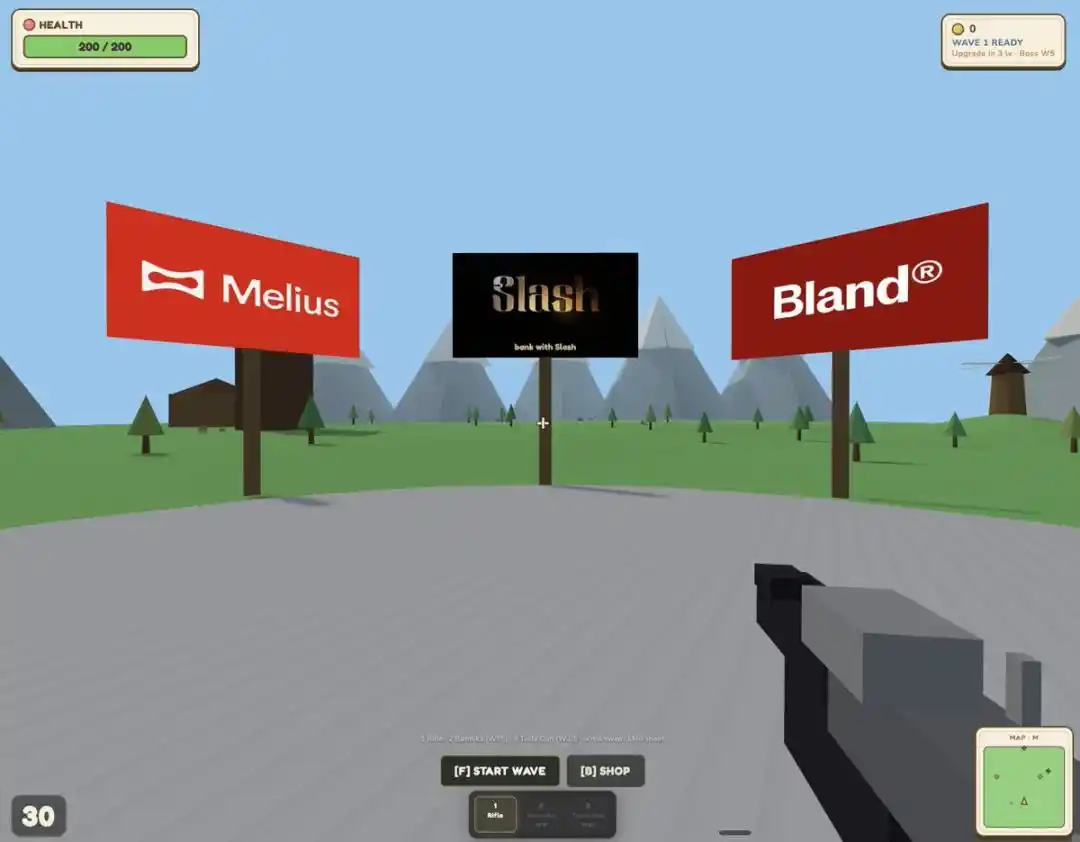
A corporate financial services company, because an employee used AI to make a brainrot shooting game, unexpectedly acquired a new media advertising slot.
How thrilling?
As long as the traffic is big enough, causing trouble can also be packaged as innovation.
Brought in $100 Million in AUM
Chinese people all know, after Tang Monk and his three disciples retrieved the true scriptures from the Great Thunderclap Monastery, the story of *Journey to the West* wasn't over.
Because they forgot to ask Buddha when the old turtle of Tongtian River could cultivate into human form. The great turtle became furious, shook its body, and threw the master, disciples, horse, and scriptures all into the river.
Nick's story turning from tragedy to joy should already count as a Happy Ending, right?
No, this matter isn't over.
Not long after, Nick appeared again to post, this time even more radiant—
Remember everyone mocking me for burning $80,000 in AI Credits before? Now, this mini-game made through Vibe Coding has already brought Slash $100 million in AUM.
To his knowledge, no one had ever reached this level before with a Vibe Coding game.
AUM stands for Assets Under Management, usually translated as such, referring to the total amount of client funds managed by a platform.
This means the brainrot game didn't directly bring the company much revenue, but after the game went viral, approximately $100 million in new funds entered its platform.

Slash did not further disclose how many clients the funds came from, the statistical period, or specifically how to prove these new AUM were brought by the game.
Therefore, this $100 million currently remains self-reported data from the company and the individual involved, lacking third-party verification.
However, even if not all the new AUM is attributed to the game, the communication effect brought by *Brainrot Shooter* is still quite impressive.
Remarkable, a fintech company originally primarily serving corporate clients has, through a rough-looking mini-game, entered the public eye more widely.
Originally, I wanted to express my afterthoughts with phrases like "What you lose on the swings you gain on the roundabouts," or "A loss may turn out to be a gain."
A few days later, Nick smiled smugly:
Don't rush, there's a second level.
One More Thing
Thinking the dust had settled, another thunderbolt struck out of the blue.
After the story of "employee spends $80,000 making a game, accidentally brings company $100 million AUM" had completely spread, Nick finally revealed the ultimate answer.
That $81,267 AI bill was FAKE!
He admitted that the amount in the screenshot was manually altered using the browser's Inspect Element.
The real AI cost for the first version of *Brainrot Shooter* was only about $80. After continuing to fix bugs and add content, the cumulative cost still didn't exceed $200.
That earlier token-burning bill that made onlookers' hearts go "OMG how could this be - LOL this guy's gonna get fired right? - Hmm the company's being somewhat humane - Wow they actually made money, respect respect" was a hoax from start to finish.
Wow, my left brain says, speechless, it was a marketing stunt?
My right brain says, to be fair, that's a pretty successful marketing stunt!
Now, let's rewrite the complete synopsis for this "Vibe Coding pixel brainrot mini-game astronomical bill incident":
Nick and the company used less than $200 to Vibe Code a brainrot mini-game, and then casually Vibe Marketed a global news story.
References:
[1]https://x.com/nickbruhman/status/2070558467010580877?s=20
[2]https://www.businessinsider.com/ubs-enterprises-ai-spending-tokens-2026-7?utm_source=chatgpt.com
[3]https://x.com/nickbruhman/status/2072703116667916307
This article is from the WeChat public account "QbitAI," author: Heng Yu