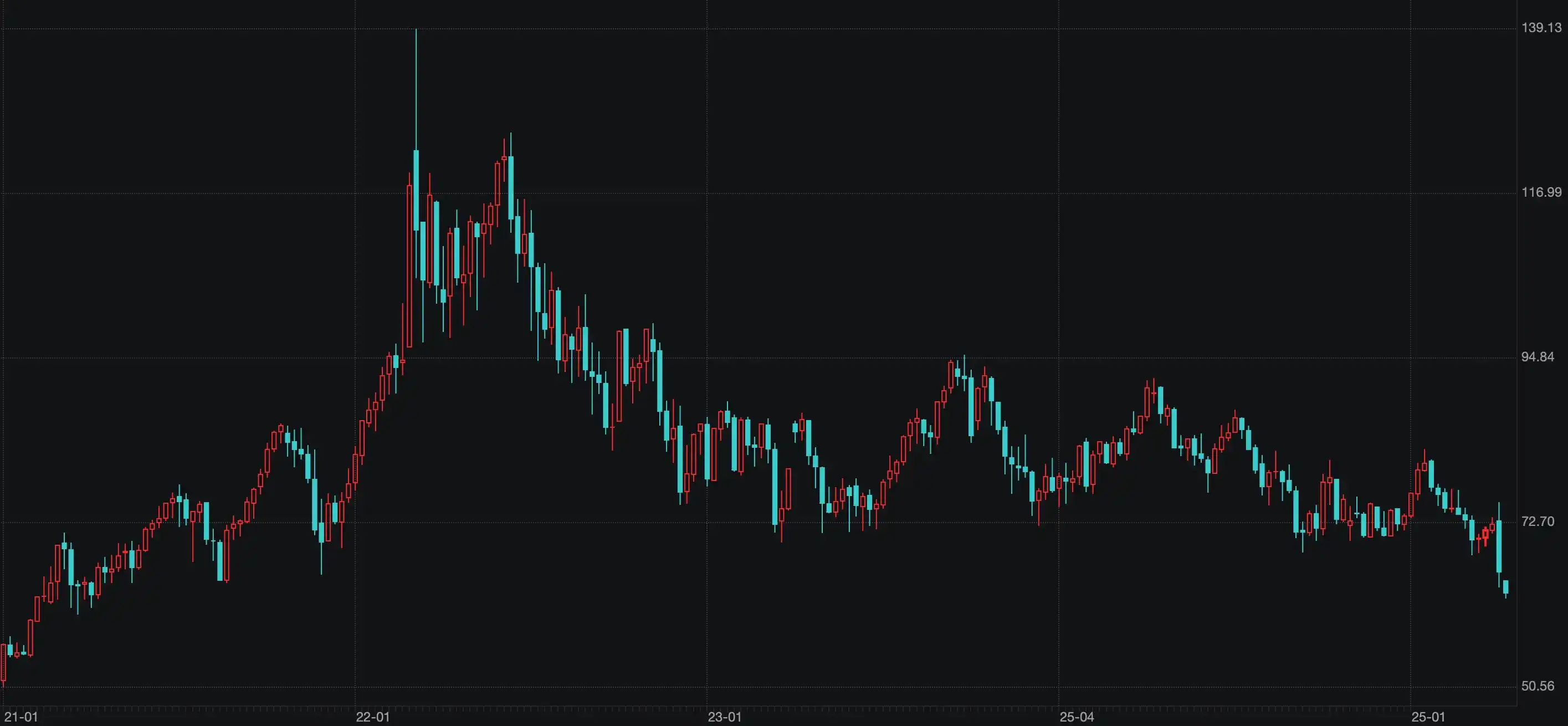
Bitcoin Remains Below Glassnode’s $77,200 True Market Mean

bitcoinistPublished on 2026-06-19Last updated on 2026-06-19

Abstract

Glassnode's latest report indicates Bitcoin continues to trade below its "True Market Mean," a key on-chain model estimating the average acquisition price of economically active coins at approximately $77,200. With BTC price roughly 15% below this level, the market is characterized as being in a repair or bearish regime rather than a confirmed bullish recovery. Trading below this cost-basis metric suggests a significant portion of active supply is under pressure, which can hinder rallies as underwater investors may sell into rebounds. The report highlights ongoing stress among short-term holders, contributing to market sensitivity. While a defense of current support levels shows demand, a sustained reclaim of the $77,200 True Market Mean is viewed as a more constructive signal for a broader regime shift than a simple relief bounce. For a bullish recovery to be confirmed, the market needs sufficient demand to overcome this overhead cost pressure.

Glassnode’s Week Onchain report says Bitcoin remains below its True Market Mean, with the model sitting near $77,200 and price trading at a sizeable discount.

TL;DR

  • Glassnode says Bitcoin is still below its $77,200 True Market Mean.
  • The metric is a cost-basis model for economically active coins.
  • Trading below it suggests the market remains in a repair or bearish regime.
  • A reclaim of the level would be more constructive than a simple relief bounce.

Bitcoin Still Below A Key Cost-Basis Line

Glassnode’s latest Week Onchain report shows Bitcoin trading below its True Market Mean, a cost-basis model that the firm says sits around $77,200. With BTC roughly 15% below that level, the report frames the market as still in a repair phase rather than a confirmed bullish recovery.

The True Market Mean is not a magic support or resistance line. It is an onchain model designed to capture the average acquisition price of economically active coins. But because cost-basis models track where different investor cohorts are sitting in profit or loss, traders often use them to understand when sentiment has shifted from stress to recovery.

Why The $77,200 Level Matters

When price trades below a widely watched cost-basis band, it usually means a meaningful portion of active supply is under pressure. That does not automatically mean more downside is coming, but it does help explain why rallies can struggle. Investors who are underwater often sell into rebounds, while short-term holders may hesitate to add exposure until breakeven levels are reclaimed.

Glassnode’s framing is important because it separates market repair from full regime change. Bitcoin can bounce from support, absorb selling, and show accumulation signals while still being below the level that would confirm broader strength. That nuance matters in a market still digesting macro pressure, ETF flows, and changing liquidity expectations.

Short-Term Holder Stress Remains A Watchpoint

The report also points to stress among short-term holders, a group that often drives faster market reactions. When short-term holder metrics remain below breakeven, the market can become more sensitive to bad news because recent buyers are sitting on unrealized losses.

That helps explain why Bitcoin’s move around the $64,000 zone has become so important. A defense of that area may show demand is still present, but a clean reclaim of the True Market Mean would carry a different message: that the active-investor cost basis is no longer acting as overhead pressure.

What Traders Are Watching Next

The setup leaves Bitcoin in a middle zone. On one hand, trading at a discount to the True Market Mean can attract value-focused buyers who believe the market is oversold relative to active investor cost basis. On the other, failure to reclaim the model keeps the bearish-regime argument alive.

For now, the practical takeaway is simple. Bitcoin bulls need more than a relief bounce. They need enough demand to push price back toward higher cost-basis levels and keep it there. Until then, Glassnode’s data suggests the market is still healing, not yet clearly breaking into a new expansion phase.

This article was written by the News Desk and edited by Samuel Rae.

This report is based on information from Glassnode Insights. at Glassnode

Trending Cryptos

Related Questions

QWhat is the current value of Glassnode's True Market Mean for Bitcoin, according to the article?

AAccording to the article, Glassnode's True Market Mean model for Bitcoin is sitting near $77,200.

QWhat does the True Market Mean metric represent?

AThe True Market Mean is a cost-basis model designed to capture the average acquisition price of economically active Bitcoin coins. It tracks where different investor cohorts are sitting in profit or loss.

QWhat does Bitcoin trading below the True Market Mean signify for the market regime?

AAccording to Glassnode's report, Bitcoin trading below this level suggests the market remains in a repair or bearish regime, rather than a confirmed bullish recovery.

QAccording to the article, what is more important for confirming broader market strength than a simple relief bounce in price?

AA clean reclaim of the True Market Mean (the $77,200 level) would be more constructive and carry a different message than a simple relief bounce, as it would show the active-investor cost basis is no longer acting as overhead pressure.

QWhich specific investor group's ongoing stress is highlighted in the report as a key watchpoint for market sensitivity?

AThe report points to stress among short-term holders as a key watchpoint. When their metrics remain below breakeven, the market can become more sensitive to bad news because these recent buyers are sitting on unrealized losses.

Related Reads

The Entire Internet Hails Noam's Joining, But OpenAI's Loss Bill Just Got Thicker

While the AI community celebrates Noam Shazeer, co-author of the "Attention Is All You Need" paper, joining OpenAI as Head of Architectural Research, the company's audited financials reveal a starkly different reality. In 2025, OpenAI reported $13.07 billion in revenue but a massive $20.92 billion operating loss. Even excluding a one-time accounting charge, the cash burn is severe, with $3.7 billion consumed in Q1 2026 alone. This high-profile hiring occurs against a backdrop of significant internal research talent drain, with key founders and researchers departing as the company's focus shifts from exploratory research to product iteration. Meanwhile, OpenAI's fundamental business model faces a deep crisis. It paid Microsoft $10.59 billion for compute in 2025, while its vast user base of 9 billion weekly actives includes only 50 million paying customers, making growth a direct driver of escalating costs. The article argues Shazeer's recruitment is less about technical necessity and more about crafting a compelling narrative for OpenAI's upcoming IPO, aiming to justify a rumored $1 trillion valuation to future public market investors. It contrasts OpenAI's strategy with Anthropic's reported path to profitability, which relies on a strong enterprise customer base and cost control, rather than star-powered narratives. Ultimately, the piece concludes that while Shazeer's architectural work may take 1-2 years to materialize, OpenAI's financial clock is ticking much faster, with its massive losses undercutting the celebratory headlines.

marsbit33m ago

The Entire Internet Hails Noam's Joining, But OpenAI's Loss Bill Just Got Thicker

marsbit33m ago

Market Trend (June 19): US-Iran Deal Drives Out Geopolitical Premium; Chip Stocks Soar to New Highs; Energy Sector Leads Declines

U.S. Market Trends (June 19): U.S.-Iran Deal Eases Tensions, Chip Stocks Soar, Energy Sector Leads Declines. U.S. stocks rallied on Thursday as the signing of a temporary U.S.-Iran deal in Geneva de-escalated Middle East tensions, with Saudi oil tankers transiting the Strait of Hormuz. This geopolitical relief helped markets recover from recent Fed-driven volatility. The S&P 500 rose over 1%, the Nasdaq gained nearly 2%, and the Dow Jones Industrial Average closed at another record high. The Philadelphia Semiconductor Index surged over 6% to a historic peak. Chip stocks were the standout performers. Reports of an Apple-Intel design and foundry deal for certain products, alongside mentions of potential Nvidia and SpaceX collaborations with Intel, propelled the sector. Intel surged ~10.5%, while memory chip makers like Micron also saw significant gains, highlighting sustained confidence in long-term AI capital expenditure. In contrast, the energy sector was the day's sole loser, with the S&P 500 energy sub-index declining as WTI crude fell ~2% to around $74.29/barrel. The reopening of key shipping routes erased prior geopolitical risk premiums. SpaceX extended losses for a second day on news of a potential large bond offering. Market volatility (VIX) dropped sharply, indicating a swift reversal of post-Fed jitters. Treasury yields dipped slightly but remained elevated. The focus now shifts to upcoming economic data, including next week's PCE inflation report and Micron's earnings, which will serve as a key test for the AI trade's durability.

marsbit55m ago

Market Trend (June 19): US-Iran Deal Drives Out Geopolitical Premium; Chip Stocks Soar to New Highs; Energy Sector Leads Declines

marsbit55m ago

Will MicroStrategy Fall Into a Death Spiral? How Will the Macro Outlook Evolve in the Second Half of the Year?

**Summary:** The discussion centers on recent Bitcoin price declines and the evolving financial strategy of MicroStrategy (MSTR). The core argument is that the primary pressure is not from one-off Bitcoin sales by MSTR, but from the market's new expectation that MSTR may need to engage in *sustained, small-scale* Bitcoin sales to cover cash flow obligations for its growing portfolio of preferred shares and debt instruments (like STRC). This shift is driven by its stated goal of maintaining "bitcoins per share neutrality." The market is now testing whether it can absorb this potential ongoing selling pressure without entering a severe "death spiral" with Bitcoin's price. A resolution may involve MSTR softening its approach to avoid damaging both its stock and Bitcoin. The conversation then explores the parallel rise of AI-related stocks. The guest posits that AI is fundamentally restructuring labor, with "tokens" (representing access to AI models/compute) becoming a new form of capital and a substitute for human execution. This drives corporate efficiency and profits, benefiting upstream hardware providers (semiconductors, data centers), which explains the sustained rally. This represents the early stages of a "machine economy." Regarding crypto exchanges offering US stock trading, this is seen as a natural evolution. With few crypto-native assets generating lasting value, exchanges are pivoting to distribute valuable real-world assets (RWAs). This doesn't necessarily harm crypto's long-term prospects, as blockchain infrastructure may become crucial for future machine-to-machine economies. The analysis concludes that the era of rampant altcoin speculation is likely over, heavily damaged by the liquidity shock of the "1011" event (likely referring to a major market crash). Meme-driven capital has largely migrated to US equities. Looking ahead, macroeconomic uncertainty is rising due to potential large IPOs (e.g., SpaceX) and the US elections. While short-term market corrections are possible, the long-term trends of AI-driven productivity gains and the maturation of blockchain towards real-world utility and institutional adoption remain intact.

marsbit59m ago

Will MicroStrategy Fall Into a Death Spiral? How Will the Macro Outlook Evolve in the Second Half of the Year?

marsbit59m ago

Trading

Spot
Futures

Hot Articles

What is $BITCOIN

DIGITAL GOLD ($BITCOIN): A Comprehensive Analysis Introduction to DIGITAL GOLD ($BITCOIN) DIGITAL GOLD ($BITCOIN) is a blockchain-based project operating on the Solana network, which aims to combine the characteristics of traditional precious metals with the innovation of decentralized technologies. While it shares a name with Bitcoin, often referred to as “digital gold” due to its perception as a store of value, DIGITAL GOLD is a separate token designed to create a unique ecosystem within the Web3 landscape. Its goal is to position itself as a viable alternative digital asset, although specifics regarding its applications and functionalities are still developing. What is DIGITAL GOLD ($BITCOIN)? DIGITAL GOLD ($BITCOIN) is a cryptocurrency token explicitly designed for use on the Solana blockchain. In contrast to Bitcoin, which provides a widely recognized value storage role, this token appears to focus on broader applications and characteristics. Notable aspects include: Blockchain Infrastructure: The token is built on the Solana blockchain, known for its capacity to handle high-speed and low-cost transactions. Supply Dynamics: DIGITAL GOLD has a maximum supply capped at 100 quadrillion tokens (100P $BITCOIN), although details regarding its circulating supply are currently undisclosed. Utility: While precise functionalities are not explicitly outlined, there are indications that the token could be utilized for various applications, potentially involving decentralized applications (dApps) or asset tokenization strategies. Who is the Creator of DIGITAL GOLD ($BITCOIN)? At present, the identity of the creators and development team behind DIGITAL GOLD ($BITCOIN) remains unknown. This situation is typical among many innovative projects within the blockchain space, particularly those aligning with decentralized finance and meme coin phenomena. While such anonymity may foster a community-driven culture, it intensifies concerns about governance and accountability. Who are the Investors of DIGITAL GOLD ($BITCOIN)? The available information indicates that DIGITAL GOLD ($BITCOIN) does not have any known institutional backers or prominent venture capital investments. The project seems to operate on a peer-to-peer model focused on community support and adoption rather than traditional funding routes. Its activity and liquidity are primarily situated on decentralized exchanges (DEXs), such as PumpSwap, rather than established centralized trading platforms, further highlighting its grassroots approach. How DIGITAL GOLD ($BITCOIN) Works The operational mechanics of DIGITAL GOLD ($BITCOIN) can be elaborated on based on its blockchain design and network attributes: Consensus Mechanism: By leveraging Solana’s unique proof-of-history (PoH) combined with a proof-of-stake (PoS) model, the project ensures efficient transaction validation contributing to the network's high performance. Tokenomics: While specific deflationary mechanisms have not been extensively detailed, the vast maximum token supply implies that it may cater to microtransactions or niche use cases that are still to be defined. Interoperability: There exists the potential for integration with Solana’s broader ecosystem, including various decentralized finance (DeFi) platforms. However, the details regarding specific integrations remain unspecified. Timeline of Key Events Here is a timeline that highlights significant milestones concerning DIGITAL GOLD ($BITCOIN): 2023: The initial deployment of the token occurs on the Solana blockchain, marked by its contract address. 2024: DIGITAL GOLD gains visibility as it becomes available for trading on decentralized exchanges like PumpSwap, allowing users to trade it against SOL. 2025: The project witnesses sporadic trading activity and potential interest in community-led engagements, although no noteworthy partnerships or technical advancements have been documented as of yet. Critical Analysis Strengths Scalability: The underlying Solana infrastructure supports high transaction volumes, which could enhance the utility of $BITCOIN in various transaction scenarios. Accessibility: The potential low trading price per token could attract retail investors, facilitating wider participation due to fractional ownership opportunities. Risks Lack of Transparency: The absence of publicly known backers, developers, or an audit process may yield skepticism regarding the project's sustainability and trustworthiness. Market Volatility: The trading activity is heavily reliant on speculative behavior, which can result in significant price volatility and uncertainty for investors. Conclusion DIGITAL GOLD ($BITCOIN) emerges as an intriguing yet ambiguous project within the rapidly evolving Solana ecosystem. While it attempts to leverage the “digital gold” narrative, its departure from Bitcoin's established role as a store of value underscores the need for a clearer differentiation of its intended utility and governance structure. Future acceptance and adoption will likely depend on addressing the current opacity and defining its operational and economic strategies more explicitly. Note: This report encompasses synthesised information available as of October 2023, and developments may have transpired beyond the research period.

394 Total ViewsPublished 2025.05.13Updated 2025.05.13

What is $BITCOIN

Discussions

Welcome to the HTX Community. Here, you can stay informed about the latest platform developments and gain access to professional market insights. Users' opinions on the price of BTC (BTC) are presented below.

活动图片