Breaking: GPT-5.6 Prices Slashed Effective Today

marsbitPublished on 2026-07-31Last updated on 2026-07-31

Abstract

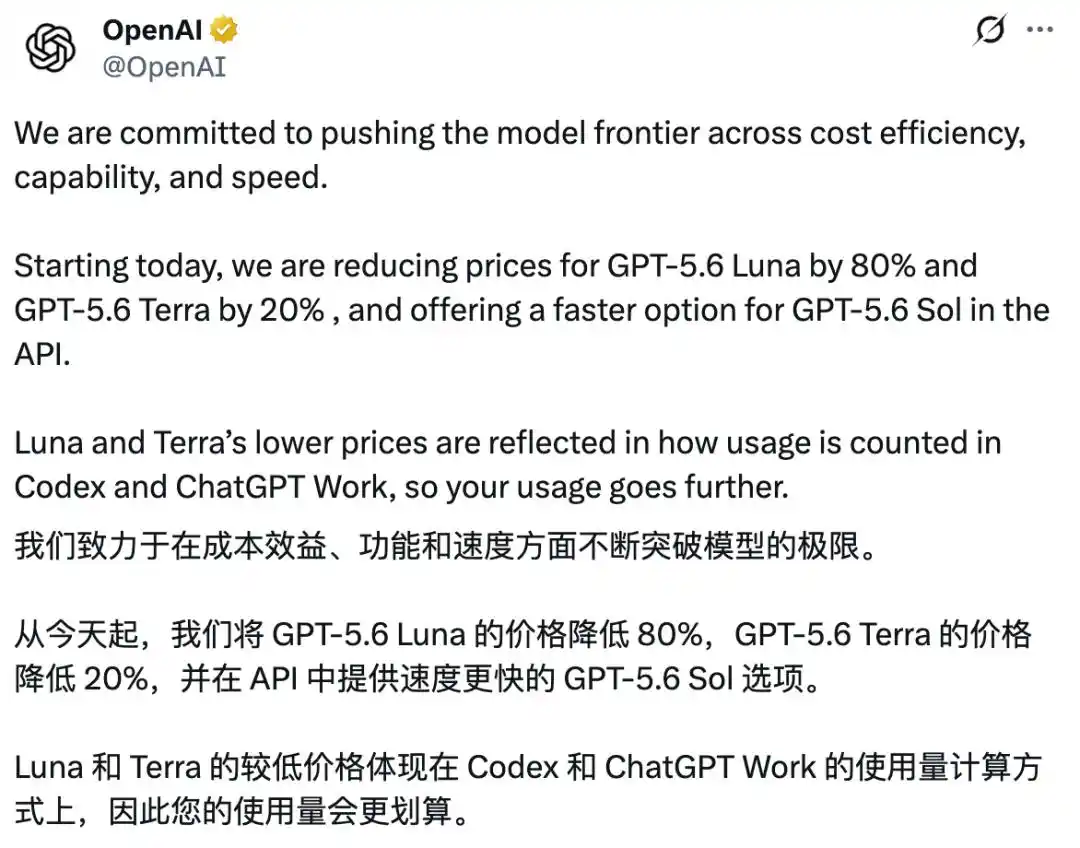
OpenAI has announced significant price cuts for its GPT-5.6 model API, effective immediately. The entry-level **GPT-5.6 Luna** sees the most drastic reduction, with input prices dropping 80% to $0.20 per million tokens and output prices falling to $1.20 per million tokens. The mid-tier **GPT-5.6 Terra** is reduced by 20%, now costing $2.00 (input) and $12.00 (output) per million tokens. The flagship **GPT-5.6 Sol** maintains its original price but introduces a new **Fast mode**, offering speeds up to 2.5 times faster for double the cost. The company attributes these price reductions to efficiency gains achieved through **GPT-5.6 Sol's own involvement in optimizing its production systems**. The model assisted in rewriting GPU kernels and improving speculative decoding, leading to a 20% reduction in end-to-end service costs and over 15% improvement in token generation efficiency. OpenAI emphasizes this process remained human-led. A key focus of the降价 is to lower the barrier for running **AI agent workflows**. By making the capable, tool-calling Luna model significantly cheaper, OpenAI aims to enable more frequent use in cost-sensitive, high-volume tasks like code review and monitoring. This creates a potential feedback loop: model-assisted efficiency gains lead to lower costs, which enables broader agent deployment, which in turn drives further optimization. The new pricing and features will also apply to Codex and ChatGPT Work subscriptions. The changes intensify competitio...

The entry-level Luna model has seen a massive price cut, with input price dropping from $1 to $0.2 per million tokens, and output price falling from $6 to $1.2 per million tokens.

Converted to RMB, this is equivalent to input price dropping from about 6.8 yuan to 1.35 yuan, and output price from about 40.6 yuan to 8.1 yuan.

The Terra model, positioned as the "daily workhorse," also saw a 20% price reduction, with input and output prices dropping to $2 and $12 per million tokens respectively.

Converted to RMB, this is approximately 13.5 yuan and 81.2 yuan respectively.

Only the flagship model, Sol, remains at its original price, but it introduces a Fast mode with speeds up to 2.5 times that of the standard mode, offering acceleration at no extra cost.
Following the aggressive reset of usage in Codex, OpenAI has promptly arranged for price cuts... who are you trying to out-compete?

The price war has directly escalated to a white-hot level.

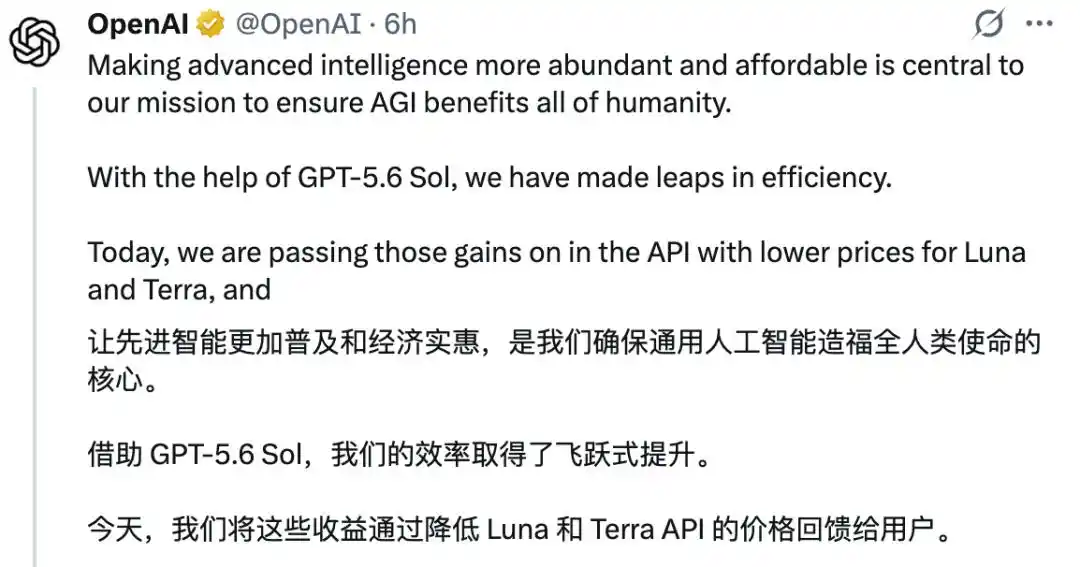
OpenAI stated that the price reduction is because GPT-5.6 Sol helped save its own costs.

GPT-5.6 Sol participated in its own improvement, achieving a leap in efficiency, hence this special feedback for our new and existing users~

So OpenAI is also playing the game of "stepping on one's own feet to ascend on the spot."

.

Two Models Get Cheaper, One Gets Faster

Currently, the API prices for the three GPT-5.6 models are:

GPT-5.6 Luna: $0.2 per million tokens input, $1.2 per million tokens output;

GPT-5.6 Terra: $2 per million tokens input, $12 per million tokens output;

GPT-5.6 Sol: $5 per million tokens input, $30 per million tokens output.
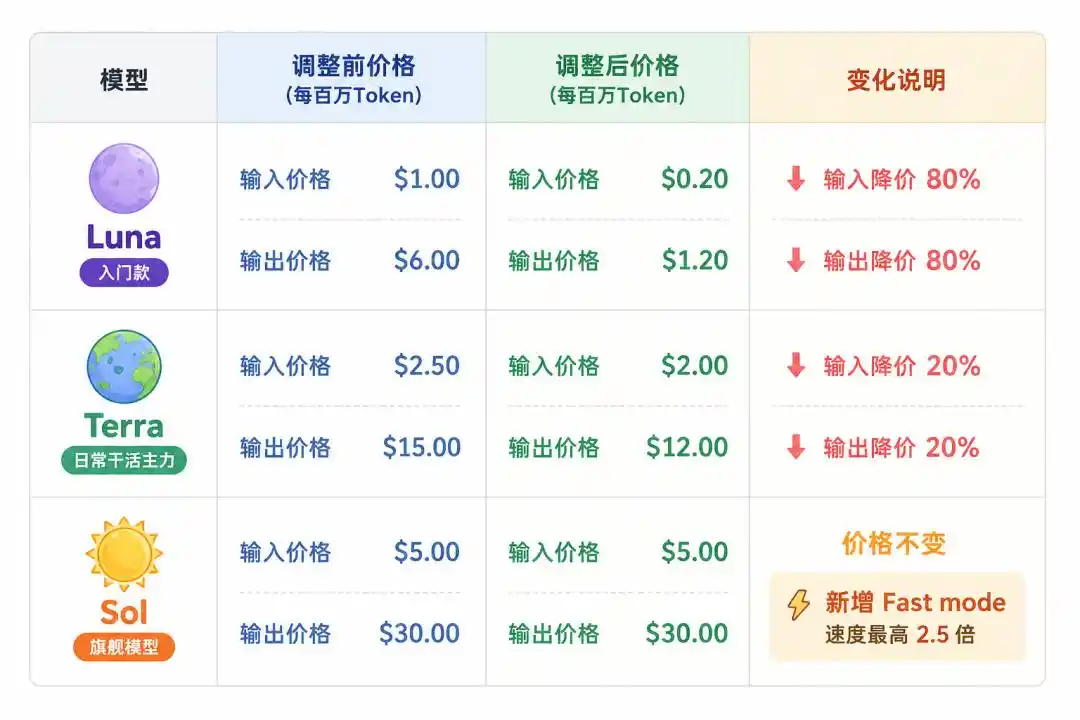
After the price cut, Luna has taken a major plunge.

Its input price is now on par with the previous generation GPT-5.4 nano, and its output price is even $0.05 cheaper.

However, the two models don't handle exactly the same tasks. GPT-5.4 nano is mainly for simple, high-frequency tasks like classification, information extraction, and ranking.

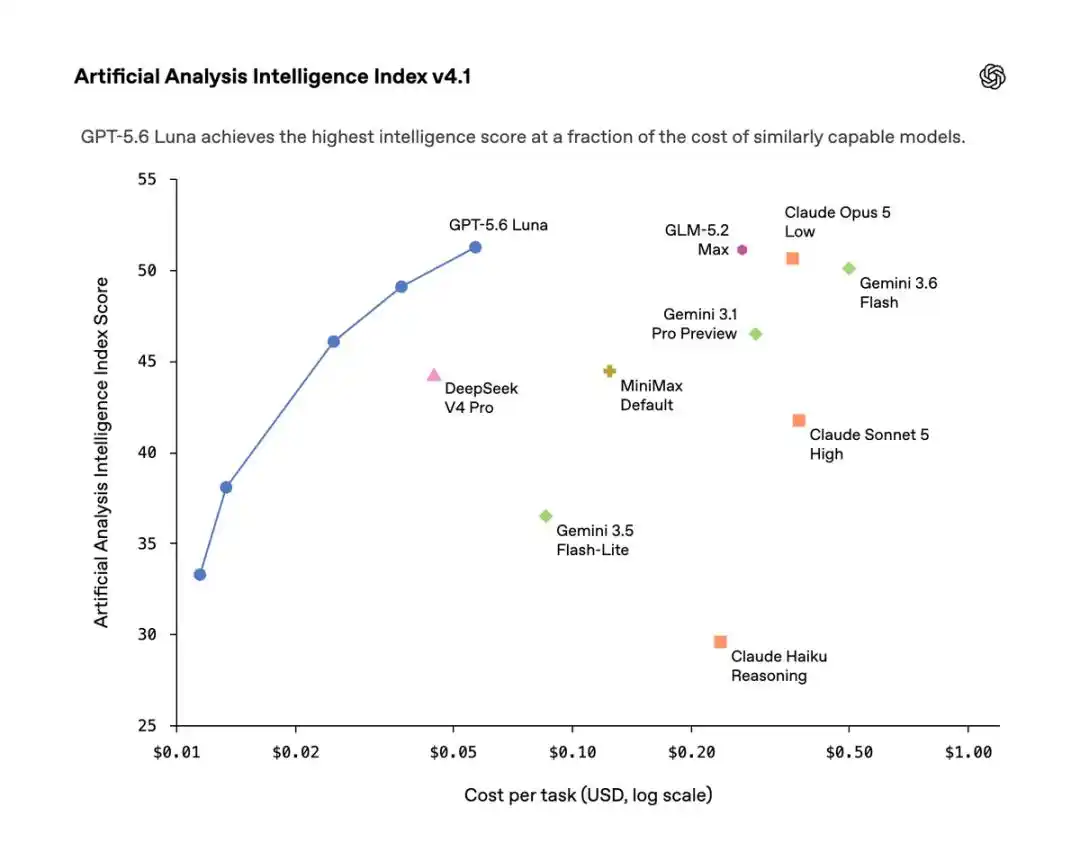
GPT-5.6 Luna is positioned by OpenAI as a model for cost-sensitive workloads, capable of calling tools, handling long contexts, and executing multi-step workflows.

Simply put, OpenAI is selling the model that powers Agents at the price point of past simple small models.

Terra's reduction is relatively more restrained, at 20%.

Sol maintains its original price but adds Fast mode, which can reach speeds up to 2.5 times the standard mode, priced at 2 times the standard mode, with no change in model intelligence.

It will also replace the previous Priority Processing. API requests originally using the priority tag can automatically switch to Fast mode.

Officials stated that this round of adjustments will also be applied to Codex and ChatGPT Work.

Subscription prices will not be lowered, and users' total quota will not increase, but when calling Terra and Luna, the quota consumed will be correspondingly reduced.

The same subscription fee can allow the model to perform more tasks.

OpenAI also casually switched the Auto-review model in ChatGPT and Codex CLI from GPT-5.4 to GPT-5.6 Luna.

Auto-review is responsible for checking code and modification results in the background, a typical high-frequency Agent task.

Combined with the model upgrade and Luna's price cut, OpenAI expects its cost to drop to about one-tenth of the original.

Cheap models are no longer only responsible for traditional "miscellaneous tasks" like classification and extraction, but are starting to enter areas like code review and backend monitoring, which require judgment and tool calling.

Currently, the positioning of the three models is:

Budget-sensitive, high-volume tasks go to Luna;

Regular daily work goes to Terra;

High-difficulty tasks continue with Sol;

If even waiting is too slow, pay double for speed.

GPT-5.6 Begins Participating in Its Own Cost Reduction

Why the sudden price drop?

OpenAI stated the reason is that GPT-5.6 Sol participated in optimizing its own production system.

The efficiency it improved then translated into discounted numbers on the price list.

Specifically, GPT-5.6 Sol rewrote and optimized some production environment GPU kernels, designed and ran hundreds of token generation experiments, and participated in monitoring training, intervening when issues arose.

The final results were also impressive: production GPU kernel optimization reduced GPT-5.6 end-to-end service costs by 20%; improved speculative decoding increased token generation efficiency by over 15%.
A GPU Kernel can be understood as the underlying program that executes specific computing tasks for the model on the GPU.

The model itself doesn't need to change; as long as these programs are written more efficiently, the same GPU can complete calculations faster, handle more requests, and the cost per call also drops.

Speculative decoding involves "guessing" the next possible tokens in bulk when generating answers, then having the main model verify them. The more accurate the guesses, the fewer steps are needed for individual generation and waiting.

Both optimizations do not reduce model capability but allow the same model to run faster and cheaper.

However, this is not GPT-5.6 fully autonomously upgrading itself.

OpenAI specifically emphasized that the entire process remains human-led.

The model can write code, run experiments, and monitor anomalies, but defining goals, deciding if results are usable, and whether code enters the production environment still require "Human in the Loop."

OMT

Finally, there's one more new development.

This price cut has a very specific focus: Agent workflows.

The most heavily discounted Luna is not just a traditional small model for classification and extraction.

According to OpenAI's positioning, it can call tools and execute multi-step tasks, mainly targeting high-frequency, cost-sensitive workloads.

Therefore, Luna's 80% price cut also serves to lower the barrier for long-running Agents.

It makes review, verification, and monitoring tasks, which were previously too costly to perform frequently, feasible as regular steps in workflows.

Combined with GPT-5.6 participating in optimizing its own production system, a new cycle emerges:

The model participates in improving operational efficiency, costs drop; after prices decrease, the model enters more high-frequency workflows; increased call volume then drives the next round of efficiency optimization.

OpenAI's price reduction flywheel is taking shape.

After this series of maneuvers, the pressure is now directly on A-She (Anthropic?):

"Your turn."

Reference links:[1]https://x.com/OpenAI/status/2082878156483219672[2]https://x.com/sama/status/2082880720989532597

This article is from the WeChat public account "QbitAI," author: Follow Frontier Technology

Trending Cryptos

Related Questions

QWhat are the key pricing changes for GPT-5.6 Luna announced in the article?

AThe price for GPT-5.6 Luna has been dramatically reduced. The input cost per million tokens dropped from $1 to $0.2, and the output cost per million tokens dropped from $6 to $1.2.

QWhat is the new 'Fast mode' introduced for GPT-5.6 Sol?

AGPT-5.6 Sol now offers a 'Fast mode' that can reach speeds up to 2.5 times faster than the standard mode. It costs twice as much as the standard mode but maintains the same level of model intelligence.

QWhat are the primary reasons OpenAI gives for the price reductions according to the article?

AOpenAI states the price reductions are due to efficiency gains achieved by GPT-5.6 Sol participating in its own improvement. Specifically, it optimized production GPU kernels (reducing service costs by 20%) and improved speculative decoding (increasing token generation efficiency by over 15%).

QHow is the role of GPT-5.6 Luna described, and what is the strategic goal of its price cut?

AGPT-5.6 Luna is described as a model for cost-sensitive workloads that can call tools, handle long contexts, and execute multi-step workflows. Its significant price cut aims to lower the barrier for running AI Agents in long-term, high-frequency tasks like code review and monitoring.

QWhat is the core concept of the 'price reduction flywheel' mentioned in the article's conclusion?

AThe 'price reduction flywheel' refers to a self-reinforcing cycle where: the model helps improve its own operational efficiency, leading to cost reductions; lower prices allow the model to be used in more high-frequency workflows; increased usage scale then drives the next round of efficiency optimization.

Related Reads

Only 153 Venture Capital Firms Invested in July: Is the Crypto VC Industry Experiencing a 'Mass Extinction'?

In July 2026, only 153 unique venture capital firms participated in disclosed crypto funding rounds, marking the lowest monthly count since November 2020. This figure represents an 87% decline from the peak of 1,177 firms in 2022. Overall, the first seven months of 2026 saw crypto projects raise approximately $11.78 billion across 481 rounds. This crypto VC contraction contrasts sharply with the broader venture capital landscape, where global VC investment reached a record $560.4 billion in H1 2026, heavily fueled by major AI company financings. This shift in capital allocation has drawn funds away from the crypto sector. Within crypto, funding is highly concentrated. Trading platforms, prediction markets, and payment sectors absorbed 53% of the total capital. While early-stage deals remain frequent, the largest sums flow to a few late-stage rounds and mergers & acquisitions, which surged to $7.23 billion in Q2 2026. The market is consolidating around top funds like a16z crypto and Dragonfly, which successfully raised new multi-billion dollar funds, while many smaller firms have retreated. Analysts describe this as a "great extinction" for crypto VCs, where capital is becoming more selective, favoring proven business models and assets over early-stage speculation. This raises the bar for project quality, funding efficiency, and viable exit paths.

marsbit8m ago

Only 153 Venture Capital Firms Invested in July: Is the Crypto VC Industry Experiencing a 'Mass Extinction'?

marsbit8m ago

Strategy's Loss in the Second Quarter Reaches $8.22 Billion Amid Bitcoin Decline

Strategy, the largest corporate holder of Bitcoin, reported a net loss of $8.22 billion for the second quarter. This loss was primarily driven by an $8.32 billion unrealized loss on its Bitcoin holdings due to a decline in the asset's price during the period. Despite these paper losses, the company increased its Bitcoin holdings to 843,775 BTC, a 25% growth since the start of the year. As part of a new monetization strategy, Strategy sold approximately $218.4 million worth of Bitcoin, mainly to fund dividends for preferred shareholders, with $216 million of that sold after Q2 ended. The company also built a $3.75 billion cash reserve, which it claims is sufficient to cover over two years of dividend and interest payments, aiming to insulate itself from Bitcoin's volatility while meeting obligations. Following the earnings release, Strategy's stock (MSTR) rose 4.7% in regular trading but corrected slightly after-hours. This pattern reflects how the company's accounting results are heavily tied to Bitcoin's price swings, even as its long-term strategy remains unchanged. The report indicates that Strategy is maintaining its core strategy of accumulating Bitcoin while building a financial buffer. This quarterly loss follows a recognizable pattern, with the company posting significant unrealized losses in previous quarters (e.g., $12.4 billion in Q4 2025 and ~$12.5 billion in Q1 2026) due to fair-value accounting. A key technical shift is its new monetization program, which introduces periodic selling pressure on the market, transitioning Strategy from a pure accumulator to a participant that occasionally adds supply. A critical question remains: how long can the cash reserve cover dividend obligations if a Bitcoin price downturn persists beyond two years?

cryptonews.ru28m ago

Strategy's Loss in the Second Quarter Reaches $8.22 Billion Amid Bitcoin Decline

cryptonews.ru28m ago

Will Terrorist Durov Ban Russian Officials?

Telegram founder Pavel Durov publicly reacted to being labeled a "terrorist" by Russian authorities, stating the designation came after he refused demands for mass surveillance and censorship on the platform. In a Telegram post, he highlighted that this status formally bans him from "publishing information online." Durov concluded with a statement widely circulated: Russian officials "clearly don't understand who can ban whom on the internet." This remark suggests Durov could potentially restrict official Russian government and officials' channels on Telegram, which continue to operate on the platform despite its formal blocking in Russia. The situation parallels previous, slow-moving state directives, like switching officials to domestic cars, contrasted with the current push to migrate all government communication to the Russian-made messenger MAX by 2030. However, reports indicate many officials still use Telegram via workarounds, fearing surveillance on MAX, while alternatives like BiP and KakaoTalk recently became inaccessible in Russia without a VPN. Durov has not specified any immediate actions against state channels. His statement is an initial response, with further developments depending on the authorities' reaction. The dynamic differs from 2020 when Russian regulators lifted a block on Telegram; now, Durov implies control from within the platform itself over the official accounts that persisted through that earlier blockade.

cryptonews.ru28m ago

Will Terrorist Durov Ban Russian Officials?

cryptonews.ru28m ago

DeepSeek V4 Official Version Arrives, New Capabilities Emerge, Value-for-Money King Enters the Fray

On July 31st, DeepSeek officially launched the public API beta for its DeepSeek-V4-Flash model. A key highlight is its performance on multiple Agent benchmark tests, reportedly nearing or even surpassing the level of the V4-Pro preview version from three months ago. Notably, the Flash model achieves this with significantly smaller scale (130B active parameters vs. Pro's 490B), suggesting that post-training optimization and data quality may be as crucial as raw model size. DeepSeek emphasized that the V4-Flash-0731 uses the same model architecture and size as its preview version, with improvements attributed solely to "re-trained post-training." The update also marks the official debut of DeepSeek's self-developed Agent framework, "Harness." The move signals DeepSeek's strategic push to position its cost-effective Flash model as a competitive base for Agent applications—scenarios requiring autonomous planning, tool usage, and complex task execution—where inference speed and cost are critical. By natively supporting OpenAI's Responses API format and adapting for code-generation scenarios, DeepSeek aims not just to be a cheaper alternative but to establish its own ecosystem in the Agent era. This release follows DeepSeek's record-breaking ~$50 billion fundraising round roughly two months prior, underscoring market confidence in its technology and commercialization prospects. The company is reportedly preparing for another funding round at a valuation of approximately $71 billion. The Flash model's advancement represents a step in fulfilling the high expectations that come with this valuation, setting the stage for the impending release of the V4-Pro official version and intensifying competition in the global Agent landscape.

marsbit32m ago

DeepSeek V4 Official Version Arrives, New Capabilities Emerge, Value-for-Money King Enters the Fray

marsbit32m ago

Trading

Spot

Hot Articles

How to Buy LUNA

Welcome to HTX.com! We've made purchasing Terra (LUNA) simple and convenient. Follow our step-by-step guide to embark on your crypto journey.Step 1: Create Your HTX AccountUse your email or phone number to sign up for a free account on HTX. Experience a hassle-free registration journey and unlock all features.Get My AccountStep 2: Go to Buy Crypto and Choose Your Payment MethodCredit/Debit Card: Use your Visa or Mastercard to buy Terra (LUNA) instantly.Balance: Use funds from your HTX account balance to trade seamlessly.Third Parties: We've added popular payment methods such as Google Pay and Apple Pay to enhance convenience.P2P: Trade directly with other users on HTX.Over-the-Counter (OTC): We offer tailor-made services and competitive exchange rates for traders.Step 3: Store Your Terra (LUNA)After purchasing your Terra (LUNA), store it in your HTX account. Alternatively, you can send it elsewhere via blockchain transfer or use it to trade other cryptocurrencies.Step 4: Trade Terra (LUNA)Easily trade Terra (LUNA) on HTX's spot market. Simply access your account, select your trading pair, execute your trades, and monitor in real-time. We offer a user-friendly experience for both beginners and seasoned traders.

5.3k Total ViewsPublished 2024.03.29Updated 2026.06.02

How to Buy LUNA

What is $LUNA

Luna28 ($$LUNA): A Moon-Inspired Crypto Venture Introduction In the ever-evolving world of cryptocurrencies, innovation is key. Luna28 stands out as a project that not only embraces technology but also intertwines it with the mystique of cosmic cycles. Inspired by the moon's 28-day cycle, Luna28 ($$LUNA) aims to create a unique and engaging experience for its community, merging the concepts of tokenomics and lunar-themed non-fungible tokens (NFTs). At its core, this project employs a distinctive token burn mechanism aligned with lunar and solar eclipses, setting a new precedent in the crypto space. What is Luna28? Luna28 is a token-based cryptocurrency project built on the Ethereum blockchain. It seeks to offer its users a blend of cosmic engagement through a series of innovative features. Key to its identity is the launch of lunar-themed NFTs which enhance community interaction while celebrating the moon's cultural significance. The project aims to create a deeper connection between its community members and the cosmos. This connection is facilitated through a carefully crafted ecosystem that leverages lunar themes, token burns, and dynamic activities associated with celestial events. The goal is not just about enhancing token value but fostering a sense of belonging and enjoyment within the community. Creator of Luna28 The details surrounding the creator of Luna28 remain largely unknown. This lack of information has led to an air of mystery around the project, further adding to its uniqueness. The anonymous nature of its creation reflects a broader trend within the crypto industry, where the focus is often on the project and its community rather than individual profiles. Investors of Luna28 Currently, there is no publicly available information regarding the specific investment foundations or organizations that support Luna28. This aspect may indicate a grassroots initiative where the community plays a vital role in the project's development and growth. The absence of prominent investors can sometimes create a more decentralized and independent project, allowing for organic community engagement and involvement. How Does Luna28 Work? One of the most compelling aspects of Luna28 is how it operates, particularly its unique features that set it apart from other cryptocurrency projects. 1. Lunar and Solar Eclipse Token Burns Luna28 incorporates a special token burn mechanism, which involves periodically burning a portion of its token supply during lunar and solar eclipses. This approach not only creates excitement around celestial events but also works on the fundamental principle of increasing scarcity. By reducing the overall token supply through burns, the remaining tokens have the potential for increased value, benefiting all holders. 2. Tokenomics The economic structure of Luna28 is crafted to ensure sustainability and growth. Each transaction incurs a 4.4% tax: 2% contributes to the Moon Cycle Fund, which is burned every 28 days during the full moon. The remaining 2.4% is earmarked for development and marketing, facilitating the project’s expansion and continuous improvement. This tax structure establishes a steady flow of funding while maintaining a deflationary approach that can enhance the token's value proposition. 3. 100% Burned Liquidity Security and trust are paramount in any cryptocurrency project. Luna28 addresses these concerns by locking its liquidity pool tokens in a burn wallet. This ensures that liquidity is permanently secured, fostering confidence within the community as they engage with the platform. 4. NFT Drops Further enhancing community engagement, Luna28 plans to release lunar-themed NFTs. These digital collectibles not only serve as a source of fun and creativity but also offer users unique assets tied to the larger lunar theme. The introduction of NFTs reflects a growing trend in the crypto space, blending traditional forms of artistic expression with innovative technology. 5. Hyper Deflationary Token Luna28 is classified as a hyper deflationary token, emphasizing its commitment to a declining token supply through systematic burns. This design encourages long-term holding, as community members anticipate potential value growth driven by scarcity. 6. First Buyer Incentive In a bid to promote active participation, Luna28 offers a unique first buyer incentive. After each celestial burn event, the first participant in the market is rewarded with 10% of the tokens burned during that event. This encourages immediate engagement and interest surrounding each significant celestial phenomenon. 7. Sustainable Tax Structure The project's tax model is specifically designed to encourage sustainable growth, balancing the need for ongoing project development with the goal of enhancing token value. This innovative tax structure serves the dual purpose of supporting the community's interests while maintaining a healthy ecosystem for the project. Timeline of Luna28 A well-charted timeline helps in understanding the progression and milestones of Luna28. Here’s a synopsis of important events in the project’s history: Stealth Launch: The project entered the crypto arena under a stealth launch, garnering significant community interest and posting a remarkable 1792% increase from its initial listing. This initial surge indicated strong community reception and a solid foundation for future growth. Token Burns: Committing to its unique approach, Luna28 plans to burn 28% of its token supply over a three-year period, timed specifically during lunar and solar eclipses. Community members eagerly await their opportunities to participate in these events. Community Involvement: Emphasizing transparency and the importance of community feedback, Luna28 plans to notify its users in advance about upcoming token burn events. This engagement approach encourages active participation, fostering a strong sense of community. Key Features Luna28's distinctive features bolster its appeal within the cryptocurrency sector: Hyper Deflationary Nature: The project's focus on hyper deflationary mechanics enables a strategic reduction in supply, aiming for enhanced value retention. Incentives for Early Engagement: The project rewards early participants with direct benefits, which cultivates a proactive community eager to contribute. Commitment to Community Development: The sustainable tax model not only ensures the project's growth but also actively involves the community in shaping its future direction. Conclusion Luna28 represents a unique fusion of technology, community engagement, and celestial inspiration in the cryptocurrency landscape. By integrating innovative mechanisms such as token burns during astrological events and creating engaging lunar-themed NFTs, the project distinguishes itself as a trailblazer within its niche. As a community-driven endeavor, Luna28 promises to deliver not just another cryptocurrency but an experience that marries elements of cosmic fascination with blockchain technology. With its innovative features and strong emphasis on community involvement, Luna28 has the potential to create a lasting impact in the world of digital currencies. The connection it forges between its users and the universe represents not only a creative endeavor but also a brilliantly calculated business strategy poised for growth. As we observe the evolution of Luna28, it is evident that it is more than just a token; it is a concept that encourages its community to look up at the cosmos and ponder their place within it, all while navigating the exciting world of cryptocurrency. The future for Luna28 looks bright and full of potential, eagerly awaiting its next lunar cycle.

1.2k Total ViewsPublished 2024.04.01Updated 2024.12.03

What is $LUNA

What is TERRA

Exploring the Terra Ecosystem: A Comprehensive Overview Introduction In the ever-evolving landscape of blockchain technology and cryptocurrency, the Terra Ecosystem has emerged as an ambitious project designed to facilitate a decentralized financial system. This innovative platform focuses on creating stable and scalable algorithmic stablecoins, aimed at driving the widespread adoption of cryptocurrencies. In this article, we will delve into the foundational aspects of the Terra Ecosystem, exploring its operational mechanisms, its creators, investors, notable components, and the timeline of its development. What is the Terra Ecosystem? Founded in 2018, the Terra Ecosystem is a layer-one blockchain designed to provide an efficient and reliable payment platform. The core mission of Terra is to create a preferred form of money that is not only decentralized but also practical for everyday use. At the heart of the ecosystem is its native algorithmic stablecoin, TerraUSD (UST), which is pegged to the US dollar using an innovative algorithmic mechanism. This unique approach addresses a common concern in the cryptocurrency space: the volatility that often accompanies digital assets. The Terra Ecosystem aims to enhance the usability of cryptocurrencies by creating an environment where digital currencies function similarly to traditional currencies. By being user-friendly and stable, Terra sets out to attract users outside of the crypto community, ultimately fostering mass adoption. The Creators of the Terra Ecosystem The Terra Ecosystem emerged under the guidance of its co-founders Daniel Shin and Do Kwon. Both individuals, with a wealth of experience in entrepreneurship and technology, launched Terraform Labs to spearhead this groundbreaking project. Daniel Shin, a prominent figure in the South Korean tech landscape, has co-founded multiple tech companies, while Do Kwon has an extensive background in computer science and engineering. Their partnership is pivotal in steering the development and growth trajectory of the Terra Ecosystem. Investors in the Terra Ecosystem While detailed information about specific investors remains limited, it is widely acknowledged that Terraform Labs has garnered substantial financial support from a variety of angel investors and venture capital firms. This backing provides the necessary resources for the ongoing development and expansion of the Terra Ecosystem. The emphasis on acquiring diversified investment sources reflects the strong belief in the project's potential within the cryptocurrency community. How Does the Terra Ecosystem Work? At the core of the Terra Ecosystem's functionality lies its innovative proof-of-stake (PoS) consensus mechanism. This allows holders of the LUNA token, the native currency of the ecosystem, to participate in the governance and operation of the network. The dual-token structure differentiates Terra from many other projects, with LUNA serving both as a stake for validators and as a governance token. The mechanism operates in a distinctive way, whereby the supply of LUNA backs the stablecoin UST. If the demand for UST increases, the algorithm automatically adjusts the supply of LUNA to maintain the stability of UST at its dollar peg. Users are enabled to exchange 1 UST for an equivalent value in LUNA, ensuring that fluctuations in demand do not affect the peg. This innovative approach enables the Terra Ecosystem to maintain price stability, one of its primary goals. Timeline of the Terra Ecosystem The development journey of the Terra Ecosystem has been marked by significant milestones: 2018: Establishment of Terraform Labs by Daniel Shin and Do Kwon, laying the groundwork for the Terra Ecosystem. April 2019: The initial release of the Terra blockchain, initiating its journey into the broader cryptocurrency landscape. 2021: Terra experiences remarkable growth as its total value locked (TVL) reaches new heights, positioning it as a dominant player in decentralized finance (DeFi). May 2022: A turbulent period arises as the Terra blockchain is temporarily halted following the collapse of UST and LUNA, leading to a significant impact on market perception and capitalization. January 2024: Terraform Labs files for bankruptcy, marking another critical event in the project's history, sparking discussions on the sustainability and future of the ecosystem. Key Components of the Terra Ecosystem A variety of features contribute to the unique functionality of the Terra Ecosystem: Core Functionality The Terra Ecosystem includes essential functionalities such as managing transaction fees, monitoring price fluctuations, and maintaining historical balances of transactions, all of which are crucial for ensuring user experience and operational integrity. Applications One of the flagship features of the Terra Ecosystem is its diverse array of applications. This includes: Anchor Protocol: A money market protocol that provides high stablecoin yields and tokenized stakes for users seeking to maximize returns on their investments. Mirroring Technology: Enabling users to create assets that mirror real-world assets and trades, allowing for broader use cases and applications. Chai: A payment platform designed to facilitate everyday transactions using Terra's stablecoin technology. Swaps and Exchanges The ecosystem provides functionality for seamless asset exchanges. Notable features include native swapping capabilities and platforms such as Terraswap, allowing users to exchange Terra assets efficiently while benefiting from competitive rates. Governance Governance plays a critical role in the decentralized nature of the Terra Ecosystem. Token holders use their LUNA tokens to propose changes or vote on proposals that affect the network, ensuring collective decision-making and community involvement in the ecosystem's evolution. Notable Projects in the Terra Ecosystem Beyond the core functionalities, the Terra Ecosystem is also home to notable projects that further augment its capabilities: Terraswap: This decentralized exchange (DEX) emerged to facilitate easy swapping of Terra assets, thus promoting a vibrant trading environment within the ecosystem. Astroport: Another DEX known for its high total value locked, Astroport enhances trading opportunities and liquidity provision for users. Loop Markets: This integrated exchange hub offers users a range of trading tools and services, significantly contributing to the user experience across the Terra platform. Conclusion The Terra Ecosystem stands as a significant player within the blockchain and cryptocurrency domains, aiming to create a stable and scalable financial platform designed for widespread cryptocurrency adoption. Although the ecosystem faced dramatic challenges, notably the collapse of its stablecoin UST and the LUNA token, it continues to adapt and evolve in the face of adversity. As the project navigates its future, it remains committed to its foundational vision of building practical products accessible to a broader audience, thereby reinforcing the potential of decentralized finance. The Terra Ecosystem, with its robust features and innovative approach, holds promise as it seeks to redefine the landscape of digital currency use, remaining a focal point for enthusiasts and investors alike in the ongoing evolution of blockchain technology.

1.6k Total ViewsPublished 2024.12.17Updated 2024.12.17

What is TERRA

Discussions

Welcome to the HTX Community. Here, you can stay informed about the latest platform developments and gain access to professional market insights. Users' opinions on the price of LUNA (LUNA) are presented below.

活动图片