The First Prediction Market Stock Has Emerged!

marsbitPublished on 2026-06-15Last updated on 2026-06-15

Abstract

"Prediction Market Unicorn Emerges!" While the World Cup drives record trading volumes in prediction markets, the industry leader Kalshi faces a new threat from a former key ally. In March 2025, Kalshi partnered with online broker Robinhood to offer prediction market services, allowing users to bet on events. This deal was mutually beneficial: Kalshi gained access to Robinhood's massive retail user base, with an estimated 25-35% of its volume coming through this channel, while Robinhood earned significant fees, reporting a 320% year-over-year increase in "other transaction revenue" to $147 million in Q1 2026, largely fueled by prediction markets. However, Robinhood's ambitions have grown. Recognizing that its user base and distribution power are the scarcest resources, it initiated a plan to bring operations in-house. In late 2025, Robinhood partnered with Susquehanna to acquire CFTC-regulated exchange MIAXdx, renaming it Rothera Exchange. By June 2026, Robinhood launched its own prediction market product on Rothera, strategically using the World Cup as a launchpad. Initial data shows Rothera processing tens of millions of contracts within days, directly siphoning volume away from Kalshi. This shift marks a pivotal moment: control is moving from the market infrastructure provider (Kalshi) to the entity controlling user distribution (Robinhood). The story illustrates a recurring internet era dynamic: "He who controls distribution controls everything." As more platforms with...

Author | Azuma (@Azuma_eth)

The flames of the World Cup have ignited, and the total global trading volume of prediction markets continues to hit new highs. However, as the industry leader, Kalshi may not be in the best mood at the moment.

The reason is not a fluctuation in Kalshi's own business data, but because Kalshi now "suddenly" faces another formidable rival after Polymarket, and this opponent was once its most important ally.
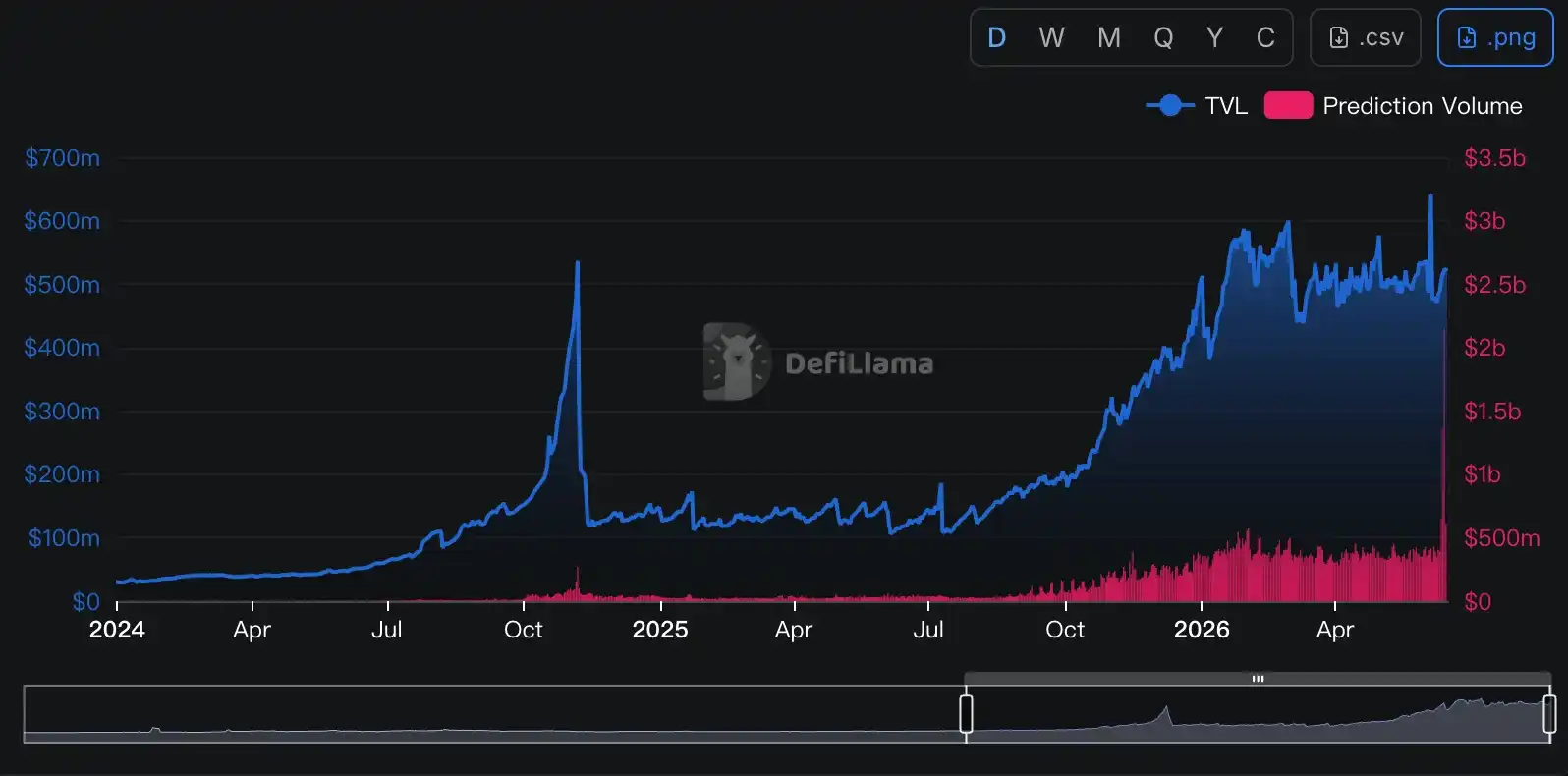
  • Odaily Note: Data sourced from Defillama.

Kalshi's Most Important Traffic Channel — Robinhood

Rewind to March 2025. At that time, Kalshi announced a partnership with the US online brokerage Robinhood. The latter would use Kalshi's services to provide its users with prediction market trading, allowing users to place bets on political, economic, sports, and other events.

From a business model perspective, this was a classic case of "mutual benefit" — Robinhood, responsible for user access and order flow distribution, could directly utilize Kalshi's mature product; Kalshi, responsible for the underlying market, matching, clearing, and regulatory compliance systems, could access Robinhood's massive pool of retail traffic.

The subsequent story proved the "win-win" outcome of this collaboration. Through Robinhood's channel distribution, Kalshi indirectly gained a massive amount of users and transaction volume. Piper Sandler analysts once estimated that "transactions completed through the Robinhood channel accounted for about 25%-35% of Kalshi's total trading volume." These orders ultimately translated into revenue for both parties — Robinhood charges an independent fee for all Kalshi event contracts traded through this channel, $0.01 per contract per side, and then shares the revenue with Kalshi (the specific split was not disclosed).
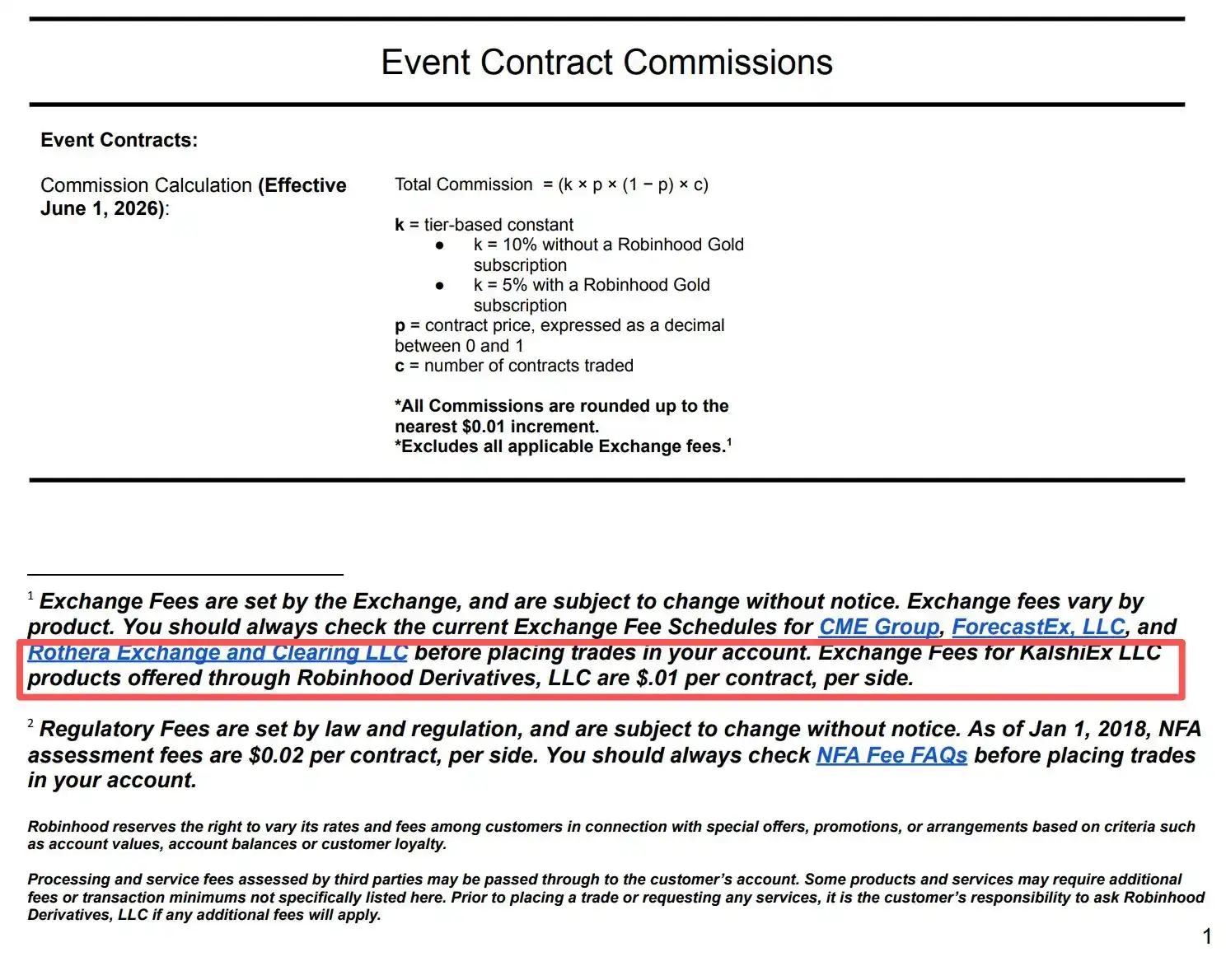
The Q1 financial report released at the end of April this year showed that Robinhood achieved trading of 8.8 billion event contracts in Q1, driving "other transaction revenue" to grow 320% year-over-year, reaching $147 million. Prediction markets have become the most eye-catching new growth engine in Robinhood's product line.

But recently, this relationship has undergone some subtle changes.

Robinhood's Ambition: Reclaiming the Cake Shared with Kalshi

As countless episodes in internet history have proven, when a channel gains sufficient influence, it is no longer content with just being a channel. Robinhood is no exception.

Although the cooperation with Kalshi also brought Robinhood considerable revenue, with prediction markets becoming one of the fastest-growing new businesses on the platform, Robinhood was no longer satisfied with the current revenue-sharing arrangement.

In their partnership model, Kalshi provided the market and infrastructure, while Robinhood provided the users and order flow. However, as the cooperation deepened, Robinhood gradually realized that what was truly scarce might not be the market itself, but the user access point it firmly controlled. After all, for most Robinhood users, they don't care whether their orders are ultimately executed on Kalshi or another platform — users only see a trading entry point within the Robinhood app, not the underlying infrastructure provider.

In other words, Robinhood always controlled one of the most critical resources in prediction markets — distribution power. If the users belong to Robinhood, why should the orders flow to someone else?

In fact, while Robinhood was quickly validating the demand for prediction markets with Kalshi, another Plan B was launched shortly after.

In November 2025, Robinhood announced the establishment of a joint venture with Wall Street quantitative trading giant Susquehanna, planning to acquire the CFTC-regulated derivatives exchange MIAXdx. According to the official statement, the joint venture would operate an independent futures and derivatives exchange and clearing agency in the future, with prediction markets being one of its key focuses. At the time, the outside world mostly viewed this as an infrastructure investment. However, with subsequent information disclosures, people gradually realized that Robinhood's goal was far beyond just finding a new partner for prediction markets.

In January 2026, the deal was officially completed. Robinhood and Susquehanna gained 90% control of MIAXdx, simultaneously acquiring a complete CFTC regulatory framework, including Designated Contract Market (DCM) and Derivatives Clearing Organization (DCO) qualifications. Subsequently, MIAXdx was renamed Rothera Exchange, and its clearing agency was renamed Rothera Clearing.

Thus, Robinhood now possessed the core elements needed to independently operate a prediction market. The only thing lacking was a mature product comparable to Kalshi's, but for Robinhood, with its rich experience in internet product development, this was clearly not a difficult task.

Rothera's Opportunity: The World Cup

In June 2026, after about six months of accelerated development, the Rothera product took shape, and Robinhood finally made the move that was almost destined to happen — gradually shifting orders that originally flowed to Kalshi into its own controlled system.

Robinhood specifically chose an excellent launch battleground for Rothera — the World Cup. For prediction markets, the World Cup is undoubtedly one of the most traffic-generating trading themes. Whether it's match outcomes, qualification results, or the ultimate champion, related markets can attract a large number of new users to trade in a short period. For Rothera's nascent platform, there is no better scenario for a cold start than the World Cup.

According to Robinhood's official disclosure, during this World Cup, which comprises a total of 104 matches, part of the event contracts will be directed to Rothera for matching and clearing, including markets for single World Cup match results, the ultimate World Cup champion, total goals in a single match, etc. Compared to the previous model that completely relied on Kalshi, this marks the first time Robinhood has directed prediction market orders into its own trading system on a large scale.
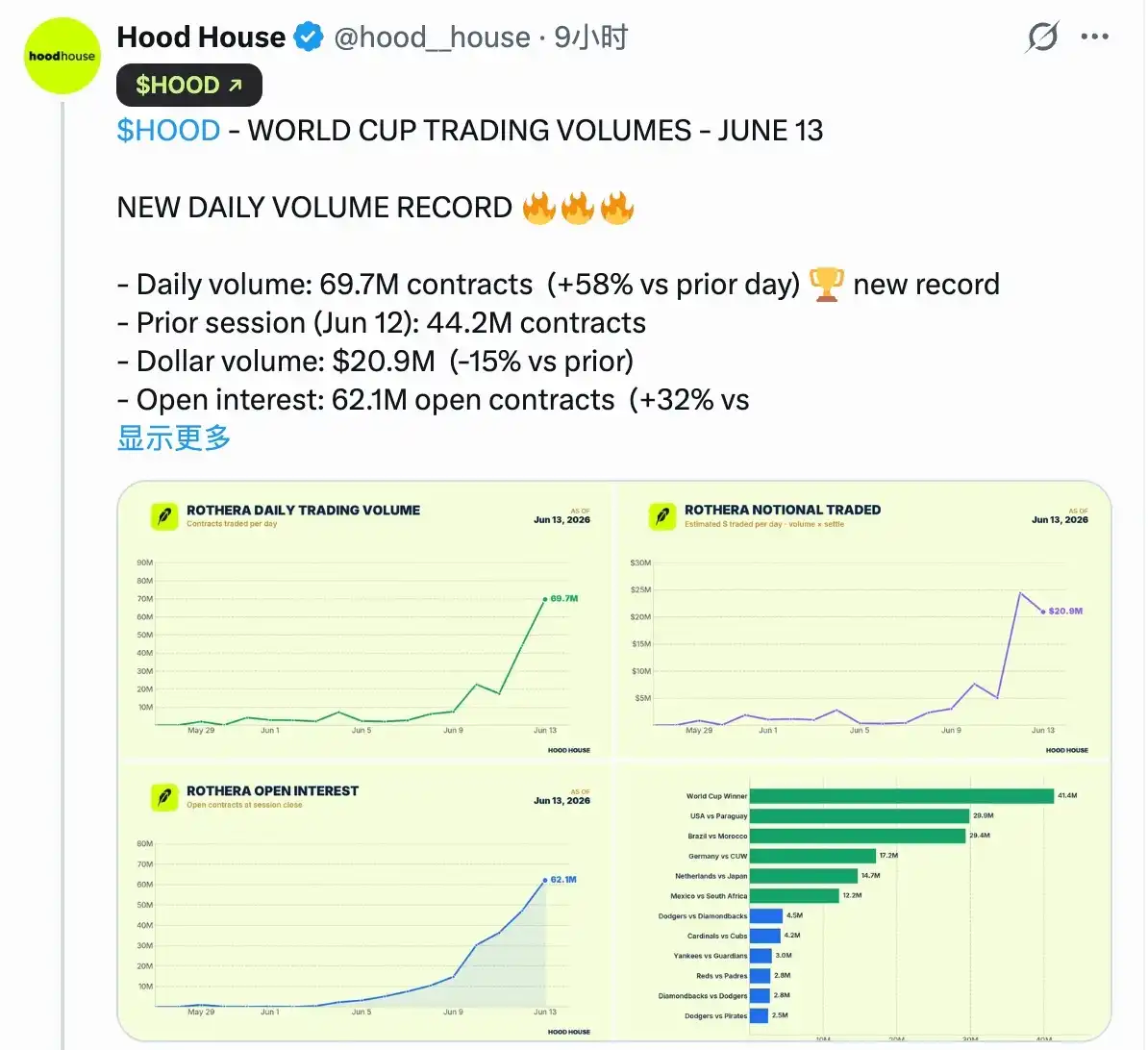
Judging by the results, Rothera clearly seized this opportunity. According to data disclosed by Hood House, a research-focused自媒体 tracking Robinhood's activities, on June 12th, Rothera completed 44.2 million contract trades, corresponding to approximately $24.4 million in dollar trading volume; on June 13th, Rothera completed 69.7 million contract trades, corresponding to approximately $20.9 million in dollar trading volume... Although these figures still lag behind Kalshi's popular markets, which often see hundreds of millions or even billions of dollars in volume, considering that Rothera has literally just launched a few days ago, this performance is sufficiently successful.

For both Robinhood and Kalshi, this means the balance of cooperation between them has begun to tilt. From Robinhood's perspective, the transaction fee revenue that previously had to be shared with Kalshi can now be retained more within its own ecosystem; from Kalshi's perspective, this means that one of its former most important growth engines has begun to show signs of weakening.

And the World Cup is clearly just the beginning of Rothera's encroachment on Kalshi. Looking further into the future, Robinhood will inevitably expand Rothera's coverage to more sports events, as well as economic and political themes. Those orders that originally flowed to Kalshi will then be intercepted one by one by Rothera.

Since Robinhood and Kalshi have never publicly disclosed their revenue-sharing ratio, we cannot know the exact value of this interception. However, considering that Robinhood alone generated $147 million in prediction market-related revenue in Q1, and with the World Cup in Q2 and the midterm elections later expected to bring even larger-scale trading activities, the annual value of this interception could reach billions of dollars.

Who Controls Distribution, Controls Everything

The drama of Robinhood and Kalshi moving from allies to rivals once again illustrates a logic repeatedly verified in the internet market — products are easy to build, traffic is hard to find; whoever controls distribution controls everything.

Over the past few years, the market generally believed that Kalshi's core moat came from regulatory licenses, exchange qualifications, and clearing capabilities. Therefore, whether it was brokerages like Robinhood or various media outlets, communities, and traffic platforms, they were essentially just Kalshi's channels and traffic inlets. However, the emergence of Rothera proves one thing: in today's market where products are highly homogenized, the product itself might not be the most important element. What remains truly scarce is always the users.

Where the users are, the liquidity is; where the liquidity is, the market will be. When Robinhood controls the access point to tens of millions of retail users, it has the full ability to direct these users to any trading venue. For users, they don't care whether their orders are ultimately executed on Kalshi or Rothera. As long as the experience isn't significantly different, it doesn't matter who is behind the matching and clearing.

If the theme of the prediction market industry in the past few years was the market competition between Polymarket and Kalshi, then the theme for the coming years might become a channel war. Robinhood incubating Rothera is, in essence, a reverse integration launched by the channel side towards the market layer. As more and more platforms with traffic inlets begin to recognize the strategic value of prediction markets, similar stories are likely to continue. Whether they are exchanges, brokerages, social platforms, or media platforms, all could become new gateways to prediction markets.

And when inlets begin to control markets, and channels begin to possess pricing power, the ultimate winner in the prediction market industry might no longer be the platform responsible for matching orders, but the one closest to the users, the one that best controls distribution.

It was true in the internet era, and it was true in the mobile internet era. This time, there are no exceptions either.


Trending Cryptos

Related Questions

QWhy is the article titled 'The First Stock of the Prediction Market Concept Has Appeared!'?

AThe title refers to the financial markets potentially viewing 'Robinhood' (HOOD), a publicly traded brokerage platform, as a stock heavily exposed to and benefiting from the growth of the prediction market industry. The article details how Robinhood, initially a distributor for Kalshi, has now built its own prediction market infrastructure (Rothera), positioning itself as a major player and capturing more value from this high-growth segment.

QWhat was the nature of the initial partnership between Robinhood and Kalshi, and why did it break down?

AThe initial partnership (March 2025) was symbiotic: Kalshi provided the regulated prediction market platform (licenses, matching, clearing), while Robinhood provided its massive retail user base and distribution. It broke down because Robinhood realized the scarcity and strategic value of its user access point. As prediction markets became a key growth driver, Robinhood wanted to capture more of the revenue by bringing the trading infrastructure in-house, leading it to develop its own platform, Rothera.

QHow did Robinhood build its own prediction market platform, Rothera?

ARobinhood built Rothera through a strategic acquisition. In November 2025, it announced a joint venture with Susquehanna to acquire MIAXdx, a CFTC-regulated derivatives exchange. The deal closed in January 2026, giving them a Designated Contract Market (DCM) and Derivatives Clearing Organization (DCO) license. MIAXdx was renamed Rothera Exchange/Rothera Clearing, providing Robinhood with the core regulated infrastructure to independently operate a prediction market.

QWhy did Robinhood choose the 2026 FIFA World Cup to launch Rothera?

ARobinhood chose the 2026 FIFA World Cup as the launchpad for Rothera because it is a premier, high-traffic event for prediction markets. Sports events, especially the World Cup, naturally attract a large volume of speculative trading on outcomes like match winners and champions. This provided Rothera with a perfect 'cold start' scenario to attract a surge of new users and generate immediate trading volume, proving the viability of their new platform.

QWhat is the core argument the article makes about the future of the prediction market industry?

AThe article argues that the future competitive landscape of prediction markets will shift from a 'market war' (between platforms like Polymarket and Kalshi) to a 'channel war.' The core thesis is that 'who controls distribution, controls everything.' The ultimate winners may not be the companies that build the trading engines (like Kalshi), but rather the entities (like Robinhood) that own the user interface, the customer relationships, and the primary access points, as they hold the power to direct traffic and capture value.

Related Reads

WeChat AI Card Hands-On Guide: Has the AI Shopping Era Arrived?

**"WeChat AI Card" Practical Test Guide: Has the Era of AI Shopping Arrived?** WeChat has officially launched the "AI Exclusive Card," a feature integrated into its Workbuddy AI assistant. This card is designed to handle payments for AI-initiated purchases. Our hands-on test reveals it's not yet a tool for fully autonomous AI shopping, but rather a controlled payment layer for AI agents. The AI Card functions as an isolated sub-wallet within WeChat Pay. Users must bind the card and transfer funds into it from their main wallet. Crucially, every transaction requires explicit user confirmation via smartphone scan; AI cannot spend autonomously. Currently accessible through the Workbuddy agent, the card targets specific digital consumption scenarios: purchasing paid content (reports, data), calling paid APIs/tools, and subscribing to services. Its design prioritizes security and control by separating funds and mandating approval for each payment. We tested a real-world scenario: ordering bubble tea via Workbuddy using a "Meituan Life Assistant" skill. The process encountered multiple hurdles: high "skill" usage costs (exceeding daily free credits), and most importantly, while a payment was successfully initiated, the AI purchased an incorrect product (a mismatched group-buy coupon instead of the desired drink). This highlights the current limitation: the **AI Card only solves the payment step**. The broader challenge lies in the **AI agent's execution chain**—accurately understanding intent, navigating third-party platforms, selecting the right product, and ensuring proper fulfillment. The payment succeeded, but the purchase failed to meet the user's need. In conclusion, the WeChat AI Exclusive Card is a cautious, early-step experiment in AI commerce. It provides a secure, user-controlled payment method for agent interactions but is not yet capable of reliable, end-to-end complex purchases. For now, it's best used for low-value, low-risk digital services with careful user verification at each step. The vision of AI handling complete shopping tasks remains a work in progress.

marsbit55m ago

WeChat AI Card Hands-On Guide: Has the AI Shopping Era Arrived?

marsbit55m ago

Deconstructing Notion's Growth: From a Note-taking Tool to 100 Million Users—How Notion Built a Triple Growth Flywheel Through Product, Templates, and Community

Notion's growth from a niche note-taking tool to a platform with 100 million users is powered by three interconnected flywheels: Product-Led Growth (PLG), a Template Economy, and Community-Driven Growth. First, Notion's PLG strategy relies on a highly flexible, "plastic" product that users can adapt to countless personal and team workflows. Its freemium model lowers the barrier to entry, while features like page sharing and collaboration drive organic, usage-based viral growth as users naturally invite others. Second, the Template Economy solves the "blank page" problem. Templates, created by both Notion and its community, transform abstract product capabilities into concrete, copyable solutions for specific scenarios (e.g., project management, content calendars). This dramatically lowers activation costs for new users and fuels SEO-driven discovery. Third, a vibrant Community acts as a distributed growth engine. Users and official Ambassadors create tutorials, share use cases, and host local events. This community not only educates users but also fosters a sense of identity around pursuing "better ways of working," strengthening loyalty and enabling global, low-cost expansion. Together, these flywheels create a self-reinforcing ecosystem: a great product attracts users who create templates and community content, which in turn attracts more users and deepens engagement. This system allowed Notion to scale from individuals to teams and enterprises through a bottom-up adoption path. Looking ahead, AI integration promises to accelerate these flywheels further by making templates smarter and the platform a potential AI-native work operating system. Ultimately, Notion's defensible advantage is not just its features, but this deeply entrenched network of user assets, creators, and community trust.

marsbit56m ago

Deconstructing Notion's Growth: From a Note-taking Tool to 100 Million Users—How Notion Built a Triple Growth Flywheel Through Product, Templates, and Community

marsbit56m ago

$10 Billion, Qualcomm to Acquire Chip Legend Jim Keller's Company

Global mobile chip giant Qualcomm is in advanced talks to acquire AI chip startup Tenstorrent in a deal valued between $8-10 billion, according to media reports. This potential acquisition would be one of the largest in the AI chip sector in recent years. Tenstorrent, led by legendary chip architect Jim Keller, has gained prominence for its RISC-V architecture and AI accelerator designs. The move highlights Qualcomm's strategic push to diversify beyond its core smartphone chip business. As the smartphone market matures, Qualcomm is aggressively targeting growth in automotive, data center, and cloud AI. Acquiring Tenstorrent would allow Qualcomm to rapidly enter the high-end AI computing market, bypassing lengthy in-house development cycles. Tenstorrent's cost-effective system architecture, which avoids expensive HBM memory and relies on standard Ethernet for clustering, offers a potential alternative to Nvidia's costly solutions. Furthermore, Tenstorrent's high-performance RISC-V CPU technology and its focus on the automotive and edge computing segments align with Qualcomm's strategic goals, including its "Snapdragon Digital Chassis" platform. Despite the strategic rationale, the high valuation has sparked some investor caution. The successful integration of Tenstorrent's open-source culture and independent team into Qualcomm's organization, along with the commercialization of its technology, remains a key challenge.

marsbit1h ago

$10 Billion, Qualcomm to Acquire Chip Legend Jim Keller's Company

marsbit1h ago

Trading

Spot
Futures

Hot Articles

How to Buy T

Welcome to HTX.com! We've made purchasing Threshold Network Token (T) simple and convenient. Follow our step-by-step guide to embark on your crypto journey.Step 1: Create Your HTX AccountUse your email or phone number to sign up for a free account on HTX. Experience a hassle-free registration journey and unlock all features.Get My AccountStep 2: Go to Buy Crypto and Choose Your Payment MethodCredit/Debit Card: Use your Visa or Mastercard to buy Threshold Network Token (T) instantly.Balance: Use funds from your HTX account balance to trade seamlessly.Third Parties: We've added popular payment methods such as Google Pay and Apple Pay to enhance convenience.P2P: Trade directly with other users on HTX.Over-the-Counter (OTC): We offer tailor-made services and competitive exchange rates for traders.Step 3: Store Your Threshold Network Token (T)After purchasing your Threshold Network Token (T), store it in your HTX account. Alternatively, you can send it elsewhere via blockchain transfer or use it to trade other cryptocurrencies.Step 4: Trade Threshold Network Token (T)Easily trade Threshold Network Token (T) on HTX's spot market. Simply access your account, select your trading pair, execute your trades, and monitor in real-time. We offer a user-friendly experience for both beginners and seasoned traders.

12.0k Total ViewsPublished 2024.03.29Updated 2026.06.02

How to Buy T

Discussions

Welcome to the HTX Community. Here, you can stay informed about the latest platform developments and gain access to professional market insights. Users' opinions on the price of T (T) are presented below.

活动图片