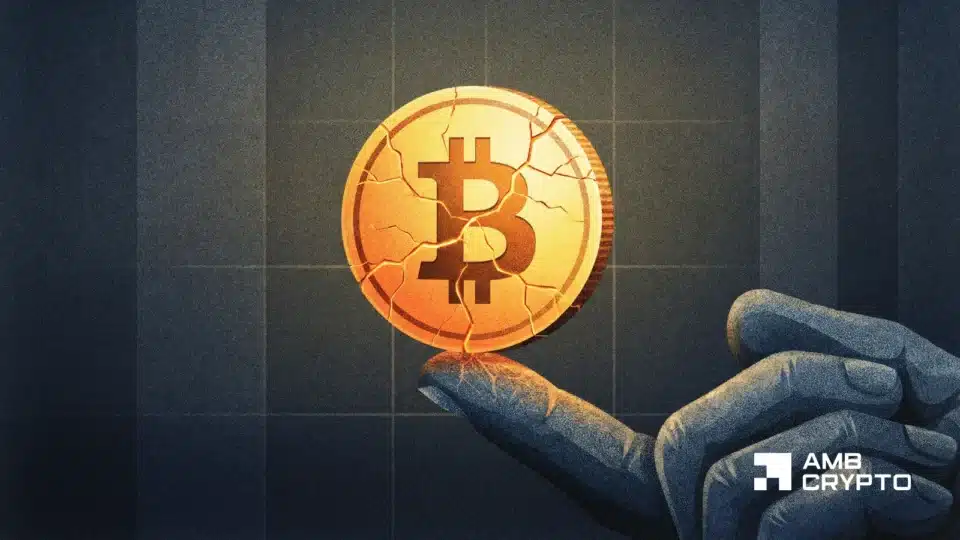
STRC 跌破面值,比特币财库实验进入下半场

marsbitPublished on 2026-06-25Last updated on 2026-06-25

Abstract

The price of STRC, Strategy's dividend-paying preferred stock, has fallen below its $100 face value, triggering a re-evaluation of the "bitcoin treasury" corporate model. This highlights a critical tension: the company's asset base consists of high-volatility, non-cash-flow-generating Bitcoin, while its capital structure requires continuous cash payouts for dividends and interest. The decline of STRC signals that market pressure is shifting from asset price volatility to the pricing of the company's financing tools. Strategy's core model involves a three-step conversion: turning equity into Bitcoin exposure, converting Bitcoin holdings into capital market credit, and packaging non-yielding BTC into cash-paying securities like STRC. While Strategy holds a massive 847,363 BTC, the focus is now on cash flow mismatches. The company faces annual preferred stock dividend obligations of approximately $1.7 billion, far exceeding the cash flow from its legacy software business. Its ability to meet these obligations relies on continued access to capital markets. The market is now scrutinizing which of three potential costs becomes untenable first: rising dividend costs to attract investors, dilution costs from issuing more common stock, or the reputational cost of selling BTC—a move contrary to its "hodl" narrative. For the broader crypto market, a constrained Strategy means the potential loss of a predictable, narrative-driven marginal buyer for Bitcoin. The STRC discount serves a...

近期,Strategy 发行的派息型优先股 STRC 跌破 100 美元面值,引发市场对 “比特币财库公司” 模式的重新讨论。

过去,人们看 Strategy,主要看两个问题——它买了多少比特币,以及比特币还能不能涨。现在,第三个问题变得同样重要:当一家公司用高波动、无现金流的资产,去支撑持续派息的资本结构时,融资成本会不会先于资产价格失控?

这不是一个简单的 “看多比特币” 或 “看空 Strategy” 的问题。STRC 跌破面值,也不等于公司已经陷入违约。

更准确地说,它是一次资产负债表的再定价:市场开始不只给 Strategy 的比特币持仓定价,也开始给它的融资循环、股息来源和资本市场依赖程度定价。

STRC 不是稳定币,100 美元也不是硬锚

Strategy 的比特币财库模式,常被概括为“融资买币”。但更细地看,它其实做了三层转换——

  • 第一层,把上市公司股票变成比特币敞口:投资者买 MSTR,不只是买一家软件公司,而是在买一种带杠杆、带融资能力、带管理层主动操作的比特币代理资产。
  • 第二层,把比特币持仓变成资本市场信用:Strategy 持有大量 BTC 后,可以用公司估值、市场关注度和资产规模去发行普通股、可转债、优先股,再用这些资金继续买 BTC 或支持资本结构。
  • 第三层,把不产生现金流的 BTC,包装成能向投资者支付现金流的证券:STRC 这类优先股的吸引力,来自 “高频派息 + 优先于普通股 + BTC 资产覆盖” 的组合。但 BTC 本身不支付利息,也不产生经营现金流。Strategy 在 STRC 文件中也明确提示,比特币不支付利息或其他回报,若要从比特币持仓获得现金,依赖出售。

这就是结构的核心张力:资产端是高波动、非现金流资产;负债和类负债端却需要持续现金支出。在牛市里,这种张力会被资产上涨掩盖。BTC 上涨,MSTR 溢价扩大,公司更容易发股或发优先股,融资买币又强化市场叙事。这个循环看起来是正向的。

但在调整期,顺序可能反过来:BTC 下跌,MSTR 溢价收缩,STRC 折价扩大,融资成本上升,买币能力下降,市场再重新审视整个模式。

STRC 跌破面值的重要性就在这里,它说明压力已经从 “资产价格波动” 传导到了 “融资工具价格”。

账面亏损不是最危险的,现金流错配才是

Strategy 的 BTC 持仓规模非常大。据最新数据,公司持有 847,363 枚比特币,平均成本约 75,651 美元。若 BTC 在 6.2万至6.4万美元区间波动,粗略测算,持仓账面浮亏大约在 95 亿至 115 亿美元之间。

但账面亏损本身并不必然构成流动性危机。如果公司没有短期偿债压力,也不被迫出售 BTC,浮亏可以长期存在。真正需要关注的是现金支出:优先股股息、债务利息、现金储备补充,以及普通股和优先股市场是否仍然愿意提供资金。

Strategy 披露,截至 5 月 25 日,公司有 67 亿美元可转债本金、155 亿美元优先股名义额,以及 8.71 亿美元美元储备。其中公司优先股股息义务,已达到约每年 17 亿美元。

与此相比,Strategy 传统软件业务规模已经很难覆盖这类资本支出。公司一季度营收为 1.243 亿美元,毛利为 8340 万美元。它仍是一家有软件业务的公司,但资本市场现在关注的,显然已经不是软件业务能产生多少经营利润,而是融资渠道能否继续支持比特币财库结构。

这也是 STRC 的敏感之处——优先股不是债务,理论上没有债券那样的到期兑付压力;但持续派息会形成事实上的现金流承诺。一旦停止或推迟派息,法律后果可能不同于债务违约,但市场信号会非常强。

三种成本,谁先变得不可接受?

Strategy 在 3 月的 STRC 文件中曾表示,公司当时的意图是未来发行 STRC 的价格不低于 99 美元、不高于 101 美元。换句话说,当 STRC 长时间低于 99 美元,STRC 作为融资工具的效率就会明显下降。

这并不意味着公司完全无法融资。它仍可以发行普通股,也可以动用美元储备,或进行其他资本市场操作。但普通股发行也有另一个约束:如果 MSTR 股价相对 BTC 持仓价值的溢价下降,继续发普通股买 BTC 可能会稀释 “每股比特币” 指标。

Strategy 一直强调 BTC Yield、Bitcoin Per Share 这类指标,说明公司也在意融资是否对普通股股东造成影响。因此,当 STRC 低于面值、MSTR 溢价收缩、BTC 低于持仓成本同时出现时,Strategy 的几个融资齿轮会一起变紧。

更中性的观察方式,不是问 “比特币财库模式还能撑多久”,而是这套模式的三种成本,哪一种先变得不可接受——

  • 股息成本:STRC 从 9% 升至 11.5%,已经显示公司需要用更高收益率维持吸引力。如果折价继续扩大,理论上继续加息可以提高吸引力,但同时也会抬高未来现金支出。利率越高,越像高收益信用产品,而不是低波动现金管理工具。
  • 稀释成本:如果公司通过发行 MSTR 普通股补充现金或支付股息,短期可以维持流动性,但普通股股东会关注稀释。如果发股买 BTC 无法提高每股 BTC,市场可能重新评估 MSTR 相对 BTC 的溢价。
  • 资产处置成本:Strategy 长期给市场的叙事是 “长期持有比特币”。如果为了流动性、债务管理或股息压力出售 BTC,哪怕金额不大,也会改变市场对其 “只买不卖” 形象的理解。Barron's 报道称,公司最近已有一次战术性卖币,这是一个值得观察的信号,但还不能简单等同于被迫抛售。

所以,真正的压力测试不是某一天 BTC 跌了多少,而是当融资成本、稀释成本和卖币成本同时上升时,公司会优先保护哪一类投资者:普通股、优先股,还是比特币持仓规模。

对加密市场的影响

Strategy 对加密市场的影响,不只在于它持有多少 BTC,还在于它曾经代表一个稳定的、可预期的边际买盘。

当 STRC 能顺利发行、MSTR 有较高溢价时,Strategy 可以持续从资本市场筹资买 BTC。这种买盘在情绪层面很重要,因为它给市场提供了一个 “有人持续吸收供给” 的叙事。

但如果 STRC 长期低于面值,优先股融资暂停或成本显著上升;如果普通股发行又受到稀释约束,那么 Strategy 的买币节奏就会放缓。对 BTC 市场而言,这未必马上形成大规模卖压,却会减少一个重要买盘。

更大的风险是叙事层面。如果市场开始相信 “比特币财库公司也会受融资窗口约束”,那么类似模式的上市公司估值逻辑可能被重新定价。

过去市场给它们的是 BTC 敞口溢价;未来可能要求扣除融资成本、股息负担、流动性风险和资产折价。这会让 “公司买币” 从牛市叙事,变成资产负债管理问题。

结语

STRC 跌破 100 美元,不意味着 Strategy 模式立刻失败,也不意味着比特币财库公司会集体崩塌。它更像是一个转折点:市场开始意识到,持有大量 BTC 只是这个模式的一半,另一半是如何为这些 BTC 融资,并支付融资成本。

在 BTC 上涨周期里,资产端会替结构说话。在 BTC 调整周期里,负债端会要求解释。

Strategy 的实验仍在继续,它有庞大的 BTC 持仓,有资本市场经验,也仍有多种融资工具。但 STRC 的折价却在不断警醒市场——

当不产生现金流的资产,被包装成持续派息的证券时,真正决定模式寿命的,不只是比特币价格,还包括融资窗口、现金储备、股息成本,以及投资者愿意为这个结构支付多久的信任溢价。

*本文内容仅供参考,不构成任何投资建议。市场有风险,投资需谨慎。

Trending Cryptos

Related Questions

QWhat is the primary reason why STRC falling below par value is considered significant, beyond simply reflecting Bitcoin price volatility?

AIt signifies that market pressure has shifted from asset price volatility to the pricing of the company's financing instruments. The STRC discount reflects market repricing of Strategy's entire capital structure, including its financing cycle, dividend sustainability, and dependence on capital markets, not just its Bitcoin holdings.

QAccording to the article, what is the core structural tension inherent in Strategy's 'Bitcoin Treasury' model?

AThe core tension lies in an asset side composed of high-volatility, non-cash-flow generating assets (Bitcoin), against a liability side that demands continuous cash outflows (to pay preferred stock dividends, debt interest, etc.). This tension is masked during bull markets but becomes exposed during price adjustments.

QThe article distinguishes between 'paper losses' on Bitcoin holdings and a more critical risk. What is that more critical risk?

AThe more critical risk is a cash flow mismatch. Paper losses are not an immediate liquidity threat if the company isn't forced to sell. The real danger is the strain on Strategy's cash reserves from its annual cash obligations, such as the approximately $1.7 billion in preferred stock dividends, which its traditional software business cannot cover.

QWhat are the three main costs or constraints the article identifies that could pressure Strategy's business model?

AThe three main costs are: 1) Dividend cost: The rising yield needed to make instruments like STRC attractive increases future cash burdens. 2) Dilution cost: Issuing common stock (MSTR) to raise cash dilutes existing shareholders and could erode the stock's premium over its Bitcoin holdings. 3) Asset disposal cost: Selling Bitcoin to raise cash contradicts the 'hodl' narrative and could change the market's perception of the company.

QBeyond its role as a large Bitcoin holder, why has Strategy been an important entity for the broader crypto market?

AStrategy represented a stable, predictable marginal buyer of Bitcoin. Its ability to consistently raise capital from markets (via MSTR and STRC) and deploy it into Bitcoin provided a bullish narrative of ongoing demand. If this financing window narrows or becomes too costly, it removes a significant source of buy-side pressure and could shift the market narrative around corporate Bitcoin treasuries.

Related Reads

Jensen Huang: Prompts are Becoming Obsolete, Loops are the New Paradigm

Jensen Huang, alongside AI leaders like Peter Norvig, Boris Cherny, and Andrew Ng, is advocating for a shift from "prompt engineering" to "loop engineering" as the new paradigm for AI development. Instead of manually crafting individual prompts, the focus is now on designing autonomous loops—systems where AI agents execute tasks, self-validate results, and iterate until completion without constant human oversight. A loop is a management framework that enables agents to operate independently. Key implementations are seen in Claude Code (with features like /loop, /goal, and /schedule) and OpenAI Codex, which employ multiple agents working in parallel within isolated environments. A core principle is the separation of roles: one agent (or model) performs the task, while an independent agent (or a smaller, separate model) validates the output to ensure objectivity. The article outlines a practical roadmap for implementing loops, starting with a "four-condition test" to assess suitability, building a minimal viable loop, and emphasizing critical pitfalls to avoid, such as lacking hard stop conditions or allowing loops to handle tasks requiring human judgment. This evolution is framed as the fourth major shift in AI interaction: from Prompt Engineering (crafting instructions) to Context Engineering (providing background information), then to Harness Engineering (building tool-enabled environments), and finally to Loop Engineering (creating self-sustaining systems). This progression reflects a consistent trend of increasing abstraction, moving human involvement from direct instruction to system design and rule-setting. The concept has academic roots in frameworks like ReAct, which formalized the "reason-act-observe" cycle. While loop engineering promises greater automation, experts caution about managing token costs and warn against outsourcing understanding—AI can assist, but deep problem comprehension remains essential.

marsbit1h ago

Jensen Huang: Prompts are Becoming Obsolete, Loops are the New Paradigm

marsbit1h ago

GPT Designs GPT

OpenAI has unveiled its first custom AI chip, Jalapeño, a move signaling a strategic shift beyond being a mere model company. While many see it as a challenge to NVIDIA, its core aim is to control the entire intelligent production pipeline—from models and chips to data centers and energy. The key driver is the evolving competitive landscape: model advantages are shrinking, while the computational gap in areas like cost-per-token, system throughput, and energy efficiency is becoming the true long-term barrier. Jalapeño is primarily an inference chip, targeting the massive and growing "inference tax"—the daily operational cost of generating tokens for services like ChatGPT and APIs. By designing its own hardware optimized for its specific workloads and future product roadmaps (even using AI to aid the chip design process), OpenAI aims to drastically reduce token generation costs and improve system efficiency. This creates a potential flywheel: better models help design better chips, which lower costs for running next-generation models, supporting more users and products, which in turn provides more data to refine future chips. The strategy mirrors Apple’s integrated approach, building a closed loop where hardware, software, and applications are co-optimized. In the long term, OpenAI is not trying to become the next NVIDIA (a supplier of "shovels" to all AI companies) but to own and operate the entire "mine"—selling the end product of intelligence itself. This move marks OpenAI's ambition to evolve from creating the smartest models to controlling the foundational infrastructure of AI production.

marsbit1h ago

GPT Designs GPT

marsbit1h ago

Trading

Spot
Futures

Hot Articles

What is $BITCOIN

DIGITAL GOLD ($BITCOIN): A Comprehensive Analysis Introduction to DIGITAL GOLD ($BITCOIN) DIGITAL GOLD ($BITCOIN) is a blockchain-based project operating on the Solana network, which aims to combine the characteristics of traditional precious metals with the innovation of decentralized technologies. While it shares a name with Bitcoin, often referred to as “digital gold” due to its perception as a store of value, DIGITAL GOLD is a separate token designed to create a unique ecosystem within the Web3 landscape. Its goal is to position itself as a viable alternative digital asset, although specifics regarding its applications and functionalities are still developing. What is DIGITAL GOLD ($BITCOIN)? DIGITAL GOLD ($BITCOIN) is a cryptocurrency token explicitly designed for use on the Solana blockchain. In contrast to Bitcoin, which provides a widely recognized value storage role, this token appears to focus on broader applications and characteristics. Notable aspects include: Blockchain Infrastructure: The token is built on the Solana blockchain, known for its capacity to handle high-speed and low-cost transactions. Supply Dynamics: DIGITAL GOLD has a maximum supply capped at 100 quadrillion tokens (100P $BITCOIN), although details regarding its circulating supply are currently undisclosed. Utility: While precise functionalities are not explicitly outlined, there are indications that the token could be utilized for various applications, potentially involving decentralized applications (dApps) or asset tokenization strategies. Who is the Creator of DIGITAL GOLD ($BITCOIN)? At present, the identity of the creators and development team behind DIGITAL GOLD ($BITCOIN) remains unknown. This situation is typical among many innovative projects within the blockchain space, particularly those aligning with decentralized finance and meme coin phenomena. While such anonymity may foster a community-driven culture, it intensifies concerns about governance and accountability. Who are the Investors of DIGITAL GOLD ($BITCOIN)? The available information indicates that DIGITAL GOLD ($BITCOIN) does not have any known institutional backers or prominent venture capital investments. The project seems to operate on a peer-to-peer model focused on community support and adoption rather than traditional funding routes. Its activity and liquidity are primarily situated on decentralized exchanges (DEXs), such as PumpSwap, rather than established centralized trading platforms, further highlighting its grassroots approach. How DIGITAL GOLD ($BITCOIN) Works The operational mechanics of DIGITAL GOLD ($BITCOIN) can be elaborated on based on its blockchain design and network attributes: Consensus Mechanism: By leveraging Solana’s unique proof-of-history (PoH) combined with a proof-of-stake (PoS) model, the project ensures efficient transaction validation contributing to the network's high performance. Tokenomics: While specific deflationary mechanisms have not been extensively detailed, the vast maximum token supply implies that it may cater to microtransactions or niche use cases that are still to be defined. Interoperability: There exists the potential for integration with Solana’s broader ecosystem, including various decentralized finance (DeFi) platforms. However, the details regarding specific integrations remain unspecified. Timeline of Key Events Here is a timeline that highlights significant milestones concerning DIGITAL GOLD ($BITCOIN): 2023: The initial deployment of the token occurs on the Solana blockchain, marked by its contract address. 2024: DIGITAL GOLD gains visibility as it becomes available for trading on decentralized exchanges like PumpSwap, allowing users to trade it against SOL. 2025: The project witnesses sporadic trading activity and potential interest in community-led engagements, although no noteworthy partnerships or technical advancements have been documented as of yet. Critical Analysis Strengths Scalability: The underlying Solana infrastructure supports high transaction volumes, which could enhance the utility of $BITCOIN in various transaction scenarios. Accessibility: The potential low trading price per token could attract retail investors, facilitating wider participation due to fractional ownership opportunities. Risks Lack of Transparency: The absence of publicly known backers, developers, or an audit process may yield skepticism regarding the project's sustainability and trustworthiness. Market Volatility: The trading activity is heavily reliant on speculative behavior, which can result in significant price volatility and uncertainty for investors. Conclusion DIGITAL GOLD ($BITCOIN) emerges as an intriguing yet ambiguous project within the rapidly evolving Solana ecosystem. While it attempts to leverage the “digital gold” narrative, its departure from Bitcoin's established role as a store of value underscores the need for a clearer differentiation of its intended utility and governance structure. Future acceptance and adoption will likely depend on addressing the current opacity and defining its operational and economic strategies more explicitly. Note: This report encompasses synthesised information available as of October 2023, and developments may have transpired beyond the research period.

451 Total ViewsPublished 2025.05.13Updated 2025.05.13

What is $BITCOIN

Discussions

Welcome to the HTX Community. Here, you can stay informed about the latest platform developments and gain access to professional market insights. Users' opinions on the price of BTC (BTC) are presented below.

活动图片