The signal of joint US-Japan intervention on the yen quickly intensified around August 3.
Japanese Finance Minister Sakaki Katayama confirmed that the Japanese Ministry of Finance has coordinated with the US Treasury to buy yen. US President Trump and Treasury Secretary Scott Bessent also subsequently confirmed US involvement, stating that further joint actions are not ruled out. Following the official announcements, USD/JPY retreated sharply from near a 40-year high of 164 last week, falling to around 155.20 at one point; AP recorded an early August 3 rate of approximately 156.34.

US and Japanese Finance Ministers Meet
The most significant change in this round is not just Japan's renewed selling of dollars and buying of yen, but that the US has moved from verbal support to actual coordination.
For traders who have long bet on yen depreciation, the original logic has not completely failed: US interest rates remain significantly higher than Japan's, and holding dollar assets can still earn interest differentials. However, the risk structure of this trade has changed. In the past, the market mainly judged the scale and duration of Japan's unilateral intervention; now, it must also consider US participation, potential repeated operations by both sides, and the possibility of officials establishing a policy defense line at specific levels.
US-Japan Joint Intervention Materializes, Yen Rebounds Sharply
USD/JPY Retreats Rapidly from 164
The speed of the yen's rebound is itself the most direct evidence of how coordinated intervention affects market expectations.
In late July, USD/JPY approached 164, with the yen hitting its lowest level in about 40 years. A weak yen can boost overseas profits for Japanese exporters when converted to yen, but it also raises the cost of imported energy, food, and raw materials, further increasing living costs for households and operational pressures for companies. As the exchange rate broke through the previously sensitive levels of 150 and 160, the Japanese government's political tolerance for depreciation decreased significantly.
Japan had previously intervened unilaterally to buy yen, but the exchange rate typically rebounded only briefly. The market's familiar script was: the Ministry of Finance steps in, shorts temporarily cover, and then the US-Japan interest rate differential attracts capital back to dollar assets.
This time, the market is facing a different script.
The Japanese Ministry of Finance explicitly used the term 'coordinated intervention,' and Bessent stated that the US Treasury will continue to communicate with Japan and 'will not hesitate' to participate in joint action again. Officials may not need to continuously inject huge sums; as long as traders believe bilateral intervention is possible when USD/JPY nears 164, the tail risk of continuing to short the yen increases significantly.
Signal of $5-10 Billion Exposure, US Moves from Verbal Support to Actual Participation
A Reuters photo taken on July 31 showed Bessent's notepad at a Camp David cabinet meeting stating: 'To Do: Buy Japanese Yen (JPY) $5-10 bil.'
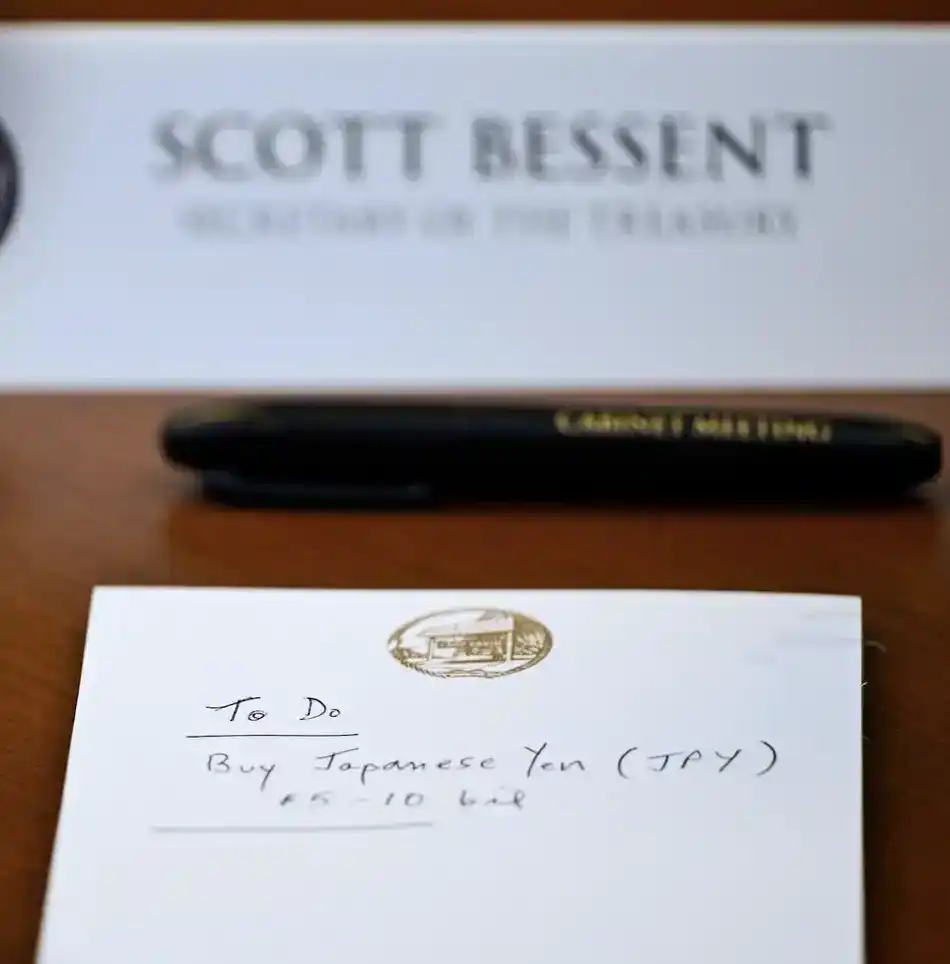
Reuters published a photo of a notepad in front of Bessent at Friday's cabinet meeting. Under the 'To Do' heading, Bessent wrote 'Buy $5-10 bil Japanese Yen (JPY)'.
This notepad does not prove how much yen the US ultimately bought. When the photo surfaced, the US Treasury had not yet confirmed the specific amount. Its key information is that the US Treasury at least seriously considered a yen-buying operation of an actual scale, beyond merely expressing diplomatic support for Japan.
Subsequently, the formal confirmation of joint intervention by the US and Japan further amplified the market significance of this photo. Bessent also publicly stated the US willingness to repeat the action if needed. $5-10 billion might not be enough to change the supply-demand dynamics of the global forex market long-term, but it is sufficient to force highly leveraged yen shorts to recalculate their stop-loss points and position sizes.
The way intervention truly works is not just through official funds directly moving the exchange rate.
When USD/JPY falls rapidly, investors who borrowed yen to buy dollar assets incur exchange rate losses. Some highly leveraged accounts need to post additional margin, and some trend trades and option positions trigger stop-losses. The covering process requires selling dollars and buying back yen, amplifying the yen's short-term gains.
Thus, the rapid retreat from near 164 to the 155-156 range likely includes both official trades and concentrated deleveraging of carry and trend positions.
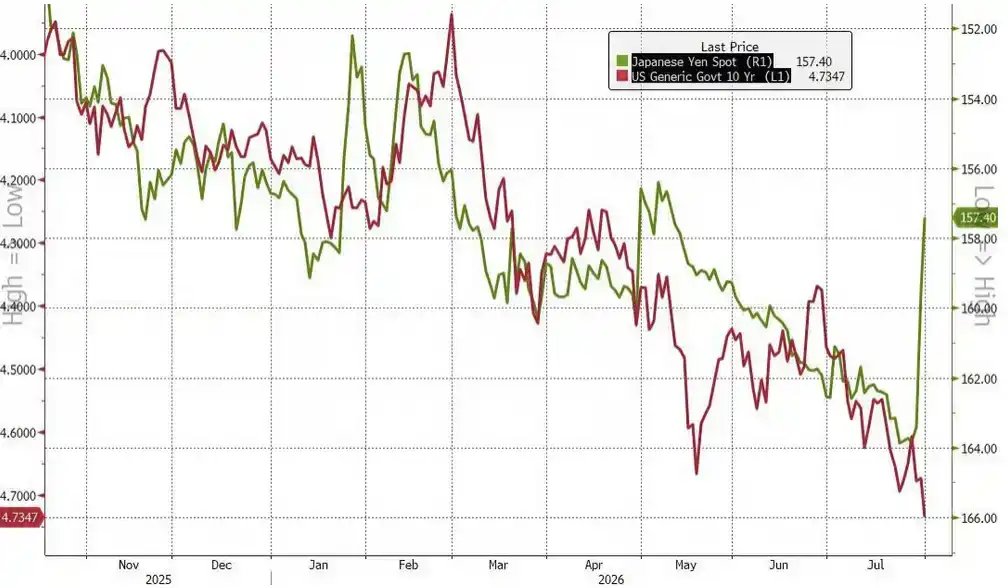
Yen Shorts Begin Retreat, Risk Spills Over to Global Assets
Yen Carry Trade Not Over, But Trade Odds Have Changed
Talk of the 'yen carry trade ending' has emerged in the market, but this judgment is premature.
The Fed kept its federal funds target range at 3.50% to 3.75% on July 29, while the Bank of Japan maintained its short-term policy rate at 1% on July 31. Even without considering hedging costs, US short-term rates remain significantly higher than Japan's, so the fundamental yield from borrowing yen and allocating to dollar assets has not disappeared.
Coordinated intervention changed the risk-reward ratio of this trade.
Previously, investors might have viewed Japan's unilateral intervention as only causing brief volatility, thus willing to re-establish shorts after yen rebounds. Now, they must also price in a higher risk premium for the possibility of US re-entering the market, officials increasing intervention frequency, and the Bank of Japan raising rates earlier.
Yen shorts may therefore reduce leverage, shrink positions, or buy more option protection, but this does not mean capital has entirely abandoned the carry trade. As long as the US-Japan rate differential remains high, the yen may still face new selling pressure on each rebound.
A more accurate assessment is: coordinated intervention has compressed the leverage space for yen shorts but has not yet eliminated the macro fundamentals for shorting the yen.
US Treasuries Face Spillover Risk, But Transmission Mechanism Has Changed
The global impact of yen intervention lies not only in the forex market but also in how Japan funds the dollars needed to buy yen.
US Treasury TIC data shows that as of the end of May 2026, Japan holds approximately $1.143 trillion in US Treasuries, the largest foreign holder. TIC data, affected by factors like custodial account attribution, does not precisely reflect ultimate ownership, but Japan's massive US Treasury holdings remain an important indicator for observing intervention spillover risk.
The traditional operational chain is that the Japanese Ministry of Finance uses foreign exchange reserves to sell dollars and buy yen in the market. If existing dollar cash is insufficient, it could theoretically sell dollar assets, including US Treasuries. Large-scale, sustained selling of US Treasuries could increase market supply, putting upward pressure on US long-term yields.
But this transmission chain is not inevitable.
Bessent revealed that the Fed's FIMA repo facility for foreign central banks and international monetary authorities played a role in this action. This tool allows foreign official institutions to temporarily pledge US Treasuries held at the New York Fed as collateral for dollar loans, thereby obtaining the dollar liquidity needed for intervention without directly selling Treasuries. Bessent also suggested expanding the scale of this facility in the future.
This implies that one aim of US-Japan coordination may be to allow Japan to support the yen while trying to avoid concentrated selling of US Treasuries that could push up US financing costs.
The US Treasury risk therefore needs to be understood on two levels: short-term, the FIMA tool can buffer forced selling pressure; if intervention scales persist and durations lengthen, Japan may still adjust its dollar asset allocation, and only then would the US Treasury market face more noticeable supply impacts.
Intervention Alters Short-Term Odds, Interest Differentials Determine Long-Term Trend
Ministry of Finance Can Buy Time, Central Bank Determines Trend
Coordinated intervention can change short-term positioning but can hardly alone determine the yen's medium-to-long term direction.
The Bank of Japan has gradually exited ultra-easy policy, raising the policy rate to 1%, but the pace of its tightening remains constrained by the domestic economy, government financing costs, and the stability of the Japanese government bond (JGB) market. On July 31, the BOJ maintained rates unchanged with an 8-1 vote, with only one board member advocating an immediate hike to 1.25%.
This creates clear tension for Japanese policy.
The Ministry of Finance wants to prevent excessive yen depreciation to reduce imported inflation and political pressure; the Bank of Japan cannot raise rates rapidly just for the exchange rate, as that could push up JGB yields and increase financing burdens for the government, companies, and households.
Intervention in this process is more like buying time: by creating two-way volatility and forcing shorts to reduce leverage, it creates a window for the BOJ to gradually normalize policy.
But the exchange rate trend ultimately depends on fundamentals. If the BOJ continues to hike and US yields fall, narrowing the US-Japan interest differential, a sustained yen rebound becomes easier; if the differential remains wide long-term, gains post-intervention could still gradually be given back.
Still Far from a 'New Plaza Accord'
Grand narratives like 'New Plaza Accord' and 'end of yen carry trade era' have already appeared in the market, but current facts are insufficient to support these judgments.
The 1985 Plaza Accord involved multiple major economies jointly pushing for an orderly dollar depreciation, encompassing broader policy coordination and global currency realignment. The current action's scope is narrower, directly aiming to curb the yen's excessive, disorderly depreciation and prevent forex and bond market volatility from spilling over into the global financial system.
What can be confirmed at this stage is that the US and Japan have jointly bought yen, Bessent's notepad shows the US considered an operation of $5-10 billion, and both sides explicitly reserve the possibility of intervening again. USD/JPY subsequently retreated rapidly from near 164 to the 155-156 range.
This is enough to change short-term trading but not enough to prove the yen has entered a long-term appreciation cycle.
Three things truly need watching next: whether the US participates in actual trades again, whether the BOJ accelerates its rate hike pace, and whether the FIMA tool allows Japan to continuously obtain dollar liquidity without significantly impacting the US Treasury market.
Until answers to these questions emerge, yen shorts will not disappear completely. But they can no longer easily bet, as in the past, that Japan's intervention is just a brief gust of wind.