Ethereum Foundation President Breaks Silence On New Mandate And Internal Tensions

bitcoinistPublished on 2026-06-02Last updated on 2026-06-02

Abstract

Ethereum Foundation (EF) President Aya Miyaguchi has outlined the organization's new, more focused mandate, framing it as a necessary reset after internal debates became strained and the EF faced competing expectations. She explained the shift is not a retreat but reflects Ethereum's maturity beyond its original institution. The EF, holding less than 0.2% of all ETH, will now concentrate on preserving Ethereum's core properties like user self-sovereignty and coordination, acting as one node among many rather than a central command. Miyaguchi's comments follow co-founder Vitalik Buterin's own post on the EF's direction. She acknowledged a wave of high-profile departures in 2026, stating that a more focused EF naturally leads to a smaller, more concentrated team, with new leaders stepping in. The restructuring aims to ensure the EF accelerates what makes Ethereum uniquely valuable, while coordinating with allies who share that mission.

Ethereum Foundation President Aya Miyaguchi has laid out her view of the organization’s new mandate, framing the shift as a necessary reset after internal debates became increasingly strained and the Foundation faced pressure to be too many things at once.

Her comments, posted on X after Vitalik Buterin shared his own view of the Foundation’s direction, arrive during a sensitive period for Ethereum’s core nonprofit. The EF is moving toward a smaller, more focused structure while the broader ecosystem debates its governance role, technical priorities and a wave of high-profile departures.

Ethereum Foundation Enters New Power Era

Miyaguchi said the mandate came from the board, but that she proposed it late last year. The trigger, in her telling, was not a single dispute but a structural problem: EF had become a focal point for competing expectations.

“First, debates that were meant to be technical had started to become political and personal, and at times shaped by quieter incentives,” she wrote. “Second, as EF grew, more and more versions of ‘what EF should be’ began pulling at the core of the organization from every direction at once. I became convinced that trying to satisfy all of them would leave us achieving nothing at all.”

That line goes to the center of the Foundation’s dilemma. Ethereum has long relied on EF for research funding, coordination and stewardship, but its culture has also resisted the idea that any single entity should become Ethereum’s command center. Miyaguchi leaned heavily into that tension, arguing that EF’s reduced centrality is not a retreat from responsibility but proof that Ethereum has matured beyond its first institution.

“We have said it many times: EF is one of many nodes in Ethereum,” she wrote. “I know that is hard to hear for some, because EF was the first group, and in the early years it was essential for making things happen. But it was never meant to stay that way.”

Miyaguchi connected that philosophy to her own history in crypto, noting that she has been in the sector since 2012 and joined Kraken in 2013 shortly before the collapse of Mt. Gox, which she said she helped clean up. That experience, she argued, shaped her understanding of both growth and centralization risk. When she became executive director in 2018, her goal was to help Ethereum grow beyond EF.

The Foundation, she said, made deliberate choices to distribute power rather than retain control. Miyaguchi pointed to EF’s role in incubating and releasing projects such as Uniswap and ENS, supporting ETHGlobal and hackathons, and “funding the funders” through groups such as Gitcoin and Moloch. The guiding question, she said, was always: “how does this stand on its own, without us?”

That strategy, according to Miyaguchi, has left EF with less than 0.2% of all ETH and a role that is now narrower by design. The mandate, she said, is to preserve and accelerate the properties and goals that make Ethereum “uniquely valuable, competitive, and worth building on,” centered on what she called CROPS and “inalienable user self-sovereignty and self-sovereign coordination.”

“We cannot do it alone, and we do not intend to,” she wrote. “But defining this as the north star for the mission, and coordinating with the allies who share it, is the responsibility we are keeping.”

Miyaguchi also pushed back against the idea that a sharper EF means less concern for adoption. She said the opposite is true, arguing that everyday users and institutions both depend on Ethereum’s underlying value proposition. Adoption, including institutional adoption, remains part of EF’s work, she said, but only in ways that fit the mission.

The comments come as EF has seen a notable exodus of senior and high-profile contributors in 2026, including researchers and ecosystem figures such as Carl Beekhuizen, Julian Ma, Barnabé Monnot, Tim Beiko, Trent Van Epps, Josh Stark and former co-executive director Tomasz Stańczak. That turnover has intensified scrutiny over whether the Foundation’s restructuring is a sign of healthy decentralization, internal strain, or both.

Miyaguchi acknowledged the personnel implications directly. “As EF becomes more focused and more opinionated, the team naturally becomes smaller and more concentrated. That is part of the choice,” she wrote, adding that new leaders are already stepping into the mission and that management will provide more details on the new structure and strategy in the coming weeks.

Buterin’s May 24 post set the stage for Miyaguchi’s remarks. He described the EF as still being in transition, emphasized that he does not hold special power over the board, and said another leader is executing much of the current transition. He also framed the Foundation’s future as leaner and more focused, with less emphasis on being the center of Ethereum and more emphasis on preserving the network’s long-term properties.

At press time, ETH traded at $1,986.
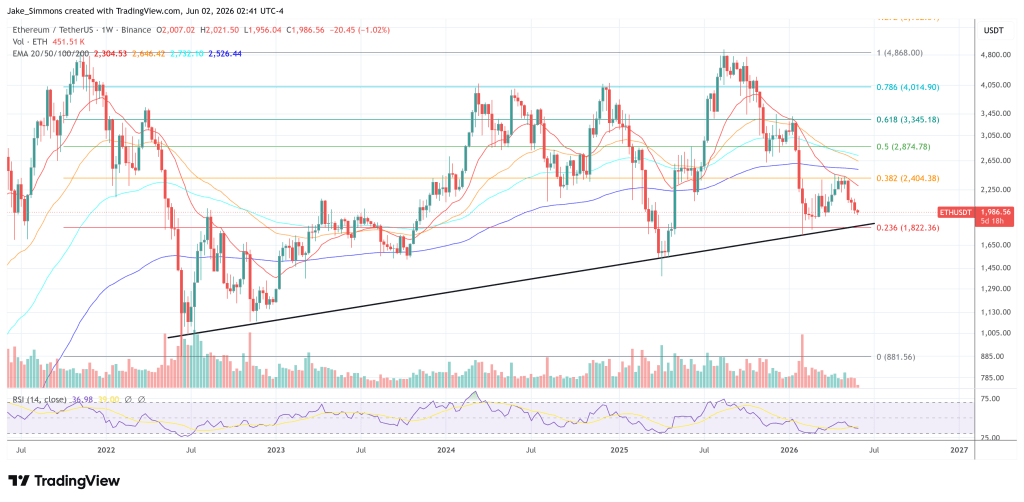
ETH uptrend remains intact, 1-week chart | Source: ETHUSDT on TradingView.com

Trending Cryptos

Related Questions

QWhat is the new mandate of the Ethereum Foundation, according to Aya Miyaguchi, and why was it necessary?

AThe new mandate is for the Ethereum Foundation (EF) to become a smaller, more focused organization. Its role is to preserve and accelerate the properties and goals that make Ethereum 'uniquely valuable, competitive, and worth building on,' centered on concepts like CROPS and 'inalienable user self-sovereignty and self-sovereign coordination.' This shift was necessary because internal debates had become overly political and personal, and the EF was facing conflicting expectations, trying to be too many things at once, which risked achieving nothing.

QHow does Miyaguchi respond to the idea that a more focused EF means less concern for adoption?

AMiyaguchi pushes back against this idea, arguing the opposite is true. She states that both everyday users and institutions depend on Ethereum's underlying value proposition. Adoption, including institutional adoption, remains part of the EF's work, but only in ways that align with its newly defined, more focused mission.

QWhat is Miyaguchi's explanation for the wave of high-profile departures from the Ethereum Foundation?

AMiyaguchi acknowledges the departures are a direct consequence of the Foundation's strategic shift. She states, 'As EF becomes more focused and more opinionated, the team naturally becomes smaller and more concentrated. That is part of the choice.' She adds that new leaders are stepping into the mission and more details on the new structure will be provided soon.

QHow does Miyaguchi describe the historical and intended role of the Ethereum Foundation within the ecosystem?

AMiyaguchi describes the EF as 'one of many nodes in Ethereum.' While it was the first group and essential for making things happen in the early years, it was never meant to stay as the central command center. The goal was always to help Ethereum grow beyond the EF by distributing power, such as by incubating projects like Uniswap and ENS, and 'funding the funders' to ensure they could stand on their own.

QWhat was the trigger for proposing the new mandate, according to Miyaguchi's account?

AAccording to Miyaguchi, the trigger was not a single dispute but a structural problem. She identified two main issues: first, technical debates had become political and personal; second, as the EF grew, it was being pulled in too many directions by competing visions of 'what EF should be,' which threatened its effectiveness.

Related Reads

Football Draw Harvests Whales: Extreme Profit-Loss Divergence on Polymarket's World Cup

A bettor known as "fishalive" made a stunning profit of nearly $9 million on the Polymarket prediction platform by correctly wagering against favorites during the 2026 FIFA World Cup group stage. The account, registered just before the tournament, risked roughly $400,000 on two contracts for a Spain vs. Cape Verde match: one that Spain would *not* win, and another on a Cape Verde +2.5 goal handicap. The resulting 0-0 draw triggered both payouts. This single event, with a total market volume of $64 million, highlighted extreme profit-and-loss divergence. Other traders, like "betoor619" and "leeeeroyjenkins," lost millions by betting heavily on favorites Spain and Belgium to win outright—contracts that become worthless in a draw. The article explains that while markets heavily favored strong teams, the "team to win" contracts are binary and do not account for the common outcome of a draw. This creates high-risk, low-reward scenarios for favorite backers, while asymmetric profits flow to those betting on underdogs or against outright wins. The transparency of Polymarket's on-chain ledger publicly documents these massive wins and losses, driving mainstream media coverage. As the tournament progresses, the author suggests traders may shift towards hedging strategies that account for draws. The piece also notes growing regulatory scrutiny in the US and Europe, questioning whether such large-scale, anonymous sports prediction markets should be regulated as gambling or financial derivatives.

Foresight News29m ago

Football Draw Harvests Whales: Extreme Profit-Loss Divergence on Polymarket's World Cup

Foresight News29m ago

ChatGPT Loses Half Its Market: From Monopoly to Shared Market in Three and a Half Years

In a landmark shift three and a half years after its debut, ChatGPT's global market share in the AI assistant market has fallen below 50% for the first time, dropping to 46.4% as of May 2026. This signals the end of its initial dominance, with the market now diversifying among competitors like Gemini (27.7%) and Claude (10.3%). The report from Sensor Tower indicates the AI assistant landscape has matured from a phase of awe and experimentation into one of product comparison, ecosystem integration, and monetization. Users are increasingly pragmatic, readily switching between assistants based on specific use cases, brand trust, and value propositions. The industry is moving past the "free lunch" era, with users demonstrating a willingness to pay for premium features, driving significant in-app expenditure. Major players are adopting varied monetization strategies: Claude boasts a high subscription conversion rate, while ChatGPT is increasingly testing ads and shopping integrations to complement its subscription revenue. However, this growth comes with immense costs, as exemplified by OpenAI's soaring cash burn for model training and infrastructure. While ChatGPT remains the largest single player, its declining share symbolizes a broader normalization of AI. The technology is no longer a novelty but an integral, scrutinized part of daily digital life, judged on practical utility, price, and seamless integration. The battle has shifted from proving AI's potential to competing in a crowded field where no single product holds a permanent monopoly.

marsbit40m ago

ChatGPT Loses Half Its Market: From Monopoly to Shared Market in Three and a Half Years

marsbit40m ago

Trading

Spot
Futures

Hot Articles

Discussions

Welcome to the HTX Community. Here, you can stay informed about the latest platform developments and gain access to professional market insights. Users' opinions on the price of ETH (ETH) are presented below.

活动图片