The Senate's schedule does not include a vote on the "Digital Asset Market Clarity Act" — a bill passed by the House of Representatives aimed at dividing cryptocurrency oversight between the Securities and Exchange Commission (SEC) and the Commodity Futures Trading Commission (CFTC). The upper chamber has until Friday to pass the CLARITY Act before lawmakers leave for their August recess, after which the Senate will not reconvene until September 14.
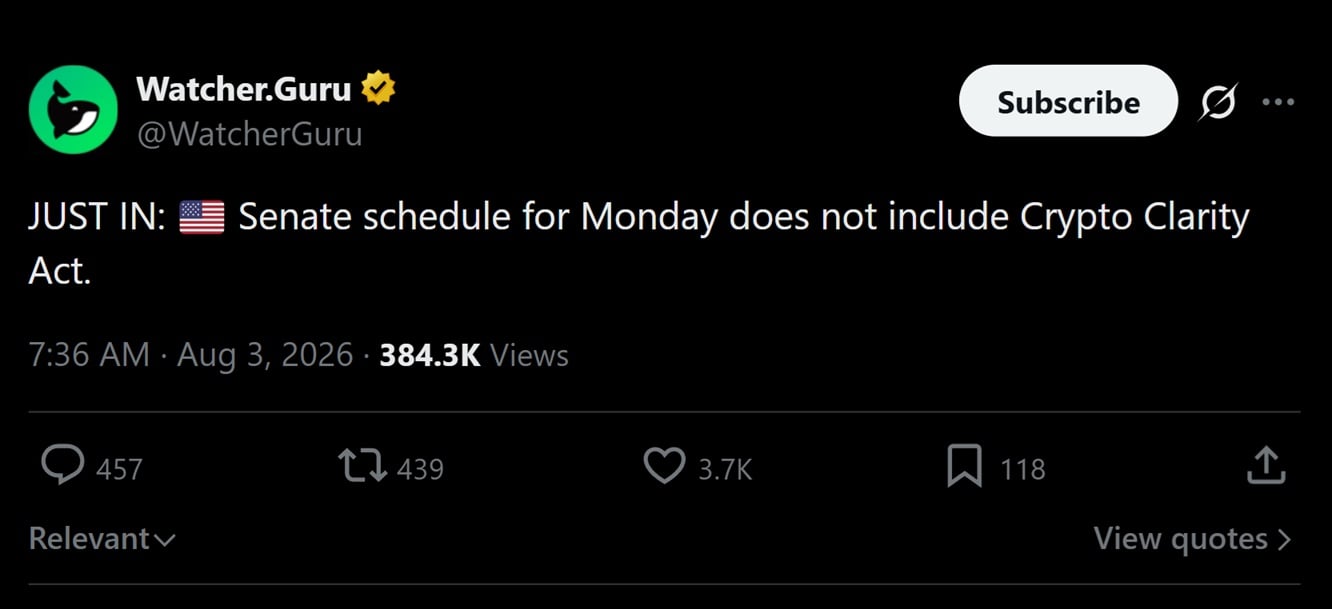
Senate Majority Leader John Thune stated he intends to bring the bill up for discussion before the recess begins, which would force senators to officially declare their positions, even if the bill cannot overcome the 60-vote threshold needed to break a filibuster. However, the tight pre-recess schedule and unresolved disputes among senators regarding enforcement authority, decentralized finance, anti-money laundering rules, and stablecoin provisions prevent setting a precise date.
Esper Calls the Bill a National Security Imperative
The stakes rose this week when former Secretary of Defense Mark Esper, who joined Coinbase's Global Advisory Council in 2023, called the CLARITY Act a national security imperative and warned that this week may be the last real chance for its passage.
Supporters of the bill, who constitute the majority, argue that it strengthens national security by bringing digital assets into a clear regulatory framework, while an analysis by minority staff shows that the CLARITY Act does not address vulnerabilities exploited by criminals and foreign adversaries.
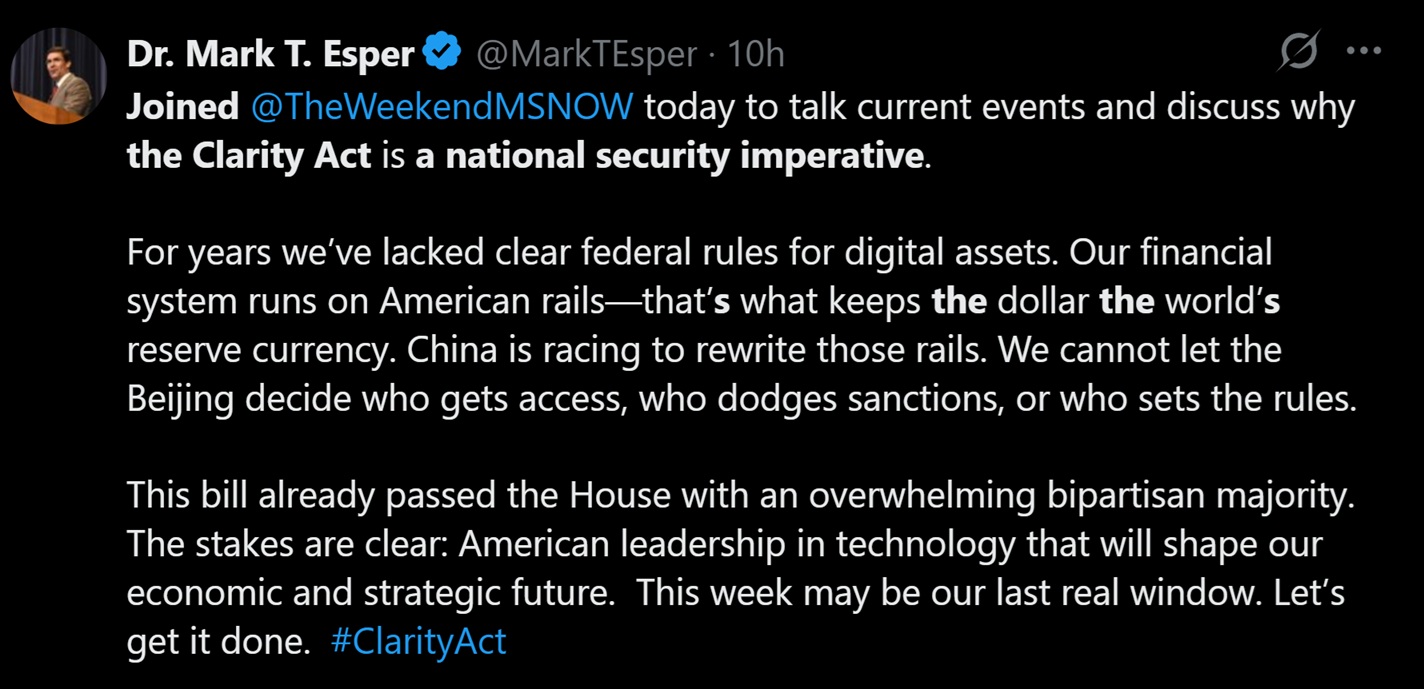
The national security argument is not new to cryptocurrency debates in Washington, but Esper's involvement adds a recognizable, bipartisan-tinted voice to this increasingly partisan fight. Senator Mark Warner separately made closing what he sees as national security gaps related to decentralized finance a condition for his support.
Industry Pressure Mounts Ahead of Congressional Recess
Lobbying has intensified as time runs out: as recently reported by Bitcoin.com News, Grayscale urged Senate leaders to hold a vote on the CLARITY Act before the August recess, warning that further delay threatens U.S. competitiveness in digital assets. Additionally, according to Bitcoin.com News, the organization Stand With Crypto reported that bill supporters have contacted lawmakers a million times urging passage before the August 7th recess.
The bill's odds fluctuate under the pressure of the approaching deadline: Galaxy Research lowered its probability estimate for the CLARITY Act passing in 2026 from 50% to 30%. Furthermore, Treasury Secretary Scott Bessent strongly rebuked the bill's critics, demanding the Senate take immediate action, while an analysis by minority staff on the Senate Banking Committee reiterated Democratic objections that the bill leaves President Trump avenues to continue profiting from cryptocurrency ventures after disclosed information showed his crypto-related revenues amounted to about $1.4 billion in 2025.
Enforcement Concerns Add Another Layer of Complexity
Arguments related to state-level enforcement have been added to the national security case, as New York Attorney General Letitia James called on Congress to strengthen cryptocurrency regulation after the FBI reported over $11 billion in crypto-related losses (arguing that the pending CLARITY Act would actually weaken, not strengthen, state-level enforcement against digital asset fraud).
This criticism emerged alongside a separate report on a new threat to the bill from the Senate concerning the President's crypto income, further illustrating how the bill's remaining obstacles now span three areas: national security, state-level enforcement, and ethics.
What Happens if the Senate Doesn't Act by Friday
If the Senate does not act by Friday, the CLARITY Act will not be reconsidered until senators reconvene on September 14, pushing the debate onto the compressed midterm-year schedule, where cryptocurrency legislation risks being crowded out by other priorities. Bitcoin.com News reported that the bill now faces significant risk of getting lost entirely in the pre-election political scramble — a scenario that would force crypto companies to continue operating under the current patchwork of SEC and CFTC guidance for several more months.
Last week, Strategy and its Executive Chairman Michael Saylor expressed support for the bill, joining a growing list of industry figures including Coinbase and Grayscale publicly pressing for its passage. Whether this pressure will lead to consideration before Friday remains an open question hanging over cryptocurrency markets this week.