Kraken's Late Shift in Position Allowed Solana to Surpass the Two-Thirds Vote Threshold for Inflation Reduction

cryptonews.ruPublished on 2026-08-29Last updated on 2026-08-29

Abstract

Validators of the Solana network narrowly approved proposal SGP-0002 to double the annual disinflation rate from 15% to 30%, achieving a 67% 'for' vote. This was just above the required 66.67% supermajority threshold, secured after Kraken reversed its last-minute opposition. The change means Solana will reach its final long-term inflation target of 1.5% in approximately 2.8 years instead of 5.7 years, resulting in 18.9 million fewer SOL being issued over the next six years. While this benefits SOL holders through reduced dilution, it will lower staking rewards for validators and delegators. Major staking firms were divided, with Figment (controlling 17.1 million SOL votes) opposing the proposal, while Helius and Jupiter supported it. Opponents like Everstake and P2P Validator argued it would reduce their revenue streams from new SOL issuance. Proponents countered that potential price appreciation from slower supply growth would outweigh lost staking yields. The vote was part of Solana's first mandatory governance process. While the disinflation proposal passed, a related fee change proposal (SGP-0003) was rejected, leaving the daily SOL burn rate at around 650 SOL instead of a potential 7,500-9,000 SOL. SOL's price was around $104 at the time, down approximately 5.2% for the day. Rejected proposals can be resubmitted, but supporters must address the stated objections from key validators.

Solana network validators narrowly approved a proposal to double the annual rate of disinflation on the network.

After Kraken changed its position from 'for' to 'against' in the final hours, it managed to surpass the two-thirds vote threshold, edging out the closest competitor by just 0.33 percentage points.

Supply Issuance Will Reach Its Minimum of 1.5% in 2.8 Years

Bill SGP-0002 "Double Disinflation" was passed with 67% votes in favor, against 25.16% opposed, and 7.84% abstaining, with a turnout of 60.7% of eligible voters. Support was just above the required 66.67% threshold for the bill to pass.
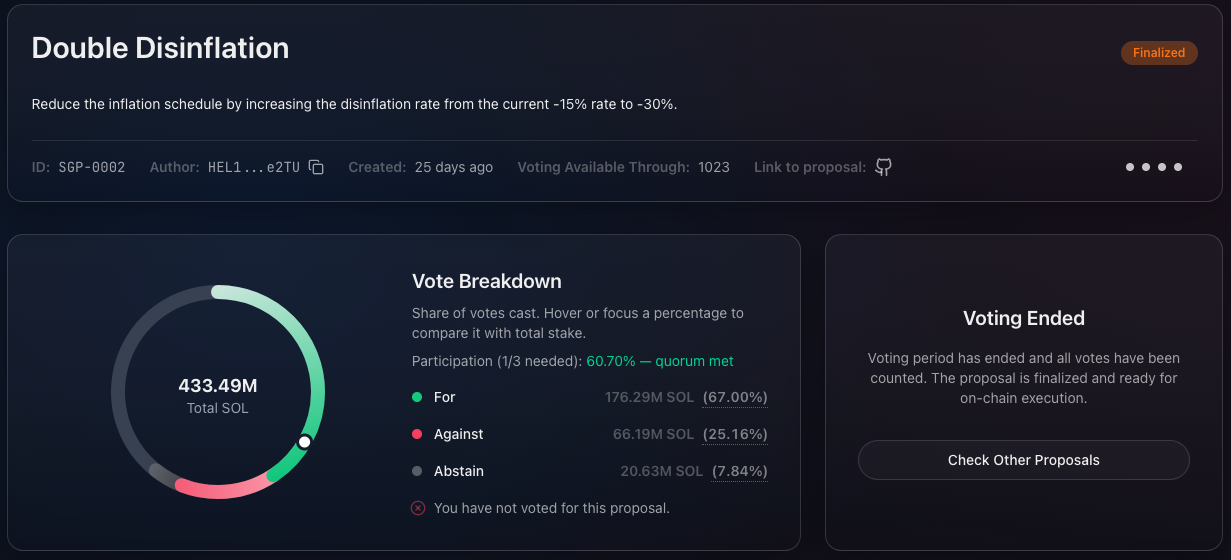
Final data for SGP-0002 on the Solana Validator Dashboard, recorded on August 29, 2026. Source Solana Governance.

Both supply proposals were rejected by Kraken at 12:33 UTC on August 28. This pushed SGP-0002 below the supermajority threshold less than three hours before the vote tally closure at 15:00 UTC for epoch 1024.

Earlier that morning, support stood at 68.77%, with about 47.72% of eligible voters having participated. Kraken's vote against dropped support to roughly 65%.

Kraken then switched its position again. By the close, the proposal received support from over 90% of the US exchange's participants, who hold approximately 8.9 million $SOL voting shares.

The plan, related to SIMD-0550, involves doubling Solana's annual disinflation rate from 15% to 30%, while keeping the network's long-term target inflation rate at 1.5%.

Under the old scenario, Solana would have reached its final level of 1.5% in about 5.7 years, but now it will happen in about 2.8 years. This means that over the next six years, 18.9 million fewer $SOL will enter circulation from bond issuance.

The upside is less dilution for $SOL holders, but the downside is lower staking rewards for validators and delegators.

Figment Staked 17.1 Million $SOL Solely Against SGP-0002

Figment, which had 17.1 million $SOL in the final governance data, voted against the proposal, while Helius and Jupiter voted in favor. Other notable custody and staking firms opposed at least SGP-0002, including Everstake and P2P Validator.

Since depository operations are paid from the issuance of new $SOL, faster disinflation means a quicker decline in annual percentage yield (APY) and less cash flow.

"This logic is nonsense," said Mert Mumtaz, CEO of Helius and co-author of the proposals, in a post on X. He said any price increase due to slower supply growth would outweigh the foregone profits.

Solana , listed on Nasdaq under the ticker HSDT, stated support for the Solana Constitution on August 21 but opposed both supply increase proposals. In the firm's view, revising the inflation schedule undermines the multi-year models used by institutional investors.

SGP-0002 was part of Solana's first mandatory governance process. The Solana Constitution, SGP-0001, was passed with support from 85.97% of voters.

SGP-0003 did not garner support at 53.90%. The fee change under SIMD-0553 would have resulted in transactions paying for reserved compute power, with a portion of those funds being burned.

Rejection of the proposal means the $SOL burn rate will remain at around 650 $SOL per day. This contrasts with the 7,500–9,000 $SOL – roughly $800,000 daily at current prices – that could have been burned under the fee change.

According to CoinGecko, the price of $SOL was around $104, down about 5.2% for the day.

Both rejected supply proposals can be resubmitted without any waiting period. However, proponents will have to convince stakeholders who have already publicly voiced their objections.

end-content

Trending Cryptos

Related Questions

QWhat was the outcome of the SGP-0002 'Double Disinflation' proposal vote on the Solana network?

AThe proposal was narrowly approved with 67% votes in favor, just surpassing the required supermajority threshold of 66.67%.

QWhat was Kraken's pivotal role in the Solana governance vote SGP-0002?

AKraken initially voted against the proposal, pushing support below the required threshold, but later changed its position to 'yes' in the final hours, allowing the proposal to pass.

QWhat is the primary effect of the approved SGP-0002 proposal on Solana's monetary policy?

AIt doubles the annual disinflation rate from 15% to 30%, which will allow the network to reach its long-term target inflation rate of 1.5% in approximately 2.8 years instead of the previous 5.7 years.

QWhich major staking service was the primary opponent of the SGP-0002 proposal, and why?

AFigment, with 17.1 million $SOL voting shares, was the primary opponent. Staking services like Figment generally opposed the faster disinflation because it would lead to lower staking rewards (APY) and reduced cash inflow for validators and delegators.

QWhat was the fate of the related fee change proposal SGP-0003 (SIMD-0553), and what would it have done?

AThe SGP-0003 proposal was rejected with 53.90% support (below the required threshold). It would have changed transaction fees so that payments for reserved compute capacity would be partially burned, potentially increasing daily SOL burn from ~650 to 7,500-9,000 SOL.

Related Reads

Ripple (XRP) Company Announces Plans for Major Future Update

Ripple (XRP) has announced a four-phase plan to prepare the XRP Ledger (XRPL) for future security threats posed by quantum computers. The company's senior director of engineering stated the goal is to build necessary infrastructure before quantum computers become a direct threat, aiming to minimize impact on existing systems, user assets, and network operations. The plan begins with identifying potential quantum vulnerabilities within XRPL, followed by testing quantum-resistant cryptographic methods. The next phase involves parallel testing of existing security mechanisms and new quantum-resistant solutions to ensure reliability and prevent disruption for users and applications. The final phase would involve transitioning the XRPL to more comprehensive, quantum-resistant security standards if the technology matures. Ripple is also developing contingency plans for a faster-than-expected advancement of quantum computing, which could accelerate the transition timeline. A current XRPL feature allowing users to change the keys controlling their accounts without altering the accounts themselves is seen as a potential advantage in any future migration. However, Ripple cannot unilaterally change transaction validation rules or network-wide cryptographic standards; such updates require coordination and approval from independent validators via XRPL's governance process. While quantum computers are not yet capable of breaking the cryptography used by major blockchains like Bitcoin or XRPL, developers across the industry are already evaluating transition scenarios to quantum-resistant algorithms due to the long-term risks they pose to public-key cryptography.

cryptonews.ru1h ago

Ripple (XRP) Company Announces Plans for Major Future Update

cryptonews.ru1h ago

Trading

Spot

Hot Articles

Discussions

Welcome to the HTX Community. Here, you can stay informed about the latest platform developments and gain access to professional market insights. Users' opinions on the price of SOL (SOL) are presented below.

活动图片