Recently, a research article from Matrixdock, the RWA tokenisation platform under BIT (formerly Matrixport), was published again in《Crucible》, the industry publication of the Singapore Bullion Market Association (SBMA). Matrixdock's Head, Eva Meng, published an article titled "Why Tokenisation Matters for the Bullion Industry and How Carrying Costs Fit In", discussing how tokenisation enhances the usability and capital efficiency of precious metal assets from perspectives such as market efficiency, carrying costs, and the evolution of precious metals market infrastructure.
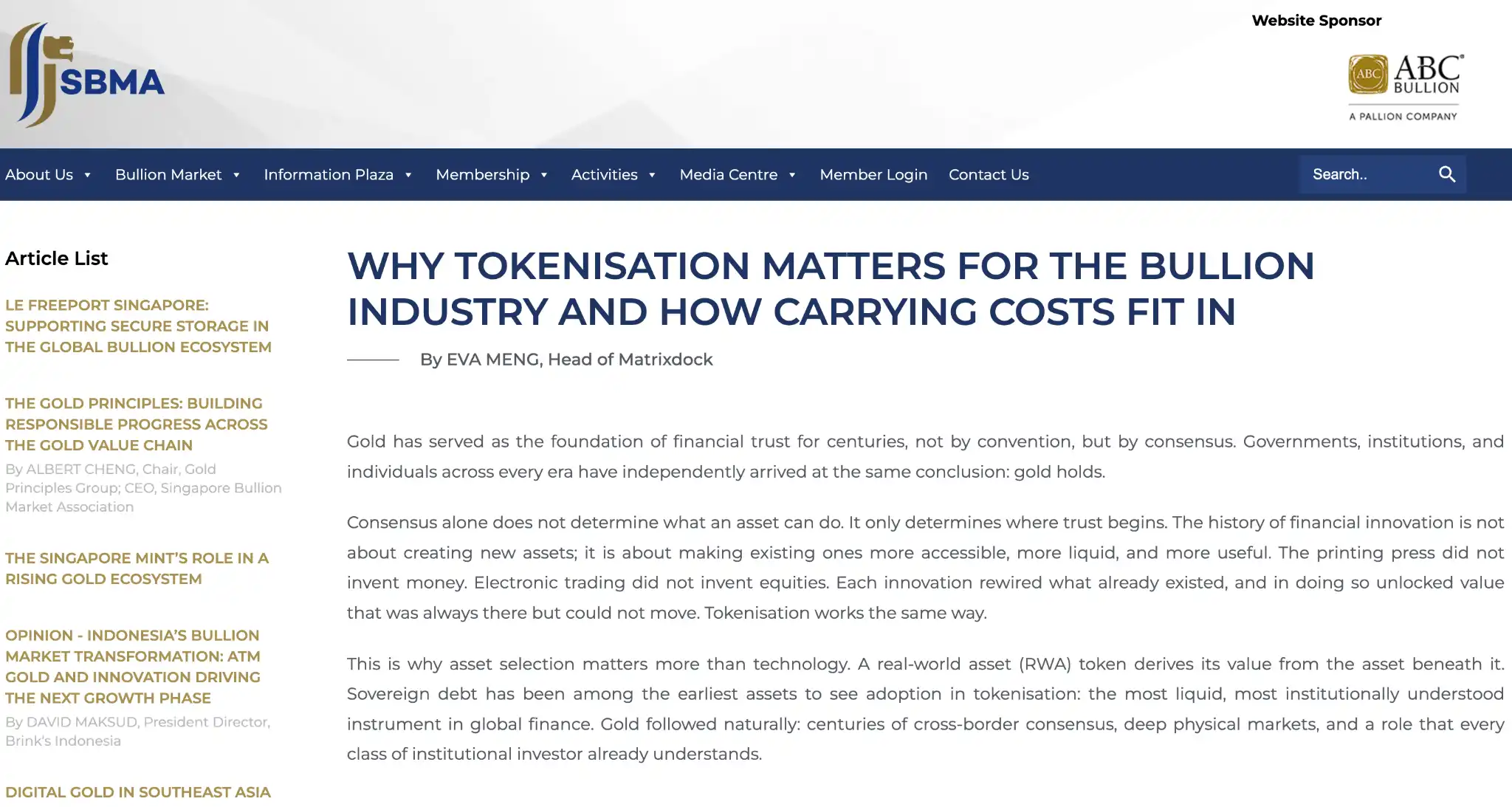
As an SBMA member, Matrixdock has been actively participating in global precious metals industry discussions since joining the association. Following previous insights on transparency and asset verification mechanisms for tokenised gold, this publication further extends the discussion focus to market efficiency and financial infrastructure upgrades, reflecting that tokenised precious metals are gradually gaining more attention from the traditional precious metals industry.
ETFs Changed How Gold is Invested In, Tokenisation Further Expands Gold's Use Cases
Gold has long been regarded as an important store of value, with its value consensus spanning nations and markets, persisting through centuries of financial evolution. However, the stability of an asset's value does not mean its usage remains static. From paper certificates to electronic trading, and then to ETFs, each upgrade in financial infrastructure has continuously improved the liquidity and accessibility of gold.
The article posits that the changes brought by tokenisation are similar. It does not seek to redefine gold but, while preserving gold's value attributes, enables this traditional asset to enter the digital financial system more efficiently.
Over the past two decades, gold ETFs have significantly lowered investment barriers, allowing gold to enter modern investment portfolios more easily. However, the core objective of ETFs is to provide price exposure, not to enable gold to directly participate in broader financial activities. With the development of digital finance, the market is beginning to ask new questions: Beyond holding gold, can gold be used for instant settlement? Can it be used as digital collateral? Can it circulate in markets that operate around the clock?
In this context, tokenised gold does not aim to replace ETFs. Instead, building upon the improved accessibility for gold investment already achieved by ETFs, it seeks to further enhance gold's liquidity and usability, gradually equipping gold with broader application capabilities such as settlement, collateral, and payment, moving beyond its role as merely a portfolio allocation tool.
Carrying Costs Do Not Disappear; Transparent Mechanisms are Key for Real-World Assets
For physical assets like gold and silver, costs for storage, insurance, and custody always exist objectively. Especially for silver, due to its lower unit value and larger volume, the issue of carrying costs is more pronounced.
Traditional ETFs typically cover related costs through an expense ratio, but the actual custody costs, management fees, and profit margins are often bundled together, making it difficult for investors to clearly distinguish the sources of different costs.
Addressing this issue, Matrixdock introduced the Fungible Reserve Standard (FRS) framework in the article, hoping to reflect the carrying costs of real-world assets in a more transparent manner through FRS. The underlying Economic Purity Principle emphasizes that tokens should faithfully reflect the economic characteristics of the underlying asset, not obscure them.
Matrixdock believes that the key to tokenising real-world assets is not merely putting assets on-chain but, more importantly, accurately reflecting the true economic attributes of the assets in a transparent manner.
From XAUm to XAGm, Matrixdock Expands Precious Metals Tokenisation Practice
The article also introduced Matrixdock's practice in the field of precious metals tokenisation. As the first tokenised asset built on the FRS framework, XAGm transparently incorporates carrying costs into the token mechanism; while the gold token XAUm represents Matrixdock's core practice in institutional-grade gold tokenisation.
From gold to silver, Matrixdock is exploring more transparent, chain-based expression methods for different precious metal assets that better align with their economic properties.
Notably, as the market develops, industry focus is also shifting. The early market paid more attention to proof-of-reserves and asset authenticity. As the market matures, the industry is beginning to focus more on issues like asset efficiency and capital utilization. According to data cited in the article, the market size for tokenised gold surpassed $6 billion in February 2026 and has seen significant growth over the past year. The article points out that as the market size continues to expand, tokenised gold is gradually becoming an important component in the digitisation process of the precious metals market.
If ETFs made gold an integral part of modern investment portfolios, then tokenisation is pushing gold further into the digital financial system. The value of gold has not changed, but its methods of use and application scenarios are continuously expanding. From a store of value tool to a digital asset capable of supporting settlement, collateral, and broader financial operations, the development of precious metals tokenisation may still be in its early stages.