Core Members of Ethereum Foundation Stage Mass Exodus: 'Decentralization' or 'Dissolution'?

marsbitPublished on 2026-05-20Last updated on 2026-05-20

Abstract

In April-May 2026, at least six core members, including key engineers and researchers, departed from the Ethereum Foundation (EF). This followed the earlier exit of co-executive director Tomasz Stańczak. High-profile leavers included long-time contributors from the Protocol Cluster and the "Trillion Dollar Security Initiative." EF framed the departures as part of its "Mandate" restructuring aimed at reducing its central role. However, community concerns grew as core developer numbers fell from 225 in May 2025 to 169 in May 2026, though a recent one-month rebound of 63% was noted. ETH holdings in the EF treasury also decreased. Despite the leadership flux, Ethereum's overall developer activity remains substantial, with nearly 10,000 active ecosystem developers. The departures have sparked discussions about EF's future direction, coordination, and the practical meaning of decentralization for Ethereum, which faces challenges like price declines and project security concerns while aspiring to be a global financial infrastructure layer.

Author: Hristina Vasileva

Compiled by: Deep Tide TechFlow

Deep Tide Intro: During April and May 2026, at least six core members of the Ethereum Foundation (EF) left in rapid succession, spanning protocol engineering, cryptoeconomics research, and management. EF officially frames this within its "Mandate" framework as active downsizing, but the community sees: core developers dropping from 225 to 169, shrinking ETH holdings, and the Glamsterdam upgrade delayed. This Cryptopolitan report details the list of departures, the logic behind EF's restructuring, and the current state of ecosystem developers.

The Ethereum Foundation (EF) has lost several key contributors, sparking renewed questions about the organization's direction and Ethereum's future. This wave of departures follows Tomasz Stańczak's resignation as EF co-Executive Director after just one year in the role.

In April and May, a total of six contributors left or began long-term leave. Departures were concentrated in the foundation's core engineering teams and research department.

Some of the engineers were from the Protocol Cluster responsible for Ethereum's L1 design. This unit underwent restructuring, with engineers Barnabé Monnot and Tim Beiko departing subsequently.

Earlier, Josh Stark announced his departure after seven years at EF, where he served as co-chair of the 'Trillion Dollar Security Initiative.' Trent Van Epps left after five years, having been involved with organizing the Protocol Guild; he will continue contributing to the broader ecosystem part-time.

May Exodus Intensifies

The most recent to leave EF is Carl Beek, a seven-year veteran and a key figure in the Beacon Chain launch phase.

Julian Ma also recently resigned after four years of cryptoeconomics research at EF, focusing on mechanism design.

These two departures sparked greater concern within the Ethereum community, escalating discussions about EF's future direction. The foundation's own public statements have consistently focused on "supporting the ecosystem as a whole," deliberately downplaying its role as a central authority.

The departure of core members doesn't directly indicate problems with Ethereum itself. However, these exits have indeed reignited discussions about leadership, coordination mechanisms, and what the goal of "decentralization" actually entails.

Developer Activity Maintains a Baseline

Despite the high-level personnel turbulence, Ethereum's developer activity retains a solid baseline. Token Terminal data shows the project currently has 169 core developers, a 63% rebound over the past month. However, looking at a longer timeframe, core developers have declined from 225 in May 2025 to 169 as of May 19, 2026.
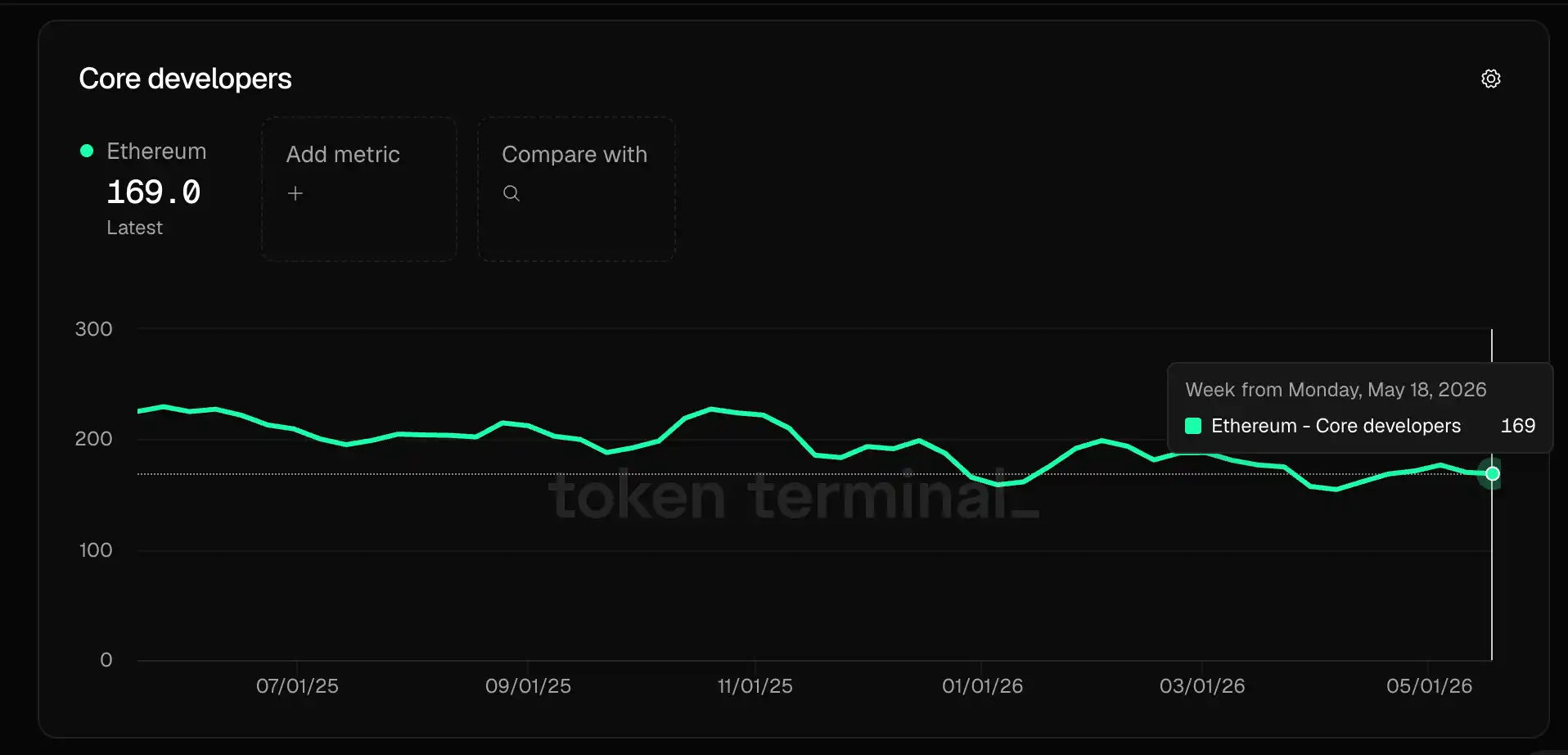
Caption: Ethereum core developers saw a slight uptick over the past month, but have declined from 225 in May 2025 to 169.

Source: Token Terminal

The overall number of ecosystem developers now lags behind Solana. However, according to Chainspect data, the Ethereum ecosystem still boasts 9,744 active developers.

EF is proceeding with a restructuring guided by its newly released Mandate document, adjusting its development focus. One of the Mandate's core objectives is to reduce the foundation's direct influence, which inherently involves parting ways with some key contributors.

Another practical issue facing EF is the shrinking ETH reserves in its organizational wallet. The foundation currently holds 103,660 ETH, having previously staked a portion and sold some reserves to BitMine.

The timing of this exodus is not ideal: Ethereum is being looked to as a critical infrastructure layer for global finance. The team restructuring also coincides with a peak period of concentrated attacks against decentralized projects, with the Ethereum ecosystem bearing the brunt.

Following these reports, ETH price continues to hover in a low range, down 40% over the past year. At the time of writing, ETH is trading at $2,117.02, despite the amount staked in the Beacon Chain contract reaching 31% of the circulating supply.


Related Questions

QAccording to the article, what is the primary reason the Ethereum Foundation (EF) gives for the recent wave of key member departures?

AThe EF officially attributes the departures to an active organizational downsizing under its new 'Mandate' framework, which aims to reduce the foundation's direct influence and decentralize its role.

QHow has the number of Ethereum core developers changed between May 2025 and May 2026, as mentioned in the report?

AThe number of Ethereum core developers declined from 225 in May 2025 to 169 by May 19, 2026, though it saw a 63% increase in the month preceding the report.

QWhich two recently departed EF members were highlighted as being key figures in the Beacon Chain's launch and cryptoeconomics research?

ACarl Beek, a key figure in the Beacon Chain launch, and Julian Ma, who focused on cryptoeconomics and mechanism design research.

QWhat financial pressure does the Ethereum Foundation face, as indicated in the article?

AThe EF faces financial pressure from its shrinking ETH treasury reserves, which now hold 103,660 ETH after using some for staking and selling a portion to BitMine.

QWhat broader community concern is sparked by the departures of EF core members, beyond the organizational changes themselves?

AThe departures have sparked discussions about leadership, coordination mechanisms, and the practical meaning and implications of Ethereum's 'decentralization' goal.

Related Reads

Five Core Forms of AI Agent in YC's Eyes

The article outlines five core architectural patterns for effective AI Agents, emerging from tools like Codex and Claude, that move beyond simple prompts towards reusable, process-based capabilities. 1. **Skills**: Reusable, parameterized workflows that function like method calls, allowing a single process (e.g., "/investigate") to handle various tasks based on input parameters. 2. **Thin Harness**: A lightweight execution framework (~200 lines) that manages the AI model's "hands and feet"—handling loops, file I/O, and context—without becoming bloated. 3. **Resolvers**: Routing tables that map tasks to specific Skills, preventing "context corruption" when managing dozens of Skills and ensuring outputs go to the correct locations. 4. **Latent vs. Deterministic Layer**: A critical separation where LLMs handle judgment, synthesis, and pattern recognition, while deterministic code handles tasks requiring precision, consistency, and low cost (like calculations). 5. **Memory**: A persistent, accumulating knowledge base (e.g., a markdown folder) with a "current trusted conclusion" section and an append-only timeline, enabling the system to learn and retain context over time. Together, these patterns create a "process power"—a durable competitive advantage. Unlike one-off prompt-based applications whose value quickly commoditizes, a well-designed AI Agent system encodes experience into reusable, parameterized workflows, offloads stable rules to code, and continuously learns through memory. This creates a structured, hard-to-replicate capability that can provide sustained value for individuals or businesses, such as an accountant automating client reviews while preserving privacy and accumulating expertise.

marsbit1h ago

Five Core Forms of AI Agent in YC's Eyes

marsbit1h ago

Tiger Research: On-Chain Risk Operators, The Market Cap Gap Between 147 Trillion and 70 Billion

This report by Tiger Research examines the evolution of risk management in decentralized finance (DeFi) lending. It highlights a power shift from protocol developers to specialized professional risk operators who manage on-chain capital. The era of protocols and community governance solely dictating DeFi lending is ending. A new professional asset management layer has emerged. While the sector is nascent, capital and distribution channels are rapidly consolidating around top risk operator teams, whose past performance is now a key criterion for institutional entry. The industry's development, accelerated by modular infrastructures like Morpho, has led to a clear division of labor mirroring traditional finance: distribution channels (e.g., exchanges), strategy/risk management (the risk operators), and product infrastructure/asset custody (smart contract protocols). This structure lowers the entry barrier for traditional institutions. Currently, the total value managed by risk operators is approximately $70 billion, dominated by a few leading teams like Steakhouse (RWA focus), Sentora (AI models), and Gauntlet (crisis management). Competition now centers on collateral standards, distribution access, and crisis response capabilities. The report outlines three primary entry paths for institutions: 1) **Distribution Model**: Leveraging external risk operators as backend service providers (common for exchanges). 2) **Asset Supply Model**: Onboarding real-world assets to DeFi as collateral. 3) **Independent Operator Model**: Building an in-house team to become a risk operator (e.g., Bitwise). The core opportunity lies in the strategy/risk management layer, where traditional financial institutions can leverage their existing expertise in due diligence and risk assessment without deep technical development. A vast opportunity gap exists: the global traditional asset management industry manages ~$147 trillion, while the entire DeFi sector is only ~$800 billion, with the risk operator niche at ~$70 billion. This disparity signifies immense growth potential. Once robust risk frameworks and clearer regulations are established, even a minor allocation from traditional markets could trigger exponential DeFi growth. Early movers who help build these foundational systems will gain significant rule-setting influence and first-mover advantages.

marsbit1h ago

Tiger Research: On-Chain Risk Operators, The Market Cap Gap Between 147 Trillion and 70 Billion

marsbit1h ago

Trading

Spot
Futures

Hot Articles

Discussions

Welcome to the HTX Community. Here, you can stay informed about the latest platform developments and gain access to professional market insights. Users' opinions on the price of ETH (ETH) are presented below.

活动图片