Don't Just Focus on Layoffs, The New Structure of the Ethereum Foundation is More Worthy of Appreciation

Foresight NewsPublished on 2026-06-24Last updated on 2026-06-24

Abstract

The Ethereum Foundation (EF) has undergone a significant organizational restructuring, with the most notable change being a strategic refocusing of its priorities rather than just a 20% staff reduction (approximately 54 people). The new structure clearly prioritizes the Protocol and Access layers, which now comprise the largest teams (57 and 34 people, respectively). This signals EF's intent to concentrate its core resources on fundamental, hard-to-outsource aspects of Ethereum: protocol evolution, security, privacy, client development, and the foundational access layer. Key areas within the Protocol layer, led by an architecture group including Vitalik Buterin and Justin Drake, receive heightened emphasis. These include post-quantum security, zkEVM, formal verification, and long-term roadmap development ("Strawmap"). This reflects a shift towards tackling complex, interdependent challenges like scalability, privacy, and future-proofing the protocol, potentially moving from a pure "redundant security" multi-client model towards more specialized clients aided by AI-assisted formal verification. Financially, EF's budget is being reduced by approximately 40%. The goal is to transition from spending about 15% of its remaining funds annually to a more sustainable 5% rate, akin to a long-term endowment, ensuring its longevity. Concurrently, the restructuring involves pushing certain responsibilities—such as application development, adoption, and ecosystem coordination—to externa...


Author: KarenZ, Foresight News


The Ethereum Foundation (EF) has finally begun to define its own boundaries.


In this reorganization, the most significant aspect is not merely the reduction of 54 people (approximately 20% of the Foundation), but that it has brought a long-standing, unresolved question into the open: What should the EF still manage, and what must it let go? The answer is already written into the new organizational structure: the protocol, security, privacy, and access layers are given greater prominence.


In an Organizational Chart, What Matters Most is the Weighting


The Ethereum Foundation's new structure is broadly divided into eight sections: the Protocol layer, the Access layer, the User layer, the Community layer, the Institutional layer, the Operations layer, along with Management and Management Support.


According to the official organizational chart annotations, the Protocol layer is the largest, with 57 people; the Access layer has 34, the Operations layer 26, the Community layer 25; the Institutional layer has 12, the User layer 5; Management has 5, and Management Support 6.
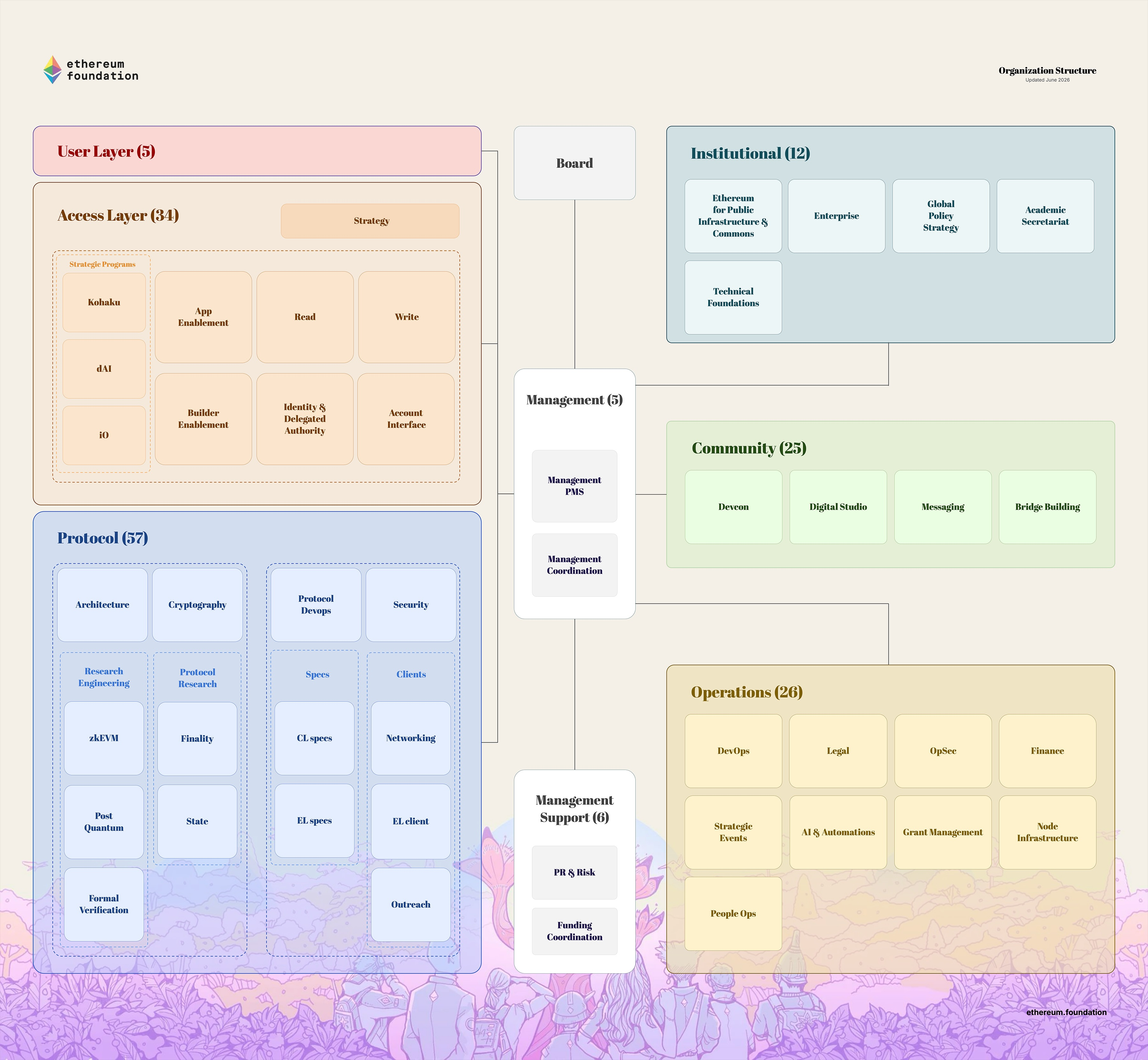


This ranking itself is telling: after the EF's contraction, resources have not been evenly diluted but are instead being concentrated towards the Protocol and Access layers once more. In other words, the Foundation is focusing more energy back on the most foundational and hardest-to-outsource parts of Ethereum: protocol evolution, security, privacy, clients, specifications, and the entry points through which users and institutions actually interact with the chain.


First, let's look at the Protocol layer. The official definition is to continue maintaining Ethereum's most defensible attributes: censorship resistance, capture resistance, open-source nature, privacy, and security. The EF blog states it bluntly: the protocol team's work is not to make Ethereum easier to market, nor to transform it into a financially controlled rail by intermediaries, but to ensure it remains dependable when counterparties fail, platforms censor, governments overreach, or intermediaries extract rent.


In the detailed breakdown chart of the Protocol layer provided by EF researcher Justin Drake, what stands out most is not each individual name, but several technical lines that have been explicitly elevated in priority.


Most prominent is the Architecture Group: led by Justin Drake, with Vitalik Buterin also listed. Justin Drake has frequently pushed discussions on strawmap, post-quantum security, zkEVM, issuance policy, etc., over the past year, while Vitalik represents one of the highest weights in Ethereum's long-term roadmap. Their simultaneous presence in the Architecture Group indicates that the EF is not simply compressing teams, but is reassigning higher priority to the long-term evolution of the protocol.


Several more specific long-term technical topics are also individually highlighted: Thomas Coratger is responsible for post-quantum security (a team newly established in January 2026), Ignacio Hagopian for zkEVM, and Alex Hicks for formal verification. These names may not all be publicly active, but the directions they represent are critical: post-quantum security relates to whether Ethereum can complete its cryptographic migration ahead of schedule, zkEVM relates to the long-term form of the execution layer and proof systems, and formal verification is a new tool the EF hopes to use to reduce protocol complexity and client maintenance costs.
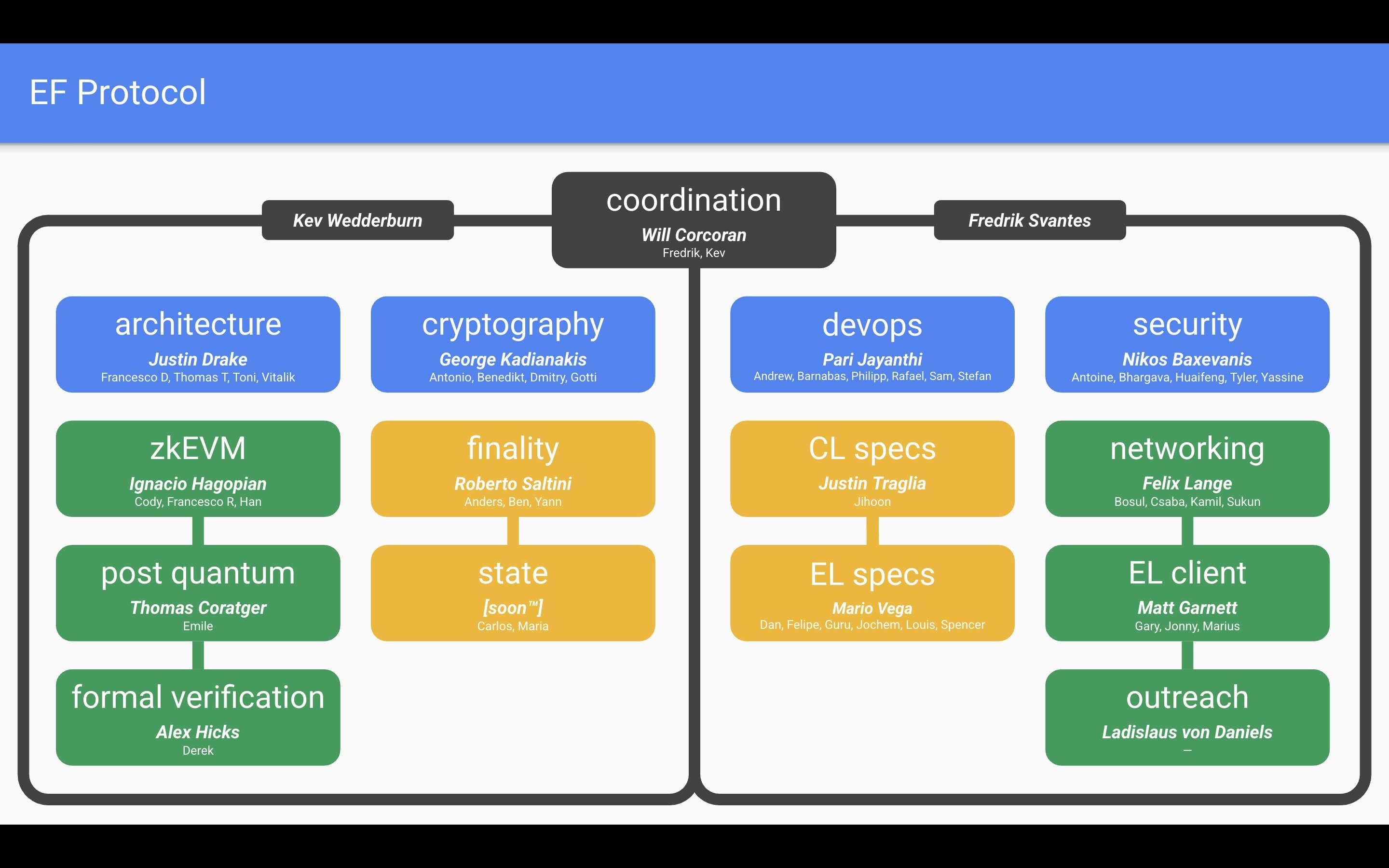


Additionally, cryptography is overseen by George Kadianakis. He has long been involved in research related to privacy networks and anonymous communication, including security research for the Tor anonymous communication network; the Security direction is led by Nikos Baxevanis; and Protocol DevOps is led by Pari Jayanthi.


The signal from these two charts is strong: The EF is not turning the Protocol layer into a generic "Research Department"; instead, it's breaking down post-quantum security, zkEVM, formal verification, finality, clients, specifications, and security engineering into accountable sub-units. Ethereum's next challenge is not a single scalability problem, but a set of interconnected hard problems: a faster L1, stronger privacy, lower complexity, fewer trusted dependencies, and a cryptographic migration before quantum computing risks materialize.


Justin Drake's update made the Protocol layer's direction even more specific. He stated the EF Protocol cluster shrank from about 100 to about 60 people, that EF subsidies for consensus and execution layer clients will end in 2027, and that annual expenditure, including grants, is dropping to around $30 million. He also mentioned that timelines for strategic upgrades like post-quantum security and zkEVM are shortening, and that AI-assisted formal verification and automated research are changing protocol R&D methods.


Vitalik also noted that Ethereum's ongoing Strawmap is a "Phase 3"-style overhaul involving consensus, proofs, privacy, account models, state, and more. He further judged that the multi-client model might shift from a past emphasis on "redundant security" towards more "specialization," with some security responsibilities shouldered by AI-assisted formal verification.


This touches a sensitive point in Ethereum's culture. In the past, multiple clients were seen as a hallmark of Ethereum's security philosophy: as long as no single client exceeds a critical threshold, the chain won't halt due to one bug. But if protocol complexity continues to rise, the cost of all clients fully replicating the same capabilities will become increasingly high. The EF's new direction seems to be betting on another security philosophy: reduce unnecessary complexity, and combine provable correctness, formal verification, AI-assisted research, and specialized clients.


This path carries risks. Formal verification is not magic, and AI cannot replace engineering responsibility. Yet it points to the deep waters of Ethereum's next round of competition: future chains won't just compete on TPS, but also on who can establish new safe production methods before complexity spirals out of control. If Ethereum wants privacy, scaling, MEV resistance, post-quantum security, and better user access simultaneously, the bottleneck is no longer just human scale, but R&D methodology, engineering coordination, and roadmap trade-offs.


20% Layoff, ~40% Budget Cut: The EF is Learning to Live Long-term


Vitalik's explanation of this reorganization gets closer to the financial and strategic underpinnings. He stated that the EF's budget this year is decreasing by approximately 40%, with the goal of shifting from consuming an average of about 15% of remaining funds annually pre-2026, to becoming a long-term endowment-style organization with a roughly 5% annual spend rate post-2030.


This passage is important because it explains the EF's real dilemma: a foundation operating on an ETH treasury cannot spend forever as if in a bull market. The more Ethereum aspires to be "world-class infrastructure," the less the EF can operate like a perpetually expanding tech company. Tech companies justify expenses with growth; foundations constrain expenses with mission. When these two logics are mixed, you get the state repeatedly criticized by outsiders in recent years: the Foundation is expected to fund public goods, support applications, branding, conferences, institutional adoption, ecosystem relations—everything finds a justification, and everything can dilute the main line.


Comments from Tomasz K. Stańczak, former co-Executive Director of the Ethereum Foundation, provide another perspective. He acknowledged the direction of cutting large events, client funding, institutional teams, and non-core large projects, but also expressed concern that the new organizational chart still appears complex.


He also mentioned that the EF needs more professional, transparent treasury management, and should not miss significant ETH opportunities in staking and capital allocation due to insufficient financial capabilities.


The Ethereum Ecosystem Needs to Grow More Nodes


Another subtle change during the reorganization is the EF pushing some work outside to the broader ecosystem.


The emergence of EthLabs fits perfectly within this context. The organization describes itself as a non-profit R&D lab for Ethereum and ETH, aiming to make Ethereum the settlement layer for the global economy, and emphasizes its role in translating real needs between users, applications, wallets, L2s, infrastructure, institutions, ETH holders, core developers, and researchers into protocol work, standards, infrastructure, and products.


EthLabs resembles a prototype for the EF's "multi-node future." It takes on some work that the EF is no longer suited to handle directly but remains crucial for Ethereum: closer to adoption, more ETH-focused, and closer to product and market feedback. If the EF is the constitutional layer, organizations like EthLabs are more like policy labs and engineering translators. Their value lies not in speaking for the EF, but in ensuring Ethereum doesn't have to place all public goods, research, adoption, and narrative on the same foundation.


Recommended reading: "Ethlabs Established, Treasury Companies Pay for Ethereum After EF"


In a thread on June 22nd, the EF mentioned that realizing Ethereum's potential requires a set of organizations collaborating around a shared vision, and that over the past year, multiple organizations have emerged, enhancing the ecosystem's resilience and capacity. It named EthLabs, Ethereum Apps Guild (EAG, promoting adoption of native Ethereum apps), Ethereum Economic Zone (EEZ, a framework for synchronizing composable Rollups), and Argot (maintaining Solidity and open-source compiler tools relied upon by the Ethereum ecosystem), and concluded by emphasizing: "The privilege of stewarding Ethereum should not be hoarded, but shared thoughtfully with others committed to building self-sovereign infrastructure."


Viewed against the backdrop of the EF's reorganization, these organizations collectively illustrate one thing: Ethereum is no longer suited to place all public goods, adoption, research, standards, and narrative on a single central foundation. The EF needs to concentrate resources on the hardest-to-replace work: protocol, security, privacy, and access layers; while application adoption, developer tools, ecosystem coordination, institutional communication, ETH narrative, and productization advancement need more external nodes to fill the gaps.


The real test lies here. A multi-node structure can increase resilience, but may also create new coordination costs. Whether third-party organizations can form complementary roles rather than pushing their own separate agendas; whether they can reduce the ecosystem's dependency on the EF rather than creating new centers of discourse; and whether they can transform funding, talent, and research outcomes into actual products and protocol progress—these factors will determine if the EF's step back is a healthy devolution of power or a more complex coordination experiment.


The EF's New Role: Contracting Boundaries, Betting on Hard Problems


The true signal released by this reorganization runs deeper: the Ethereum Foundation is abandoning the safety of being "big and complete," turning towards a narrower, harder, more long-term role.


The EF's reorganization points not to contraction itself, but to redefining the boundaries of the Foundation's responsibilities. Doing less doesn't mean ambition has shrunk; it's more like a discipline: concentrating limited funds and talent on the hardest-to-replace areas. Making things harder also doesn't equate to technical romanticism; it requires the EF to deliver executable roadmaps for post-quantum security, formal verification, zkEVM, privacy, and access layers, while simultaneously enabling new nodes outside the Foundation to genuinely grow.


Vitalik mentioned that Ethereum must be worthy of occupying a place in the era of quantum computing, Mars rockets, powerful biotechnology, and artificial intelligence, and be capable of confronting the challenges brought by this era.


This path won't please everyone. Developers will worry about reduced funding, institutions about narrower interfaces, the market will think it doesn't tell a good enough story, and the community will continue questioning the EF's transparency. As Tomasz expressed concern: if the org chart gets smaller but decisions remain opaque, the reorganization is just a more expensive typesetting exercise.


Trending Cryptos

Related Questions

QAccording to the article, what are the primary areas of focus for the Ethereum Foundation (EF) following its restructuring?

AFollowing its restructuring, the Ethereum Foundation is primarily focusing its resources and efforts on the protocol layer and the access layer. These include core areas like protocol evolution, security, privacy, client development, specifications, and the entry points where users and institutions interact with the chain.

QWhat are some of the key long-term technical initiatives highlighted within the EF's protocol layer after the reorganization?

AKey long-term technical initiatives within the reorganized EF protocol layer include post-quantum security (led by Thomas Coratger), zkEVM development (led by Ignacio Hagopian), and formal verification (led by Alex Hicks). An architecture group led by Justin Drake and including Vitalik Buterin is also established to oversee long-term protocol evolution.

QWhat financial and operational goals did Vitalik Buterin outline for the Ethereum Foundation in the context of this restructuring?

AVitalik Buterin stated that the EF's budget for the year has been reduced by approximately 40%. The goal is to transition from an average annual spending rate of about 15% of its remaining funds pre-2026 to a long-term endowment-like model of about 5% annual spending after 2030.

QHow is the role of external organizations like EthLabs described in relation to the EF's new structure?

AExternal organizations like EthLabs are described as complementary nodes that will take on work the EF is stepping back from, such as driving adoption, product development, and market-facing initiatives. They act as policy labs and engineering translators, helping to distribute the responsibility for Ethereum's public goods beyond a single central foundation.

QWhat potential shift in Ethereum's security philosophy is suggested by the article's discussion on client models and new tools?

AThe article suggests a potential shift from a security philosophy heavily reliant on the 'redundant security' of multiple full clients, towards a model that combines specialization among clients with new tools like formal verification and AI-assisted research. This aims to manage rising protocol complexity while maintaining security.

Related Reads

EF's Epic Reorganization: 20% Layoffs, Budget Halved, Is Ethereum Gearing Up for a Leaner Future?

The Ethereum Foundation (EF) has announced a major organizational restructuring, involving a 20% staff reduction (approx. 54 employees) and a division into functional clusters like Protocol, Access, User, Community, and Institutional layers. Co-founder Vitalik Buterin further revealed plans to cut the EF's budget by around 40% over the coming years, aiming to reduce its annual spending rate from about 15% to roughly 5% by 2030, transitioning to an endowment-driven model. This overhaul is seen as a long-overdue correction to the EF's ambiguous role. As Ethereum grew, the foundation faced persistent criticism over ETH sales, perceived lack of execution, and unclear strategy, often becoming a focal point for community frustration amid ETH's price stagnation. The reform aims to redefine the EF's boundaries, narrowing its focus to core protocol research, public goods funding, and ecosystem coordination, while offloading more applied development work to the broader market. Concurrently, ecosystem forces like the newly formed Ethlabs (founded by ex-EF researchers) and other independent groups are stepping in to fill the space, signaling a shift from a centralized model to a more distributed, collaborative ecosystem structure. The move was notably praised by Solana co-founder toly, who viewed a "leaner" EF as potentially more decisive and agile.

Odaily星球日报23m ago

EF's Epic Reorganization: 20% Layoffs, Budget Halved, Is Ethereum Gearing Up for a Leaner Future?

Odaily星球日报23m ago

Dragonfly Partner Haseeb: The Fastest-Growing Companies of the Future May All Get Stuck at 149 Employees

Dragonfly partner Haseeb explores the distorted economics of AI model pricing, drawing parallels to tax policy. He notes that startups and small teams (under 150 users) enjoy heavily subsidized, fixed-price AI subscriptions (like Claude Code), where the marginal cost of an additional token is effectively zero. This creates a powerful incentive for them to maximize token usage ("token-maxxing") and innovate aggressively with AI automation. In contrast, large enterprises (over 150 users) are forced onto "Enterprise" plans, paying per-token API fees with high (~75%) markups. This acts like a steep "tax" on AI-powered labor, disincentivizing marginal automation and experimental use, and encouraging them to retain more human workers. Haseeb argues this pricing creates a "150-person cliff," a regulatory notch similar to labor laws in France that discourage firms from growing past 50 employees. He predicts the fastest-growing future companies may deliberately cap their headcount at 149 to avoid the punitive enterprise pricing. This would foster an "AI-first" management philosophy obsessed with automation and outsourcing to stay lean. While not intentionally designed, this bifurcated pricing could become one of the most influential de facto tax policies, shaping how AI replaces labor—not through mass layoffs at big firms, but through agile, AI-native startups outcompeting them.

marsbit34m ago

Dragonfly Partner Haseeb: The Fastest-Growing Companies of the Future May All Get Stuck at 149 Employees

marsbit34m ago

How xBubble Breaks Through in the VC-Heavily-Backed OPC Economy

xBubble: Addressing the Structural Gap in the VC-Backed OPC Economy The concept of OPC (One Person Company) is evolving from a buzzword to a significant AI-driven market. While AI coding tools like Replit and Lovable have validated demand from non-technical users wanting to build applications, a key gap remains: the leap from creating a demo to running a stable, evolving business. These tools still require users to manage the development process, including technical judgments for integrations, modifications, and deployments—a major hurdle for OPCs. xBubble, by DAPPOS, tackles this by shifting from "Prompt-to-Code" to "SOP-to-Business." Instead of generating code from instructions, its core is a system of pre-organized SOPs (Standard Operating Procedures) that translate business goals—like "sell World Cup merchandise"—into complete, executable workflows. This includes generating cohesive assets, pages, payment systems, and backend logic. The platform is augmented by a network of third-party service providers who handle infrastructure (hosting, domains, payment setup), acting like "on-site service engineers." Users can pay for these services directly with xBubble credits, simplifying onboarding. This ecosystem aims to deliver not just an app, but a complete, modifiable business launch path. xBubble targets a clear OPC segment: small commercial nodes (e.g., creators, merchants) with existing products, customers, or channels, but for whom a full tech team is unjustifiable. Its potential lies in SOPs accumulating expertise from real cases, improving reliability and reducing delivery costs over time. Additionally, its native support for crypto payments caters to global or digital-native OPCs. In summary, as AI democratizes software creation, xBubble's opportunity is to prove that "SOP-to-Business" provides more immediate value for launching a real, operational business than a powerful but unstructured AI coding tool.

链捕手37m ago

How xBubble Breaks Through in the VC-Heavily-Backed OPC Economy

链捕手37m ago

If It's Not a Clear Yes, It's a No: A Nine-Year Retrospective by a VC Who Survived Four Cycles

**"Invest Only When Certain": A Nine-Year Retrospective from a VC Across Four Cycles** IOSG founder Jocy shares hard-earned lessons from nine years and over a hundred investments in Web3. The core challenge isn't identifying successful founders, but understanding why talented founders with solid ideas still fail. Through building a "failed founder database," IOSG identified six recurring failure patterns. **Founder Trait Red Flags:** 1. **Emotionally Unstable:** Founders who react defensively to criticism or publicly lash out under pressure (e.g., 80% drawdowns) often fail. Resilience is key. 2. **Lacking Hunger / Having a Fallback:** Founders with significant safety nets (family wealth, cushy fallback jobs) may lack the "do-or-die" commitment needed to survive crypto's brutal cycles. 3. **Unchecked Ego:** Includes "polished execution machines" who excel in known frameworks but struggle when paradigms shift, and "professor-types" who are technically brilliant but resistant to commercial feedback or coaching. **Project Structure Red Flags:** 4. **Token-First, Not Product-First:** Treating the token solely as a fundraising tool with no real utility or connection to product value is a major warning sign. The project should have value even if the token goes to zero. 5. **No Day-1 Exit Thesis:** Founders must have a clear, staged capital strategy from the start, understanding what each funding round needs to prove to unlock the next. "Exit before entry" is crucial. 6. **No Full-Cycle Experience:** Founders who haven't lived through a complete crypto bull/bear cycle (e.g., 2018, 2022) often underestimate their vulnerability. IOSG limits initial checks for such teams to $250k, sizing for risk. **The Positive Flipside: Desirable Founder Traits** The ideal candidate exhibits: obsessive problem-depth, being a second-time founder with a non-consensus vision, strong communication skills with *controlled* ego, relentless perseverance, and a global perspective with agency and taste (increasingly vital in the AI era). **Three Survival Tips for Founders:** 1. **Cash Flow Over Narrative:** Real revenue is what sustains projects, not vanity metrics. 2. **Tokens Are a Liability:** Avoid issuing a token unless absolutely necessary. The hidden costs (market making, liquidity, compliance) are immense, often a multi-million-dollar burden. 3. **Respect Liquidity:** Sell during peaks to build treasury, buy back to support the protocol during troughs. Be realistic about valuations and your ability to deliver for the next round. The final principle is simple yet paramount: **"If it's a borderline 'yes' or 'no,' don't invest."** In an industry that reinvents itself every few years, the discipline to consistently say "no" is the ultimate secret to longevity.

Foresight News1h ago

If It's Not a Clear Yes, It's a No: A Nine-Year Retrospective by a VC Who Survived Four Cycles

Foresight News1h ago

Trading

Spot
Futures

Hot Articles

Discussions

Welcome to the HTX Community. Here, you can stay informed about the latest platform developments and gain access to professional market insights. Users' opinions on the price of ETH (ETH) are presented below.

活动图片