How Much Longer Can Ethereum's Last Major Buyer Hold On?

链捕手Published on 2026-06-11Last updated on 2026-06-11

Abstract

"The article analyzes the precarious position of Bitmine, currently the largest and most aggressive marginal buyer of Ethereum (ETH). Despite holding a massive position of approximately 5.66 million ETH (nearing its 5% supply target) and generating staking income, the company faces over $10 billion in unrealized losses due to a high average purchase price. With ETH prices depressed, its equity has plummeted nearly 90%. To sustain its buying spree, Bitmine recently issued $274 million in perpetual preferred shares with a 9.5% annual dividend. The core dilemma is whether staking yields (3-4%) can long-term support these high dividend obligations without significant ETH price appreciation. The article warns that once Bitmine achieves its 5% goal and potentially stops buying, the ETH market risks losing its key support pillar. Other institutional buyers, like ETH ETFs, have shown net outflows, while potential new demand from stablecoin legislation or RWA tokenization remains slow to materialize. The conclusion questions who will provide the next wave of sustained buying pressure to support ETH's price, highlighting a critical uncertainty for the asset's near-term trajectory."

As the crypto market continues to fall, BTC and ETH have once fallen to around $60,000 and $1,500, with both Strategy and Bitmine experiencing floating losses exceeding $10 billion. Just at the end of May, Strategy sold 32 BTC, breaking its long-standing narrative of not selling coins, marking the pressure testing phase for the model of financing purchases with debt.

Against this backdrop, Bitmine grandly announced the issuance of its Series A Perpetual Preferred Shares with a 9.5% annualized yield, raising approximately $274 million net. As of press time, Bitmine increased its holdings by 127,000 ETH last week and accumulated purchases of 125,000 ETH over the past three days. Its total holdings now stand at about 5.66 million ETH, less than 400,000 ETH away from its 5% target.

As the most persistent and aggressive marginal buyer of ETH in the current market, Bitmine continues to increase its holdings despite facing over ten billion dollars in unrealized losses. Now, even it needs to rely on preferred shares to replenish its flywheel. Once the financing market experiences changes and its coin-hoarding machine is forced to slow down, who will be left to support the price of Ethereum?

Reaching 5% Before Year-End, Then What?

Bitmine began accumulating ETH in the second half of last year, planning to complete its "5% Alchemy" plan within 5 years. Data shows that Bitmine raised $19.2 billion through 50 equity offerings between July 2025 and June 2026, with all funds used to purchase ETH.

As of press time, Bitmine's Ethereum holdings have reached approximately 5.66 million ETH, less than 400,000 ETH away from its 5% target, achieving over 90% of the plan's progress within a year.
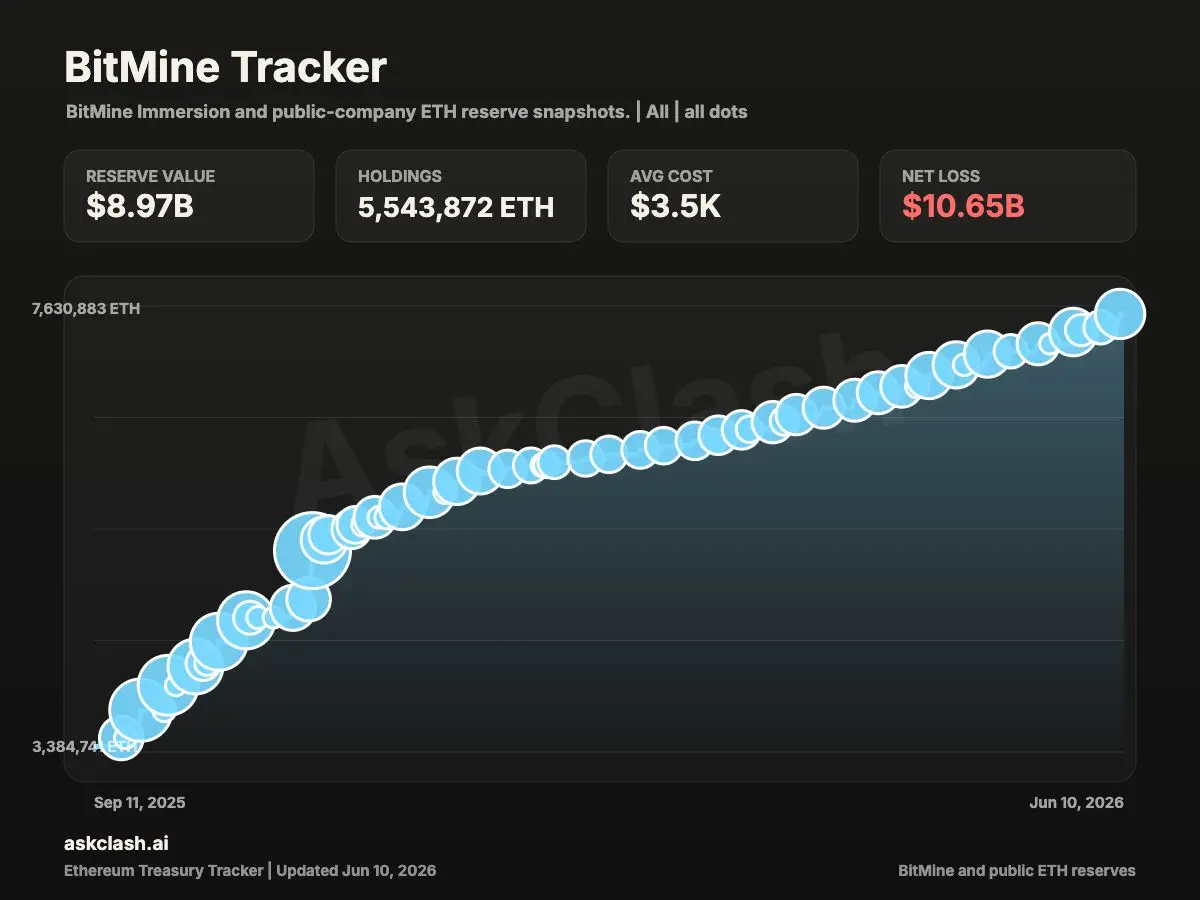
Among these, about 4.719 million ETH have been staked, accounting for over 85% of total holdings, with expected annualized staking returns ranging from $230 million to $296 million. This staking system is supported by the company's self-built MAVAN validator node network, considered the most critical structural design differentiating Bitmine from Strategy.

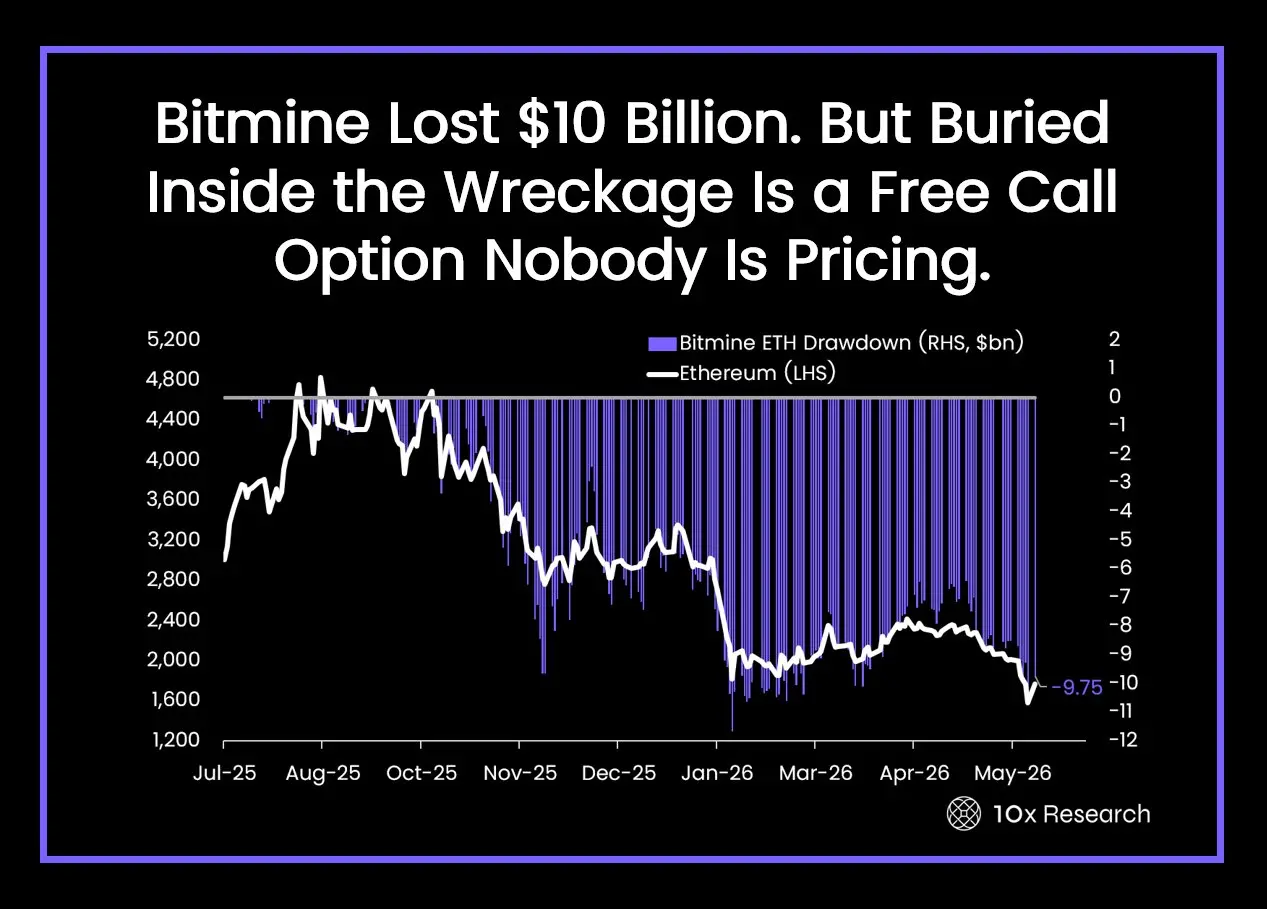
However, the cost of aggressive accumulation is also evident. With current ETH prices around $1,650, the company's average holding cost is as high as about $3,500. Its ETH treasury is valued at only about $9.3 billion, resulting in an overall company loss of $10.5 billion, a drawdown exceeding 50%. The company's stock price has plummeted nearly 90% from its peak.
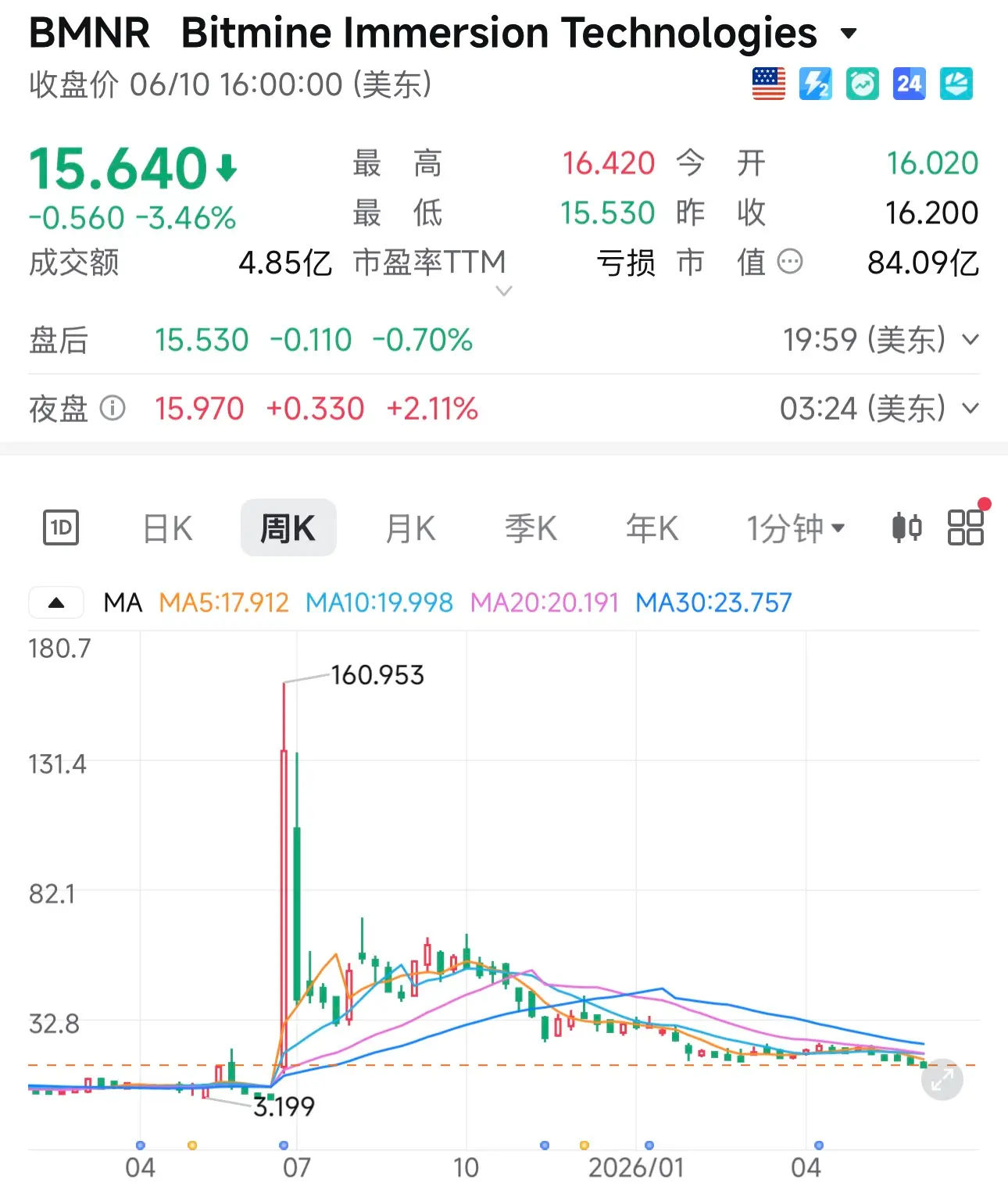
10x Research points out that Bitmine's investors face two layers of losses: the floating loss from ETH's price drop is the first layer. The second layer is the approximately $4.6 billion premium investors paid for BMNR stock relative to the underlying ETH net asset value. Combined, these layers amplify the actual loss magnitude for shareholders.
Facing massive unrealized losses, Tom Lee characterizes this round of decline as superficial. He believes the existing financial system harbors a large amount of fake trading, whereas Ethereum has never had fraudulent transactions, with lower operating costs. On-chain transaction volume and daily active addresses have both hit record highs. The price correction is led by macro factors and leverage unwinding, with fundamentals undamaged. The longer-term bet is that AI agent systems will rely on blockchains to operate, ETH supply is continuously contracting, and Ethereum is the most direct beneficiary.

Tom Lee recently revealed that Bitmine is expected to complete its 5% target before the end of 2026, at which point it may no longer need to continue increasing holdings. He also mentioned the company may be formally included in the Russell 1000 index by the end of June, which, based on market cap calculations at the time, would bring at least $2.15 billion in passive fund buying pressure for BMNR.

How Can 3% Staking Returns Support 9.5% Dividends?

On June 5th, Bitmine completed pricing for its Series A Perpetual Preferred Shares: 3.5 million shares, issued at $80 per share, with a par value of $100, raising approximately $274 million net. The dividend yield is 9.5%, paid weekly in cash, and dividends continue to accrue even if undeclared by the board. Annualized dividend obligation is about $33.25 million based on par value.

Bitmine holds an early redemption right: it can redeem at 110% of par value within 18 months of issuance, at 105% between 18 months and 3 years, and at 100% after 3 years, with accrued but unpaid dividends also paid upon redemption.

At first glance, the math isn't hard. By the end of May, Bitmine had cumulatively staked 4.7 million ETH, with expected annualized staking returns of about $230 million to $296 million, which is 8 to 9 times the annualized dividend obligation.

However, the prediction exceeding $200 million is based on the assumption that the recent 4.7 million ETH are fully staked. According to the prospectus, for the six months ended February 28, 2026, the company's staking income was $11.18 million, annualized to about $22 million.

It's noteworthy that staking rewards are denominated in ETH, not USD. If ETH continues to fall, the company's staking income will shrink accordingly.

Here lies a fundamental difference between Bitmine and Strategy. BTC has no native yield; Strategy's STRC can only pay dividends through BTC price appreciation or selling coins, as detailed by ChainCatcher in the article "Strategy Cashes Out $2.5 Million as Bitcoin Market Cap Evaporates $80 Billion".

ETH's staking mechanism offers Tom Lee a different path: even if the price stays flat, staking rewards still generate income without touching the principal holdings. This is the real pressure-resistant advantage of the Bitmine model in the current bear market.

But this path may not be sustainable. Crypto KOL chenmo points out that in the early stages with low issuance, covering dividends with staking returns is manageable. However, as preferred share issuance scale continues to expand, the 3-4% staking yield is destined to be unable to cover the 9.5% annual interest. At that point, only a rise in ETH can maintain this logic.

Analyst Yuyue also noted that Strategy's model is already under pressure in the current market. Following up with preferred share issuance now, even if it's a short-term positive, may be interpreted by the market as a worse signal.

According to CointelegraphMT research, two details in the prospectus for this issuance are worth noting. The auditor was changed to KPMG on April 27th, with simultaneous disclosure of material weaknesses in internal controls. The audit is not yet complete, and financial data may be subject to restatement.

Additionally, the board has complete discretionary power over dividend payments. The only enforcement mechanism for preferred shareholders is the right to nominate two directors after 18 consecutive months without receiving dividends.

If Bitmine Stops Buying After 5%, Where Will ETH's Price Go?

On-chain analyst Yu Jin stated that at the current buying pace, the target could be reached as early as next month. So, will they continue buying after reaching it? If they stop, and this market's last staunch bull disappears, what will support ETH?

Bitmine has been the most consistent and aggressive marginal buyer in the ETH market over the past year. Other potential buying forces are scattered and weak. ETH spot ETFs saw a net outflow of $173 million overall last week. Although they briefly turned positive on June 8th after 17 consecutive days of outflows, the strength was far less than the previous outflow scale.

Meanwhile, Goldman Sachs reduced its ETH ETF holdings by about 70% in Q1 2026, and Harvard University's endowment fund completely liquidated its approximately $87 million ETHA holdings, selling all after holding for just one quarter. Details on institutional fund movements can be found in "Harvard and Other Institutions Liquidate, Six Core Talents Depart in One Month, What's Wrong with Ethereum?".

Furthermore, stablecoin legislation and institutional incremental demand brought by RWA tokenization are slow variables, difficult to fill a gap of Bitmine's scale in the short term.

Without an overall reversal in the crypto market, it can be foreseen that the treasury flywheel will become difficult to sustain. The transmission would be: ETH price continues to fall, BMNR stock price is under pressure, the premium relative to net assets narrows, the window for additional fundraising shrinks, the buying pace slows, and ETH further loses marginal support. This cycle doesn't even require Bitmine to actively sell a single ETH; the disappearance of buying power alone is sufficient.
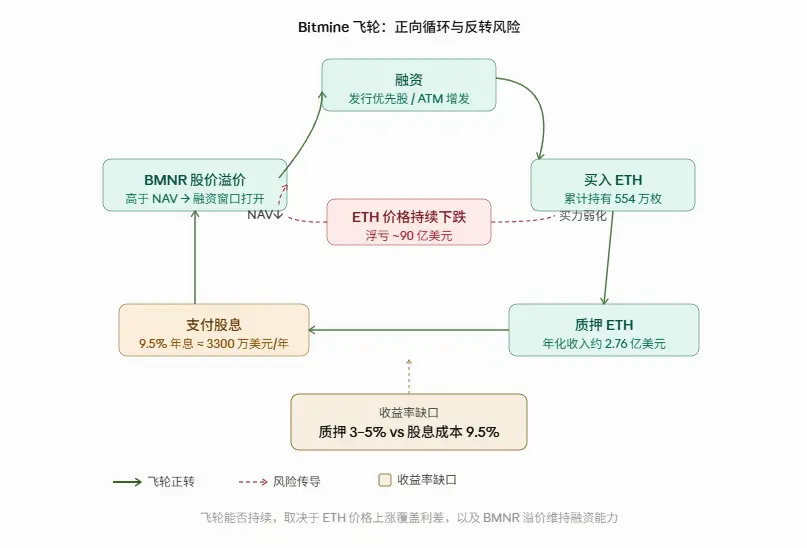
Image Source: AI Generated

In a pessimistic scenario, if the financing market's acceptance of preferred shares declines, BMNR continues to hit new lows, and buying slows significantly, ETH may explore the next key consensus level (around $1,000). DWF Labs co-founder Andrei Grachev believes Strategy and Bitmine have a great chance to create the largest market crash in cryptocurrency history. This is a tail risk judgment, not a baseline expectation.

In the baseline scenario, Bitmine maintains buying, staking returns provide a buffer, preferred shares are smoothly absorbed, and ETH consolidates and bottoms out in the $1,500 to $2,000 range. Despite Bitmine's heavy losses and ETH's difficulty recovering in the short term, a 10x Research report mentions that when a stock falls deep enough, the underlying asset becomes almost irrelevant. What investors are buying is essentially a pure option—a free call option on ETH's future rebound, which is not yet fully priced in by the market.

In an optimistic scenario, formal inclusion in the Russell 1000 brings passive funds, and the landing of stablecoin legislation like the GENIUS Act clears obstacles for institutional entry. Standard Chartered maintains its year-end 2026 ETH target price of $4,000, believing recent price declines do not reflect the continuous improvement in Ethereum's network fundamentals. It likens the current situation to Amazon's stage after the 2001 bubble burst—price temporarily disconnected from network value, but infrastructure building never stopped. The bank expects the ETH/BTC exchange rate to recover to about 0.08 by the end of this decade, with a target price of $40,000 by the end of 2030.

Conclusion

Ultimately, how long this financing can sustain Bitmine's flywheel comes down to the price of ETH. However, Bitmine's coin-buying itself is a crucial part of price support.

So the core question is: after Bitmine completes its 5% target and gradually fades out, who will take up the baton? Traditional institutions are withdrawing, ETF funds flow in and out, and real incremental demand from stablecoins and RWA has yet to materialize on a large scale.

Perhaps Ethereum is not short on narratives, but when the liquidity turning point will appear and where the new marginal buyers will come from are key questions determining ETH's price trend going forward.


Related Questions

QWhat is Bitmine's primary strategy and goal in the Ethereum market, and what is its current progress?

ABitmine's strategy is to aggressively accumulate Ethereum (ETH) with the goal of holding 5% of the total ETH supply. They finance this through equity offerings. Currently, Bitmine holds approximately 5.66 million ETH, which is over 90% of their 5% target, requiring less than 400,000 ETH more to complete.

QWhat significant financial challenge is Bitmine currently facing, and how is it attempting to address it?

ABitmine is facing over $10.5 billion in unrealized losses due to ETH's price falling well below its average acquisition cost of around $3,500. To address this and continue its buying strategy, Bitmine recently issued perpetual preferred shares with a 9.5% annual dividend, raising approximately $274 million.

QWhat is a key structural difference between Bitmine and a company like Strategy, and what advantage does it provide in a bear market?

AA key difference is that Bitmine stakes its ETH holdings (over 85%), generating an estimated annual yield of $230-$296 million. Unlike Bitcoin held by Strategy, this provides a native yield stream that can help cover obligations without needing to sell the underlying asset or rely solely on price appreciation, offering an advantage in a bear market.

QWhat are the potential scenarios for ETH's price if Bitmine stops being a major buyer after reaching its 5% goal?

AIf Bitmine stops buying, several scenarios are outlined: 1) Pessimistic: If buying halts and financing dries up, ETH could fall towards $1,000. 2) Base case: ETH trades between $1,500-$2,000. 3) Optimistic: Factors like inclusion in the Russell 1000 index, positive legislation, and strong network fundamentals could lead to a significant price recovery, with targets like $4,000 by 2026 or even $40,000 by 2030 mentioned.

QWhat is the core dilemma or 'flywheel' problem highlighted for Bitmine's business model?

AThe core dilemma is a potential negative feedback loop: If ETH price falls, Bitmine's stock (BMNR) price suffers, making it harder to raise new funds through equity. This slows or stops their buying, which in turn removes a major source of buying pressure for ETH, potentially causing further price declines. This cycle can occur even without Bitmine actively selling any ETH.

Related Reads

Raising Interest Rates Is Not a Tech Killer, EPS Is: A Strategy for Discarding the Weak and Retaining the Strong After the AI Theme's Sharp Decline

**Summary: Rising Interest Rates Are Not the Killer of Tech; EPS Is: The "Keep the Strong, Ditch the Weak" Strategy After the AI Theme Plunge** The author argues that the sharp sell-off in tech and AI-related stocks, triggered by a strong US jobs report that heightened Fed rate hike fears, represents a "pullback to pick up passengers" rather than a "car crash." The true end of a tech bull market is not determined by an extra 25 basis point hike, but by industry overcapacity and the disproval of earnings per share (EPS) expectations. Historical analysis shows that during past rate hike cycles, the Nasdaq-100 often outperformed, provided EPS growth remained strong. The current phase is seen as a shift from a "broad narrative-driven rally" to a "focused verification stage" for AI. The investment strategy should be to "keep the strong, ditch the weak." * **Retain exposure** to high-conviction AI infrastructure leaders with clear order visibility, stable margins, strong cash flow, and upward EPS revisions (e.g., AI servers, advanced packaging, optical modules, key cloud suppliers). * **Reduce exposure** to high-beta, narrative-driven stocks with unclear profit paths (e.g., some quantum computing, space, or speculative chip stocks), especially on rebounds. Valuation concerns should focus on whether earnings can catch up to high multiples, not on high P/E alone. Crowded positioning signals a concentration into quality assets, not necessarily a market top. The upcoming Q2 earnings season will be a key validation point. The core principle is to hold stocks with proven EPS, while using macro events (CPI data, central bank meetings) to manage timing and risk.

marsbit4h ago

Raising Interest Rates Is Not a Tech Killer, EPS Is: A Strategy for Discarding the Weak and Retaining the Strong After the AI Theme's Sharp Decline

marsbit4h ago

Trading

Spot
Futures

Hot Articles

What is $BITCOIN

DIGITAL GOLD ($BITCOIN): A Comprehensive Analysis Introduction to DIGITAL GOLD ($BITCOIN) DIGITAL GOLD ($BITCOIN) is a blockchain-based project operating on the Solana network, which aims to combine the characteristics of traditional precious metals with the innovation of decentralized technologies. While it shares a name with Bitcoin, often referred to as “digital gold” due to its perception as a store of value, DIGITAL GOLD is a separate token designed to create a unique ecosystem within the Web3 landscape. Its goal is to position itself as a viable alternative digital asset, although specifics regarding its applications and functionalities are still developing. What is DIGITAL GOLD ($BITCOIN)? DIGITAL GOLD ($BITCOIN) is a cryptocurrency token explicitly designed for use on the Solana blockchain. In contrast to Bitcoin, which provides a widely recognized value storage role, this token appears to focus on broader applications and characteristics. Notable aspects include: Blockchain Infrastructure: The token is built on the Solana blockchain, known for its capacity to handle high-speed and low-cost transactions. Supply Dynamics: DIGITAL GOLD has a maximum supply capped at 100 quadrillion tokens (100P $BITCOIN), although details regarding its circulating supply are currently undisclosed. Utility: While precise functionalities are not explicitly outlined, there are indications that the token could be utilized for various applications, potentially involving decentralized applications (dApps) or asset tokenization strategies. Who is the Creator of DIGITAL GOLD ($BITCOIN)? At present, the identity of the creators and development team behind DIGITAL GOLD ($BITCOIN) remains unknown. This situation is typical among many innovative projects within the blockchain space, particularly those aligning with decentralized finance and meme coin phenomena. While such anonymity may foster a community-driven culture, it intensifies concerns about governance and accountability. Who are the Investors of DIGITAL GOLD ($BITCOIN)? The available information indicates that DIGITAL GOLD ($BITCOIN) does not have any known institutional backers or prominent venture capital investments. The project seems to operate on a peer-to-peer model focused on community support and adoption rather than traditional funding routes. Its activity and liquidity are primarily situated on decentralized exchanges (DEXs), such as PumpSwap, rather than established centralized trading platforms, further highlighting its grassroots approach. How DIGITAL GOLD ($BITCOIN) Works The operational mechanics of DIGITAL GOLD ($BITCOIN) can be elaborated on based on its blockchain design and network attributes: Consensus Mechanism: By leveraging Solana’s unique proof-of-history (PoH) combined with a proof-of-stake (PoS) model, the project ensures efficient transaction validation contributing to the network's high performance. Tokenomics: While specific deflationary mechanisms have not been extensively detailed, the vast maximum token supply implies that it may cater to microtransactions or niche use cases that are still to be defined. Interoperability: There exists the potential for integration with Solana’s broader ecosystem, including various decentralized finance (DeFi) platforms. However, the details regarding specific integrations remain unspecified. Timeline of Key Events Here is a timeline that highlights significant milestones concerning DIGITAL GOLD ($BITCOIN): 2023: The initial deployment of the token occurs on the Solana blockchain, marked by its contract address. 2024: DIGITAL GOLD gains visibility as it becomes available for trading on decentralized exchanges like PumpSwap, allowing users to trade it against SOL. 2025: The project witnesses sporadic trading activity and potential interest in community-led engagements, although no noteworthy partnerships or technical advancements have been documented as of yet. Critical Analysis Strengths Scalability: The underlying Solana infrastructure supports high transaction volumes, which could enhance the utility of $BITCOIN in various transaction scenarios. Accessibility: The potential low trading price per token could attract retail investors, facilitating wider participation due to fractional ownership opportunities. Risks Lack of Transparency: The absence of publicly known backers, developers, or an audit process may yield skepticism regarding the project's sustainability and trustworthiness. Market Volatility: The trading activity is heavily reliant on speculative behavior, which can result in significant price volatility and uncertainty for investors. Conclusion DIGITAL GOLD ($BITCOIN) emerges as an intriguing yet ambiguous project within the rapidly evolving Solana ecosystem. While it attempts to leverage the “digital gold” narrative, its departure from Bitcoin's established role as a store of value underscores the need for a clearer differentiation of its intended utility and governance structure. Future acceptance and adoption will likely depend on addressing the current opacity and defining its operational and economic strategies more explicitly. Note: This report encompasses synthesised information available as of October 2023, and developments may have transpired beyond the research period.

363 Total ViewsPublished 2025.05.13Updated 2025.05.13

What is $BITCOIN

Discussions

Welcome to the HTX Community. Here, you can stay informed about the latest platform developments and gain access to professional market insights. Users' opinions on the price of BTC (BTC) are presented below.

活动图片