In Order to Buy Investigational Weight-Loss Drugs, a Group of Americans Learn to Use Bitcoin Payments

marsbitPublished on 2026-07-22Last updated on 2026-07-22

Abstract

To purchase the experimental weight-loss drug retatrutide, Americans like Zach are turning to Bitcoin despite initial skepticism. Retatrutide, an unapproved triple-agonist from Eli Lilly, offers significant weight loss but is inaccessible through U.S. channels. Buying from domestic resellers costs around $3,600 annually, whereas Zach found a Chinese seller offering a year’s supply for $240—with Bitcoin as the only payment option. This price disparity led him to learn cryptocurrency for the transaction. Online sellers of such “research chemicals” or peptides often use Bitcoin because traditional payment systems avoid the regulatory and legal risks. Chainalysis data shows crypto payments to grey-market peptide sellers reached $32 million in Q1 2026, suggesting an annualized volume exceeding $100 million, though this remains a fraction of the estimated $1-3 billion black market. The trend intersects with communities like DeSciNYC, where events on peptides draw crowds interested in biohacking and longevity, indicating shared interests between crypto and wellness circles. However, potential FDA moves to legalize certain peptides could shift demand away from the black market and reduce the need for crypto payments.

Original: Bloomberg

Compiled & Edited by: angelilu, Foresight News

A 49-year-old American marketing director, who previously considered Bitcoin to have "no underlying value," spent several days this year opening an account, buying cryptocurrency, and making a transfer. His goal was to purchase 20 bottles of an investigational weight-loss drug from a Chinese seller. A Bloomberg report on July 20 revealed that such transactions are forming a crypto payment market, with annual transaction volume projected to exceed $100 million at the current pace—and the buyers are mostly ordinary consumers who had never touched cryptocurrency before.

A Transfer to Save Money

The buyer interviewed by Bloomberg is named Zach (surname withheld for privacy), from the Pacific Northwest region of the US. He wanted retatrutide—an investigational weight-loss drug from Eli Lilly. It is a triple GIP, GLP-1, and glucagon receptor agonist; in simple terms, it targets one more point than current market drugs like semaglutide and tirzepatide. Eli Lilly released its phase 3 clinical data in March this year, showing weight loss of up to 28% at the highest dose over 80 weeks. However, this drug has not yet been approved by the US Food and Drug Administration (FDA) and is unavailable through regular channels.

Zach searched for months and finally found a Chinese seller willing to sell him 20 bottles of what they claimed to be that compound, roughly a year's supply, for a total of $240. In contrast, buying from secondary dealers in the US would cost him $300 a month, or $3,600 a year.

The only condition: Bitcoin only.

According to Bloomberg's description, Zach had previously categorized Bitcoin as a purely speculative asset. But the more than tenfold price difference changed his mind—"The spread is too vast; it felt like a risk worth taking." The seller gave him a webpage teaching him how to buy and transfer cryptocurrency. A few days later, he opened a Coinbase account, bought Bitcoin for the first time in his life, transferred it to the seller, and received the package a week later.

What Peptides Are, and Why They Need Crypto Payments

Peptides are short chains of amino acids that participate in regulating various physiological processes in the human body. They have entered the public spotlight over the past two years alongside the weight-loss drug craze—injectable drugs like semaglutide (Wegovy) and tirzepatide (Zepbound), which have undergone full clinical validation and approval, are themselves peptide drugs.

But beyond these approved drugs, a large number of similar products that have not undergone full human safety and efficacy verification circulate online, often sold under the label of "research chemicals," with packaging clearly stating they are not approved by the FDA and are not for human or animal use. They are shipped directly from overseas laboratories, requiring no prescription and bypassing insurance.

Due to the unproven health claims of these products and the high legal and regulatory risks, banks and credit card networks are often unwilling to provide services to such sellers. Locked out of the traditional payment system, more and more sellers accept only Bitcoin.

style="text-align: left;">It should be noted that crypto payments themselves are stratified: Data cited by Bloomberg shows that among sellers with an average transaction value exceeding $1,000, stablecoins have surpassed Bitcoin as the preferred choice; but on the end catering to small retail customers like Zach, Bitcoin remains mainstream.

Growing in Scale, but Still Small Overall

Data from blockchain analytics firm Chainalysis shows that in Q1 2026, gray-market peptide sellers received $32 million in cryptocurrency payments, a 700% year-on-year increase (a 159% increase from the previous quarter's $12 million). Projecting based on recent months' pace, the annualized scale now exceeds $100 million.
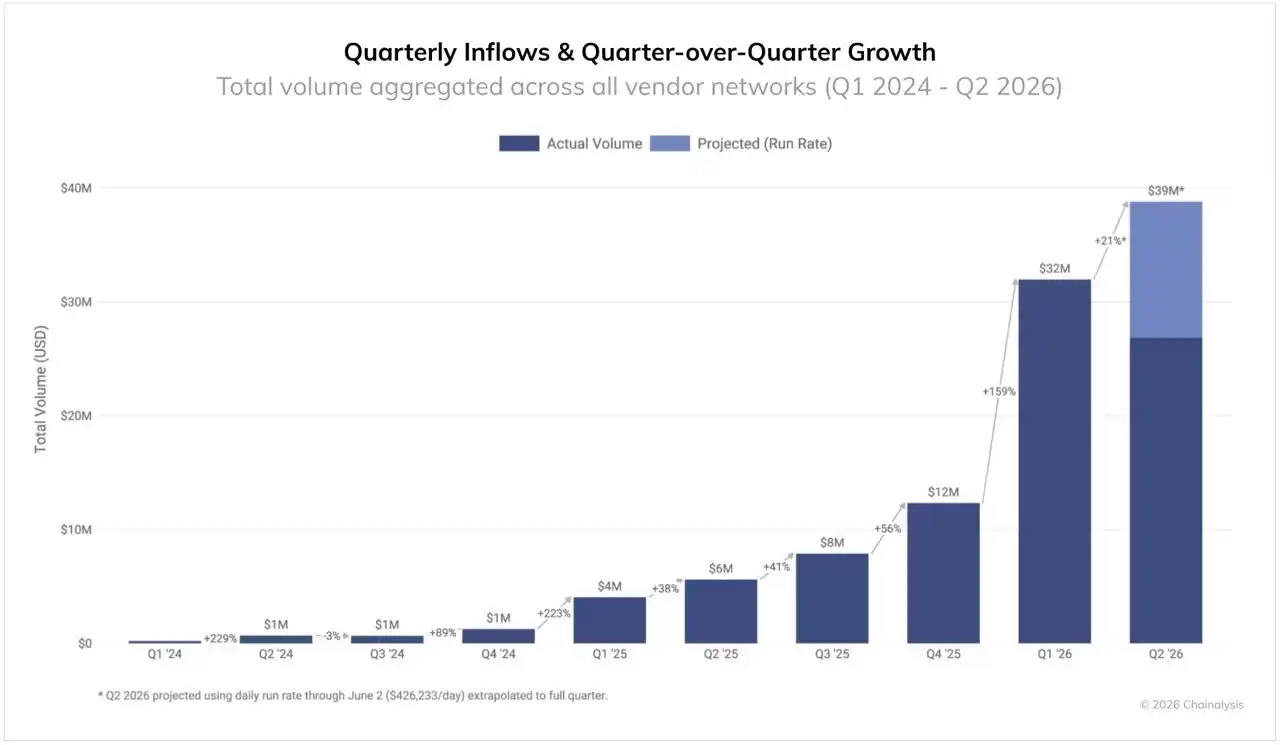
Security firm TRM Labs, using another method—combining on-chain analysis with public information investigations on drug precursor manufacturers—estimated crypto inflows into this sector at $41.4 million in 2025, a 20% year-on-year increase.

Ari Redbord, Global Head of Policy at TRM Labs, believes, "This market is huge and expanding. I'm not sure there's another pharmaceutical market in the world growing as fast as peptides."

This paints a somewhat dramatic scene: regular gym-goers, podcast listeners, middle-aged individuals wanting to lose weight—these demographics are being linked to gray-market buyers.

Despite the growth, industry investors estimate the overall size of the peptide black market to be between $1 billion and $3 billion. The volume using cryptocurrency as a payment method remains very small.

A Bar Adorned with Crypto Memorabilia

The most interesting scene in Bloomberg's report takes place in a corner of a bar in Manhattan—walls covered with crypto memorabilia, over a hundred people crammed into a stuffy room, listening to a lecture on peptides.

The organizer was DeSciNYC, a monthly in-person gathering for science enthusiasts, with the slogan "Science for everyone." Its past themes have included: longevity, CRISPR gene editing, AI & science, microbiome, bioelectricity, tardigrades, cellular metabolism, academic publishing fraud, prediction markets, etc.

This peptide-themed session was called "Peptides 101." The speaker was Julius Ritter, in his twenties, founder of the California Peptide Club, who also runs a longevity-themed meal delivery company and operates a hackathon house in San Francisco. He spent an hour covering peptide chemistry, potential uses, some risks, and several specific products, finally lifting his black T-shirt and injecting himself on the spot, earning a round of applause.

This scene illustrates something more direct than payment data: the connection between crypto and this market is not just a payment channel; it's the same crowd. The DeSci, longevity, biohacking, and fitness self-optimization circles are highly overlapping, with the crypto community being frequent visitors.

Regulation Is Moving, This Use Case Might Disappear

It's worth noting that the US is moving in the direction of "legalization."

The FDA is convening advisory committees to discuss whether to allow the legal domestic production of some popular peptides. US Secretary of Health and Human Services, Robert F. Kennedy Jr., has publicly supported this direction, arguing that legalization "helps shift demand away from the black market." Lee Rosebush, President of the American Peptide Medical Association, which advocates for regulation, used the term "Wild West" to describe the current market state. He believes stricter rules could actually squeeze out "for research only" manufacturers, making it easier for patients to obtain safe medication.

If this path succeeds, crypto payments' position in this market could become awkward—its current share largely occupies the space left by the absence of the traditional payment system.

Zach himself plans to exit. He says he has already reached his target weight.

Trending Cryptos

Related Questions

QAccording to the article, why is a market for unapproved weight-loss peptides using Bitcoin payments emerging in the United States?

AThe market is emerging because these unapproved peptide products, often sold as 'research chemicals,' face significant legal and regulatory risks. As a result, traditional payment networks like banks and credit cards are often unwilling to process transactions for these sellers. Bitcoin provides a workaround, allowing sellers to receive payments from buyers who cannot access these products through approved channels. Additionally, the large price difference compared to buying from domestic 'gray market' sources is a key driver for consumers to learn and use Bitcoin.

QWhat key difference in payment preference is highlighted between large-scale and small-scale buyers in the peptide crypto market?

AAccording to blockchain data cited in the article, stablecoins have surpassed Bitcoin as the preferred payment method for sellers dealing with large-scale transactions where the average order value exceeds $1,000. However, for small-scale retail buyers making smaller purchases, Bitcoin remains the dominant cryptocurrency used for payment.

QWhat does the scene at the DeSciNYC event in a Manhattan bar illustrate about the connection between the crypto community and the peptide market?

AThe scene illustrates that the connection goes beyond just a payment method. It shows that the communities for decentralized science (DeSci), biohacking, longevity, fitness optimization, and cryptocurrency are highly overlapping. The event, focused on peptide education and featuring a live injection demonstration, attracted a crowd in a crypto-themed bar, indicating shared interests and values between these groups.

QBased on the article, what potential regulatory change in the U.S. could threaten the use of cryptocurrencies in the peptide market?

AThe U.S. Food and Drug Administration (FDA) is considering allowing the legal domestic production of some popular peptide compounds. Key figures like Health and Human Services Secretary RFK Jr. support this move to shift demand away from the black market. If successful, this legalization would likely integrate peptide sales into the traditional financial and pharmaceutical systems, reducing the need for cryptocurrency as a workaround payment method and potentially causing its role in this specific market to diminish.

QWhat was the primary motivation for 'Zach', the 49-year-old marketing director, to use Bitcoin for the first time?

AZach's primary motivation was the massive cost savings. He found a Chinese seller offering a one-year supply (20 bottles) of the unapproved weight-loss drug retatrutide for $240 total. In contrast, purchasing a similar supply from U.S.-based secondary sellers would cost him $300 per month, or $3,600 per year. The enormous price disparity made him decide that the risk and effort of learning to use Bitcoin were 'worth taking.'

Related Reads

As Consensus Accelerates, What Are Young Investors Betting On?

Title: As Consensus Forms Faster, What Are Young Investors Betting On? In the rapid evolution of tech investment, a new generation of young investors is navigating a landscape where AI, robotics, commercial aerospace, and quantum computing are advancing simultaneously. Traditional investment logic based on financial models is giving way to a need for deep technical understanding and the ability to act before industry consensus forms. An analysis of trends from the "WAIC FUTURE TECH" list of young investment leaders reveals key shifts in focus. The first major trend is the movement of AI from the digital screen into the physical world. Investment is shifting from large language models and chatbots towards embodied AI, robotics, AI hardware, and edge computing. While demonstrations generate excitement, the real challenge lies in achieving scalable, reliable, and cost-effective delivery in complex real-world environments like factories and logistics. Success depends not just on algorithms but on the integration of sensors, actuators, and control systems. Second, the competitive focus for large models is moving beyond raw capability toward building an "intelligence flywheel." The goal is to create self-reinforcing systems where user interaction generates data, improving the model, which in turn enhances the user experience and attracts more engagement. Companies that successfully embed AI into workflows to create these closed-loop systems can build lasting value that isn't easily erased by the next model upgrade. Third, facing a potential bottleneck in high-quality human-generated data, investors are looking at new underlying technologies. Reinforcement learning and self-play, as demonstrated by AlphaGo Zero, offer paths for AI to generate its own experience. Scientific foundation models, which aim to build general AI capabilities for fields like life sciences and materials discovery, represent a non-consensus direction that could unlock new frontiers of knowledge and data. Finally, in deep-tech areas like quantum computing, commercial aerospace, and space-based infrastructure, patient capital is essential. These fields have long, uncertain development and validation cycles involving complex engineering, supply chains, and regulations. Investment here requires a long-term view, focusing on foundational team capabilities and the eventual emergence of market demand, even if commercial returns are distant. Collectively, these trends illustrate how young investors are adapting to a new era. They are learning to make earlier, technically-informed judgments, balance hype with real-world viability, and provide the patient capital needed to build the deep-tech foundations of the future.

marsbit22m ago

As Consensus Accelerates, What Are Young Investors Betting On?

marsbit22m ago

Can Japan Buy Growth with AI? Will the Bond Market Believe It?

Japan's cabinet has introduced the 2026 Basic Policy on Economic and Fiscal Management and Reform, shifting its primary fiscal target. The new framework moves away from the traditional annual primary balance goal and instead prioritizes a stable reduction of the debt-to-GDP ratio. This change is tied to a strategy of increased "responsible proactive fiscal" spending, aiming to boost long-term growth through investments in strategic sectors like AI, semiconductors, energy, and robotics. The government estimates total public and private investment in 62 key technologies could exceed 370 trillion yen by 2040. The market reaction has been mixed and cautious. While equity markets may respond to policy signals, bond markets are focused on fiscal credibility. Concerns center on whether the weakening of the clear primary balance anchor could lead to looser fiscal discipline. If investors doubt that these strategic investments will generate sufficient productivity gains, tax revenue, and nominal growth to outpace rising interest costs, they may demand higher yields on Japanese Government Bonds (JGBs). Recent volatility in the yen and JGB yields, with the 10-year yield briefly reaching 2.9%, reflects this skepticism. The success of this new framework hinges on two factors: whether Japan can achieve a nominal growth rate consistently higher than its long-term interest rates, and whether future budgets demonstrate disciplined control over bond issuance. The government's narrative is that strategic investment is essential to break Japan's cycle of low growth, aging, and labor shortages. However, the bond market will continuously assess the credibility of this plan, pricing the risk that it may represent fiscal expansion rather than a viable growth strategy.

marsbit59m ago

Can Japan Buy Growth with AI? Will the Bond Market Believe It?

marsbit59m ago

Misjudged A-Shares: Resilience, Expectations, and Confidence

China's A-share market recently faced selling pressure, especially in tech sectors, initially triggered by a global tech sell-off that began in South Korea. However, the article argues this is a case of "mistaken injury" and highlights the market's underlying resilience. This resilience stems from three main pillars: **1) Tech Sector Fundamentals:** Unlike Korea's market dominated by a few memory chip stocks, China's tech sector is diversified across computing, communications, electronics, and semiconductors, supported by dual narratives of global AI supply chains and domestic substitution. Core areas like optical modules and fiber optics continue to show strong earnings growth. **2) "National Team" Support:** State-backed institutions and large corporations have made significant market purchases and announced buybacks, providing liquidity and signaling confidence. This is seen as a stabilizing policy signal, often associated with market bottoms. **3) Broader Market Pillars:** Other major sectors are showing endogenous recovery momentum. Consumer stocks benefit from stabilizing CPI and signs of sector recovery (e.g., liquor price hikes). Cyclical sectors like aluminum have high earnings, potential price increases due to tight supply, and low valuations. The financial sector offers stable dividends and low valuations. The conclusion is that the sell-off was driven by external contagion, not a collapse in fundamentals. With strong policy support and recovering momentum across key sectors, the A-share market possesses the toughness to regain stability.

marsbit1h ago

Misjudged A-Shares: Resilience, Expectations, and Confidence

marsbit1h ago

Trading

Spot

Hot Articles

What is $BITCOIN

DIGITAL GOLD ($BITCOIN): A Comprehensive Analysis Introduction to DIGITAL GOLD ($BITCOIN) DIGITAL GOLD ($BITCOIN) is a blockchain-based project operating on the Solana network, which aims to combine the characteristics of traditional precious metals with the innovation of decentralized technologies. While it shares a name with Bitcoin, often referred to as “digital gold” due to its perception as a store of value, DIGITAL GOLD is a separate token designed to create a unique ecosystem within the Web3 landscape. Its goal is to position itself as a viable alternative digital asset, although specifics regarding its applications and functionalities are still developing. What is DIGITAL GOLD ($BITCOIN)? DIGITAL GOLD ($BITCOIN) is a cryptocurrency token explicitly designed for use on the Solana blockchain. In contrast to Bitcoin, which provides a widely recognized value storage role, this token appears to focus on broader applications and characteristics. Notable aspects include: Blockchain Infrastructure: The token is built on the Solana blockchain, known for its capacity to handle high-speed and low-cost transactions. Supply Dynamics: DIGITAL GOLD has a maximum supply capped at 100 quadrillion tokens (100P $BITCOIN), although details regarding its circulating supply are currently undisclosed. Utility: While precise functionalities are not explicitly outlined, there are indications that the token could be utilized for various applications, potentially involving decentralized applications (dApps) or asset tokenization strategies. Who is the Creator of DIGITAL GOLD ($BITCOIN)? At present, the identity of the creators and development team behind DIGITAL GOLD ($BITCOIN) remains unknown. This situation is typical among many innovative projects within the blockchain space, particularly those aligning with decentralized finance and meme coin phenomena. While such anonymity may foster a community-driven culture, it intensifies concerns about governance and accountability. Who are the Investors of DIGITAL GOLD ($BITCOIN)? The available information indicates that DIGITAL GOLD ($BITCOIN) does not have any known institutional backers or prominent venture capital investments. The project seems to operate on a peer-to-peer model focused on community support and adoption rather than traditional funding routes. Its activity and liquidity are primarily situated on decentralized exchanges (DEXs), such as PumpSwap, rather than established centralized trading platforms, further highlighting its grassroots approach. How DIGITAL GOLD ($BITCOIN) Works The operational mechanics of DIGITAL GOLD ($BITCOIN) can be elaborated on based on its blockchain design and network attributes: Consensus Mechanism: By leveraging Solana’s unique proof-of-history (PoH) combined with a proof-of-stake (PoS) model, the project ensures efficient transaction validation contributing to the network's high performance. Tokenomics: While specific deflationary mechanisms have not been extensively detailed, the vast maximum token supply implies that it may cater to microtransactions or niche use cases that are still to be defined. Interoperability: There exists the potential for integration with Solana’s broader ecosystem, including various decentralized finance (DeFi) platforms. However, the details regarding specific integrations remain unspecified. Timeline of Key Events Here is a timeline that highlights significant milestones concerning DIGITAL GOLD ($BITCOIN): 2023: The initial deployment of the token occurs on the Solana blockchain, marked by its contract address. 2024: DIGITAL GOLD gains visibility as it becomes available for trading on decentralized exchanges like PumpSwap, allowing users to trade it against SOL. 2025: The project witnesses sporadic trading activity and potential interest in community-led engagements, although no noteworthy partnerships or technical advancements have been documented as of yet. Critical Analysis Strengths Scalability: The underlying Solana infrastructure supports high transaction volumes, which could enhance the utility of $BITCOIN in various transaction scenarios. Accessibility: The potential low trading price per token could attract retail investors, facilitating wider participation due to fractional ownership opportunities. Risks Lack of Transparency: The absence of publicly known backers, developers, or an audit process may yield skepticism regarding the project's sustainability and trustworthiness. Market Volatility: The trading activity is heavily reliant on speculative behavior, which can result in significant price volatility and uncertainty for investors. Conclusion DIGITAL GOLD ($BITCOIN) emerges as an intriguing yet ambiguous project within the rapidly evolving Solana ecosystem. While it attempts to leverage the “digital gold” narrative, its departure from Bitcoin's established role as a store of value underscores the need for a clearer differentiation of its intended utility and governance structure. Future acceptance and adoption will likely depend on addressing the current opacity and defining its operational and economic strategies more explicitly. Note: This report encompasses synthesised information available as of October 2023, and developments may have transpired beyond the research period.

972 Total ViewsPublished 2025.05.13Updated 2025.05.13

What is $BITCOIN

Discussions

Welcome to the HTX Community. Here, you can stay informed about the latest platform developments and gain access to professional market insights. Users' opinions on the price of BTC (BTC) are presented below.

活动图片















