Inflation Slows, Bitcoin Stagnates Ahead of a Major Test for the Fed

cryptonews.ruPublished on 2026-08-12Last updated on 2026-08-12

Abstract

U.S. consumer price inflation (CPI) slowed in July, with monthly and yearly rates at 0.1% and 3.4% respectively, meeting market expectations. Core CPI, excluding food and energy, rose 0.2% for the month and 2.5% year-over-year, a multi-year low. The figures provided the Federal Reserve some breathing room after recent persistent price pressures, though policymakers are awaiting more sustained moderation. Housing costs, which accounted for two-thirds of the monthly CPI increase, remain a key challenge. Energy prices fell 1.5% in July as gasoline declined, but are still up 14.7% year-over-year due to earlier oil supply shocks. U.S. stocks rose on the news. Bitcoin, trading near $64,000, showed minimal volatility in response to the data, continuing its recent consolidation within the $60,000 range. The focus now shifts to the August CPI report in September for confirmation of a sustained disinflationary trend.

On August 12, the Bureau of Labor Statistics reported that the U.S. Consumer Price Index (CPI) rose 0.1% in July on a seasonally adjusted basis. This figure fully met expectations and brought the annual inflation rate down to 3.4% from 3.5% in June. The core CPI, excluding volatile food and energy prices, rose 0.2% for the month and 2.5% over the previous year. U.S. stocks immediately rose in pre-market trading on the news.

Inflation Retreats from Spring Peak

The latest data continues the downward trend that began in May, when annual inflation reached 4.2% amid an energy shock. The figure fell to 3.5% in June and continued to decline in July, providing policymakers with two consecutive more moderate readings after several months of renewed price pressures.

The housing sector remains one of the most challenging issues in the fight against inflation. Housing prices rose 0.1% in July and accounted for approximately two-thirds of the monthly increase in the overall CPI. Rent and owners' equivalent rent, which estimates what property owners would pay to rent their properties, rose 0.3%.

Food prices rose 0.1%, with prices for food away from home (restaurants and other food services) rising 0.3%. Prices for food at home (groceries) declined 0.1%. The energy situation was the opposite: energy prices fell 1.5% in July as gasoline prices fell 2.9% on a seasonally adjusted basis.

A Sharp 24.6% Jump in Gasoline Prices Continues to Fuel Inflation

This brief respite hardly means energy troubles are over. Energy prices remained 14.7% higher than a year ago, and gasoline prices are up 24.6%. These figures reflect the aftereffects of the previous oil price shock linked to Middle East tensions and supply disruptions in the first half of 2026. At the time of writing, Brent crude oil is at $91 per barrel and West Texas Intermediate (WTI) crude is at $83.
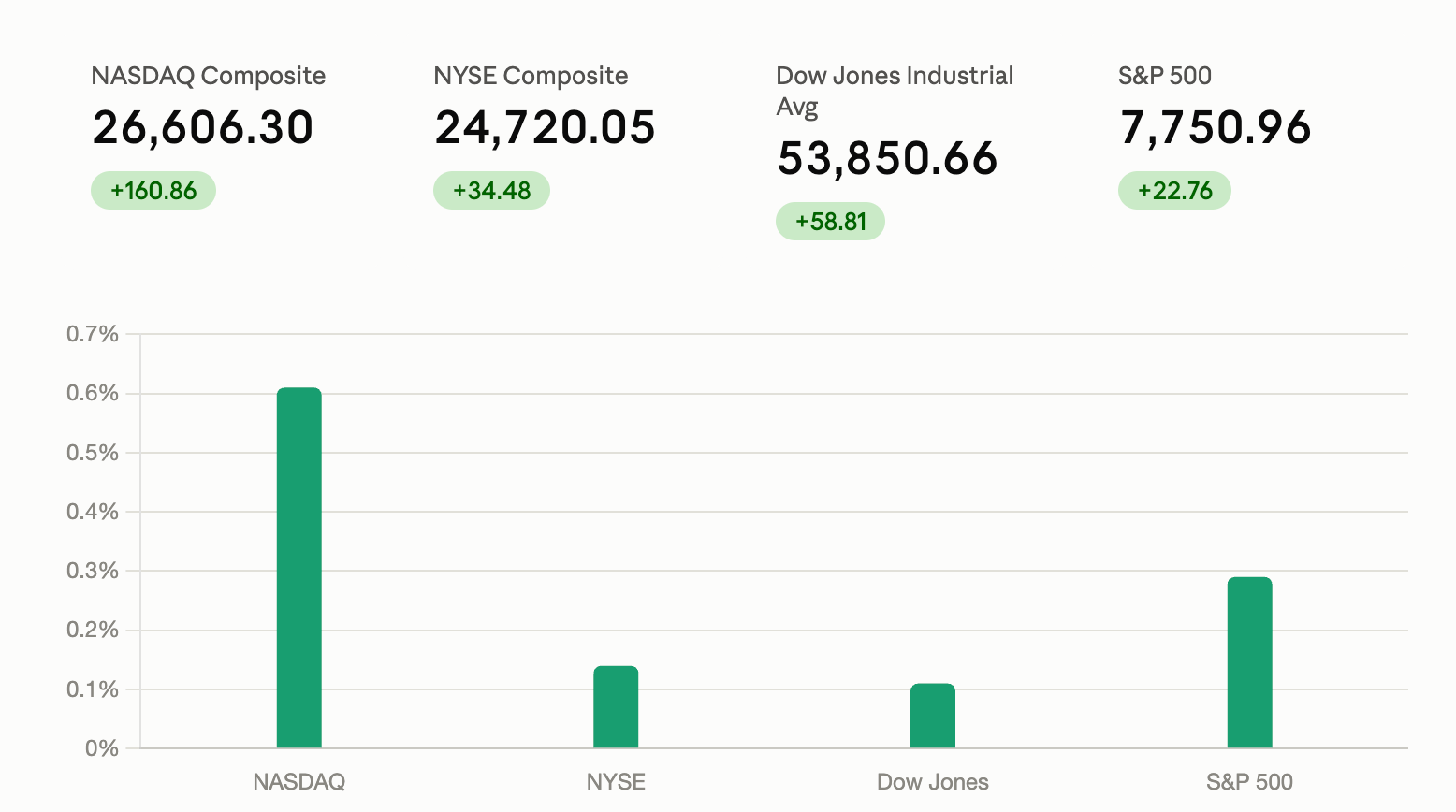
Overview of four major U.S. stock indices, all of which rose at market open on Wednesday, with the Nasdaq leading in percentage gain.

A clearer signal came from core inflation. Its annual rate of 2.5% is among the lowest readings since early 2021, although prices in several service categories continued to rise. In July, medical care service prices rose 0.4%, airfares rose 2.2%, prices for used cars and trucks rose 0.4%, and new vehicle prices rose 0.1%.

The Fed Gets a Reprieve, But Victory Is Still Far Off

For the Federal Reserve, the latest CPI report provides breathing room rather than forcing an immediate shift in monetary policy. At the end of July, the central bank kept the target range for the federal funds rate at 3.50–3.75%, although three members of the monetary policy committee dissented, effectively advocating for rate hikes. Officials have made it clear that several months of more moderate readings will be needed before it can be stated that inflation is confidently returning to the 2% mark.

July's inflation data somewhat reduces pressure for another rate hike, but energy remains a clear "trap." Another oil shock or persistent inflation in service sectors could put the question of policy tightening back on the agenda later this year, especially if housing prices stop declining.

Financial markets were largely braced for lower readings, which tempered the initial reaction in stocks and other risk assets. Real average hourly earnings also showed moderate pressure, as consumer price growth outpaced wage growth by some measures.

Bitcoin Holds Near $64,000 as CPI Data Fails to Spark Volatility

Bitcoin also remained calm following the report's release but has slipped about 0.4% over the past hour. The leading crypto asset traded in a range of roughly $63,800 to $64,300 in the hours leading up to the CPI release, after dipping to the lower $63,000 range earlier in the session.

In recent weeks, Bitcoin has fluctuated between the low-to-mid $60,000 range, with inflation data failing to spark the kind of dramatic volatility seen in previous periods of macroeconomic uncertainty.

The next key moment will arrive on September 11, when the government is scheduled to release August CPI data. Investors and Fed officials will scrutinize the energy, housing, and core services figures for confirmation that the slowdown seen in July is evolving into a sustained trend, not just another temporary dip.

end-content

Trending Cryptos

Related Questions

QAccording to the article, what was the annual inflation rate in the US for July, and how did it compare to June?

AThe annual inflation rate in the US for July was 3.4%, which was a decrease from the 3.5% rate recorded in June.

QWhat is the article's view on the Federal Reserve's monetary policy stance following the July CPI report?

AThe article states that the July CPI report gives the Federal Reserve room to wait rather than forcing immediate changes to monetary policy. Officials have indicated that several months of moderate data are needed before they can confidently declare that inflation is returning to the 2% target.

QHow did the prices for housing and energy behave in July, according to the data presented?

AIn July, housing costs rose by 0.1% and accounted for about two-thirds of the monthly increase in the overall CPI. Conversely, energy prices fell by 1.5%, driven by a 2.9% seasonal drop in gasoline prices.

QWhat was Bitcoin's price reaction to the release of the July CPI data, and what range had it been trading in recently?

ABitcoin showed a muted reaction to the CPI report, trading down about 0.4% in the hour after the release. It had been trading in a range of roughly $63,800 to $64,300 before the report and had recently been fluctuating in the low-to-mid $60,000 range.

QWhat upcoming event does the article identify as the next important milestone for investors and the Fed regarding inflation?

AThe article identifies the release of the August Consumer Price Index (CPI) data, scheduled for September 11, as the next important milestone. Investors and the Fed will analyze this data for confirmation that the July slowdown in inflation is becoming a sustained trend.

Related Reads

Trading

Spot

Hot Articles

What is $BITCOIN

DIGITAL GOLD ($BITCOIN): A Comprehensive Analysis Introduction to DIGITAL GOLD ($BITCOIN) DIGITAL GOLD ($BITCOIN) is a blockchain-based project operating on the Solana network, which aims to combine the characteristics of traditional precious metals with the innovation of decentralized technologies. While it shares a name with Bitcoin, often referred to as “digital gold” due to its perception as a store of value, DIGITAL GOLD is a separate token designed to create a unique ecosystem within the Web3 landscape. Its goal is to position itself as a viable alternative digital asset, although specifics regarding its applications and functionalities are still developing. What is DIGITAL GOLD ($BITCOIN)? DIGITAL GOLD ($BITCOIN) is a cryptocurrency token explicitly designed for use on the Solana blockchain. In contrast to Bitcoin, which provides a widely recognized value storage role, this token appears to focus on broader applications and characteristics. Notable aspects include: Blockchain Infrastructure: The token is built on the Solana blockchain, known for its capacity to handle high-speed and low-cost transactions. Supply Dynamics: DIGITAL GOLD has a maximum supply capped at 100 quadrillion tokens (100P $BITCOIN), although details regarding its circulating supply are currently undisclosed. Utility: While precise functionalities are not explicitly outlined, there are indications that the token could be utilized for various applications, potentially involving decentralized applications (dApps) or asset tokenization strategies. Who is the Creator of DIGITAL GOLD ($BITCOIN)? At present, the identity of the creators and development team behind DIGITAL GOLD ($BITCOIN) remains unknown. This situation is typical among many innovative projects within the blockchain space, particularly those aligning with decentralized finance and meme coin phenomena. While such anonymity may foster a community-driven culture, it intensifies concerns about governance and accountability. Who are the Investors of DIGITAL GOLD ($BITCOIN)? The available information indicates that DIGITAL GOLD ($BITCOIN) does not have any known institutional backers or prominent venture capital investments. The project seems to operate on a peer-to-peer model focused on community support and adoption rather than traditional funding routes. Its activity and liquidity are primarily situated on decentralized exchanges (DEXs), such as PumpSwap, rather than established centralized trading platforms, further highlighting its grassroots approach. How DIGITAL GOLD ($BITCOIN) Works The operational mechanics of DIGITAL GOLD ($BITCOIN) can be elaborated on based on its blockchain design and network attributes: Consensus Mechanism: By leveraging Solana’s unique proof-of-history (PoH) combined with a proof-of-stake (PoS) model, the project ensures efficient transaction validation contributing to the network's high performance. Tokenomics: While specific deflationary mechanisms have not been extensively detailed, the vast maximum token supply implies that it may cater to microtransactions or niche use cases that are still to be defined. Interoperability: There exists the potential for integration with Solana’s broader ecosystem, including various decentralized finance (DeFi) platforms. However, the details regarding specific integrations remain unspecified. Timeline of Key Events Here is a timeline that highlights significant milestones concerning DIGITAL GOLD ($BITCOIN): 2023: The initial deployment of the token occurs on the Solana blockchain, marked by its contract address. 2024: DIGITAL GOLD gains visibility as it becomes available for trading on decentralized exchanges like PumpSwap, allowing users to trade it against SOL. 2025: The project witnesses sporadic trading activity and potential interest in community-led engagements, although no noteworthy partnerships or technical advancements have been documented as of yet. Critical Analysis Strengths Scalability: The underlying Solana infrastructure supports high transaction volumes, which could enhance the utility of $BITCOIN in various transaction scenarios. Accessibility: The potential low trading price per token could attract retail investors, facilitating wider participation due to fractional ownership opportunities. Risks Lack of Transparency: The absence of publicly known backers, developers, or an audit process may yield skepticism regarding the project's sustainability and trustworthiness. Market Volatility: The trading activity is heavily reliant on speculative behavior, which can result in significant price volatility and uncertainty for investors. Conclusion DIGITAL GOLD ($BITCOIN) emerges as an intriguing yet ambiguous project within the rapidly evolving Solana ecosystem. While it attempts to leverage the “digital gold” narrative, its departure from Bitcoin's established role as a store of value underscores the need for a clearer differentiation of its intended utility and governance structure. Future acceptance and adoption will likely depend on addressing the current opacity and defining its operational and economic strategies more explicitly. Note: This report encompasses synthesised information available as of October 2023, and developments may have transpired beyond the research period.

1.8k Total ViewsPublished 2025.05.13Updated 2025.05.13

What is $BITCOIN

Discussions

Welcome to the HTX Community. Here, you can stay informed about the latest platform developments and gain access to professional market insights. Users' opinions on the price of BTC (BTC) are presented below.

活动图片