By The Numbers: How Do Bitcoin, Ethereum, & Dogecoin Compare In Addresses?

bitcoinistPublished on 2025-12-20Last updated on 2025-12-20

Abstract

Santiment's on-chain analysis reveals Ethereum leads in total number of addresses with non-zero balances at 167.96 million, significantly ahead of Bitcoin's 57.62 million. This gap is attributed to Ethereum's robust ecosystem of layer two blockchains and DeFi applications. USDT stablecoin ranks third with 9.63 million addresses, followed by Dogecoin (8.13 million) and XRP (7.41 million). While Bitcoin's holder count has remained relatively flat over the past year, Ethereum has continued to grow, further extending its lead. This growth is supported by a spike in Ethereum's Network Growth metric, which now averages 163,000 new addresses per day compared to 124,000 in July. At the time of writing, Bitcoin was trading around $87,500, down 2% over the week.

On-chain analytics firm Santiment has shared the data about how Bitcoin, Ethereum, and other top coins compare in Total Amount of Holders.

Ethereum Beats Bitcoin, Dogecoin, & Others In Total Amount Of Holders

In a new post on X, Santiment has talked about where the Total Amount of Holders indicator stands for Bitcoin, Dogecoin, and other coins in the cryptocurrency sector today. This metric measures, as its name suggests, the total number of addresses carrying a non-empty balance on a given network.

When the value of this indicator rises, it can be a sign that new investors are joining the blockchain and/or old investors who sold earlier are making a return. The trend can also arise from existing holders creating multiple wallets for accounting or privacy purposes.

In general, all of these factors can be assumed to simultaneously be in action whenever the Total Amount of Holders registers an increase. As such, some net adoption of the cryptocurrency can be considered to have occurred.

On the other hand, the metric going down implies some investors have cleaned out their wallet balances, potentially because they have decided to exit the blockchain.

Now, here is the chart shared by Santiment that shows the trend in the Total Amount of Holders for eight different cryptocurrencies:
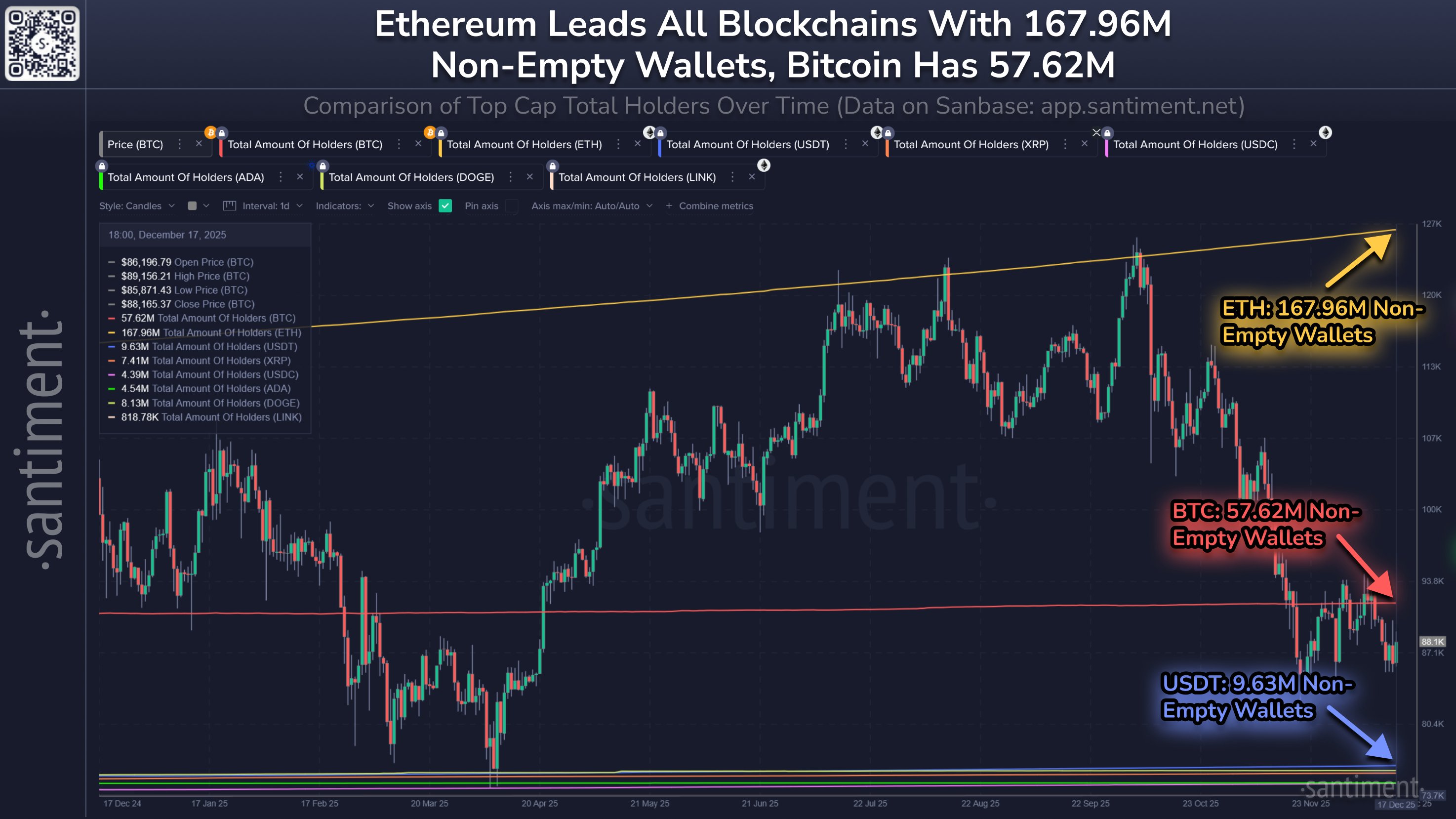
The metric's value appears to be the highest for ETH right now | Source: Santiment on X

As displayed in the above graph, Ethereum is the most dominant cryptocurrency in terms of the Total Amount of Holders, with the metric sitting at 167.96 million. Bitcoin, the next largest network, only hosts a userbase that’s a third of ETH’s (about 57.62 million addresses).

Ethereum’s dominance could be down to the fact that the blockchain hosts a vibrant ecosystem of layer two blockchains and decentralized finance (DeFi) applications, made possible by its smart-contracts system.

The gulf between Bitcoin and third place is again massive, with the stablecoin USDT having 9.63 million non-empty wallets. From USDT on, however, the altcoins are much closer to each other.

Dogecoin and XRP are the cryptocurrencies with the fourth and fifth largest holder counts on the list with the indicator having a value of 8.13 million and 7.41 million, respectively.

From the chart, it’s visible that while Bitcoin has seen a more or less flat trajectory in the Total Amount of Holders during the last year, Ethereum has only been witnessing growth, extending its lead.

The adoption trend for ETH is also visible from another indicator shared by the analytics firm, known as the Network Growth. This metric keeps track of the new addresses appearing on the blockchain.
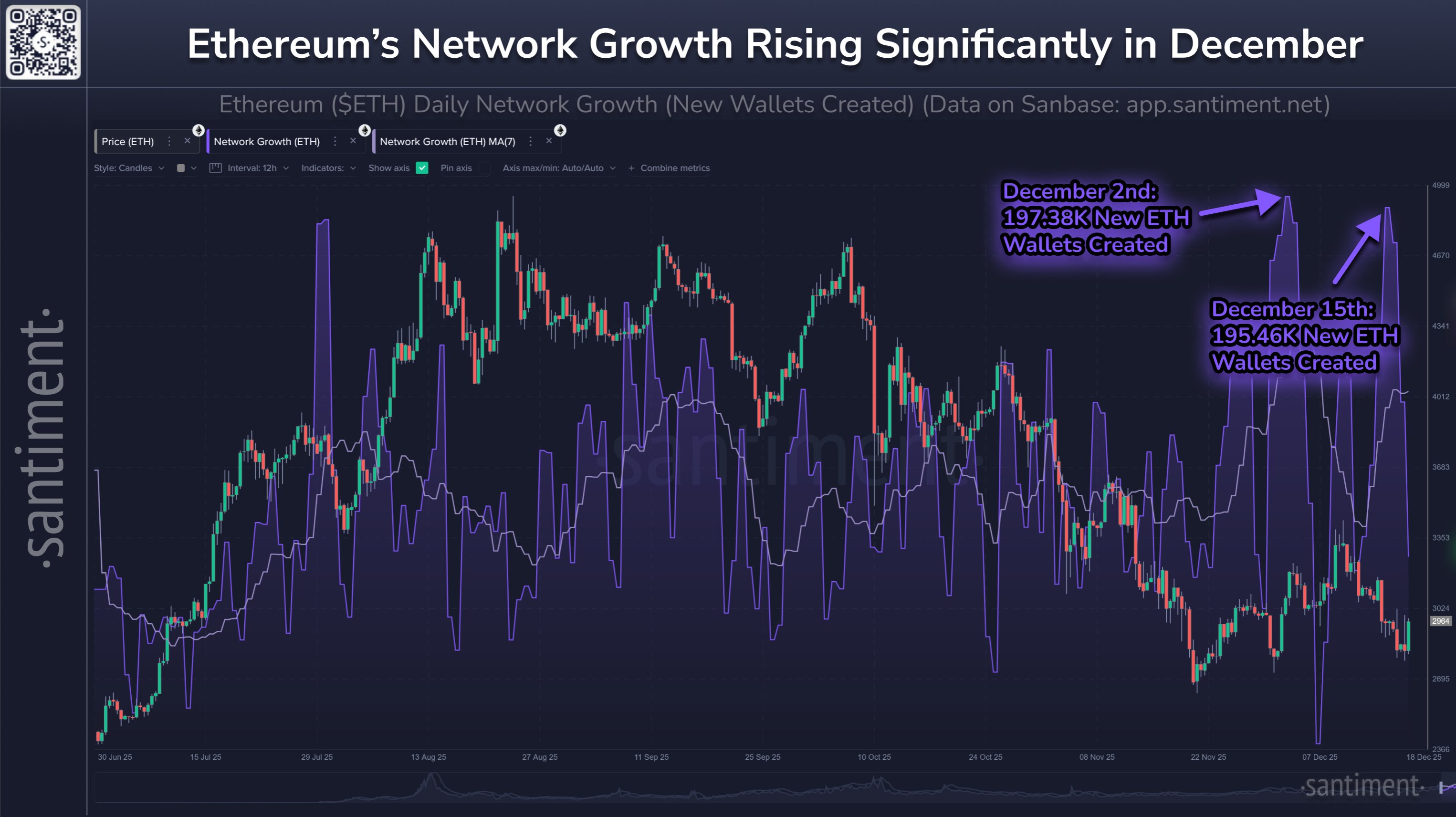
The trend in the ETH Network Growth over the last few months | Source: Santiment on X

As is apparent from the chart, the Ethereum Network Growth has spiked recently. “The #2 market cap is seeing an average of 163K new addresses per day, compared to 124K in July,” noted Santiment.

BTC Price

At the time of writing, Bitcoin is trading around $87,500, down 2% over the last week.

Looks like the price of the coin has consolidated recently | Source: BTCUSDT on TradingView

Trending Cryptos

Related Questions

QWhich cryptocurrency has the highest Total Amount of Holders according to Santiment's data?

AEthereum has the highest Total Amount of Holders with 167.96 million addresses.

QWhat is the Total Amount of Holders for Bitcoin and how does it compare to Ethereum?

ABitcoin has 57.62 million non-empty addresses, which is about one-third of Ethereum's total.

QWhat does an increase in the Total Amount of Holders metric typically indicate?

AAn increase suggests new investors are joining, old investors are returning, or existing holders are creating multiple wallets for accounting or privacy purposes, indicating net adoption.

QHow does Dogecoin rank in terms of Total Amount of Holders among the mentioned cryptocurrencies?

ADogecoin ranks fourth with 8.13 million non-empty addresses, behind Ethereum, Bitcoin, and USDT.

QWhat recent trend has been observed in Ethereum's Network Growth metric?

AEthereum's Network Growth has spiked recently, with an average of 163,000 new addresses per day compared to 124,000 in July.

Related Reads

July Security Report: Total Losses Approximately $97 Million, Cross-Chain Bridge Attacks Concentrated with Over $35 Million

In July 2026, the cryptocurrency sector suffered total losses of approximately $97 million, with hacker attacks and contract vulnerabilities accounting for about $94 million. A significant trend was the shift in attack vectors from smart contract code to off-chain infrastructure, signature key leaks, and governance manipulation. Major incidents included: * **Ostium ($23.75M loss):** An attacker gained access to its off-chain price oracle signing system, manipulated BTC prices, and drained funds. * **AFX Trade Bridge ($24.15M loss):** The private validator key for its cross-chain bridge was compromised, allowing unauthorized withdrawals. * **BonkDAO ($20M loss):** An attacker acquired enough tokens to pass a malicious governance proposal and drain the treasury, exploiting low voting thresholds. * **Bonzo Lend ($9.05M loss):** A third-party oracle provider's signature verification was exploited to inject manipulated token prices. * **Verus Bridge ($7.55M loss):** A repeat attack exploiting the same unpatched bridge vulnerability. * **B2 Network ($3.86M loss):** An attacker seized the upgrade authority for a staking contract. Cross-chain bridges remained a prime target, with concentrated attacks causing over $35 million in losses. Phishing scams resulted in roughly $3 million in losses, employing sophisticated methods like fake mobile apps and physical counterfeit letters targeting Ledger users. Key takeaways are the acceleration of attacks on off-chain infrastructure, the persistent vulnerability of cross-chain bridges, and the rising prominence of governance-layer exploits. Recommendations include enhancing off-chain key management with multi-sig security, implementing stricter governance controls, and increasing user vigilance against phishing.

marsbit29m ago

July Security Report: Total Losses Approximately $97 Million, Cross-Chain Bridge Attacks Concentrated with Over $35 Million

marsbit29m ago

AI Bulk Bombards Apple Bug Bounty Program, Review Team Has Gone Offline

Apple has temporarily suspended and limited submissions to its Bug Bounty Program due to a flood of AI-generated vulnerability reports. The program, launched in 2016 and offering rewards up to $5 million, has been overwhelmed by reports from amateur researchers using tools like ChatGPT, many containing false positives or "AI hallucinations." This AI-driven surge in bug reports is straining Apple's security review team, leading the company to impose a 30-day "cooling-off" period and submission caps. The trend highlights a broader industry challenge, with other major firms like Google and GitHub also adjusting their vulnerability disclosure programs. Paradoxically, while AI is creating a reporting bottleneck, it's also accelerating defense. Apple's recent macOS Tahoe 26.6 security update, which patched 194 vulnerabilities, included its first-ever acknowledgments to AI tools (Claude, Codex Security, etc.) for helping discover flaws. This forces Apple into faster, more frequent security updates, a departure from its traditionally controlled release cadence. A key example involves Apple's advanced "Memory Integrity Enforcement" (MIE) security feature, touted as a major breakthrough. However, researchers using an AI model bypassed its protections in just five days, demonstrating both the power and disruptive pace of AI in cybersecurity. The incident underscores a critical shift: as AI compresses the vulnerability discovery cycle to days, traditional monthly security update cycles may become dangerously long exposure windows.

marsbit1h ago

AI Bulk Bombards Apple Bug Bounty Program, Review Team Has Gone Offline

marsbit1h ago

Qualcomm Wants to Expand the Market with Dual Flagship Chips but Hits Memory Price Hikes

Qualcomm is reportedly planning to launch a dual-flagship chip strategy for its upcoming 2nm-based Snapdragon 8 Elite Gen 6 platform in 2026, featuring both a standard and a Pro version. This move aims to expand the reach of its premium chipsets beyond just ultra-high-end phones into more mainstream flagship models, similar to Apple's approach with its A-series chips. However, this expansion plan coincides with a significant and likely prolonged surge in memory prices, driven by AI data centers consuming production capacity for HBM and server DRAM. This cost increase squeezes the entire smartphone market, particularly price-sensitive segments. While Pro-tier chips might still find a place in expensive Ultra models, the standard version—intended to make the new platform more accessible—may not result in meaningfully lower phone prices. The savings from using a less powerful chip could be offset by higher memory costs. Consequently, consumers might face a scenario where phones with the standard chip are still expensive but lack the "best" specs, creating a perception gap. With Qualcomm also hinting at potential price hikes for its chips, smartphone makers are caught in a difficult position: use the Pro version and risk prohibitively high prices, use the standard version and market a "lesser" flagship, or rely on previous-generation chips and struggle with marketing. Ultimately, Qualcomm's strategy to broaden its flagship lineup through product segmentation is being undermined by market forces that are shrinking consumer demand and raising overall device costs. This could lead to a more expensive and confusing premium Android market, potentially pushing consumers towards older, discounted models instead.

marsbit1h ago

Qualcomm Wants to Expand the Market with Dual Flagship Chips but Hits Memory Price Hikes

marsbit1h ago

Three Industry Signals from the Systematic Revision of the 'Regulations on the Protection of Integrated Circuit Layout Designs'

The revised "Regulations on the Protection of Integrated Circuit Layout Designs" were promulgated on July 23, 2026, marking the first comprehensive amendment since its 2001 implementation. The revision sends three key industry signals. First, the protection scope is expanded from "semiconductor" to include "semiconductor + photonics + quantum," formally covering next-generation technologies like silicon photonics and quantum chips in the post-Moore era. Second, it introduces a "statement of originality" system to address long-standing difficulties in defining protection scope and proving infringement. Applicants must now clearly indicate the original portions of their design. Procedures for rejection, revocation (including third-party initiated), and rights restoration are also refined. Third, infringement penalties are significantly strengthened, shifting from compensatory to punitive damages. For willful and serious infringement, punitive damages of 1 to 5 times the actual loss, illicit profits, or license fees can be applied. Beneficiaries include IC design firms in emerging fields and IP suppliers. Entities facing new pressure include those reliant on reverse engineering, applicants filing fraudulent registrations, and packaging/test houses with heightened compliance duties. The amendment provides clearer rules, but their practical impact will be tested in post-implementation judicial practice, where courts are expected to strictly scrutinize rights foundations, originality, and commercial use timelines.

marsbit2h ago

Three Industry Signals from the Systematic Revision of the 'Regulations on the Protection of Integrated Circuit Layout Designs'

marsbit2h ago

Trading

Spot

Hot Articles

What is $BITCOIN

DIGITAL GOLD ($BITCOIN): A Comprehensive Analysis Introduction to DIGITAL GOLD ($BITCOIN) DIGITAL GOLD ($BITCOIN) is a blockchain-based project operating on the Solana network, which aims to combine the characteristics of traditional precious metals with the innovation of decentralized technologies. While it shares a name with Bitcoin, often referred to as “digital gold” due to its perception as a store of value, DIGITAL GOLD is a separate token designed to create a unique ecosystem within the Web3 landscape. Its goal is to position itself as a viable alternative digital asset, although specifics regarding its applications and functionalities are still developing. What is DIGITAL GOLD ($BITCOIN)? DIGITAL GOLD ($BITCOIN) is a cryptocurrency token explicitly designed for use on the Solana blockchain. In contrast to Bitcoin, which provides a widely recognized value storage role, this token appears to focus on broader applications and characteristics. Notable aspects include: Blockchain Infrastructure: The token is built on the Solana blockchain, known for its capacity to handle high-speed and low-cost transactions. Supply Dynamics: DIGITAL GOLD has a maximum supply capped at 100 quadrillion tokens (100P $BITCOIN), although details regarding its circulating supply are currently undisclosed. Utility: While precise functionalities are not explicitly outlined, there are indications that the token could be utilized for various applications, potentially involving decentralized applications (dApps) or asset tokenization strategies. Who is the Creator of DIGITAL GOLD ($BITCOIN)? At present, the identity of the creators and development team behind DIGITAL GOLD ($BITCOIN) remains unknown. This situation is typical among many innovative projects within the blockchain space, particularly those aligning with decentralized finance and meme coin phenomena. While such anonymity may foster a community-driven culture, it intensifies concerns about governance and accountability. Who are the Investors of DIGITAL GOLD ($BITCOIN)? The available information indicates that DIGITAL GOLD ($BITCOIN) does not have any known institutional backers or prominent venture capital investments. The project seems to operate on a peer-to-peer model focused on community support and adoption rather than traditional funding routes. Its activity and liquidity are primarily situated on decentralized exchanges (DEXs), such as PumpSwap, rather than established centralized trading platforms, further highlighting its grassroots approach. How DIGITAL GOLD ($BITCOIN) Works The operational mechanics of DIGITAL GOLD ($BITCOIN) can be elaborated on based on its blockchain design and network attributes: Consensus Mechanism: By leveraging Solana’s unique proof-of-history (PoH) combined with a proof-of-stake (PoS) model, the project ensures efficient transaction validation contributing to the network's high performance. Tokenomics: While specific deflationary mechanisms have not been extensively detailed, the vast maximum token supply implies that it may cater to microtransactions or niche use cases that are still to be defined. Interoperability: There exists the potential for integration with Solana’s broader ecosystem, including various decentralized finance (DeFi) platforms. However, the details regarding specific integrations remain unspecified. Timeline of Key Events Here is a timeline that highlights significant milestones concerning DIGITAL GOLD ($BITCOIN): 2023: The initial deployment of the token occurs on the Solana blockchain, marked by its contract address. 2024: DIGITAL GOLD gains visibility as it becomes available for trading on decentralized exchanges like PumpSwap, allowing users to trade it against SOL. 2025: The project witnesses sporadic trading activity and potential interest in community-led engagements, although no noteworthy partnerships or technical advancements have been documented as of yet. Critical Analysis Strengths Scalability: The underlying Solana infrastructure supports high transaction volumes, which could enhance the utility of $BITCOIN in various transaction scenarios. Accessibility: The potential low trading price per token could attract retail investors, facilitating wider participation due to fractional ownership opportunities. Risks Lack of Transparency: The absence of publicly known backers, developers, or an audit process may yield skepticism regarding the project's sustainability and trustworthiness. Market Volatility: The trading activity is heavily reliant on speculative behavior, which can result in significant price volatility and uncertainty for investors. Conclusion DIGITAL GOLD ($BITCOIN) emerges as an intriguing yet ambiguous project within the rapidly evolving Solana ecosystem. While it attempts to leverage the “digital gold” narrative, its departure from Bitcoin's established role as a store of value underscores the need for a clearer differentiation of its intended utility and governance structure. Future acceptance and adoption will likely depend on addressing the current opacity and defining its operational and economic strategies more explicitly. Note: This report encompasses synthesised information available as of October 2023, and developments may have transpired beyond the research period.

1.4k Total ViewsPublished 2025.05.13Updated 2025.05.13

What is $BITCOIN

Discussions

Welcome to the HTX Community. Here, you can stay informed about the latest platform developments and gain access to professional market insights. Users' opinions on the price of BTC (BTC) are presented below.

活动图片