StarDynamics Secures 2.5 Billion in Two Months, State-Owned Capital Consortium Joins In

marsbitPublished on 2026-07-06Last updated on 2026-07-06

Abstract

Star Era Raises 25 Billion Yuan in Two Months with State Capital Leading the Charge. Chinese humanoid robotics leader Star Era has secured a new 10-billion-yuan funding round led by state-owned capital, including funds like Chengtong Fund under the SASAC, marking 25 billion yuan raised within two months. The company, a spin-off from Tsinghua University, has built a comprehensive capital matrix combining state guidance, top-tier financial backers, and industrial partners. Founded in 2023 by Dr. Chen Jianyu, one of Tsinghua's youngest doctoral supervisors, Star Era stands out for its early and pioneering work on "world models" for embodied AI, notably releasing its PAD world action model ahead of major global players. The company follows an AI-native, full-stack R&D strategy from data and AI brain to control, dexterous hands (XHAND series), and robot bodies (bipedal L7, wheeled Q5). A core innovation is its fully direct-drive dexterous hands, which act as high-fidelity data collectors for training its AI models like the ERA-42 and VLAW, creating a virtuous cycle of data and intelligence. Star Era claims to possess one of the world's largest real-world dexterous hand datasets. Commercially, Star Era has achieved product-market fit, most notably in logistics, with robots operating 24/7 in distribution centers for partners like SF Express and China Post, handling over 1,200 parcels per hour. It is also expanding into high-end manufacturing (Samsung, Geely) and commercial servi...

China's top embodied intelligence companies are engaged in a battle of titans—

Investment community learned that today (July 6), StarDynamics completed a new round of 1 billion yuan financing. This round was led by the State-owned Assets Supervision and Administration Commission's (SASAC) state-owned capital operation company, Chengtong Fund. Other major state-owned capital participants included Jiangxi State-owned Capital Operation Holding Group, Guoyuan Equity, Yufu Zhongxin Fund, Hangzhou Capital, and others. Additionally, CICC Renault, Jiukun Venture Capital, Hony Capital, Juntai Capital, and Shenghe Capital followed on; existing shareholders Houxue Capital, Tsinghua Unigroup Tiancheng, and Qianshan Capital continued to invest.

With this, StarDynamics has raised 2.5 billion yuan in intensive financing over two months, constructing a triple capital matrix of "National-Level Capital Leadership + Top-Tier Financial Empowerment + Industrial Ecosystem Synergy," which assembles the industry's most extensive industrial capital injections, totaling over 20 entities.

In past communications with investors, StarDynamics left a deep impression on us: it is Tsinghua University's only equity-held embodied company, one of the earliest to propose world models in embodied AI, and despite being only three years old, it has already achieved scaled deployment in logistics scenarios. China's embodied intelligence landscape is filled with various schools, yet StarDynamics has quietly broken through.

Tsinghua's Direct Robotics Lineage

2.5 Billion in Financing in Two Months

The outside world may not know that StarDynamics is the proponent of the world model concept in embodied intelligence.

Rewind to 2024, VLA (Vision-Language-Action) was still the industry mainstream, but StarDynamics had already begun exploring research on world models. Not only did StarDynamics first propose the "world model" approach, it also released its world model achievement earlier than most globally—the PAD model released in September 2024 was the world's first World Action Model (WAM), integrating video prediction and action prediction, released nearly a year before similar solutions from NVIDIA (like DreamZero).

At the time, this was a pioneering, "minority" voice, somewhat esoteric.

It wasn't until the second half of 2025 that discussions about world models began frequently appearing in the embodied field. In October that year, StarDynamics collaborated with the Stanford University team led by Chelsea Finn to introduce Ctrl-World, using world models as data simulators to generate training data approximating real-world physics, improving performance by 45% over Pi0.5. Subsequently, we witnessed a global explosion of world models, with the entire industry converging towards this direction.

Being able to move slightly ahead of the industry is inseparable from the unique academic background of its helmsman, Chen Jianyu.

Born in 1992, he was admitted to Tsinghua University's Department of Precision Instruments in 2011—one of China's earliest institutions engaged in bipedal humanoid robotics research. During his undergraduate studies, Chen Jianyu began researching gait planning for bipedal robots. He later went to the University of California, Berkeley, for a direct Ph.D., studying under Professor Masayoshi Tomizuka, a member of the U.S. National Academy of Engineering and a pioneer in mechatronic control, delving deeply into robot reinforcement learning and motion control algorithms.

After earning his Ph.D. in 2020, upon invitation from Turing Award laureate and Chinese Academy of Sciences academician Yao Qizhi, Chen Jianyu returned to China and joined Tsinghua University's Institute for Interdisciplinary Information Sciences, serving as an assistant professor. At 28, he became one of the youngest doctoral supervisors at Tsinghua at the time.

These academic and research experiences made Chen Jianyu a rare talent in the industry with both hardware + brain capabilities, leading to very forward-thinking and keen choices in technical roadmaps and model iterations. In August 2023, leveraging Tsinghua's technology transfer policies, Beijing StarDynamics was officially established. It is the only embodied intelligence enterprise with direct equity held by Tsinghua University, with Chen Jianyu as its founder.

His core judgment is: to achieve true general intelligence, robots must simultaneously possess a smart "brain" and a dexterous "body"—a robot without a brain easily becomes scrap metal, and a brain without a body can hardly be called a robot.

Therefore, from day one, StarDynamics has been driven by AI Native principles, constructing the industry's only full-stack self-developed barrier encompassing "data-brain-motion control-dexterous hand-body." The core logic is "algorithm requirements first, data value first," starting from the actual needs of brain model training and deployment, and reverse-defining hardware design. To date, it possesses three major product lines: the full-size bipedal humanoid robot Star-L7, the wheeled humanoid service robot Star-Q5, and the full direct-drive five-finger dexterous hand Star-XHAND series.
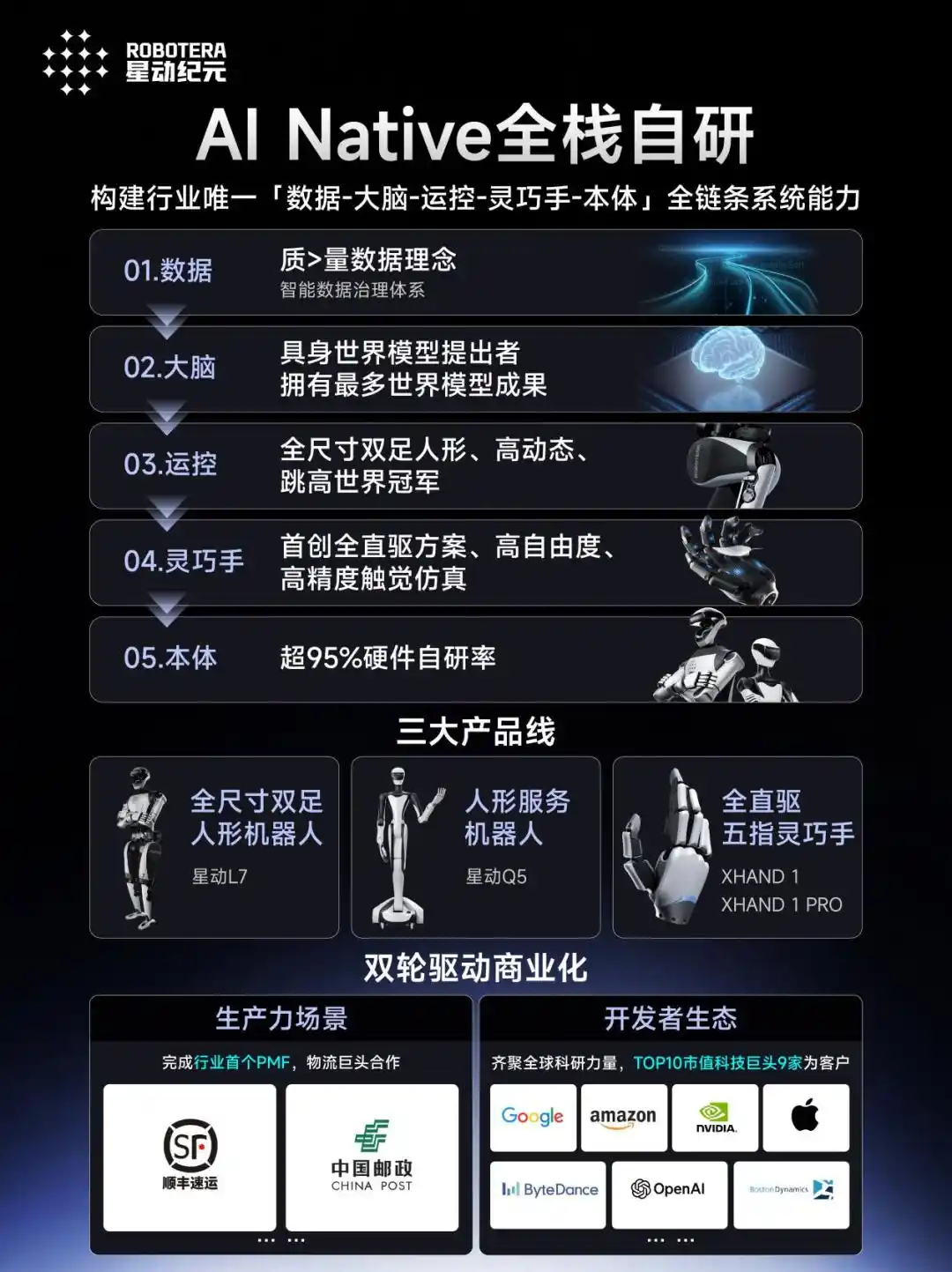
In less than three years, a long queue of investors has lined up behind Chen Jianyu. From early backers like Tsinghua University and Alibaba, to top-tier financial institutions like CDH VGC, Sequoia Capital China, IDG Capital, Qingliu Capital, CICC Capital, to industry giants like SF Express, Samsung, Geely Capital, Haier, Lenovo, Singtel, BAIC Capital, Dongfeng Capital, CICC Porsche, CICC Renault, and funds under China Unicom, as well as local state-owned capital like the Beijing Artificial Intelligence Industry Investment Fund—StarDynamics' shareholder list almost covers the most complete capital spectrum in the embodied intelligence sector.

Entering 2026, the financing pace accelerated dramatically: In March, it completed a 1 billion yuan strategic financing round, with valuation breaking through the 10 billion yuan mark. South Korea's Samsung and Singapore's Singtel appeared among its shareholders as overseas industrial capital for the first time. Just a month later, $200 million in financing arrived, led by SF Express, with leading institutions like Sequoia Capital China and IDG Capital jointly following on, while the industrial investor lineup expanded simultaneously. And today, with national-level state-owned capital platforms like Chengtong Fund collectively joining, a new 1 billion yuan financing round was announced. Securing three consecutive large-scale financings within three months, it set one of the fastest financing speeds in the embodied sector this year.

Thus, StarDynamics has constructed a triple capital matrix of "National-Level Capital Leadership + Top-Tier Financial Empowerment + Industrial Ecosystem Synergy," with over 20 industrial capital entities assembled behind it—a lineup not commonly seen in the industry.

Strengthening the Brain Through the Hand, Forging a New Path in Embodiment

At this juncture, for embodied intelligence to deliver industrial value, the competition is no longer about individual strengths, but the systemic capability integrating software and hardware—the brain (model and data) determines the upper limit of value, while the body (whole machine and end-effectors) constrains the lower limit of capability.

But within this system, there is a core hub often overlooked: the dexterous hand.

StarDynamics adheres to the AI Native principle of full-stack self-development across the entire embodied chain of "data-brain-motion control-dexterous hand-body," meaning hardware design does not start from mechanical structures but is reverse-defined from "what kind of data is most valuable for the brain." The five-finger dexterous hand is precisely the richest and most precise data collection entry point for physical world interaction—whether a grasp is successful, how force feedback changes, if an object slips, these high-dimensional data points directly determine what the model can learn.

Over the past two years, StarDynamics' models have continuously evolved:

In the first half of 2024, the team first proposed the robot fast-slow system VLA architecture (frequency-separated VLA), achieving the unity of "acting in real-time" and "deep thinking"; in the second half, they combined world models with VLA, releasing the VLA algorithm framework PAD and VPP integrating world models, and consolidating them to launch the end-to-end native robot brain model ERA-42.

ERA-42 is one of StarDynamics' core models, integrating vision, understanding, prediction, and action into one, enabling control of whole-body dexterous operations through a single end-to-end VLA model.

In February this year, building upon Ctrl-World, StarDynamics launched VLAW, pioneering the world's first VLA reinforcement learning framework based on world models, achieving synergistic iteration of policy and simulator, making world models not only "look right" but also "be physically correct." To date, StarDynamics is one of the embodied companies with the most world model achievements.

Breakthroughs in brain capability depend on high-quality data. On this front, relying on its self-developed dexterous hand and deployment applications, StarDynamics possesses the world's largest dataset from real dexterous hand hardware.

Simply put, StarDynamics uses dexterous hand hardware to obtain high-quality dexterous manipulation data, then uses this data to train smarter "brain" models, and finally feeds the evolved models back to the dexterous hands, forming a virtuous cycle of "the more used, the smarter; the smarter, the more capable." Therefore, the "dexterous hand" business is not merely a single-point component on the robot body but a core hub connecting the entire full-stack capability, the central entry point for collecting physical world interaction data.

Having long anticipated that end-effectors would become a bottleneck for embodied intelligence deployment, StarDynamics' dexterous hand adopted a brain-friendly, pioneering full direct-drive technical route—joint module output directly acts on joints, with no transmission backlash, elasticity, or friction loss. The generated data inherently possesses high precision, low latency, and reproducibility, and can be directly used for model training, fundamentally solving the quality issue of physical interaction data.

Currently, StarDynamics employs a "dual-hand strategy" with two differently positioned dexterous hand products:

1. Star-XHAND 1 PRO (Brain Hand), emphasizing high performance, core positioning as a data collection and algorithm validation platform, anchoring the upper limit of model capability;
2. Star-XHAND 1 (Work Hand), achieving precise force control and flexible operation through a full direct-drive technical architecture, adaptable to various humanoid robot platforms, solidifying the lower limit for scaled deployment.

It is reported that Star-XHAND 1 is now widely adopted to meet diverse needs in scenarios like industrial sorting and routine operations, becoming a shared choice for global robot manufacturers—American embodied intelligence unicorn Skild AI, South Korea's Rainbow Robotics, UK's Extend Robotics and Discover Robotics, as well as the new-generation humanoid robot HMND 01 from UK's Humanoid AI, among others, have all adopted Star-XHAND 1 as a core end-effector.

When the valuation of a single dexterous hand within the industry can even exceed that of the entire robot body, StarDynamics' narrative of "strengthening the brain through the hand" gains more substance. But ultimately, "strengthening the brain through the hand" is not the goal, but a means—obtaining high-quality data through the hand, training a stronger brain through the data, driving more intelligent robots through the brain, ultimately running through the full-stack system capability of "data-brain-motion control-dexterous hand-body," becoming real productivity in industrial scenarios—that is StarDynamics' true moat.

Relying on its self-developed dexterous hand and deployment applications, StarDynamics has accumulated a leading-scale dataset from real dexterous hand hardware within the industry. Based on this, the company has built a triple-gradient data source system:

Core Value Layer: Long-duration real hardware interaction data from real scenarios like logistics and industry, with 100% physical authenticity, forming the core foundation for models to align with industrial needs;
Precision Training Layer: High-precision teleoperation data, providing standardized action reference paradigms; currently has over 12 million clips of real hardware teleoperation data, including over 1.5 million clips of dexterous hand real hardware teleoperation data, one of the largest datasets of its kind in the industry;
Breadth Expansion Layer: First-person human behavior data and large-scale internet video data, enabling million-hour scaling, cost-effectively covering vast daily behaviors and scenarios.

Among these, long-duration real hardware interaction data from real scenarios and large-scale human video data simultaneously satisfy authenticity and diversity, constituting the dual core engines of the data system.

Currently, StarDynamics' overall dataset covers 100+ real scenarios and 1000+ dexterous manipulation tasks, sufficiently ensuring scene richness and behavioral diversity, laying a high-quality data foundation for the continuous iteration of the general embodied brain.

On this foundation, StarDynamics begins to answer the next question: Can this data support the brain in achieving commercial closed loops in real industrial scenarios?

Robots Begin Stable Deployment

The Watershed Moment

The answer lies on the industrial front lines where robots can stably deploy and work continuously.

StarDynamics adheres to a "B2B first, then B2C" commercialization path, gradually deploying in logistics, high-end manufacturing, and commercial service scenarios.

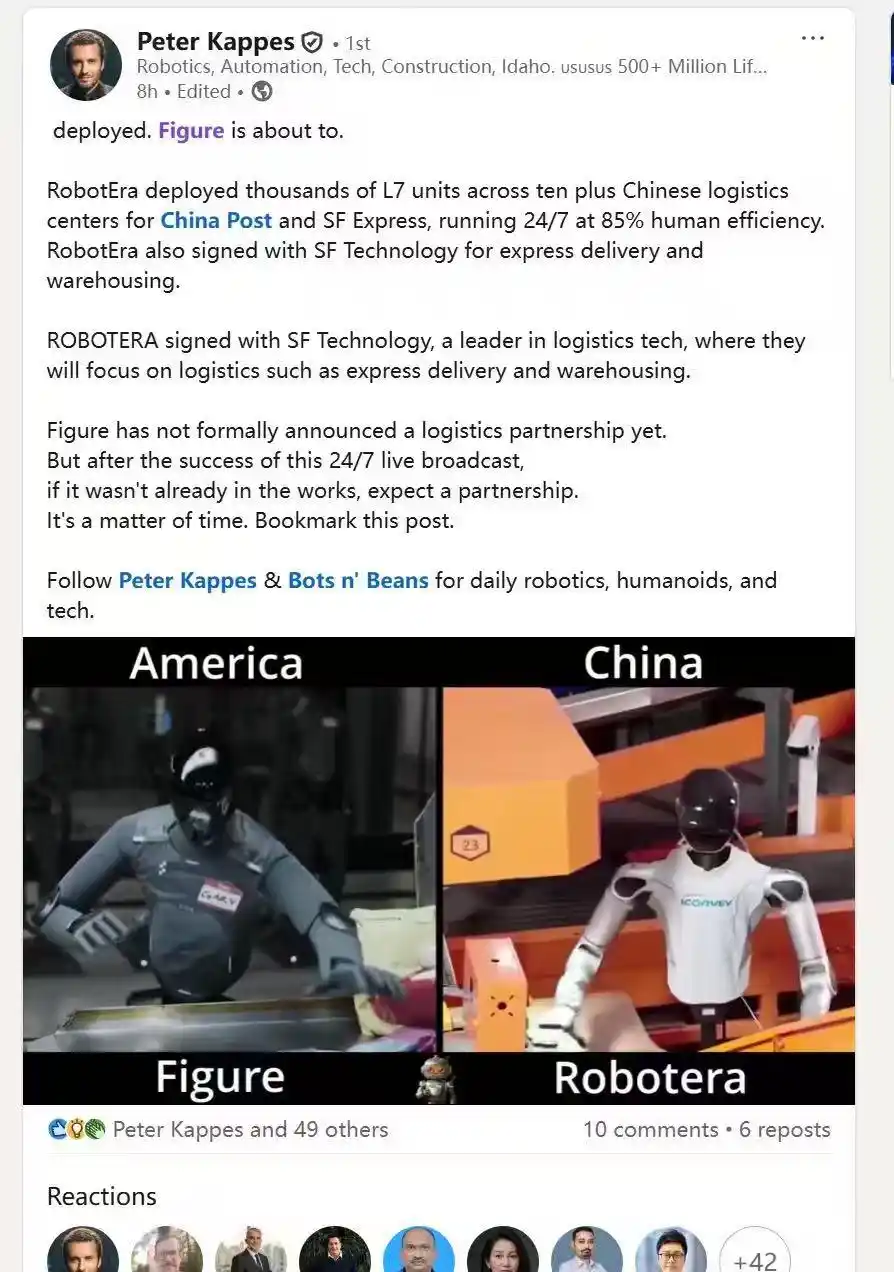
As we have seen, StarDynamics first achieved the industry's first PMF (Product-Market Fit) in logistics scenarios, deeply cooperating with leading clients like SF Express and China Post, batch-deploying to over 10 logistics centers across 5 provinces/municipalities in North, East, and South China, with some achieving normal 7×24 hour operations.

Here, embodied robots can flexibly handle various parcel sorting tasks involving packages of different shapes, materials, and sizes—grasping, turning parcel labels face-up, placing, etc. It's reported that efficiency in some scenarios even surpasses human levels, with processing speeds reaching over 1200 pieces per hour.

There's an interesting anecdote here—when the overseas embodied leader Figure conducted a live stream from its testing room, it was called out by foreign media: "StarDynamics' robots in China are already working at SF Express and China Post. When will Figure step out of the testing room and truly deploy?"
It is revealed that in the future, StarDynamics will continue to expand logistics scenarios, building a full-process embodied logistics service system covering inbound logistics, in-plant logistics, sales logistics, after-sales logistics, and extended express logistics links.

Meanwhile, high-end manufacturing and commercial service scenarios are also being rolled out. In high-end manufacturing for 3C electronics and automotive, StarDynamics has partnered with industry leaders like Samsung, Lenovo, Haier, and Geely. The real hardware data flowing back from these industrial sites continuously provides iterative nourishment for the embodied brain. Additionally, the Star-Q5 super-realistic service robot has been deployed in scenarios like Haier, Lenovo, and Century Golden Resources, providing services like store attraction, guided tours, explanation, and product delivery, exploring B2C entry points.

The underlying body capabilities supporting these deployments are also being validated by global top-tier institutions. StarDynamics' dexterous hands, universal body base, and development kits are not only used internally but have also been shipped globally, serving 9 out of the world's top 10 tech companies by market capitalization, becoming the shared choice of top tech firms and research institutions including OpenAI, Boston Dynamics, NVIDIA, Apple, Google, Amazon, ByteDance, as well as MIT, UC Berkeley, Stanford University, Tsinghua University, and Shanghai Qizhi Research Institute. Feedback from top-tier research clients further drives continuous upgrades to StarDynamics' hardware base.

As robots begin stable deployment, the prelude to the era of embodied intelligence leaders opens. As more robots enter the real world to perform tasks, those who can first establish data moats and evolution barriers for the next-generation robot brain that others find difficult to replicate will occupy key positions in the new round of competition.

As widely believed, 2026 is a watershed year for embodied models: in the first half, model capabilities diverge; in the second half, commercialization closed loops diverge. Capital markets no longer pay for stories, only recognizing one thing—whether technology can deploy, whether deployment can scale, and whether scale can feed back into technology.

The watershed moment has emerged—not under the spotlight of the laboratory, but on the logistics sorting lines at 3 a.m.

This article is from the WeChat public account "Investment Community" (ID: pedaily2012), author: Yang Jiyun


Trending Cryptos

Related Questions

QWhat is the significance of Xingdong Jiyuan's recent financing round, and which type of investors led it?

AXingdong Jiyuan recently completed a new 10 billion RMB financing round. It is significant because it was led by the State-owned Assets Supervision and Administration Commission (SASAC) state-owned capital operation company, Chengtong Fund, and involved participation from other major state-owned entities. This builds a 'three-fold capital matrix' of national capital leadership, top-tier financial empowerment, and industrial ecosystem collaboration. The company has raised 25 billion RMB in just two months.

QAccording to the article, what core technical concept did Xingdong Jiyuan pioneer in the field of embodied intelligence?

AXingdong Jiyuan was the proposer of the World Model concept in the field of embodied intelligence. It was an early pioneer, releasing its PAD model (a World Action Model) in September 2024, nearly a year before similar solutions like NVIDIA's DreamZero were announced.

QHow does Xingdong Jiyuan's 'AI Native' approach and its focus on dexterous hands (XHAND) create a competitive advantage?

AXingdong Jiyuan's 'AI Native' approach reverses the traditional hardware-first design. It starts by asking 'what data is most valuable for the AI brain?' and uses its self-developed, fully direct-drive dexterous hands (XHAND) as the primary sensor to collect high-quality, high-precision physical interaction data. This data is then used to train smarter brain models. This creates a virtuous cycle where better hands gather better data, which trains a better brain, enabling more capable robots, forming a core barrier through its full-stack 'data-brain-control-hand-body' capability.

QIn which industrial sector has Xingdong Jiyuan first achieved Product-Market Fit (PMF) with its robots?

AXingdong Jiyuan has first achieved Product-Market Fit (PMF) in the logistics sector. Its robots are deployed in-depth with leading clients like SF Express and China Post, operating 24/7 in over 10 logistics centers across China. They perform tasks like parcel sorting, handling items of various shapes and materials, with reported efficiency exceeding human levels in some scenarios.

QWhat does the article suggest is the key factor for success in the embodied intelligence field as of 2026?

AThe article suggests that 2026 is a watershed year where success is no longer about stories or isolated technologies. The key factors are whether the technology can be implemented, whether that implementation can be scaled, and whether the scale can, in turn, feed back to improve the technology. The 'dividing line' is now drawn in real-world industrial settings, like late-night logistics sorting lines, rather than in research labs.

Related Reads

Is Anyone Still Buying in the Crypto Market? Unpacking 3 Common Watch-and-Wait Mentalities Today

Is Anyone Still Buying in the Crypto Market? Unpacking 3 Common Wait-and-See Mindsets This article analyzes the current cautious sentiment in the crypto market, distilled from conversations with sophisticated investors. The author identifies three dominant investor mindsets: 1. **Satisfied with Current Holdings:** Many retain a long-term belief in digital assets but see no immediate catalyst for significant price appreciation. They hold positions to avoid missing a future surge but allocate minimal new capital or attention. A shift requires a new, observable catalyst or a rotation from other portfolio areas. 2. **Waiting for Lower Prices:** This reflects not just short-term timing but a belief about crypto's total addressable market and upside potential. It could change if key perceived cycle bottoms pass without a crash, a major bullish event occurs (e.g., sovereign adoption), or price rebounds trigger FOMO-driven buying. 3. **High Opportunity Cost of Allocation:** The core question is comparative growth. With AI-related equities appearing to offer relentless, high-speed growth, justifying marginal investment into assets without similar perceived momentum is difficult. A slowdown in the AI trade could potentially mark a bottom and trigger capital reallocation into crypto. In conclusion, while long-term conviction persists for many, near-term marginal capital flows are constrained by these beliefs. The author suggests the market may be closer to a bottom than a top, but the current climate is defined by this wait-and-see approach, awaiting a catalyst to reignite broader investor commitment.

marsbit5m ago

Is Anyone Still Buying in the Crypto Market? Unpacking 3 Common Watch-and-Wait Mentalities Today

marsbit5m ago

China Added 67 New Unicorns in Half a Year, with AI and Robotics Accounting for Over Half

China added 67 new unicorn companies in the first half of 2026, reaching a total of 517 unicorns with a combined valuation of approximately $2.39 trillion. This surge marks a significant rebound after a post-2022 slowdown and sets a new semi-annual record. The growth is primarily driven by Artificial Intelligence (AI) and Robotics, which together account for over 53% of the new entrants. Specifically, 19 new unicorns are in robotics and 17 in AI. Notable companies include DeepSeek ($615.38B) and Kling AI ($18B). The trend indicates a decisive shift from internet consumer models to hard tech innovation. Geographically, new unicorns are highly concentrated in four cities: Beijing (19), Shanghai (18), Shenzhen (9), and Hangzhou (5), which together host 76.1% of the new companies. Hangzhou's overall valuation is boosted significantly by DeepSeek. Valuation distribution among new unicorns is pyramidal: 77.6% are valued between $1B and $2B, indicating early-stage status, while only two exceed $10B. There is a notable "speed divide": many AI/robotics startups achieved unicorn status in under three years, often via corporate spin-offs or led by star founders, while hard tech companies in semiconductors or biotech typically took over eight years. The report concludes that this wave reflects China's accelerating transition into an AI and robotics-powered innovation cycle, characterized by faster company formation, heightened geographic concentration, and a clear focus on foundational technologies.

marsbit48m ago

China Added 67 New Unicorns in Half a Year, with AI and Robotics Accounting for Over Half

marsbit48m ago

Trading

Spot

Hot Articles

What is SONIC

Sonic: Pioneering the Future of Gaming in Web3 Introduction to Sonic In the ever-evolving landscape of Web3, the gaming industry stands out as one of the most dynamic and promising sectors. At the forefront of this revolution is Sonic, a project designed to amplify the gaming ecosystem on the Solana blockchain. Leveraging cutting-edge technology, Sonic aims to deliver an unparalleled gaming experience by efficiently processing millions of requests per second, ensuring that players enjoy seamless gameplay while maintaining low transaction costs. This article delves into the intricate details of Sonic, exploring its creators, funding sources, operational mechanics, and the timeline of significant events that have shaped its journey. What is Sonic? Sonic is an innovative layer-2 network that operates atop the Solana blockchain, specifically tailored to enhance the existing Solana gaming ecosystem. It accomplishes this through a customised, VM-agnostic game engine paired with a HyperGrid interpreter, facilitating sovereign game economies that roll up back to the Solana platform. The primary goals of Sonic include: Enhanced Gaming Experiences: Sonic is committed to offering lightning-fast on-chain gameplay, allowing players and developers to engage with games at previously unattainable speeds. Atomic Interoperability: This feature enables transactions to be executed within Sonic without the need to redeploy Solana programmes and accounts. This makes the process more efficient and directly benefits from Solana Layer1 services and liquidity. Seamless Deployment: Sonic allows developers to write for Ethereum Virtual Machine (EVM) based systems and execute them on Solana’s SVM infrastructure. This interoperability is crucial for attracting a broader range of dApps and decentralised applications to the platform. Support for Developers: By offering native composable gaming primitives and extensible data types - dining within the Entity-Component-System (ECS) framework - game creators can craft intricate business logic with ease. Overall, Sonic's unique approach not only caters to players but also provides an accessible and low-cost environment for developers to innovate and thrive. Creator of Sonic The information regarding the creator of Sonic is somewhat ambiguous. However, it is known that Sonic's SVM is owned by the company Mirror World. The absence of detailed information about the individuals behind Sonic reflects a common trend in several Web3 projects, where collective efforts and partnerships often overshadow individual contributions. Investors of Sonic Sonic has garnered considerable attention and support from various investors within the crypto and gaming sectors. Notably, the project raised an impressive $12 million during its Series A funding round. The round was led by BITKRAFT Ventures, with other notable investors including Galaxy, Okx Ventures, Interactive, Big Brain Holdings, and Mirana. This financial backing signifies the confidence that investment foundations have in Sonic’s potential to revolutionise the Web3 gaming landscape, further validating its innovative approaches and technologies. How Does Sonic Work? Sonic utilises the HyperGrid framework, a sophisticated parallel processing mechanism that enhances its scalability and customisability. Here are the core features that set Sonic apart: Lightning Speed at Low Costs: Sonic offers one of the fastest on-chain gaming experiences compared to other Layer-1 solutions, powered by the scalability of Solana’s virtual machine (SVM). Atomic Interoperability: Sonic enables transaction execution without redeployment of Solana programmes and accounts, effectively streamlining the interaction between users and the blockchain. EVM Compatibility: Developers can effortlessly migrate decentralised applications from EVM chains to the Solana environment using Sonic’s HyperGrid interpreter, increasing the accessibility and integration of various dApps. Ecosystem Support for Developers: By exposing native composable gaming primitives, Sonic facilitates a sandbox-like environment where developers can experiment and implement business logic, greatly enhancing the overall development experience. Monetisation Infrastructure: Sonic natively supports growth and monetisation efforts, providing frameworks for traffic generation, payments, and settlements, thereby ensuring that gaming projects are not only viable but also sustainable financially. Timeline of Sonic The evolution of Sonic has been marked by several key milestones. Below is a brief timeline highlighting critical events in the project's history: 2022: The Sonic cryptocurrency was officially launched, marking the beginning of its journey in the Web3 gaming arena. 2024: June: Sonic SVM successfully raised $12 million in a Series A funding round. This investment allowed Sonic to further develop its platform and expand its offerings. August: The launch of the Sonic Odyssey testnet provided users with the first opportunity to engage with the platform, offering interactive activities such as collecting rings—a nod to gaming nostalgia. October: SonicX, an innovative crypto game integrated with Solana, made its debut on TikTok, capturing the attention of over 120,000 users within a short span. This integration illustrated Sonic’s commitment to reaching a broader, global audience and showcased the potential of blockchain gaming. Key Points Sonic SVM is a revolutionary layer-2 network on Solana explicitly designed to enhance the GameFi landscape, demonstrating great potential for future development. HyperGrid Framework empowers Sonic by introducing horizontal scaling capabilities, ensuring that the network can handle the demands of Web3 gaming. Integration with Social Platforms: The successful launch of SonicX on TikTok displays Sonic’s strategy to leverage social media platforms to engage users, exponentially increasing the exposure and reach of its projects. Investment Confidence: The substantial funding from BITKRAFT Ventures, among others, emphasizes the robust backing Sonic has, paving the way for its ambitious future. In conclusion, Sonic encapsulates the essence of Web3 gaming innovation, striking a balance between cutting-edge technology, developer-centric tools, and community engagement. As the project continues to evolve, it is poised to redefine the gaming landscape, making it a notable entity for gamers and developers alike. As Sonic moves forward, it will undoubtedly attract greater interest and participation, solidifying its place within the broader narrative of blockchain gaming.

1.7k Total ViewsPublished 2024.04.04Updated 2024.12.03

What is SONIC

What is $S$

Understanding SPERO: A Comprehensive Overview Introduction to SPERO As the landscape of innovation continues to evolve, the emergence of web3 technologies and cryptocurrency projects plays a pivotal role in shaping the digital future. One project that has garnered attention in this dynamic field is SPERO, denoted as SPERO,$$s$. This article aims to gather and present detailed information about SPERO, to help enthusiasts and investors understand its foundations, objectives, and innovations within the web3 and crypto domains. What is SPERO,$$s$? SPERO,$$s$ is a unique project within the crypto space that seeks to leverage the principles of decentralisation and blockchain technology to create an ecosystem that promotes engagement, utility, and financial inclusion. The project is tailored to facilitate peer-to-peer interactions in new ways, providing users with innovative financial solutions and services. At its core, SPERO,$$s$ aims to empower individuals by providing tools and platforms that enhance user experience in the cryptocurrency space. This includes enabling more flexible transaction methods, fostering community-driven initiatives, and creating pathways for financial opportunities through decentralised applications (dApps). The underlying vision of SPERO,$$s$ revolves around inclusiveness, aiming to bridge gaps within traditional finance while harnessing the benefits of blockchain technology. Who is the Creator of SPERO,$$s$? The identity of the creator of SPERO,$$s$ remains somewhat obscure, as there are limited publicly available resources providing detailed background information on its founder(s). This lack of transparency can stem from the project's commitment to decentralisation—an ethos that many web3 projects share, prioritising collective contributions over individual recognition. By centring discussions around the community and its collective goals, SPERO,$$s$ embodies the essence of empowerment without singling out specific individuals. As such, understanding the ethos and mission of SPERO remains more important than identifying a singular creator. Who are the Investors of SPERO,$$s$? SPERO,$$s$ is supported by a diverse array of investors ranging from venture capitalists to angel investors dedicated to fostering innovation in the crypto sector. The focus of these investors generally aligns with SPERO's mission—prioritising projects that promise societal technological advancement, financial inclusivity, and decentralised governance. These investor foundations are typically interested in projects that not only offer innovative products but also contribute positively to the blockchain community and its ecosystems. The backing from these investors reinforces SPERO,$$s$ as a noteworthy contender in the rapidly evolving domain of crypto projects. How Does SPERO,$$s$ Work? SPERO,$$s$ employs a multi-faceted framework that distinguishes it from conventional cryptocurrency projects. Here are some of the key features that underline its uniqueness and innovation: Decentralised Governance: SPERO,$$s$ integrates decentralised governance models, empowering users to participate actively in decision-making processes regarding the project’s future. This approach fosters a sense of ownership and accountability among community members. Token Utility: SPERO,$$s$ utilises its own cryptocurrency token, designed to serve various functions within the ecosystem. These tokens enable transactions, rewards, and the facilitation of services offered on the platform, enhancing overall engagement and utility. Layered Architecture: The technical architecture of SPERO,$$s$ supports modularity and scalability, allowing for seamless integration of additional features and applications as the project evolves. This adaptability is paramount for sustaining relevance in the ever-changing crypto landscape. Community Engagement: The project emphasises community-driven initiatives, employing mechanisms that incentivise collaboration and feedback. By nurturing a strong community, SPERO,$$s$ can better address user needs and adapt to market trends. Focus on Inclusion: By offering low transaction fees and user-friendly interfaces, SPERO,$$s$ aims to attract a diverse user base, including individuals who may not previously have engaged in the crypto space. This commitment to inclusion aligns with its overarching mission of empowerment through accessibility. Timeline of SPERO,$$s$ Understanding a project's history provides crucial insights into its development trajectory and milestones. Below is a suggested timeline mapping significant events in the evolution of SPERO,$$s$: Conceptualisation and Ideation Phase: The initial ideas forming the basis of SPERO,$$s$ were conceived, aligning closely with the principles of decentralisation and community focus within the blockchain industry. Launch of Project Whitepaper: Following the conceptual phase, a comprehensive whitepaper detailing the vision, goals, and technological infrastructure of SPERO,$$s$ was released to garner community interest and feedback. Community Building and Early Engagements: Active outreach efforts were made to build a community of early adopters and potential investors, facilitating discussions around the project’s goals and garnering support. Token Generation Event: SPERO,$$s$ conducted a token generation event (TGE) to distribute its native tokens to early supporters and establish initial liquidity within the ecosystem. Launch of Initial dApp: The first decentralised application (dApp) associated with SPERO,$$s$ went live, allowing users to engage with the platform's core functionalities. Ongoing Development and Partnerships: Continuous updates and enhancements to the project's offerings, including strategic partnerships with other players in the blockchain space, have shaped SPERO,$$s$ into a competitive and evolving player in the crypto market. Conclusion SPERO,$$s$ stands as a testament to the potential of web3 and cryptocurrency to revolutionise financial systems and empower individuals. With a commitment to decentralised governance, community engagement, and innovatively designed functionalities, it paves the way toward a more inclusive financial landscape. As with any investment in the rapidly evolving crypto space, potential investors and users are encouraged to research thoroughly and engage thoughtfully with the ongoing developments within SPERO,$$s$. The project showcases the innovative spirit of the crypto industry, inviting further exploration into its myriad possibilities. While the journey of SPERO,$$s$ is still unfolding, its foundational principles may indeed influence the future of how we interact with technology, finance, and each other in interconnected digital ecosystems.

93 Total ViewsPublished 2024.12.17Updated 2024.12.17

What is $S$

What is AGENT S

Agent S: The Future of Autonomous Interaction in Web3 Introduction In the ever-evolving landscape of Web3 and cryptocurrency, innovations are constantly redefining how individuals interact with digital platforms. One such pioneering project, Agent S, promises to revolutionise human-computer interaction through its open agentic framework. By paving the way for autonomous interactions, Agent S aims to simplify complex tasks, offering transformative applications in artificial intelligence (AI). This detailed exploration will delve into the project's intricacies, its unique features, and the implications for the cryptocurrency domain. What is Agent S? Agent S stands as a groundbreaking open agentic framework, specifically designed to tackle three fundamental challenges in the automation of computer tasks: Acquiring Domain-Specific Knowledge: The framework intelligently learns from various external knowledge sources and internal experiences. This dual approach empowers it to build a rich repository of domain-specific knowledge, enhancing its performance in task execution. Planning Over Long Task Horizons: Agent S employs experience-augmented hierarchical planning, a strategic approach that facilitates efficient breakdown and execution of intricate tasks. This feature significantly enhances its ability to manage multiple subtasks efficiently and effectively. Handling Dynamic, Non-Uniform Interfaces: The project introduces the Agent-Computer Interface (ACI), an innovative solution that enhances the interaction between agents and users. Utilizing Multimodal Large Language Models (MLLMs), Agent S can navigate and manipulate diverse graphical user interfaces seamlessly. Through these pioneering features, Agent S provides a robust framework that addresses the complexities involved in automating human interaction with machines, setting the stage for myriad applications in AI and beyond. Who is the Creator of Agent S? While the concept of Agent S is fundamentally innovative, specific information about its creator remains elusive. The creator is currently unknown, which highlights either the nascent stage of the project or the strategic choice to keep founding members under wraps. Regardless of anonymity, the focus remains on the framework's capabilities and potential. Who are the Investors of Agent S? As Agent S is relatively new in the cryptographic ecosystem, detailed information regarding its investors and financial backers is not explicitly documented. The lack of publicly available insights into the investment foundations or organisations supporting the project raises questions about its funding structure and development roadmap. Understanding the backing is crucial for gauging the project's sustainability and potential market impact. How Does Agent S Work? At the core of Agent S lies cutting-edge technology that enables it to function effectively in diverse settings. Its operational model is built around several key features: Human-like Computer Interaction: The framework offers advanced AI planning, striving to make interactions with computers more intuitive. By mimicking human behaviour in tasks execution, it promises to elevate user experiences. Narrative Memory: Employed to leverage high-level experiences, Agent S utilises narrative memory to keep track of task histories, thereby enhancing its decision-making processes. Episodic Memory: This feature provides users with step-by-step guidance, allowing the framework to offer contextual support as tasks unfold. Support for OpenACI: With the ability to run locally, Agent S allows users to maintain control over their interactions and workflows, aligning with the decentralised ethos of Web3. Easy Integration with External APIs: Its versatility and compatibility with various AI platforms ensure that Agent S can fit seamlessly into existing technological ecosystems, making it an appealing choice for developers and organisations. These functionalities collectively contribute to Agent S's unique position within the crypto space, as it automates complex, multi-step tasks with minimal human intervention. As the project evolves, its potential applications in Web3 could redefine how digital interactions unfold. Timeline of Agent S The development and milestones of Agent S can be encapsulated in a timeline that highlights its significant events: September 27, 2024: The concept of Agent S was launched in a comprehensive research paper titled “An Open Agentic Framework that Uses Computers Like a Human,” showcasing the groundwork for the project. October 10, 2024: The research paper was made publicly available on arXiv, offering an in-depth exploration of the framework and its performance evaluation based on the OSWorld benchmark. October 12, 2024: A video presentation was released, providing a visual insight into the capabilities and features of Agent S, further engaging potential users and investors. These markers in the timeline not only illustrate the progress of Agent S but also indicate its commitment to transparency and community engagement. Key Points About Agent S As the Agent S framework continues to evolve, several key attributes stand out, underscoring its innovative nature and potential: Innovative Framework: Designed to provide an intuitive use of computers akin to human interaction, Agent S brings a novel approach to task automation. Autonomous Interaction: The ability to interact autonomously with computers through GUI signifies a leap towards more intelligent and efficient computing solutions. Complex Task Automation: With its robust methodology, it can automate complex, multi-step tasks, making processes faster and less error-prone. Continuous Improvement: The learning mechanisms enable Agent S to improve from past experiences, continually enhancing its performance and efficacy. Versatility: Its adaptability across different operating environments like OSWorld and WindowsAgentArena ensures that it can serve a broad range of applications. As Agent S positions itself in the Web3 and crypto landscape, its potential to enhance interaction capabilities and automate processes signifies a significant advancement in AI technologies. Through its innovative framework, Agent S exemplifies the future of digital interactions, promising a more seamless and efficient experience for users across various industries. Conclusion Agent S represents a bold leap forward in the marriage of AI and Web3, with the capacity to redefine how we interact with technology. While still in its early stages, the possibilities for its application are vast and compelling. Through its comprehensive framework addressing critical challenges, Agent S aims to bring autonomous interactions to the forefront of the digital experience. As we move deeper into the realms of cryptocurrency and decentralisation, projects like Agent S will undoubtedly play a crucial role in shaping the future of technology and human-computer collaboration.

763 Total ViewsPublished 2025.01.14Updated 2025.01.14

What is AGENT S

Discussions

Welcome to the HTX Community. Here, you can stay informed about the latest platform developments and gain access to professional market insights. Users' opinions on the price of S (S) are presented below.

活动图片