Bhutan Transfers 519 BTC to External Wallet in Latest Bitcoin Move

TheNewsCryptoPublished on 2026-03-26Last updated on 2026-03-26

Abstract

Bhutan has significantly increased its Bitcoin sales, transferring 519.707 BTC (worth $36.75 million) to an external wallet this week. According to Arkham Intelligence, the country has moved a total of $152 million worth of BTC in 2026, marking a notable acceleration in divesting state-owned Bitcoin holdings. Recent transactions, including a single-week outflow of nearly $72 million, suggest active portfolio management. Analysts indicate these moves may reflect rebalancing rather than outright liquidation, highlighting growing sovereign involvement in cryptocurrency markets as part of broader institutional adoption trends.

Bhutan has made another transfer of 500 Bitcoins to cryptocurrency exchanges. This is not the beginning or the end of a series of transactions that have seen the overall outflows for 2026 rise considerably. The data from Arkham Intelligence, shows that Bhutan have been moving funds in line with the management and liquidity trends. Bhutan has increased the rate of selling its state-owned Bitcoin holdings and has already moved $152 million worth of BTC in 2026.

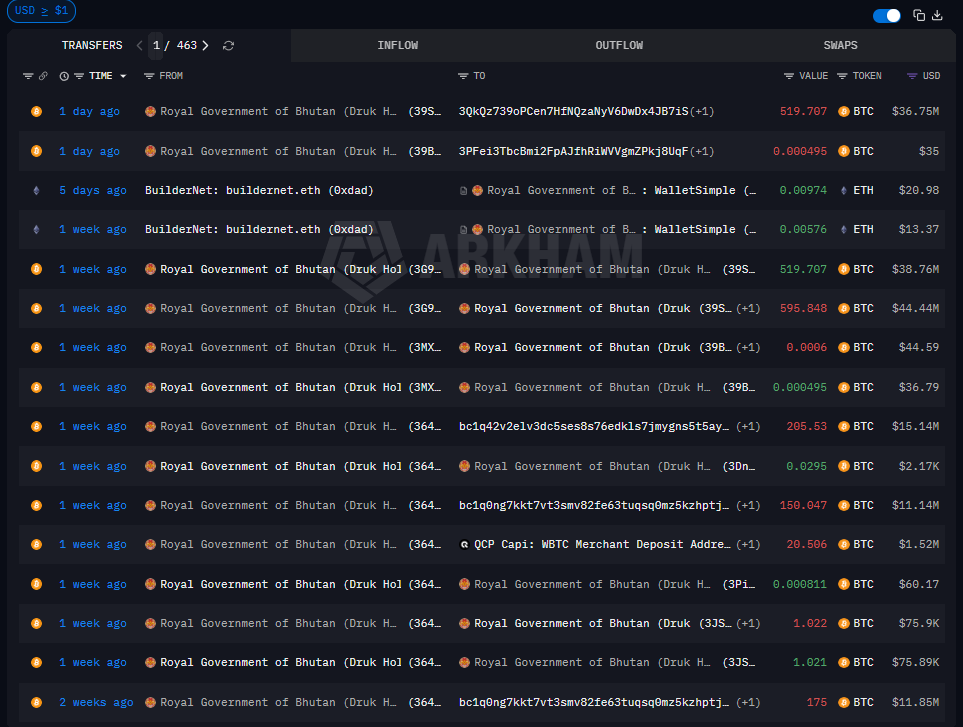
The Royal Government of Bhutan transferred 519.707 BTC, valued at 36.75 million dollars, to an external wallet on Wednesday. It was seen that the rate of selling off its Bitcoin holdings rise considerably over the past two weeks. That indicates a surge in the cryptocurrency portfolio of Bhutan. Bhutan has accelerated sales of its state-owned Bitcoin holdings and has already moved $152 million worth of BTC in 2026.
SOURCE: Arkham Intelligence

Market Reaction and Analyst Perspectives

Market players assessed the effect of Bhutan’s bitcoin transactions in relation to short-term price action and liquidity in general within crypto markets. The week before Wednesday’s transactions was the busiest in Bhutan’s bitcoin transaction history, according to blockchain records. According to Arkham’s information, there were transactions totaling close to $72 million executed in a single week by Bhutan-related addresses. The transactions included 595.848 BTC valued at $44.44 million, recorded as the single largest transaction executed in 2026. Other transactions included 205.53 BTC valued at $15.14 million and 150.047 BTC valued at $11.14 million. Bhutan also transferred 20.506 BTC valued at $1.52 million to a merchant deposit address related to QCP Capital. However, analysts noted that such transactions might indicate portfolio rebalancing rather than liquidations, depending on general conditions in global markets.

Broader Implications of the Crypto Markets

The continued outflows are a reflection of the continued involvement of the Kingdom of Bhutan in the management of its digital asset holdings in the ever-changing global cryptocurrency environment. Analysts opined that the involvement of sovereigns in the Bitcoin markets can be attributed to the increased institutionalization and integration of digital assets in the global environment.

The event was a reflection of the increased involvement of public entities in the global cryptocurrency markets. Market watchers opined that the involvement of sovereigns in the markets can be attributed to the global conversation on the involvement of governments in the decentralized financial environment.

Highlighted Crypto News:
Coinbase Pushes Back Against CLARITY Act Over Stablecoin Yield Rules

TagsBhutanBitcoinBitcoin (BTC)BlockchainBTCCryptocurrency

Related Questions

QHow much Bitcoin did Bhutan transfer to an external wallet in its latest transaction, and what was its value?

ABhutan transferred 519.707 BTC, valued at $36.75 million, to an external wallet.

QWhat is the total value of Bitcoin that Bhutan has moved in 2026 according to the article?

ABhutan has moved $152 million worth of BTC in 2026.

QAccording to analysts, what might the large Bitcoin transactions by Bhutan indicate rather than liquidations?

AAnalysts noted that such transactions might indicate portfolio rebalancing rather than liquidations.

QWhich organization provided the data on Bhutan's Bitcoin transactions mentioned in the article?

AThe data was provided by Arkham Intelligence.

QWhat broader trend does the article suggest is reflected by Bhutan's involvement in the Bitcoin markets?

AThe article suggests it reflects the increased institutionalization and integration of digital assets, as well as the involvement of sovereigns and public entities in the global cryptocurrency markets.

Related Reads

Running Gemma 4 Locally on iPhone Goes Viral: How Far Are We from the Zero Token Era?

Google's newly open-sourced Gemma 4 model, built on the same architecture as Gemini 3, has gained significant attention for its ability to run locally on mobile devices like the iPhone and Samsung Galaxy. With smaller versions such as E2B (2.3B parameters) and E4B (4.5B parameters), it supports native multimodal capabilities and offers a 128K context window. Users report impressive speeds—over 40 tokens per second on Apple chips with MLX optimization—making it feel "like magic." The model is accessible via Google’s official AI Edge Gallery app, ensuring ease of use and security. While Gemma 4 excels in tasks like text generation, coding, and image understanding, it struggles with more complex agent-based workflows, such as tool calling and structured outputs, where models like Qwen3-coder perform better. Despite some limitations in reasoning, Gemma 4’s local performance hints at a future where everyday AI tasks—chat, coding, reasoning—can be handled offline, reducing reliance on cloud-based token services. Although cloud models still lead in advanced reasoning and large-scale multi-agent tasks, the trend suggests that as hardware and quantization improve, on-device models will increasingly handle high-frequency simple tasks. This shift could disrupt the AI industry’s reliance on token sales and API subscriptions, pushing providers to focus on more complex, data-intensive capabilities. Gemma 4 is just the beginning of this transformation.

marsbit2h ago

Running Gemma 4 Locally on iPhone Goes Viral: How Far Are We from the Zero Token Era?

marsbit2h ago

Trading

Spot
Futures

Hot Articles

What is $BITCOIN

DIGITAL GOLD ($BITCOIN): A Comprehensive Analysis Introduction to DIGITAL GOLD ($BITCOIN) DIGITAL GOLD ($BITCOIN) is a blockchain-based project operating on the Solana network, which aims to combine the characteristics of traditional precious metals with the innovation of decentralized technologies. While it shares a name with Bitcoin, often referred to as “digital gold” due to its perception as a store of value, DIGITAL GOLD is a separate token designed to create a unique ecosystem within the Web3 landscape. Its goal is to position itself as a viable alternative digital asset, although specifics regarding its applications and functionalities are still developing. What is DIGITAL GOLD ($BITCOIN)? DIGITAL GOLD ($BITCOIN) is a cryptocurrency token explicitly designed for use on the Solana blockchain. In contrast to Bitcoin, which provides a widely recognized value storage role, this token appears to focus on broader applications and characteristics. Notable aspects include: Blockchain Infrastructure: The token is built on the Solana blockchain, known for its capacity to handle high-speed and low-cost transactions. Supply Dynamics: DIGITAL GOLD has a maximum supply capped at 100 quadrillion tokens (100P $BITCOIN), although details regarding its circulating supply are currently undisclosed. Utility: While precise functionalities are not explicitly outlined, there are indications that the token could be utilized for various applications, potentially involving decentralized applications (dApps) or asset tokenization strategies. Who is the Creator of DIGITAL GOLD ($BITCOIN)? At present, the identity of the creators and development team behind DIGITAL GOLD ($BITCOIN) remains unknown. This situation is typical among many innovative projects within the blockchain space, particularly those aligning with decentralized finance and meme coin phenomena. While such anonymity may foster a community-driven culture, it intensifies concerns about governance and accountability. Who are the Investors of DIGITAL GOLD ($BITCOIN)? The available information indicates that DIGITAL GOLD ($BITCOIN) does not have any known institutional backers or prominent venture capital investments. The project seems to operate on a peer-to-peer model focused on community support and adoption rather than traditional funding routes. Its activity and liquidity are primarily situated on decentralized exchanges (DEXs), such as PumpSwap, rather than established centralized trading platforms, further highlighting its grassroots approach. How DIGITAL GOLD ($BITCOIN) Works The operational mechanics of DIGITAL GOLD ($BITCOIN) can be elaborated on based on its blockchain design and network attributes: Consensus Mechanism: By leveraging Solana’s unique proof-of-history (PoH) combined with a proof-of-stake (PoS) model, the project ensures efficient transaction validation contributing to the network's high performance. Tokenomics: While specific deflationary mechanisms have not been extensively detailed, the vast maximum token supply implies that it may cater to microtransactions or niche use cases that are still to be defined. Interoperability: There exists the potential for integration with Solana’s broader ecosystem, including various decentralized finance (DeFi) platforms. However, the details regarding specific integrations remain unspecified. Timeline of Key Events Here is a timeline that highlights significant milestones concerning DIGITAL GOLD ($BITCOIN): 2023: The initial deployment of the token occurs on the Solana blockchain, marked by its contract address. 2024: DIGITAL GOLD gains visibility as it becomes available for trading on decentralized exchanges like PumpSwap, allowing users to trade it against SOL. 2025: The project witnesses sporadic trading activity and potential interest in community-led engagements, although no noteworthy partnerships or technical advancements have been documented as of yet. Critical Analysis Strengths Scalability: The underlying Solana infrastructure supports high transaction volumes, which could enhance the utility of $BITCOIN in various transaction scenarios. Accessibility: The potential low trading price per token could attract retail investors, facilitating wider participation due to fractional ownership opportunities. Risks Lack of Transparency: The absence of publicly known backers, developers, or an audit process may yield skepticism regarding the project's sustainability and trustworthiness. Market Volatility: The trading activity is heavily reliant on speculative behavior, which can result in significant price volatility and uncertainty for investors. Conclusion DIGITAL GOLD ($BITCOIN) emerges as an intriguing yet ambiguous project within the rapidly evolving Solana ecosystem. While it attempts to leverage the “digital gold” narrative, its departure from Bitcoin's established role as a store of value underscores the need for a clearer differentiation of its intended utility and governance structure. Future acceptance and adoption will likely depend on addressing the current opacity and defining its operational and economic strategies more explicitly. Note: This report encompasses synthesised information available as of October 2023, and developments may have transpired beyond the research period.

363 Total ViewsPublished 2025.05.13Updated 2025.05.13

What is $BITCOIN

Discussions

Welcome to the HTX Community. Here, you can stay informed about the latest platform developments and gain access to professional market insights. Users' opinions on the price of BTC (BTC) are presented below.

活动图片