BREAKING – Michael Saylor Tries To Cool Bitcoin’s Internal Rivalries — But Can He?

bitcoinistPublished on 2026-06-05Last updated on 2026-06-05

Abstract

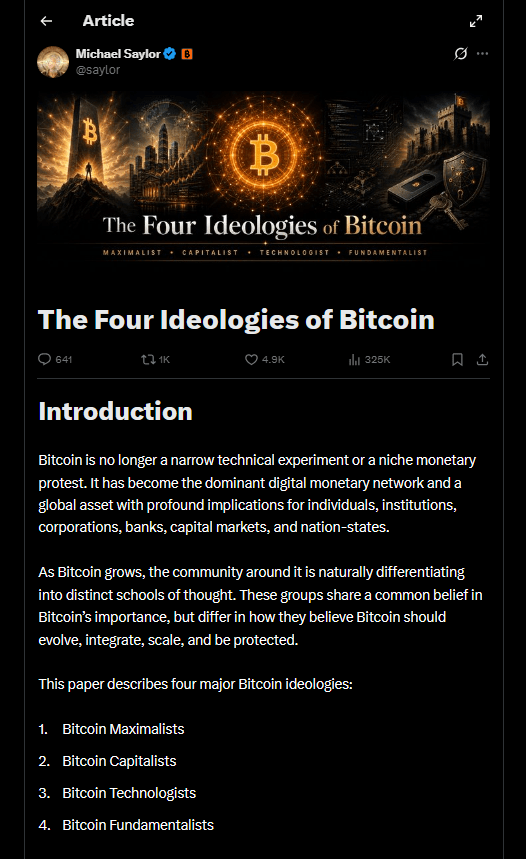
In a new paper, Michael Saylor addresses internal tensions within the Bitcoin community by identifying four primary camps: Maximalists, who view it as sound money; Capitalists, focused on institutional integration; Technologists, pushing protocol upgrades; and Fundamentalists, prioritizing decentralization and self-custody. Saylor argues these divisions reflect Bitcoin's maturation into a broader financial system, reaching individuals, companies, and governments, rather than signaling collapse. He suggests Bitcoin can maintain its core protocol while supporting growth in surrounding financial markets and products. This analysis comes amid market pressure on his company, MicroStrategy, following its first Bitcoin sale since 2022. The central question remains whether Saylor can mediate these rivalries rooted in money, politics, and principle.

Michael Saylor said Bitcoin has moved far beyond its early life as a niche protest and now reaches individuals, companies, banks, capital markets, and governments.

In a new paper posted on X, he grouped the Bitcoin world into four camps and argued that the split reflects growth, not collapse.

Four Camps, One Network

The four labels are Bitcoin Maximalists, Bitcoin Capitalists, Bitcoin Technologists, and Bitcoin Fundamentalists. According to the paper, they all see value in Bitcoin, but they disagree on how far it should stretch, how fast it should change, and how tightly it should tie itself to the financial system.

Saylor cast Maximalists as people who see Bitcoin as the main digital monetary network, a form of sound money, and a shield against inflation and weak currencies.

He also said this group gives Bitcoin moral clarity, while still leaving open the question of how the network fits with banks, public companies, and governments.

Bitcoin Capitalists, in his view, push in the other direction and want the asset embedded in portfolios, balance sheets, credit products, custody systems, and market infrastructure.

Saylor described them as the group most comfortable with corporate treasuries, institutional custody, and financial tools built around Bitcoin rather than just on top of it.
Protocol Pressure Points

The technologist camp, Saylor said, wants Bitcoin to keep improving on issues like scalability, privacy, security, wallet design, usability, custody, and even future threats such as quantum computing.

He warned that upgrades carry risk, because Bitcoin’s base layer holds value in part because users trust it not to change carelessly.

He drew a hard line around the Fundamentalists, who focus on self-custody, personal nodes, decentralization, immutability, and censorship resistance.

BTCUSD trading at $60,877 on the 24-hour chart: TradingView

Their concern is that banks, governments, custodians, leverage, and financial engineering could push Bitcoin away from the purpose that made it worth defending in the first place.

That wider argument lands while Strategy, the company Saylor leads as executive chairman, is under fresh market pressure after a rare Bitcoin sale drew attention last week.

Reports said the firm sold 32 BTC for about $2.5 million, its first Bitcoin sale since 2022, as Bitcoin traded near $60,000 and ETF outflows weighed on sentiment.

Can Saylor Stop The Rivalry?

Saylor’s paper frames the split as a normal stage in Bitcoin’s growth, not a sign of failure. His message was that Bitcoin can keep its base layer intact while allowing markets, custody services, and new financial products to grow around it.

Four camps, one coin, and a lot of egos. Saylor calls it growing pains. But with money, politics, and principles all colliding, can he actually get them to stop fighting — or does everyone think they’re the only one keeping Bitcoin alive?

Featured image from Unsplash, chart from TradingView

Trending Cryptos

Related Questions

QAccording to Michael Saylor's paper, what are the four main camps within the Bitcoin world and their core focus?

AThe four camps are Bitcoin Maximalists (see Bitcoin as sound money and a shield against inflation), Bitcoin Capitalists (want Bitcoin embedded in traditional financial portfolios and infrastructure), Bitcoin Technologists (focus on technical improvements like scalability and security), and Bitcoin Fundamentalists (prioritize self-custody, decentralization, and censorship resistance).

QHow does Michael Saylor characterize the internal disagreements among Bitcoin's different camps?

AHe frames the disagreements as a normal stage of growth and "growing pains," reflecting Bitcoin's expansion from a niche project to reaching individuals, companies, banks, and governments. He argues the split shows growth, not collapse.

QWhat recent action by Michael Saylor's company, MicroStrategy, is mentioned in the article?

AThe article mentions that MicroStrategy sold 32 BTC for about $2.5 million, which was its first Bitcoin sale since 2022, occurring while Bitcoin was trading near $60,000.

QWhat is the main concern of the 'Bitcoin Fundamentalist' camp as described by Saylor?

ATheir concern is that involvement from banks, governments, custodians, and financial engineering (like leverage) could push Bitcoin away from its original purpose of decentralization, self-custody, immutability, and censorship resistance.

QWhat is the central question posed by the article's title and concluding paragraph?

AThe central question is whether Michael Saylor can actually get the different Bitcoin camps to stop their internal rivalries and fighting, or if each camp believes they alone are the ones keeping Bitcoin's true purpose alive.

Related Reads

The Verdict in Choi Tae-won's Divorce Case: Revealing the Inheritance Undercurrent Behind SK Hynix's Trillion-Won Empire

SK Group Chairman Chey Tae-won's high-profile divorce case, involving a record 1.38 trillion won settlement, has drawn attention to the succession plans for Korea's second-largest conglomerate, especially its crown jewel, SK hynix. Unlike traditional chaebol scripts centered on the eldest son, Chey's three children from his marriage to former President Roh Tae-woo's daughter, Roh Soh-yeong, are carving distinct, non-traditional paths. Eldest daughter Chey Yun-jung (b. 1989) is seen as the most evident successor. With a scientific and consulting background, she holds executive roles at SK bioscience and SK Inc.'s growth support department, focusing on future strategy and biopharma. Her marriage is to an AI infrastructure entrepreneur, not a traditional business alliance. Second daughter Chey Min-jung (b. 1991) took a unique route, voluntarily serving as a South Korean naval officer, including an anti-piracy deployment. She later worked on policy and strategy for SK hynix in Washington D.C. before co-founding an AI-driven healthcare startup. She married a former U.S. Marine Corps officer, connecting her to U.S. defense and policy circles—networks crucial for a global semiconductor giant. The only son, Chey In-geun (b. 1995), who studied physics like his father, worked briefly at SK E&S before joining McKinsey. Despite fitting the traditional "heir" profile as the eldest son, he remains silent and holds no public position or shares in SK, suggesting the old succession playbook is obsolete. As SK hynix's valuation soars, becoming a geopolitical asset in the AI era, the heirs' legitimacy is no longer automatic. They must prove themselves in fields like AI biotech, global policy, and strategic consulting. Their marriages also reflect new elite networks in tech and defense, not old political alliances. Their inheritance is the complex challenge of navigating a globalized, tech-driven world, not just a corporate throne.

marsbit2 days ago 09:06

The Verdict in Choi Tae-won's Divorce Case: Revealing the Inheritance Undercurrent Behind SK Hynix's Trillion-Won Empire

marsbit2 days ago 09:06

From OpenSea to OpenRouter: Is Alex Atallah Repeating His 'Exit at the Peak' Playbook?

From OpenSea to OpenRouter: Is Alex Atallah Repeating His "Exit at the Peak" Playbook? According to the Wall Street Journal, payments giant Stripe is in talks to acquire the AI model aggregation platform OpenRouter in a potential deal valuing the company near $100 billion. This would mark founder Alex Atallah's second creation of a company reaching a $100 billion valuation, following his co-founding of NFT marketplace OpenSea. OpenRouter, founded just over three years ago, has grown rapidly by acting as a unified gateway for developers to access over 400 AI models. It currently has about 10 million users and processes over 200 trillion tokens monthly. While the platform's annualized revenue is around $50 million, its valuation has skyrocketed from $1.3 billion in March 2026. The potential acquisition by Stripe, a company OpenRouter's founder once likened it to, represents a major expansion into AI infrastructure for the payments leader. This move echoes Atallah's previous timing with OpenSea, where he departed before the NFT market's significant downturn. For OpenRouter, selling now may be strategic. Despite its scale, its business model—charging a 5-5.5% fee on AI inference calls—faces pressure from competition, open-source models, and potential price wars among model providers, limiting its profitability narrative for an IPO. A key asset for potential acquirers like Stripe is OpenRouter's vast repository of real-world AI usage data, which offers unique insights into model performance and developer preferences that are difficult to replicate. Whether this potential deal signifies a new valuation benchmark for AI infrastructure or another market peak signal remains to be seen.

链捕手2 days ago 08:42

From OpenSea to OpenRouter: Is Alex Atallah Repeating His 'Exit at the Peak' Playbook?

链捕手2 days ago 08:42

Trading

Spot

Hot Articles

What is $BITCOIN

DIGITAL GOLD ($BITCOIN): A Comprehensive Analysis Introduction to DIGITAL GOLD ($BITCOIN) DIGITAL GOLD ($BITCOIN) is a blockchain-based project operating on the Solana network, which aims to combine the characteristics of traditional precious metals with the innovation of decentralized technologies. While it shares a name with Bitcoin, often referred to as “digital gold” due to its perception as a store of value, DIGITAL GOLD is a separate token designed to create a unique ecosystem within the Web3 landscape. Its goal is to position itself as a viable alternative digital asset, although specifics regarding its applications and functionalities are still developing. What is DIGITAL GOLD ($BITCOIN)? DIGITAL GOLD ($BITCOIN) is a cryptocurrency token explicitly designed for use on the Solana blockchain. In contrast to Bitcoin, which provides a widely recognized value storage role, this token appears to focus on broader applications and characteristics. Notable aspects include: Blockchain Infrastructure: The token is built on the Solana blockchain, known for its capacity to handle high-speed and low-cost transactions. Supply Dynamics: DIGITAL GOLD has a maximum supply capped at 100 quadrillion tokens (100P $BITCOIN), although details regarding its circulating supply are currently undisclosed. Utility: While precise functionalities are not explicitly outlined, there are indications that the token could be utilized for various applications, potentially involving decentralized applications (dApps) or asset tokenization strategies. Who is the Creator of DIGITAL GOLD ($BITCOIN)? At present, the identity of the creators and development team behind DIGITAL GOLD ($BITCOIN) remains unknown. This situation is typical among many innovative projects within the blockchain space, particularly those aligning with decentralized finance and meme coin phenomena. While such anonymity may foster a community-driven culture, it intensifies concerns about governance and accountability. Who are the Investors of DIGITAL GOLD ($BITCOIN)? The available information indicates that DIGITAL GOLD ($BITCOIN) does not have any known institutional backers or prominent venture capital investments. The project seems to operate on a peer-to-peer model focused on community support and adoption rather than traditional funding routes. Its activity and liquidity are primarily situated on decentralized exchanges (DEXs), such as PumpSwap, rather than established centralized trading platforms, further highlighting its grassroots approach. How DIGITAL GOLD ($BITCOIN) Works The operational mechanics of DIGITAL GOLD ($BITCOIN) can be elaborated on based on its blockchain design and network attributes: Consensus Mechanism: By leveraging Solana’s unique proof-of-history (PoH) combined with a proof-of-stake (PoS) model, the project ensures efficient transaction validation contributing to the network's high performance. Tokenomics: While specific deflationary mechanisms have not been extensively detailed, the vast maximum token supply implies that it may cater to microtransactions or niche use cases that are still to be defined. Interoperability: There exists the potential for integration with Solana’s broader ecosystem, including various decentralized finance (DeFi) platforms. However, the details regarding specific integrations remain unspecified. Timeline of Key Events Here is a timeline that highlights significant milestones concerning DIGITAL GOLD ($BITCOIN): 2023: The initial deployment of the token occurs on the Solana blockchain, marked by its contract address. 2024: DIGITAL GOLD gains visibility as it becomes available for trading on decentralized exchanges like PumpSwap, allowing users to trade it against SOL. 2025: The project witnesses sporadic trading activity and potential interest in community-led engagements, although no noteworthy partnerships or technical advancements have been documented as of yet. Critical Analysis Strengths Scalability: The underlying Solana infrastructure supports high transaction volumes, which could enhance the utility of $BITCOIN in various transaction scenarios. Accessibility: The potential low trading price per token could attract retail investors, facilitating wider participation due to fractional ownership opportunities. Risks Lack of Transparency: The absence of publicly known backers, developers, or an audit process may yield skepticism regarding the project's sustainability and trustworthiness. Market Volatility: The trading activity is heavily reliant on speculative behavior, which can result in significant price volatility and uncertainty for investors. Conclusion DIGITAL GOLD ($BITCOIN) emerges as an intriguing yet ambiguous project within the rapidly evolving Solana ecosystem. While it attempts to leverage the “digital gold” narrative, its departure from Bitcoin's established role as a store of value underscores the need for a clearer differentiation of its intended utility and governance structure. Future acceptance and adoption will likely depend on addressing the current opacity and defining its operational and economic strategies more explicitly. Note: This report encompasses synthesised information available as of October 2023, and developments may have transpired beyond the research period.

1.1k Total ViewsPublished 2025.05.13Updated 2025.05.13

What is $BITCOIN

Discussions

Welcome to the HTX Community. Here, you can stay informed about the latest platform developments and gain access to professional market insights. Users' opinions on the price of BTC (BTC) are presented below.

活动图片