Bitcoin Liquidation Shakeout Leaves Traders Watching $66K Resistance And $61K Support

bitcoinistPublished on 2026-06-13Last updated on 2026-06-13

Abstract

Bitcoin's recent volatility triggered a major liquidation event, wiping out roughly $980 million in leveraged positions within 24 hours as price swung from ~$64,100 down to $60,700 and back above $63,000. Traders are now watching key technical levels. Major pivot resistance is identified at $66,247, with reclaimed highs near $64,234 and next resistance at $65,890. Critical support zones lie between $63,127-$63,354, then $62,459, with broader downside targets around $59,150-$60,171. Liquidation heatmaps show significant liquidity clusters above ($63.5K-$66K) and below ($58.5K-$61K) spot price, creating a volatile corridor. The market is in a corrective phase; a clean break above resistance is needed for a bullish shift, while failure to hold low-$63K support risks a move toward lower liquidity zones.

TL;DR

  • Bitcoin’s sharp move from the mid-$64,000 area to near $60,700, followed by a rebound above $63,000, triggered a large leverage reset across crypto markets.
  • CryptoReviewing/status/2065076555949216117′′>CryptoReviewing said total crypto liquidations reached about $980 million in less than 24 hours, with liquidity zones now sitting both above and below spot.
  • Trade Nation’s TradingView analysis places Bitcoin’s key pivot resistance at 66,247, with downside supports at 59,150, 56,900, and 54,920.
  • A separate TradingView idea from virDeStatera points to 64,234 as the swept high to reclaim, with 65,890 as the next key resistance.

Bitcoin traders are watching a tight cluster of liquidation zones and technical levels after a sharp two-way move flushed leverage from both sides of the market.

CryptoReviewing, citing a Coinglass liquidation heatmap, said Bitcoin first dropped from $64,100 to $60,700, liquidating roughly $456 million, before rebounding back above $63,000 and triggering another $524 million in liquidations. The analyst described the combined move as roughly $980 million in crypto liquidations in less than 24 hours.
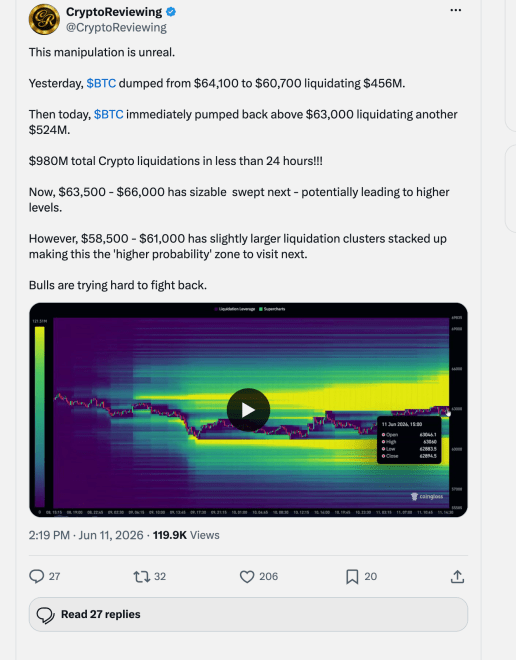
CryptoReviewing highlighted Bitcoin liquidation clusters using Coinglass heatmap data.

The word “manipulation” appeared in the original post, but the cleaner read is that this was a high-leverage market reacting violently around crowded positioning. In that kind of environment, both long and short traders can be forced out quickly as price sweeps liquidity above and below nearby ranges.

Bitcoin Liquidity Zones Sit On Both Sides

The key issue now is where the next liquidity pocket sits. CryptoReviewing pointed to the $63,500 to $66,000 region as a sizable upside zone, while also noting a slightly larger downside cluster around $58,500 to $61,000.

That creates an awkward setup for short-term traders. A push higher could force more short covering if Bitcoin breaks into the upper liquidity zone. But a failure to hold current levels could pull price back toward the lower cluster, where late longs may again be vulnerable.

Liquidation maps are not precise price forecasts. They show where leveraged positions may be concentrated, not where price must go. Still, when volatility is elevated and liquidity is thin, these levels can become magnets because forced liquidations often add fuel to already-moving markets.

Trade Nation Flags 66,247 As Pivot Resistance

A TradingView idea from Trade Nation offered a more traditional support-and-resistance framework for Bitcoin’s current pullback. The analysis described BTC as being in a corrective phase on the four-hour chart and identified 66,247 as the main pivot resistance level.

As long as Bitcoin remains below that level, Trade Nation’s downside scenario highlights 59,150 as near-term support, followed by 56,900 and 54,920. On the upside, a move above 66,247 would shift attention toward 67,950 and then 69,940.

Those levels line up reasonably well with the broader liquidation-map picture. The $59,150 support sits inside the wider $58,500 to $61,000 downside liquidity region, while the 66,247 pivot is close to the upper $63,500 to $66,000 zone identified in the heatmap post.
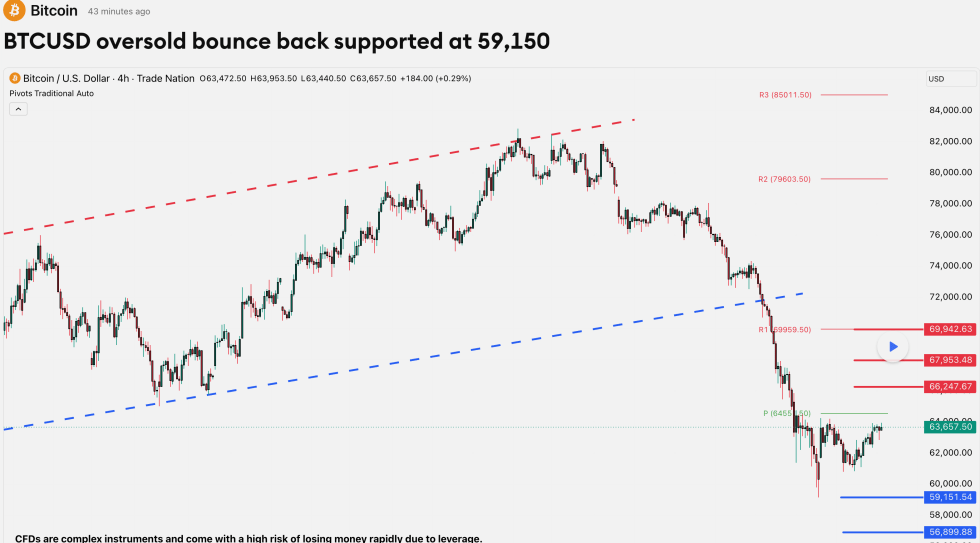
Trade Nation’s TradingView setup marked 66,247 as the main pivot resistance.

Short-Term Traders Watch The Swept High

A separate TradingView idea from virDeStatera focused on Bitcoin’s one-hour structure and argued that a new overnight high had been swept. The analysis placed that swept high at 64,234, with price pulling back toward 63,713 at the time of the post.

The same setup identified 65,890 as key resistance, with intraday support between 63,127 and 63,354. Below that, virDeStatera highlighted 62,459 as key support and 60,171 as a broader thesis line.

The technical language in the original TradingView post included several proprietary indicators, but the practical takeaway is simpler: Bitcoin needs to reclaim the swept 64,234 area with convincing volume before traders can reasonably look toward 65,890 and the broader 66,000 region.

If that reclaim fails, attention likely shifts back toward the lower support stack. The first area to watch would be the 63,127 to 63,354 band, followed by 62,459 and then the wider 60,000 to 61,000 zone flagged by liquidation data.
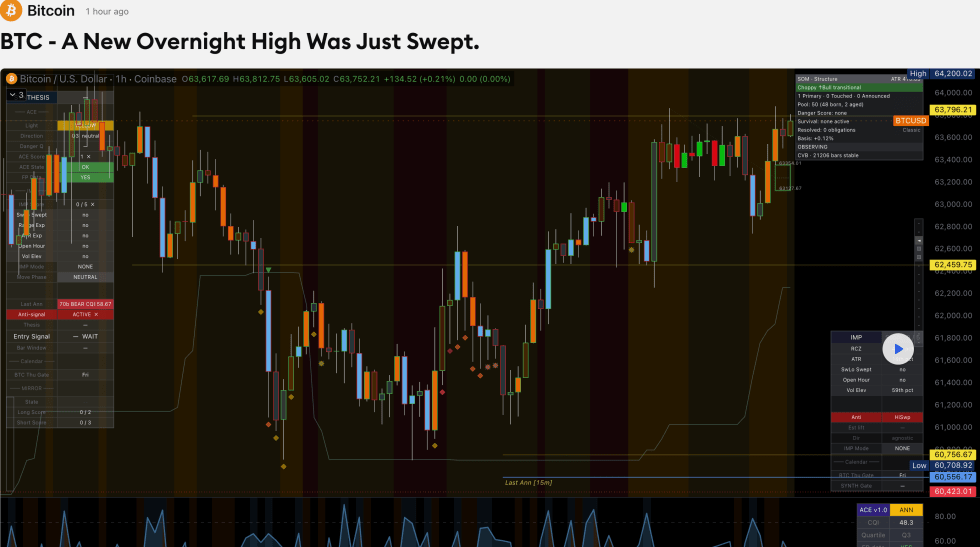
virDeStatera’s TradingView idea focused on the 64,234 swept high and nearby intraday support.

What This Means For Bitcoin Traders

The current setup does not offer a clean one-way signal. Instead, it shows a market sitting between two obvious liquidity pockets after a major leverage reset.

For bulls, reclaiming 64,234 and then pressing toward 65,890 would be the first step toward testing the 66,247 pivot and the upper liquidation zone. For bears, failure to hold above the low-$63,000 area would keep the lower support cluster in play.

That makes risk management more important than prediction. Bitcoin can move quickly when liquidation levels sit close to spot, and the recent $980 million flush shows how fast crowded positioning can unwind.

For now, the clearest map is this: resistance is stacked between roughly 64,234, 65,890, and 66,247, while downside risk builds around 63,127 to 63,354, then 62,459, and finally the broader 59,150 to 60,171 region. Until one side breaks cleanly, Bitcoin remains trapped in a short-term volatility corridor.


Originally shared by CryptoReviewing on X

Trending Cryptos

Related Questions

QWhat was the total estimated value of crypto liquidations triggered by Bitcoin's recent volatile price move, and over what time period did this occur?

AThe total estimated value of crypto liquidations was about $980 million, and this occurred in less than 24 hours.

QAccording to the article, what is the main pivot resistance level for Bitcoin identified in Trade Nation's TradingView analysis?

AThe main pivot resistance level identified by Trade Nation is $66,247.

QWhat are the two broad Bitcoin price ranges identified as liquidity clusters or zones by the analyst CryptoReviewing?

ACryptoReviewing identified an upside liquidity zone from $63,500 to $66,000, and a slightly larger downside liquidity cluster around $58,500 to $61,000.

QIn the shorter-term analysis by virDeStatera, what price level is identified as the 'swept high' that Bitcoin needs to reclaim?

AThe 'swept high' that Bitcoin needs to reclaim is at $64,234.

QBased on the article's conclusion, what is the primary focus for traders in the current Bitcoin market setup, rather than trying to predict direction?

AThe primary focus for traders should be on risk management, as the market is trapped in a short-term volatility corridor between key resistance and support levels.

Related Reads

Why Is the World Nervous About Japan Raising Interest Rates?

In June 2026, the Bank of Japan raised its policy rate to 1%, marking its first hike to this level since 1995. While this rate remains low compared to global peers like the US and Europe, the move signals a profound shift for a nation that has been a global source of ultra-cheap funding for decades. Japan's long-standing near-zero or negative interest rates had facilitated massive "yen carry trades," where international investors borrowed low-cost yen to invest in higher-yielding assets worldwide, such as US tech stocks and emerging market bonds. This made Japan a critical, often overlooked, source of global liquidity. Japan's ultra-loose policy stemmed from structural challenges post-1990s asset bubble: aging demographics, chronic low inflation/deflation, and high public debt. Recent shifts, including sustained wage growth (exceeding 5% in recent years) and inflation consistently above the 2% target, have created a "wage-price spiral" possibility, prompting the policy normalization. The global market's concern lies not in the absolute rate but in the potential unwinding of the yen carry trade. As Japanese borrowing costs rise, the economics of these leveraged global investments change, potentially triggering deleveraging and capital outflows from risk assets. Market anxiety focuses on the end of a thirty-year consensus that Japan would perpetually provide cheap funding. Ultimately, the global impact will depend on the interplay with US monetary policy. While Japan is tightening, the significant interest rate differential with the US remains. The key future dynamic is whether simultaneous Japanese hikes and eventual US rate cuts will narrow this gap, forcing a major recalibration of global capital flows and asset pricing built on an era of abundant, cheap yen liquidity.

marsbit10h ago

Why Is the World Nervous About Japan Raising Interest Rates?

marsbit10h ago

Trading

Spot
Futures

Hot Articles

What is $BITCOIN

DIGITAL GOLD ($BITCOIN): A Comprehensive Analysis Introduction to DIGITAL GOLD ($BITCOIN) DIGITAL GOLD ($BITCOIN) is a blockchain-based project operating on the Solana network, which aims to combine the characteristics of traditional precious metals with the innovation of decentralized technologies. While it shares a name with Bitcoin, often referred to as “digital gold” due to its perception as a store of value, DIGITAL GOLD is a separate token designed to create a unique ecosystem within the Web3 landscape. Its goal is to position itself as a viable alternative digital asset, although specifics regarding its applications and functionalities are still developing. What is DIGITAL GOLD ($BITCOIN)? DIGITAL GOLD ($BITCOIN) is a cryptocurrency token explicitly designed for use on the Solana blockchain. In contrast to Bitcoin, which provides a widely recognized value storage role, this token appears to focus on broader applications and characteristics. Notable aspects include: Blockchain Infrastructure: The token is built on the Solana blockchain, known for its capacity to handle high-speed and low-cost transactions. Supply Dynamics: DIGITAL GOLD has a maximum supply capped at 100 quadrillion tokens (100P $BITCOIN), although details regarding its circulating supply are currently undisclosed. Utility: While precise functionalities are not explicitly outlined, there are indications that the token could be utilized for various applications, potentially involving decentralized applications (dApps) or asset tokenization strategies. Who is the Creator of DIGITAL GOLD ($BITCOIN)? At present, the identity of the creators and development team behind DIGITAL GOLD ($BITCOIN) remains unknown. This situation is typical among many innovative projects within the blockchain space, particularly those aligning with decentralized finance and meme coin phenomena. While such anonymity may foster a community-driven culture, it intensifies concerns about governance and accountability. Who are the Investors of DIGITAL GOLD ($BITCOIN)? The available information indicates that DIGITAL GOLD ($BITCOIN) does not have any known institutional backers or prominent venture capital investments. The project seems to operate on a peer-to-peer model focused on community support and adoption rather than traditional funding routes. Its activity and liquidity are primarily situated on decentralized exchanges (DEXs), such as PumpSwap, rather than established centralized trading platforms, further highlighting its grassroots approach. How DIGITAL GOLD ($BITCOIN) Works The operational mechanics of DIGITAL GOLD ($BITCOIN) can be elaborated on based on its blockchain design and network attributes: Consensus Mechanism: By leveraging Solana’s unique proof-of-history (PoH) combined with a proof-of-stake (PoS) model, the project ensures efficient transaction validation contributing to the network's high performance. Tokenomics: While specific deflationary mechanisms have not been extensively detailed, the vast maximum token supply implies that it may cater to microtransactions or niche use cases that are still to be defined. Interoperability: There exists the potential for integration with Solana’s broader ecosystem, including various decentralized finance (DeFi) platforms. However, the details regarding specific integrations remain unspecified. Timeline of Key Events Here is a timeline that highlights significant milestones concerning DIGITAL GOLD ($BITCOIN): 2023: The initial deployment of the token occurs on the Solana blockchain, marked by its contract address. 2024: DIGITAL GOLD gains visibility as it becomes available for trading on decentralized exchanges like PumpSwap, allowing users to trade it against SOL. 2025: The project witnesses sporadic trading activity and potential interest in community-led engagements, although no noteworthy partnerships or technical advancements have been documented as of yet. Critical Analysis Strengths Scalability: The underlying Solana infrastructure supports high transaction volumes, which could enhance the utility of $BITCOIN in various transaction scenarios. Accessibility: The potential low trading price per token could attract retail investors, facilitating wider participation due to fractional ownership opportunities. Risks Lack of Transparency: The absence of publicly known backers, developers, or an audit process may yield skepticism regarding the project's sustainability and trustworthiness. Market Volatility: The trading activity is heavily reliant on speculative behavior, which can result in significant price volatility and uncertainty for investors. Conclusion DIGITAL GOLD ($BITCOIN) emerges as an intriguing yet ambiguous project within the rapidly evolving Solana ecosystem. While it attempts to leverage the “digital gold” narrative, its departure from Bitcoin's established role as a store of value underscores the need for a clearer differentiation of its intended utility and governance structure. Future acceptance and adoption will likely depend on addressing the current opacity and defining its operational and economic strategies more explicitly. Note: This report encompasses synthesised information available as of October 2023, and developments may have transpired beyond the research period.

384 Total ViewsPublished 2025.05.13Updated 2025.05.13

What is $BITCOIN

Discussions

Welcome to the HTX Community. Here, you can stay informed about the latest platform developments and gain access to professional market insights. Users' opinions on the price of BTC (BTC) are presented below.

活动图片