Ethereum at $1.5K: A tense stand-off forms, with ETH shorts under pressure

ambcryptoPublished on 2026-07-01Last updated on 2026-07-01

Abstract

Ethereum faces a tense standoff, trading around $1,500 after a nearly 50% decline in the first half of 2026. While technicals and bearish derivatives positioning signal downside risk, key on-chain data suggests a potential trap for short sellers. Large transfers to exchanges are accompanied by significant stablecoin inflows, indicating whales may be preparing to buy rather than sell. Furthermore, strong user retention and rising ETH staking activity are reducing available supply. This clash between heavy bearish bets and solid holder conviction creates conditions for a possible short squeeze, making the current consolidation risky for those positioned for further downside.

One look at the technicals is enough to show how bearish the market has turned. Nothing reflects this better than Ethereum.

According to CoinGlass data, ETH closed Q2 down 25.28%, extending Q1’s 29.26% drop. That puts the altcoin down nearly 50% in the first half of 2026, leaving holders who bought the top deep underwater.

The price structure tells the same story. As the chart below shows, ETH has lost two major support levels. It first broke below $3,200 in mid-January, then lost the $2,000 level in early June.

Since then, the next base has formed around $1,500, where ETH has been chopping sideways for more than four straight weeks.
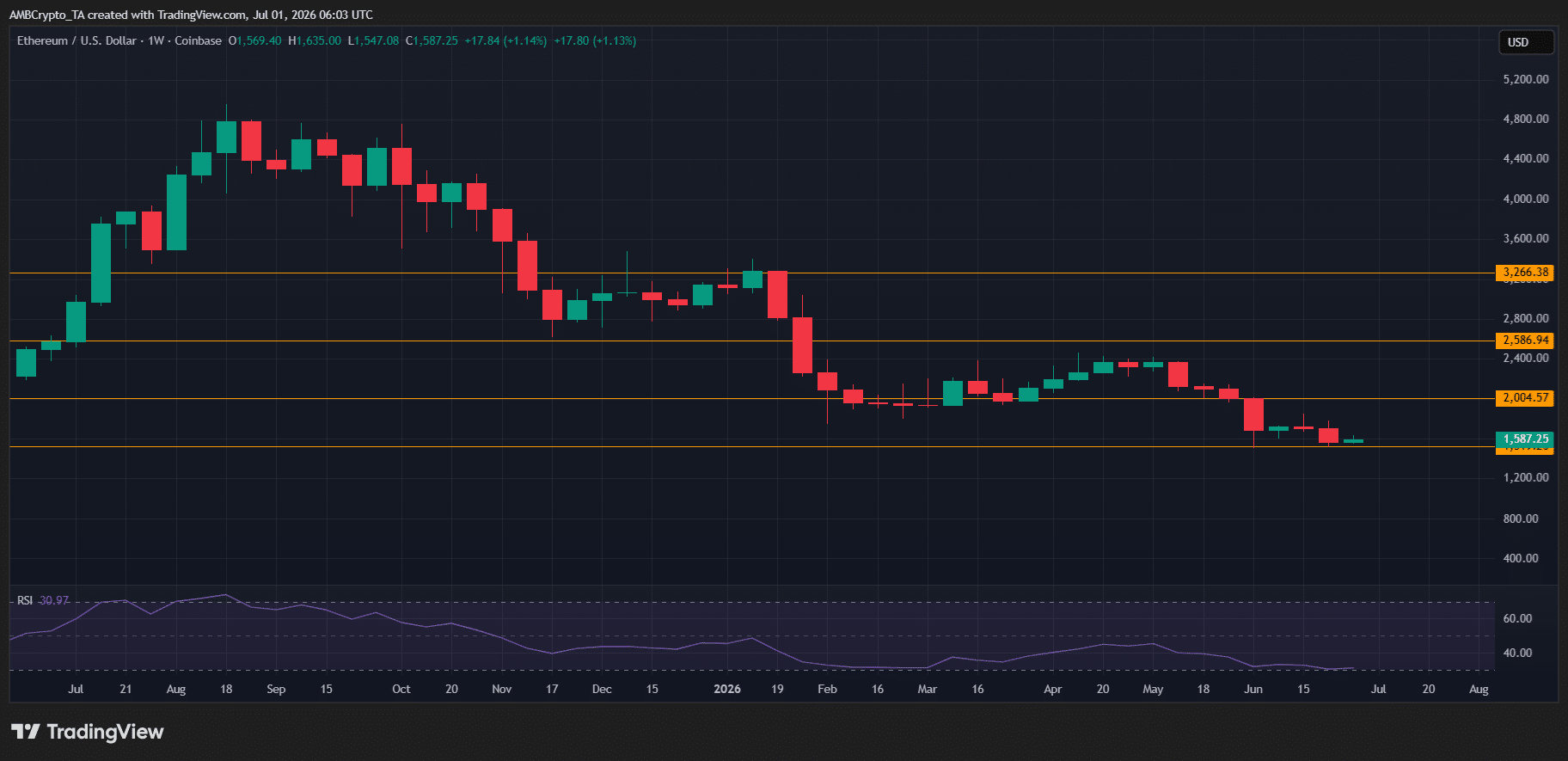
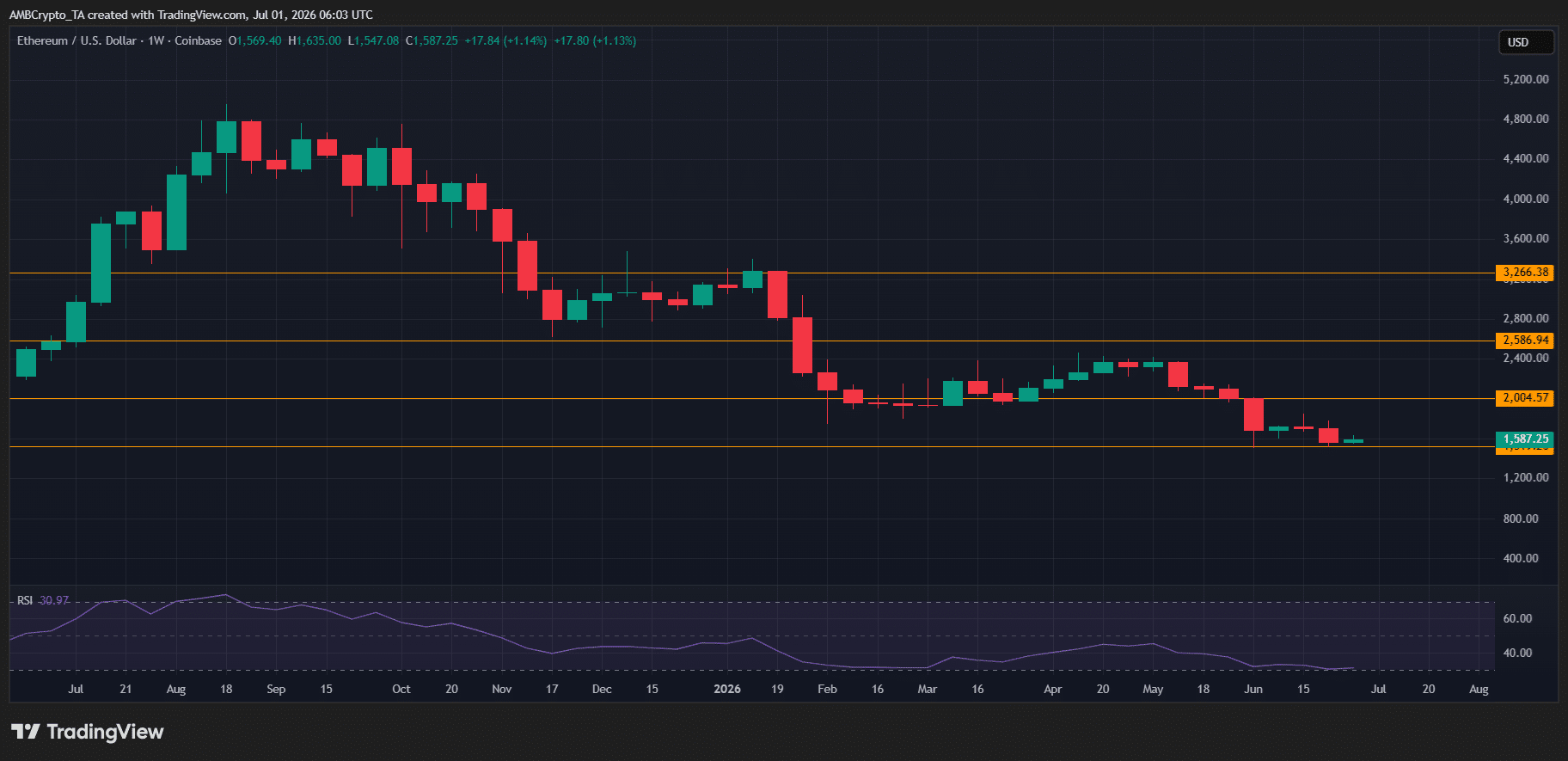
Source: TradingView (ETH/USDT)

Now, looking at Santiment’s latest report, it seems another breakdown could be on the cards.

According to the report, large Ethereum transfers to CEXs usually point to higher selloff risk, as whales tend to move coins onto exchanges before selling, hedging, or rebalancing. However, this time there’s a catch.

Those ETH inflows have been accompanied by strong stablecoin inflows, suggesting whales are also moving dry powder onto exchanges. That points to large players keeping capital ready, potentially to buy the dip rather than simply offload their ETH.

And the data already hints at where that capital could be moving. The timing looks deliberate, with Ethereum [ETH] trading right on top of a key support zone. A clean break below this level could trigger another round of panic selling as more HODLers fall deeper underwater. But so far, the cycle is telling a different story.

Ethereum’s chop may be a trap for short sellers

Every time the market consolidates in uncertainty, it tends to set a trap for traders.

Looking at Ethereum’s current flows, its chop around $1.5k could be building pressure for a short squeeze, with many traders still positioned for downside in a broader risk-off environment. But ETH is starting to diverge from the rest of the market based on key on-chain signals.

According to CryptoQuant, Ethereum is going through a sentiment reset, with negative Coinbase Premium and funding rates showing bearish positioning across both U.S. Spot and derivatives markets.

Even so, price is holding steady as exchange liquidity declines and ETH staking inflows continue to rise. This creates a “wall of worry” setup, where traders stay bearish while long-term holders keep locking up supply.
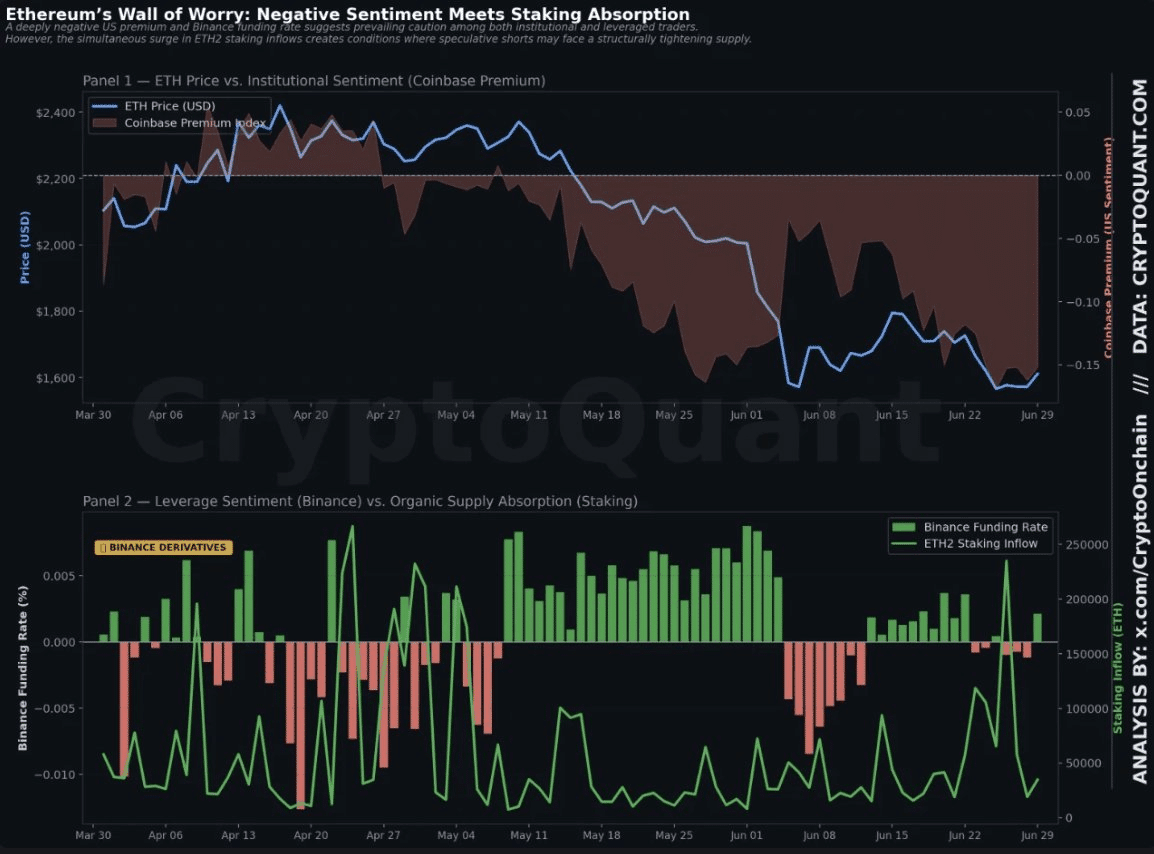
Source: CryptoQuant

In essence, Ethereum is in a high-conviction standoff.

This divergence is creating a potential trap for short sellers, as heavy bearish positioning in derivatives is clashing with strong holder conviction. In fact, Ethereum recorded the highest user retention rate among major blockchains at 26.2%, according to CoinGecko’s Q1 2025 to Q1 2026 cohort study.

Hence, with strong retention, rising staking activity, and ongoing deleveraging, Ethereum’s current chop could be risky for those still positioned short.


Final Summary

  • Ethereum bears are positioned heavily, but staking and retention remain strong.
  • Price is chopping near $1.5k, increasing the risk of a squeeze.

Trending Cryptos

Related Questions

QWhat is the current price level that Ethereum is chopping around, according to the article?

AEthereum is currently chopping sideways around the $1,500 level.

QWhat key on-chain signals suggest Ethereum may be diverging from broader market sentiment?

AKey signals include declining exchange liquidity, rising ETH staking inflows, and strong user retention, which contrast with negative funding rates and Coinbase Premium indicating bearish market positioning.

QWhy does the article suggest that large ETH transfers to CEXs might not necessarily lead to a selloff this time?

ABecause these ETH inflows were accompanied by significant stablecoin inflows, suggesting whales are moving 'dry powder' onto exchanges, potentially to buy a dip rather than just sell their ETH.

QWhat is the 'wall of worry' setup described in the article regarding Ethereum's market?

AThe 'wall of worry' setup refers to a situation where traders remain bearish (as shown in derivatives positioning), while long-term holders demonstrate strong conviction by continuing to lock up supply through staking, creating potential for a price squeeze.

QWhat risk does the article highlight for traders who are still positioned short on Ethereum?

AThe article highlights the risk of a short squeeze, as heavy bearish positioning in derivatives clashes with strong holder conviction, rising staking, and high user retention, potentially forcing short sellers to cover their positions if the price moves up.

Related Reads

How Collector Crypt Uses 'Recirculating Buybacks' to Create an Illusion of Growth

Title: How Collector Crypt Creates a Growth Illusion with "Buyback Loops" Key Findings: Collector Crypt's (CC) net take rate has halved from 11.2% in Q3 2025 to 5.6% in Q2 2026, while GMV grew 4.7x. This growth is driven by higher-tier card packs ($250, $1,000, $2,500) which have lower platform dollar retention rates. The newly launched $2,500 Mythic tier captured 36.7% of June GMV within 13 days. Growth is fueled by a small cohort of high-spending, high-frequency wallets rather than broad user base expansion. The economic model faces pressure from three key areas: 1) **Shifting GMV Mix**: Pushing users towards larger, lower-retention card packs increases GMV but reduces overall profitability. 2) **Physical Redemptions**: Card redemptions for physical items remove reusable inventory from the system, creating costly replenishment needs. In May, redemptions consumed 41.6% of pre-redemption net income. Only 75 wallets drove redemptions in June. 3) **B2B/API Strategy**: Partner revenue remains negligible (cumulatively $1.83M) and dependent on CC for inventory, vaulting, and buyback services, failing to create a scalable, asset-light recurring revenue stream. The core product is a repetitive pack-buyback loop with limited secondary market activity and token value accrual. Sensitive modeling shows CC's economics turn negative when any two of the following pressures coincide: replenishment costs near market price, redemption rates exceeding 9%, or high-tier buyback rates around 93%. While CC operates in a large and growing collectibles market, its current growth levers—bigger packs, high buyback rates, and capital recycling by a few wallets—create a volume illusion without demonstrating sustainable collector engagement, deep secondary markets, or a viable path to improved margins. Future proof points include broadening collector participation, deepening secondary trading, and developing true asset-light B2B revenue channels.

Foresight News8m ago

How Collector Crypt Uses 'Recirculating Buybacks' to Create an Illusion of Growth

Foresight News8m ago

Grayscale's Latest Research: What is Solana's Next Growth Engine?

Grayscale's latest report, "Solana: Crypto's Financial Bazaar," signals a shift in how the market views Solana, moving beyond its high-performance and meme-centric reputation. The report frames Solana as an evolving application platform for large-scale economic activity, akin to a bustling digital marketplace. The analysis highlights that public chain competition has moved past raw throughput (TPS) to focus on genuine economic activity—daily users, transaction volume, and real revenue. Solana's metrics, such as over 1,000 dApps, 100M+ daily transactions, and ~4.3M daily active users, showcase this shift toward application-layer prosperity. The report identifies three key growth drivers: 1. **Jupiter**: Evolving from a DEX aggregator to a core liquidity hub and comprehensive financial platform for Solana's DeFi. 2. **Pump.fun**: Demonstrates Solana's capacity for consumer-scale applications, attracting millions of users and generating significant, sustainable revenue, validating network stability under high load. 3. **Helium & DePIN**: Represents expansion into real-world infrastructure, connecting blockchain to physical resources like wireless networks and positioning services, opening new long-term use cases. Solana Foundation's recent focus aligns with this broader vision, emphasizing AI Agents (for machine-to-machine transactions), payments, stablecoins, and Real-World Assets (RWA) to build a sustainable growth model beyond cyclical trends. While challenges remain—such as value capture for SOL and maintaining ecosystem sustainability beyond hot trends—institutional interest is growing due to Solana's maturing application business models, expanding payment/stablecoin ecosystem, and persistent developer activity. The competition is no longer about speed alone, but about which network can foster the most vibrant and valuable digital economy.

marsbit29m ago

Grayscale's Latest Research: What is Solana's Next Growth Engine?

marsbit29m ago

They Waited 7 Years for This Money

The article discusses the significant drop in share price of Circle, known as the "first stablecoin stock," triggered by the announcement of a new alliance including Visa, Stripe, Mastercard, Coinbase, BlackRock, Google, IBM, and Ripple. This alliance plans to launch Open USD, a USD stablecoin, later this year. Key to the market reaction is Open USD's plan to distribute reserve-generated profits to its adopters, directly challenging Circle's core revenue model from USDC's reserve interest. The piece draws a parallel to Facebook's 2019 Libra (later Diem) project, which involved many of the same companies. Libra failed due to regulatory pressure, its association with Facebook's controversial reputation, and overly ambitious global currency narratives. However, the underlying desire of these major financial and tech firms to create a new digital payment infrastructure persisted. Over seven years, the landscape changed: clearer US stablecoin regulations (GENIUS Act), mature blockchain infrastructure, and companies gaining practical experience with crypto payments. Open USD presents a more modest, compliance-focused narrative—a settlement tool and enterprise payment rail rather than a revolutionary global currency. While the new alliance poses a serious threat to Circle's profitability and exclusivity, it faces challenges typical of large consortia: slow decision-making and complex profit-sharing. USDC's established liquidity, trust, and integrations provide Circle with significant defenses. The market's reaction is seen partly as an emotional overreaction but also a necessary reevaluation of Circle's business model from a unique "stablecoin era ticket" to a "strong issuer" in a competitive commodity market. Ultimately, the core ambition from the Libra era remains: to digitize the movement of dollar value on the internet and capture the adjacent commercial opportunities. The lesson learned is to pursue this goal not as a high-profile, platform-led revolution, but as a quiet, utility-focused infrastructure play.

marsbit29m ago

They Waited 7 Years for This Money

marsbit29m ago

Trading

Spot

Hot Articles

Discussions

Welcome to the HTX Community. Here, you can stay informed about the latest platform developments and gain access to professional market insights. Users' opinions on the price of ETH (ETH) are presented below.

活动图片