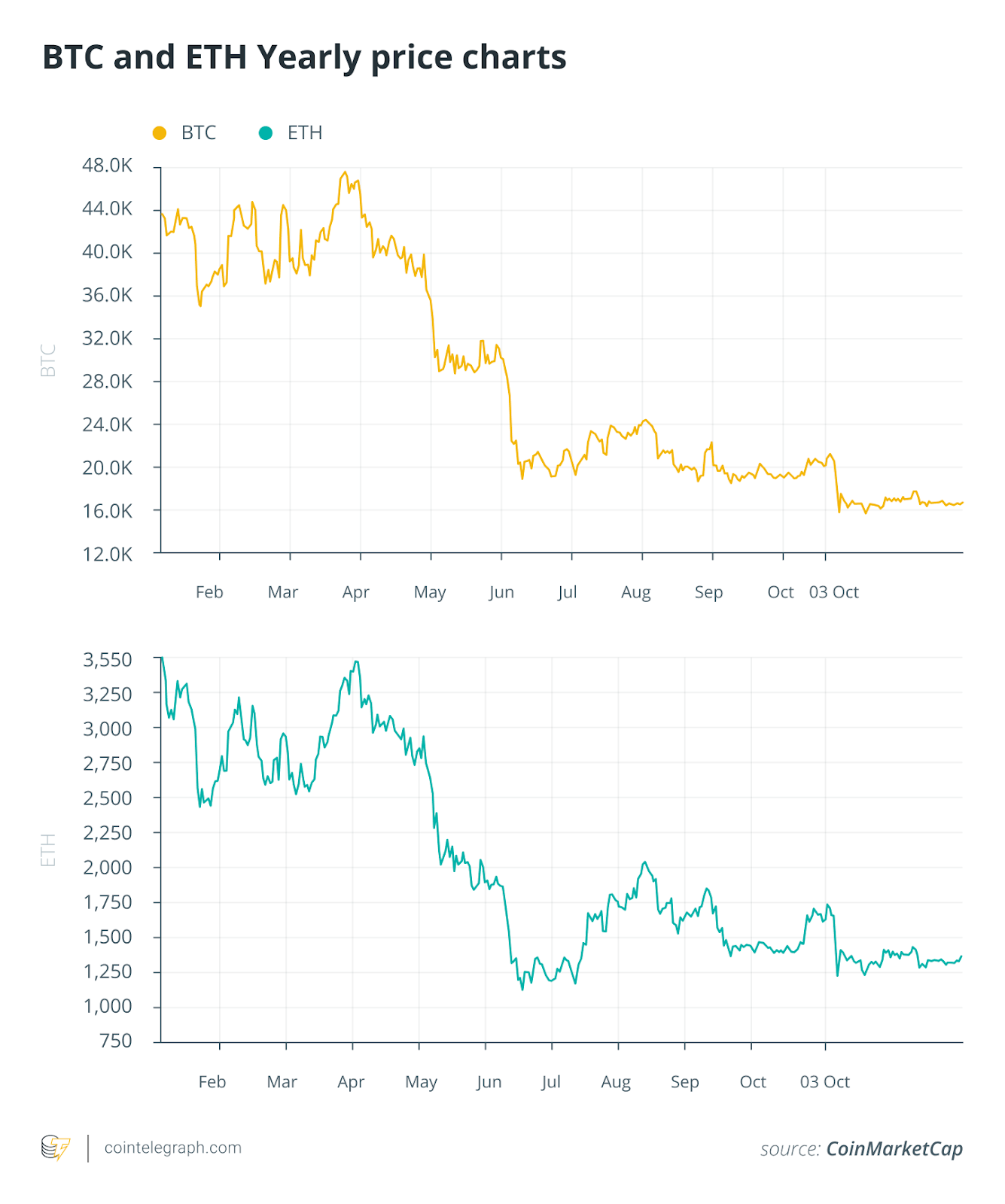
If 2022 was any kind of template for gauging what the crypto market might offer for investors going forward, it proved to be terribly difficult to predict. The space saw a brutal shock to the global crypto market capitalization, which fell just over 60% from $2.2 trillion to about $797 billion year to date. It also saw the two largest cryptocurrencies by market cap, BTC and ETH, fall by 64% and 67%, respectively, during the same time frame, with the concurrent slide in the alt market too.
⠀
⠀
These price drops, combined with the demise of the FTX exchange, were not events that many, if any, foresaw. Furthermore, the fallout from the FTX debacle is not yet over, given that some crypto projects and venture funds have retained treasury accounts on the exchange.
⠀
That said, if 2022 was indeed messy, then 2023 has to offer something more positive, but growth is likely to be slow in the first quarter – if not the first half - of the year.
⠀
Will 2023 follow the same pattern?
⠀
Following the brutal events of 2022, there will inevitably be a period of adjustment, settling, and refocus, all of which will drive months of reflection and nervous reconviction before change manifests in the market.
⠀
The macroeconomic climate is unlikely to change significantly in the short term too. The so-called “crypto winter” will persist at least for a while. But change will come. Still, whether it is going to be investor-led or corporately-led remains to be seen.
⠀
What does seem apparent though, is that as the market matures - and confidence grows again - there should be a shift in a positive direction; therefore, it would come as no surprise if risk-taking investors moved earlier in the year rather than later, which may seem counter-intuitive. Moreover, as you will read below, the forecast development in DeFi and NFTs.
⠀
Defi in 2023
⠀
Liquidity issues and attracting retail use
⠀
With trading volume and liquidity falling across the crypto space, DeFi will continue to struggle with liquidity incentives and the bootstrapping of services. Methods for getting this passive liquidity have constantly been evolving since the beginning of DeFi, from liquidity mining reward mechanics to newer concepts such as protocol-owned liquidity. Still, this problem persists and will need to be solved in the new year for DeFi to succeed as a scalable alternative to centralized financial services.
⠀
Token rewards have proved an unsustainable incentive for trading and market making, often leading to wash trading or “farm-dumping” of platform assets. Most retail users do not have the time or ability to execute optimally and manage their positions. This complexity can be a large deterrent in having retail investors commit capital to the DeFi space.
⠀
In 2023 there should be a movement to more structured product offerings. I spoke with IceCreamMan - a founding member of JONES - which is a project on the Layer 2 protocol Arbitrum. During the discussion about their structured offerings, he said, “for example, jUSDC is a delta-gamma neutral stablecoin vault, earning blue chip yields via lending to other Jones structured products in a safe, transparent way, enforced through smart contracts.” And while this highlights the inherent complexities of the DeFi market to the retail user, it also shows that there are a lot of people trying to simplify the process and make the space (and its benefits) more accessible to the retail user.
⠀
Regulatory Issues and attracting Institutional use
⠀
With regulation getting into the spotlight at the end of 2022, and the uncertainty that comes with it, a lot of institutions are hesitant to buy into decentralized distributed ledger technologies. The idea of ‘permissioned DeFi’ could just provide the solution to help institutions overcome regulatory pains.
⠀
In November 2022, we saw J.P. Morgan and DBS Bank conducting foreign bond transactions on the Polygon blockchain under a new scheme that also supported on-chain verifiable credentials. I believe this is an early example of a major bank using tokenized deposits on a public blockchain. In 2023 I expect to see an increasing amount of government-led (if not supported) initiatives that collaborate and explore DeFi adoption in partnership with various industry leaders.
⠀
Though ‘permissioned DeFi’ is not decentralized by nature, it remains to be seen just how far institutions will go towards pursuing customers’ interests and the amount of power, if any at all, they are willing to relinquish in the pursuit of decentralization and decentralized finance. Most likely, there will be tension between users choosing true crypto-native platforms - such as XGo - to help bridge and support a customer’s DeFi experience and traditional financial institutions trying to leverage DeFi’s benefits for its customer base.
⠀
NFTs in 2023
⠀
The convergence of gaming, the metaverse, and NFTs
⠀
As a sector, NFT profile picture projects have tended to transition to interoperable metaverse integration. Evidence for this has been growing significantly through 2022, and this trend is likely to continue into 2023.
⠀
Otherdeed, Cooltopia, and Spacedoodles are committing large amounts of energy and funding from their parent collection’s treasuries and still only represent the tip of the coming gamification iceberg. The question still remains as to whether this will be a catalyst to mass adoption, and even if this is the case, it remains to be seen whether the imminent metaverse(s) will be truly decentralized.
⠀
The current trend towards stability and sustainability in Web3 games, in many ways resulting from the issues of Axie Infinity and its Pay-to-Earn model, will spawn a wave of other products with built-in stability.
⠀
Furthermore, the early ecosystems of 2023 are in danger of overreacting and being designed to insulate themselves from the dynamic boom-and-bust nature of most crypto speculation. There is a risk of creating a homogenous, muted player experience, which feels like a copycat version of existing traditional video games.
⠀
Even still, we’ve yet to see a metaverse come close to the likes of Minecraft. The coming year will show that tokenomics, gamification, and exposure to speculation will have to be used in healthy, responsible ways. Moreover, mass adoption will be achieved by those platforms that produce games utilizing NFTs and cryptocurrency without that feature being their whole sales pitch. Gamers should be engaging with these technologies without even being aware of it.
⠀
What’s more, a battle is poised as we move into 2023. There are two emerging approaches to Web3 game development: crypto companies moving into gaming vs. gaming companies moving into crypto. The latter is being led by companies such as Limit Break, which is a new company with former Machine Zone CEO, Gabriel Leydon (the company that had Kate Upton, Mariah Carey, and Arnold Schwarzenegger all over our TV screens) building Web3 Massively Multiplayer Online games.
⠀
Leydon said: “People talk about Web3 gaming like a futuristic inevitability,” before adding, “it’s not. It requires people to properly design and build it”. Limit Break intends to incorporate Web3 elements into the “free-to-play” gaming model, another stark difference to the crypto-native-first approach of 2022. The reality is, usually, no more than 5% of mobile game players actually pay for anything, and so in order for mass adoption, these people need to be included.
⠀
As I am a stakeholder in both projects, I look forward to seeing how the NFT-first $450m raised by Yuga Labs (coupled with stunts from Eminem and Snoop Dogg) squares up to the Gaming-first $200m dollars raised by Limit Break (coupled with it’s announced $6.5m SuperBowl advert in 2023).
⠀
Final thoughts
⠀
With all of the above in mind, it is difficult to be exact about a predictable outcome for 2023, but what is certain is that it will be different and positively interesting. With a positive outlook in mind, and an ambitious roadmap for the space overall, 2023 is bound to be exciting. Will DeFi manage to take on the mainstream, and do blockchain-based games have the capacity to entice the masses? This year will be revealing the answers to a lot of the big questions in crypto, so stay tuned.