Altcoin Trading Dominance Exceeds 50%, What Does This Mean For Bitcoin?

BitcoinistPublished on 2023-01-06Last updated on 2023-01-06

Abstract

On-chain data shows the trading dominance of altcoins is now more than 50%; here’s what this may mean for Bitcoin.

On-chain data shows the trading dominance of altcoins is now more than 50%; here’s what this may mean for Bitcoin.

Altcoin Trading Dominance Has Increased To More Than 50%

As pointed out by an analyst in a CryptoQuant post, sustainable moves in the market have usually started with Bitcoin going up first. The “trading dominance” indicator measures the percentage of the total trading volume that any crypto is contributing.

When the value of this metric rises for any coin, it means the volume share of that particular coin is going up, showing that there is increased trading interest from investors. On the other hand, declining dominance suggests the coin is losing steam as not many holders are trading it compared to the rest of the market.

Historically, Bitcoin and Ethereum have dominated most of the market volume, as their combined dominance has usually stayed above 50%. However, there have also been some points where the altcoins (other than ETH) have flipped the picture.

The below chart displays the trend in the dominance of these altcoins over the last year and a half:
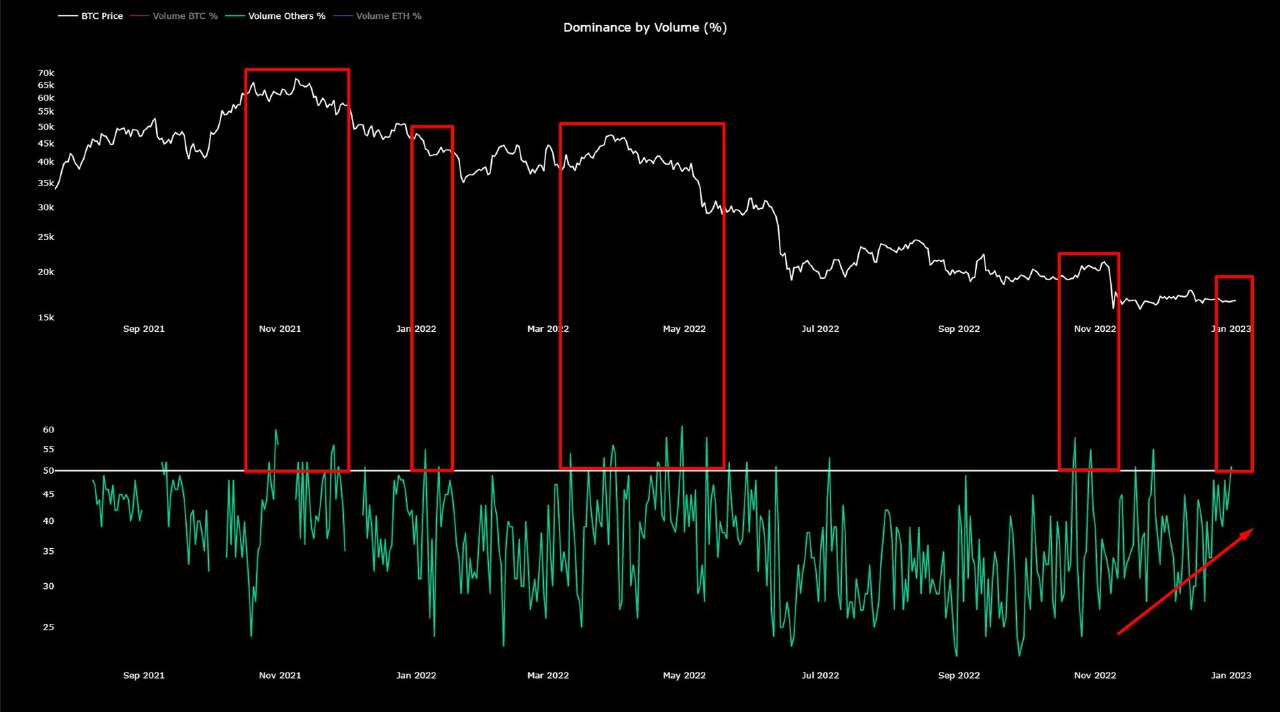
As shown in the graph, the dominance of altcoins (minus Ethereum) has recently increased, and the metric’s value is now greater than 50%. The quant has highlighted previous instances of such a trend in the chart.

It would appear that usually whenever these altcoins have occupied the majority of the trading volume, the price of Bitcoin has followed up with some decline. According to the analyst, the dominance of altcoins generally rises above this mark when investors are becoming bored of BTC, so they start trading alts instead. Since these coins, in general, carry a higher risk than BTC, their prices are fragile and easy to squeeze.

Because of this, price moves that start with altcoins can be unstable. The quant lists the 2018 ICO bubble, the bull run in the second half of 2021, and the ETH merge as some extreme examples. On the other hand, moves where Bitcoin has rallied first, and Ethereum/altcoins have followed have been more healthy and sustainable.

If the historical occurrences of altcoin dominance spiking above 50% are anything to go by, Bitcoin could see a decline soon. However, it’s not certain, as there have been a few lone spikes above this level before that never ended up causing any noticeable effects on the market. Also, even if a decline occurs, its degree may not be as intense as in some previous examples.

BTC Price

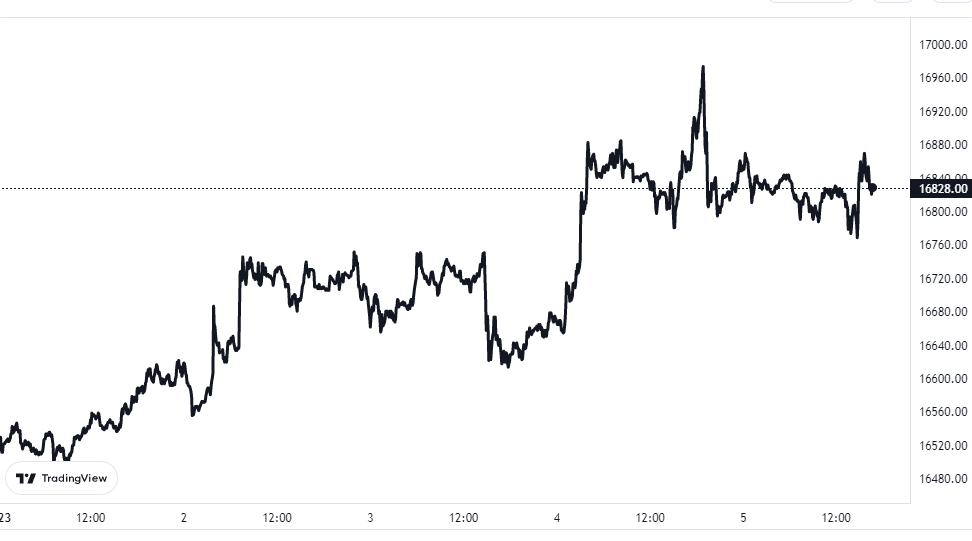
At the time of writing, Bitcoin is trading around $16,800, up 1% in the last week.
Trending Cryptos

Related Reads

a16z: In the AI Era, Company Competition for Talent Starts with Job Title Naming

The article discusses how companies in the AI era are competing for talent through strategic "title arbitrage," or the renaming of key roles to reflect and attract new, high-value capabilities. It uses Palantir's creation of the "Forward-Deployed Engineer" (FDE) as a prime example. This title reframed client-facing technical work from a peripheral "implementation" role into a core, high-status engineering function. The move was strategic, allowing Palantir to attract talent that blended technical skill with business acumen and to dominate the market's perception of this capability. The piece argues that job titles are an organizational language that signals the value and authority of certain work. Effective new titles, like "Data Scientist" or "Site Reliability Engineer," emerge when a role's strategic importance genuinely outgrows its old name. Conversely, mere title inflation without substantive change is ineffective. For AI companies, particularly in B2B, this is a crucial strategy. AI transformation creates new high-leverage roles (e.g., "Legal Engineer," "GTM Engineer") that combine domain expertise with technical automation. By naming these roles, a company can help clients internally legitimize these change-makers. This, in turn, builds market mindshare, associating the company with the new capability. In conclusion, as AI blurs the lines between product and service, the ability to accurately name and organize the critical, client-adjacent work that defines product learning will be a key competitive advantage. The first to define this new organizational language plants a flag in the market's mind.

marsbit43m ago

a16z: In the AI Era, Company Competition for Talent Starts with Job Title Naming

marsbit43m ago

Interview with Strategy CEO: Can STRC Recover After Selling Bitcoin?

Interview with Strategy CEO Phong Le on the recent sale of 32 Bitcoin and its impact. He clarifies the move was a small, strategic action to demonstrate liquidity to debt holders, test internal processes, and prove operational discipline—not a response to fears of a "death spiral" from DeFi protocols leveraging STRC (Strategy's preferred stock product), which he notes holds less than 10% of STRC. Le emphasizes Strategy’s long-term focus as the largest corporate Bitcoin holder, using the adage that markets are a "voting machine" short-term but a "weighing machine" long-term. Decision-making is data-driven, involving the board, complex modeling, and multiple stakeholder considerations, moving beyond a founder-centric model. He outlines various capital options but stresses the strategic importance of "doing nothing" as a valid choice, citing resilience built during the 2022 bear market. Le expresses unwavering belief in Bitcoin's foundational value for global sovereignty and its future role in an AI-driven economy with trillions of autonomous agents. Addressing STRC's current price below its $100 face value, Le explains recent pressure was due to using dollar reserves for bond buybacks. He expects STRC to return to par as reserves are replenished and its semi-monthly dividend payments begin, noting the product is heavily over-collateralized. Finally, Le confirms the company sold Bitcoin the week prior to May 31st, as disclosed in an 8-K filing, leaving prediction market interpretations to others. The overarching philosophy remains "Spread Bitcoin with love," embracing all methods of gaining Bitcoin exposure.

marsbit1h ago

Interview with Strategy CEO: Can STRC Recover After Selling Bitcoin?

marsbit1h ago

Trading

Spot
Futures

Hot Articles

What is $BITCOIN

DIGITAL GOLD ($BITCOIN): A Comprehensive Analysis Introduction to DIGITAL GOLD ($BITCOIN) DIGITAL GOLD ($BITCOIN) is a blockchain-based project operating on the Solana network, which aims to combine the characteristics of traditional precious metals with the innovation of decentralized technologies. While it shares a name with Bitcoin, often referred to as “digital gold” due to its perception as a store of value, DIGITAL GOLD is a separate token designed to create a unique ecosystem within the Web3 landscape. Its goal is to position itself as a viable alternative digital asset, although specifics regarding its applications and functionalities are still developing. What is DIGITAL GOLD ($BITCOIN)? DIGITAL GOLD ($BITCOIN) is a cryptocurrency token explicitly designed for use on the Solana blockchain. In contrast to Bitcoin, which provides a widely recognized value storage role, this token appears to focus on broader applications and characteristics. Notable aspects include: Blockchain Infrastructure: The token is built on the Solana blockchain, known for its capacity to handle high-speed and low-cost transactions. Supply Dynamics: DIGITAL GOLD has a maximum supply capped at 100 quadrillion tokens (100P $BITCOIN), although details regarding its circulating supply are currently undisclosed. Utility: While precise functionalities are not explicitly outlined, there are indications that the token could be utilized for various applications, potentially involving decentralized applications (dApps) or asset tokenization strategies. Who is the Creator of DIGITAL GOLD ($BITCOIN)? At present, the identity of the creators and development team behind DIGITAL GOLD ($BITCOIN) remains unknown. This situation is typical among many innovative projects within the blockchain space, particularly those aligning with decentralized finance and meme coin phenomena. While such anonymity may foster a community-driven culture, it intensifies concerns about governance and accountability. Who are the Investors of DIGITAL GOLD ($BITCOIN)? The available information indicates that DIGITAL GOLD ($BITCOIN) does not have any known institutional backers or prominent venture capital investments. The project seems to operate on a peer-to-peer model focused on community support and adoption rather than traditional funding routes. Its activity and liquidity are primarily situated on decentralized exchanges (DEXs), such as PumpSwap, rather than established centralized trading platforms, further highlighting its grassroots approach. How DIGITAL GOLD ($BITCOIN) Works The operational mechanics of DIGITAL GOLD ($BITCOIN) can be elaborated on based on its blockchain design and network attributes: Consensus Mechanism: By leveraging Solana’s unique proof-of-history (PoH) combined with a proof-of-stake (PoS) model, the project ensures efficient transaction validation contributing to the network's high performance. Tokenomics: While specific deflationary mechanisms have not been extensively detailed, the vast maximum token supply implies that it may cater to microtransactions or niche use cases that are still to be defined. Interoperability: There exists the potential for integration with Solana’s broader ecosystem, including various decentralized finance (DeFi) platforms. However, the details regarding specific integrations remain unspecified. Timeline of Key Events Here is a timeline that highlights significant milestones concerning DIGITAL GOLD ($BITCOIN): 2023: The initial deployment of the token occurs on the Solana blockchain, marked by its contract address. 2024: DIGITAL GOLD gains visibility as it becomes available for trading on decentralized exchanges like PumpSwap, allowing users to trade it against SOL. 2025: The project witnesses sporadic trading activity and potential interest in community-led engagements, although no noteworthy partnerships or technical advancements have been documented as of yet. Critical Analysis Strengths Scalability: The underlying Solana infrastructure supports high transaction volumes, which could enhance the utility of $BITCOIN in various transaction scenarios. Accessibility: The potential low trading price per token could attract retail investors, facilitating wider participation due to fractional ownership opportunities. Risks Lack of Transparency: The absence of publicly known backers, developers, or an audit process may yield skepticism regarding the project's sustainability and trustworthiness. Market Volatility: The trading activity is heavily reliant on speculative behavior, which can result in significant price volatility and uncertainty for investors. Conclusion DIGITAL GOLD ($BITCOIN) emerges as an intriguing yet ambiguous project within the rapidly evolving Solana ecosystem. While it attempts to leverage the “digital gold” narrative, its departure from Bitcoin's established role as a store of value underscores the need for a clearer differentiation of its intended utility and governance structure. Future acceptance and adoption will likely depend on addressing the current opacity and defining its operational and economic strategies more explicitly. Note: This report encompasses synthesised information available as of October 2023, and developments may have transpired beyond the research period.

440 Total ViewsPublished 2025.05.13Updated 2025.05.13

What is $BITCOIN

Discussions

Welcome to the HTX Community. Here, you can stay informed about the latest platform developments and gain access to professional market insights. Users' opinions on the price of BTC (BTC) are presented below.

活动图片