How to buy food with Bitcoin?

CointelegraphPublished on 2022-12-04Last updated on 2022-12-04

Abstract

Users can pay bills with cryptocurrency directly from their crypto wallet or using a payment processor acting as an online crypto payment gateway.

Bitcoin is a dynamic monetary asset with the potential of being both — a commodity and a currency. For instance, the Securities and Exchange Commission (SEC) classified BTC as a commodity, whereas El Salvador made Bitcoin a legal tender in 2021.

So, does this make BTC a store of value or a medium of exchange? It can do both — On one hand, BTC can be added to treasuries as an inflationary hedge. On the other hand, it could also serve the retail purpose of paying for routine expenses.

Almost over a decade ago, the first person to utilize Bitcoin for a business transaction was Laszlo Hanyecz, who spent 10,000 BTC on two pizzas, or as the crypto community addresses it, the Bitcoin pizza. However, that is not the amount of BTC anyone needs to actually buy food in the real world now. Why? Because customers have realized to only pay the amount for which the product is worth, not more or less.

This article will discuss different ways by which one can buy food using Bitcoin. From crypto debit cards and gift cards to crypto food delivery portals, this article will lay down all possible options to efficiently use cryptocurrency for grabbing a meal.

Various ways to buy food using cryptocurrency

There are a few ways to buy food with Bitcoin, depending on the user’s needs and interests. Following this, these are the three most common ways to use cryptocurrency for daily expenses like food:

Crypto cards

Crypto cards are like regular debit or credit cards, but crypto cards let the customer use their crypto to make payments. They essentially deduct crypto from the user’s wallet and transfer fiat at the merchant’s end.

It helps users pay their routine bills through crypto without the complexities of finding outlets that accept crypto payments. Moreover, nowadays, numerous crypto card companies offer mobile apps that make it easy for the customer to spend Bitcoin anywhere.

Crypto gift cards

Customers may purchase gift cards for several food and delivery services using cryptocurrencies. They can then redeem said gift cards to pay for their meals in digital currencies. Crypto gift cards facilitate the sale and purchase of items from participating merchants to customers using cryptocurrency. There are a number of companies that offer gift cards, so it’s easy to find one that fits user needs.

Crypto food delivery portals

Crypto food delivery sites are connected to many food and beverage outlets across various regions. It is like a website or application for ordering food from nearby restaurants and paying the platform via crypto instead of paying the food vendor.

How to buy food using a crypto card?

Crypto cards allow Bitcoin transactions on various items in the physical world. However, in order to spend BTC via a crypto card for daily needs like food, consumers need to follow certain steps:

The first step is to set up a digital wallet, along with a merchant account. Given there are several crypto cards available in the market. Hence, it is ideal to research the options and choose one that meets the respective user’s needs and budget.

Sign up by downloading the app and completing the Know Your Customer (KYC) requirements. Registering for the card and creating an account with the provider will allow the user to efficiently access their funds and make purchases online or in-store.

Users may set up a spending limit along with scheduling regular deposits into their accounts.

Almost all crypto cards allow customers to instantly convert crypto to fiat. Nevertheless, how to choose a crypto card that suits an individual’s goals? While some customers may prefer cash-back rewards, others may gravitate toward yielding services.

Many cards are suitable for regular shoppers since they work as purchase reward cards that allow users to earn money back on purchases. Following this, some cards also allow users to earn interest on crypto held in the account.

Furthermore, while accessing the utility of a crypto card, make sure to check for multi-coin support. The crypto card should ideally support several cryptocurrencies, such as BTC, Ether and Litecoin, among others.

Companies offering crypto credit cards include BlockFi and Gemini. However, more companies offer crypto debit cards, such as Coinbase, Crypto.com, BlockCard, Binance Visa Card and BitPay.

How to buy food using a crypto gift card?

Crypto gift cards are loaded with digital funds that can be used at any participating restaurant or retail store. They’re straightforward to use and provide a way for customers to spend their cryptocurrencies in a convenient manner. Here are some steps on how to get started:
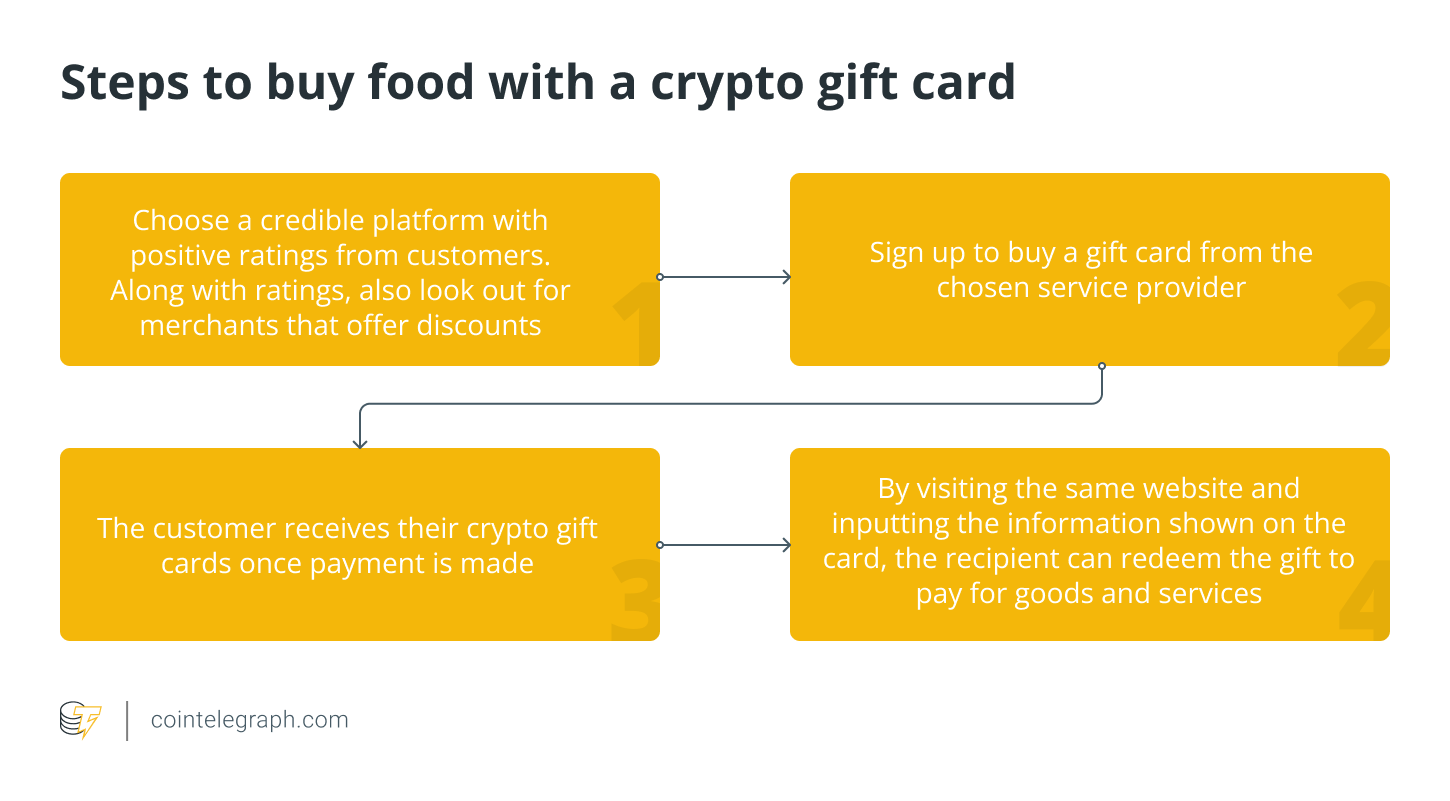
Brands like Amazon and Walmart don’t accept Bitcoin directly, but they do accept crypto gift card services. Following this, to directly pay for food in BTC using a crypto gift card, users may use Bitrefill. It is a website that offers gift cards, prepaid mobile refills and Bitcoin Lightning Network services for over 1600 products in 170 countries.

How to use crypto food delivery portals?

Crypto food delivery portals are not drastically different from using crypto gift cards. Both connect the user to merchants that accommodate the use of crypto services for payments. Following this, the steps are also fairly similar — choosing a platform, signing up and loading the wallet with funds.

Furthermore, customers have different options for using a crypto-delivery portal to buy food. From simply buying food with cryptocurrency to purchasing groceries on credit and then paying off those purchases with cryptocurrency, both make crypto delivery portals convenient for making crypto payments.

Platforms that allow users to order food directly from restaurants and then pay for it in cryptocurrency, like Hungry? in the United Kingdom, Sprigz in the United States, BiteMyCoin in Australia and Eats24/7 in Canada, can be an alternative way of ordering food using cryptocurrencies.

Should you buy food with crypto?

There is no black-and-white answer to whether or not users should choose crypto payments to buy food. However, there are both benefits and drawbacks to using cryptocurrency for food purchases.

On the plus side, cryptocurrency transactions are generally quick and straightforward. Following this, given that cryptocurrency transactions are recorded on the blockchain, it makes the process of tracing the history of transactions efficient. Furthermore, crypto payments directly connect the customer to the merchant, eliminating the need for intermediaries such as banks.

On the flip side, crypto payments pose a threat of monetary loss via hacks. Additionally, the digital asset class is also highly volatile, which may cause difficulty in pursuing daily transactions. So users must do their research before using cryptocurrency as a medium of exchange for daily expenses.


Trending Cryptos

Related Reads

Foundation Steps Back, Ethlabs Steps Forward: Ethereum Undergoes Its Largest Restructuring in History

On June 23rd, the Ethereum ecosystem witnessed two major shifts, signaling a significant governance realignment. First, former Ethereum Foundation researchers established Ethlabs, a new independent non-profit. Backed by major ETH holders like Bitmine and SharpLink, Ethlabs aims to address practical needs for institutional adoption, including faster settlement, native asset issuance, cross-chain transactions, and mainnet scaling. Secondly, the Ethereum Foundation announced a major restructuring, laying off 54 employees (20% of its staff) to become a leaner entity focused on protocol governance and maintenance rather than being the primary builder. This move represents a pivotal correction. Criticisms had mounted over the Foundation's perceived slowness, lack of clear strategy, and over-reliance on Vitalik Buterin's influence. Ethlabs emerges as a more execution-oriented, "industrialized" layer focused on market adoption—bridging the gap between research and real-world use. Notably, Vitalik Buterin is absent from its list of supporters, interpreted as an intentional step to avoid excessive personal endorsement and allow the organization to build independent credibility. The Ethereum Foundation's downsizing and redefinition mark a retreat from its former central coordinating role. It now aims to share the "privilege of stewarding Ethereum" with other emerging groups like Ethlabs, the Ethereum Applications Guild, and The Ethereum Economic Zone. Analysts frame this dual shift as the Foundation ensuring Ethereum remains "correct" (credibly neutral), while Ethlabs must prove it remains "effective" (competitive and attractive for capital and adoption). This addresses community "shareholder-like anxiety" about ETH's market performance. While risks exist—such as concerns over shifting from Foundation centrality to large-holder influence—the consensus is that the greater risk for Ethereum was inaction, caught between technical idealism and organizational inertia. These steps aim to create a more multi-stakeholder, execution-driven future for the network.

链捕手5h ago

Foundation Steps Back, Ethlabs Steps Forward: Ethereum Undergoes Its Largest Restructuring in History

链捕手5h ago

Second Half of U.S. Crypto Policy: The Clarity Act Aims for 60 Votes, CFTC's "One-Person Commission" Becomes Biggest Variable

In a pivotal year for US crypto policy, the "CLARITY Act" is advancing in the Senate but faces a high hurdle, needing 60 votes to pass. Key challenges include bridging partisan divides on ethics and swaying undecided Republican senators within a tight legislative calendar of only about 40 working days. The policy "second half" involves intense negotiations on a broader framework for Web3 and DeFi, including crypto tax reforms and the Blockchain Regulatory Certainty Act. A significant uncertainty is the understaffed CFTC, operating with four commissioner vacancies, which complicates regulatory clarity. Meanwhile, the departure of key "crypto champions"—SEC Commissioner Hester Peirce and Senator Cynthia Lummis—will impact ongoing policy efforts. Industry experts are cautiously optimistic but realistic. Sara K. Weed notes that while progress is being made, CLARITY is unlikely to pass this Congress, pushing agencies like the SEC and CFTC to provide more guidance. Sulolit Mukherjee suggests meaningful crypto tax legislation is more likely to be attached to larger must-pass bills. Rashan Colbert discusses the jurisdictional debate over prediction markets, emphasizing the need for a regulatory framework that fosters their development as financial tools rather than treating them broadly as gambling. The clock is ticking, but opportunities remain for substantive progress through continued bipartisan dialogue and pragmatic efforts.

marsbit8h ago

Second Half of U.S. Crypto Policy: The Clarity Act Aims for 60 Votes, CFTC's "One-Person Commission" Becomes Biggest Variable

marsbit8h ago

Research Report Analysis: Morgan Stanley Details SanDisk SNDK, The Truth About Cloud Data Center Pricing Power and AI Inference Benefits

Morgan Stanley raised its price target for SanDisk (SNDK) from $1100 to $1750 on June 22, maintaining an Overweight rating. The upgrade is driven by AI inference demand reshaping the NAND market, particularly for KV Cache and context window storage in cloud data centers. These cloud clients exhibit price inelasticity and sign long-term contracts, granting SanDisk significant pricing power. SanDisk's New Business Model (NBM) agreements, covering over one-third of FY27 bit shipments with 3-5 year terms and fixed price/price collar structures, are crucial. They are projected to sustain gross margins around 80% even at floor prices, providing a buffer against cyclical downturns. Morgan Stanley forecasts gross margins to surge from 30.3% in FY25 to 86.7% in FY27e. With NAND supply expected to remain tight into 2026/2027 and cloud/data centers becoming the largest end-market, SanDisk holds supply-side pricing power. The company targets 15-19% bit growth via technology transitions, not capacity expansion. Revenue is projected to grow ~6.6x from FY25 to FY27, with EPS rising from $2.74 to $14.73, driven by high-margin cloud business. Key upside catalysts include faster enterprise SSD adoption and edge AI growth. Downside risks involve slower industry growth, competitor capex increases, market share loss, and competition from Chinese players like YMTC. The investment thesis rests on AI-driven structural demand, NBM's margin protection, and sustained supply tightness. The $1750 target implies ~28x FY27e P/E.

marsbit9h ago

Research Report Analysis: Morgan Stanley Details SanDisk SNDK, The Truth About Cloud Data Center Pricing Power and AI Inference Benefits

marsbit9h ago

Trading

Spot
Futures

Hot Articles

What is $BITCOIN

DIGITAL GOLD ($BITCOIN): A Comprehensive Analysis Introduction to DIGITAL GOLD ($BITCOIN) DIGITAL GOLD ($BITCOIN) is a blockchain-based project operating on the Solana network, which aims to combine the characteristics of traditional precious metals with the innovation of decentralized technologies. While it shares a name with Bitcoin, often referred to as “digital gold” due to its perception as a store of value, DIGITAL GOLD is a separate token designed to create a unique ecosystem within the Web3 landscape. Its goal is to position itself as a viable alternative digital asset, although specifics regarding its applications and functionalities are still developing. What is DIGITAL GOLD ($BITCOIN)? DIGITAL GOLD ($BITCOIN) is a cryptocurrency token explicitly designed for use on the Solana blockchain. In contrast to Bitcoin, which provides a widely recognized value storage role, this token appears to focus on broader applications and characteristics. Notable aspects include: Blockchain Infrastructure: The token is built on the Solana blockchain, known for its capacity to handle high-speed and low-cost transactions. Supply Dynamics: DIGITAL GOLD has a maximum supply capped at 100 quadrillion tokens (100P $BITCOIN), although details regarding its circulating supply are currently undisclosed. Utility: While precise functionalities are not explicitly outlined, there are indications that the token could be utilized for various applications, potentially involving decentralized applications (dApps) or asset tokenization strategies. Who is the Creator of DIGITAL GOLD ($BITCOIN)? At present, the identity of the creators and development team behind DIGITAL GOLD ($BITCOIN) remains unknown. This situation is typical among many innovative projects within the blockchain space, particularly those aligning with decentralized finance and meme coin phenomena. While such anonymity may foster a community-driven culture, it intensifies concerns about governance and accountability. Who are the Investors of DIGITAL GOLD ($BITCOIN)? The available information indicates that DIGITAL GOLD ($BITCOIN) does not have any known institutional backers or prominent venture capital investments. The project seems to operate on a peer-to-peer model focused on community support and adoption rather than traditional funding routes. Its activity and liquidity are primarily situated on decentralized exchanges (DEXs), such as PumpSwap, rather than established centralized trading platforms, further highlighting its grassroots approach. How DIGITAL GOLD ($BITCOIN) Works The operational mechanics of DIGITAL GOLD ($BITCOIN) can be elaborated on based on its blockchain design and network attributes: Consensus Mechanism: By leveraging Solana’s unique proof-of-history (PoH) combined with a proof-of-stake (PoS) model, the project ensures efficient transaction validation contributing to the network's high performance. Tokenomics: While specific deflationary mechanisms have not been extensively detailed, the vast maximum token supply implies that it may cater to microtransactions or niche use cases that are still to be defined. Interoperability: There exists the potential for integration with Solana’s broader ecosystem, including various decentralized finance (DeFi) platforms. However, the details regarding specific integrations remain unspecified. Timeline of Key Events Here is a timeline that highlights significant milestones concerning DIGITAL GOLD ($BITCOIN): 2023: The initial deployment of the token occurs on the Solana blockchain, marked by its contract address. 2024: DIGITAL GOLD gains visibility as it becomes available for trading on decentralized exchanges like PumpSwap, allowing users to trade it against SOL. 2025: The project witnesses sporadic trading activity and potential interest in community-led engagements, although no noteworthy partnerships or technical advancements have been documented as of yet. Critical Analysis Strengths Scalability: The underlying Solana infrastructure supports high transaction volumes, which could enhance the utility of $BITCOIN in various transaction scenarios. Accessibility: The potential low trading price per token could attract retail investors, facilitating wider participation due to fractional ownership opportunities. Risks Lack of Transparency: The absence of publicly known backers, developers, or an audit process may yield skepticism regarding the project's sustainability and trustworthiness. Market Volatility: The trading activity is heavily reliant on speculative behavior, which can result in significant price volatility and uncertainty for investors. Conclusion DIGITAL GOLD ($BITCOIN) emerges as an intriguing yet ambiguous project within the rapidly evolving Solana ecosystem. While it attempts to leverage the “digital gold” narrative, its departure from Bitcoin's established role as a store of value underscores the need for a clearer differentiation of its intended utility and governance structure. Future acceptance and adoption will likely depend on addressing the current opacity and defining its operational and economic strategies more explicitly. Note: This report encompasses synthesised information available as of October 2023, and developments may have transpired beyond the research period.

434 Total ViewsPublished 2025.05.13Updated 2025.05.13

What is $BITCOIN

Discussions

Welcome to the HTX Community. Here, you can stay informed about the latest platform developments and gain access to professional market insights. Users' opinions on the price of BTC (BTC) are presented below.

活动图片