什么是真正的 Crypto Native?

FPublished on 2022-12-01Last updated on 2022-12-01

Abstract

从 2021 年开始,Crypto Native 逐渐走入加密行业。

从 2021 年开始,Crypto Native 逐渐走入加密行业。几乎每一个刚入圈的新人都听过这个词,因为圈内老人总是挂在嘴边。但是你要问圈内老人这个词代表什么,可能有些人回答不上来。对于 Crypto Native 是什么,可能每个人给到的答案都不尽相同。但它是否就意味着每天在 Twitter 上刷新关于 Crypto 的资讯,将大部分财产转移到 BTC 或者 ETH,每天盯着盘口分析市场数据,亦或者张口闭口就是「去中心化」等大词吗?可能都有,也可能不是。

我们可以看到全网搜索 Crypto Native 的提及次数。2018 年相比上一年增长 5.57 倍,2021 年相比上一年增长 7.52 倍,2022 年 11 个月相比上一年增长 2.85 倍。随着时间的推移,大家对于 Crypt Native 的关注度呈现出指数级增长规律,并且这种增长趋势丝毫没有减慢的迹象。
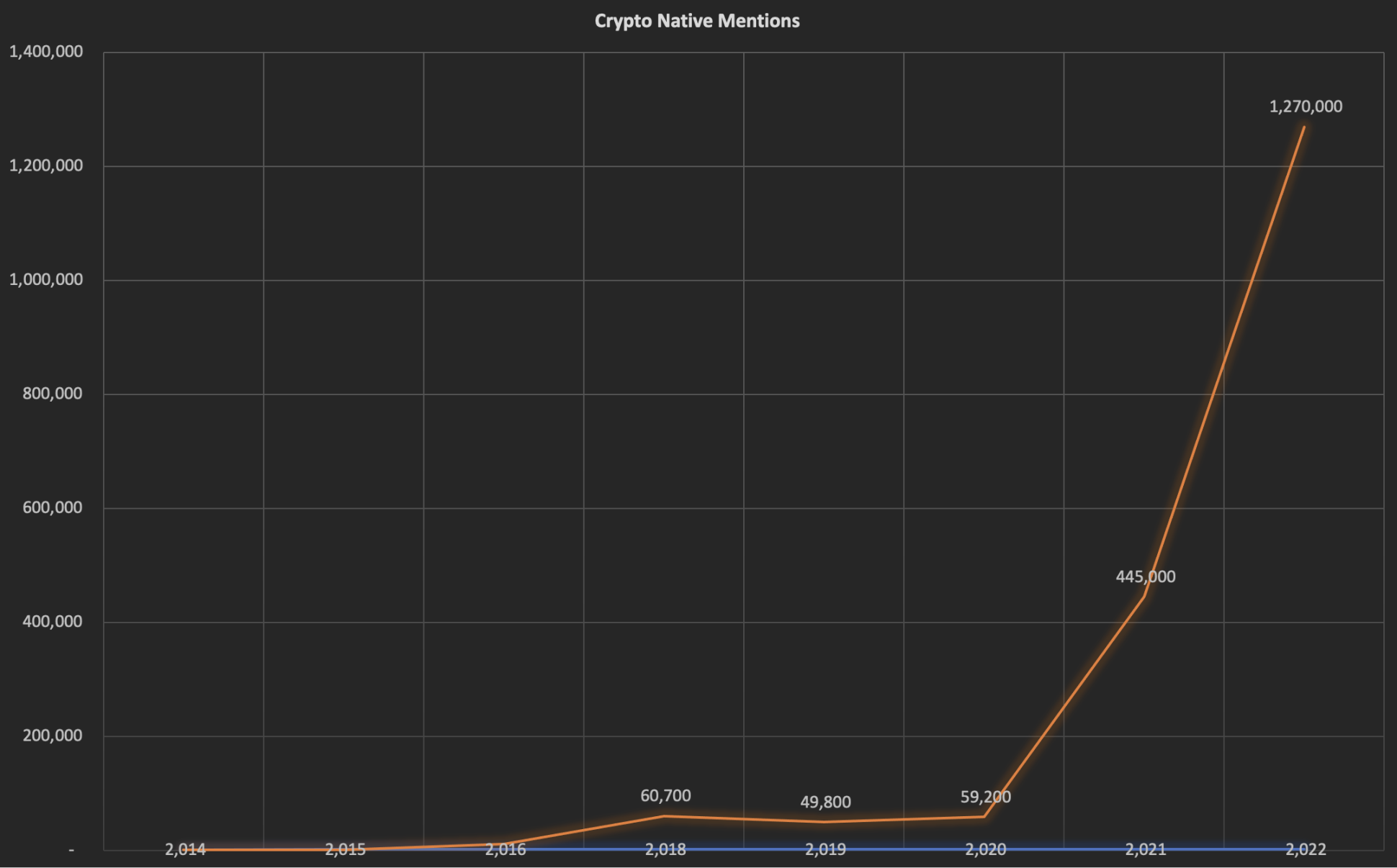
Crypto Native 的关注度 数据来源:Meltwater.com

Crypto Native 的来龙去脉

加密世界中的 Crypto Native 是对原生加密货币去中心化思想的承继。Crypto Native 的叙事起点是中本聪和比特币。作为加密货币基石的比特币,其背后的去中心化思想、去信任机制是 Crypto Native 理念的起源。

从 2008 年比特币横空出世开始,这个世界就拥有了第一批 Crypto Native 群体。在门头沟盗币事件和暗网「丝绸之路」的影响下,比特币于 2011 探顶后进入寒冬。这一批真正拥有并交易比特币的人,他们相信密码学算法和区块链技术,推崇「Code is Law」。这时,Crypto Native 就是相信密码学算法,同时拥有且使用比特币的人。

随着时间的推移,比特币被人们赋予了「数字黄金」的称号,其商品属性抢了货币属性的风头。由于大量人员和资金的进入,加密行业早期基础设施在这一时期逐渐被建设完善,矿机、支付场景、交易平台、金融衍生品都逐步成熟,比特币算力的快速增长就是很好的证明。

时间来到 2014,一件意义重大的事情发生了,以太坊创始人 Vitalik Buterin 发布了以太坊初版白皮书,并于 2014 年 7 月 24 日进行了 ETH 的预售。随后以太坊虚拟机 EVM 和智能合约应运而生,这标志着加密行业进入了一个全新的时代。同样的,这时候的 Crypto Native 的持有对象也不仅仅局限于比特币,还包括以太坊或者其他的加密货币,但是这个群体仍坚信密码学和区块链技术所建立的加密货币体系。

随着以太坊生态的建立和完善,让人们对于公链生态的想象力得到了充分发挥,随着 ICO 这种新型的融资方式层出不穷,越来越多的 dAPP 让人看到了区块链的应用价值。不仅如此,链上的金融衍生品也开始发展起来,合约,借贷等衍生品也促进了中心化交易所的繁荣。

从 2017 年之后的 Twitter 帖子上,我们可以品味一下这个词汇的内涵。Jessica Verrilli @jess 最早在 Twitter 上使用这个词语,时间定格在 2017 年 10 月 26 日,那时候指从事加密货币相关项目的大学生创业者。新的「互联网原生」或「移动原生」群体正在成熟。就像是之前出现的 Internet-native,所谓的 X-native 似乎天生会对某些生活方式以及思维模式有更强的适应能力,对于其中 Tricky 的部分感觉到适应并且能够更快速入圈。这里不难看出对于 Crypto-native 最主要的特点是年龄和行业,也就是可能第一份接触到的事业就是加密货币相关的工作的年轻人。
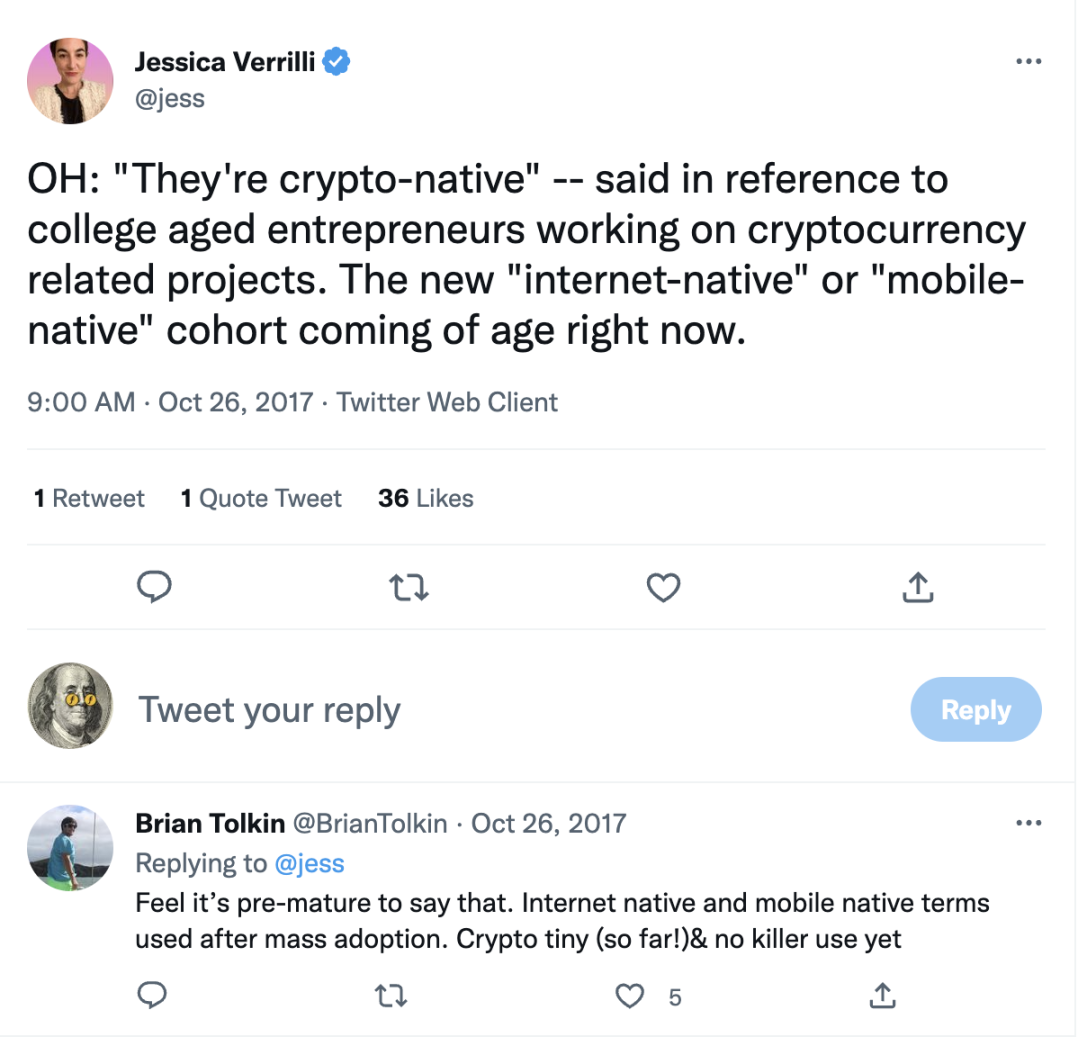
原文链接

2017 年是这个词在 Twitter 上还不温不火。Andrew Spence 在 2017 年 12 月将 Crypto-native 指向一个新的时代、新的生活方式。Crypto 将潜移默化而又悄无声息地改变人们的生活方式。
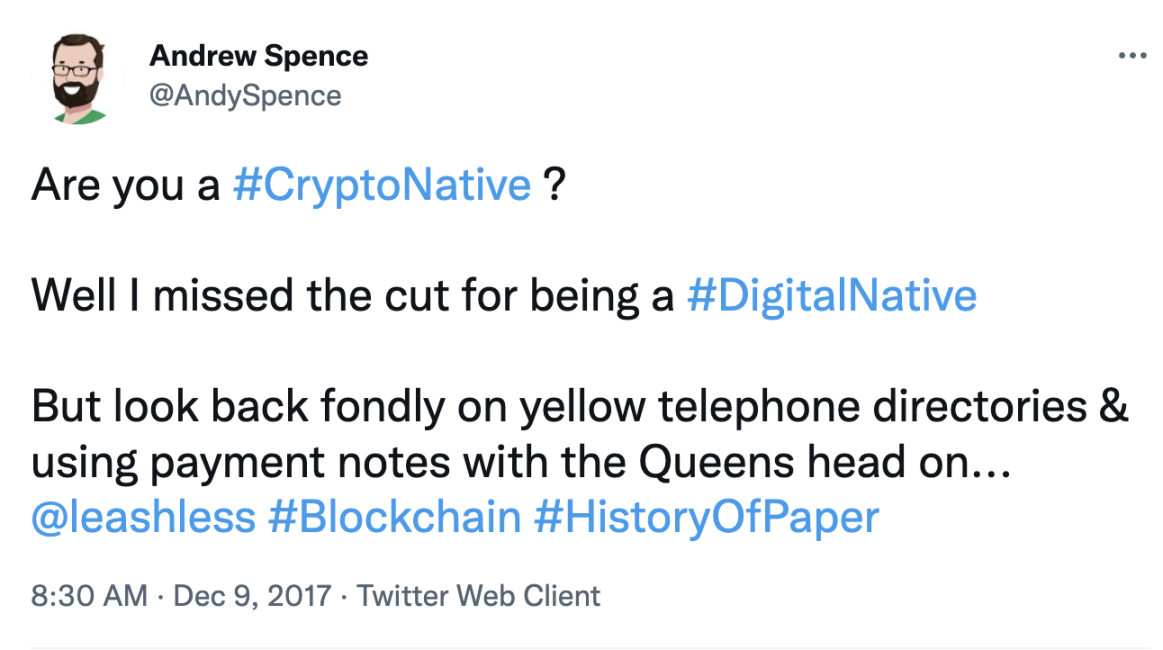
原文链接

Twitter 另一个用户 Ryan Sean Adams 在 2018 年 10 月份发帖说 Crypto Native 指一种公司运营方式,根据合同法构建,通过法律系统结算,是一个 Legal-native 的股份公司的继任者。它将通过代码构建,通过区块链结算。这里的 Crypto-native 更倾向于指代一种底层治理逻辑,即规范行为的渊源是来源于法律还是代码,是源于对哪一种实体规则的遵守而产生的商业运转机制。规范行为的渊源来自于代码即是我们所熟知的 DAO(去中心化组织)。
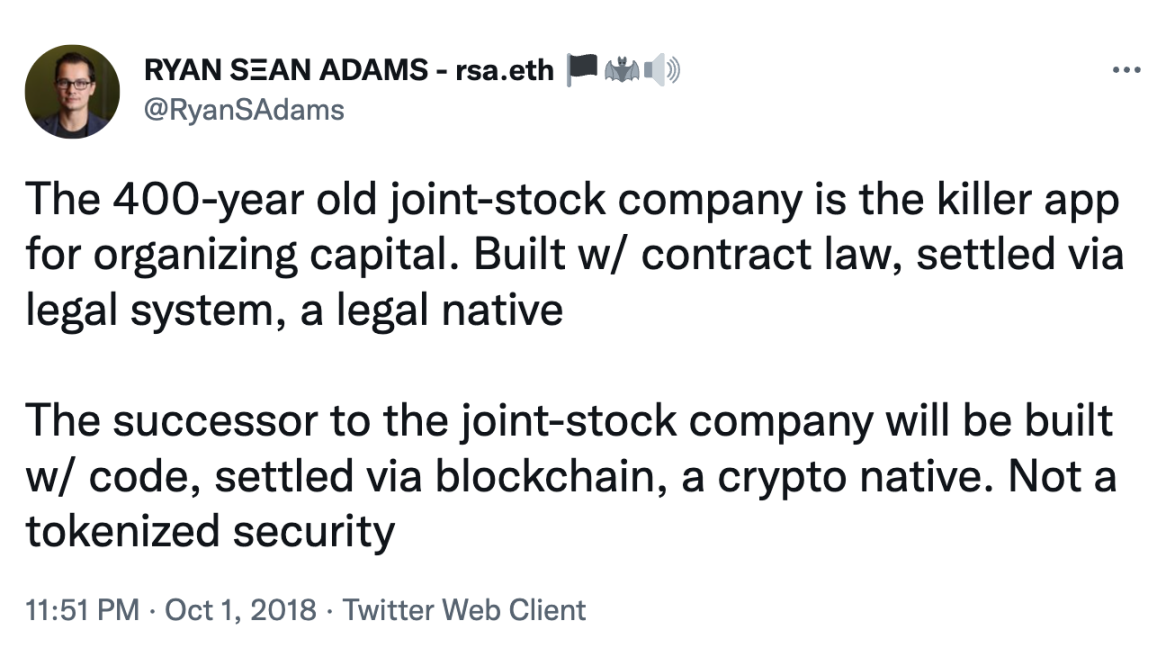
原文链接

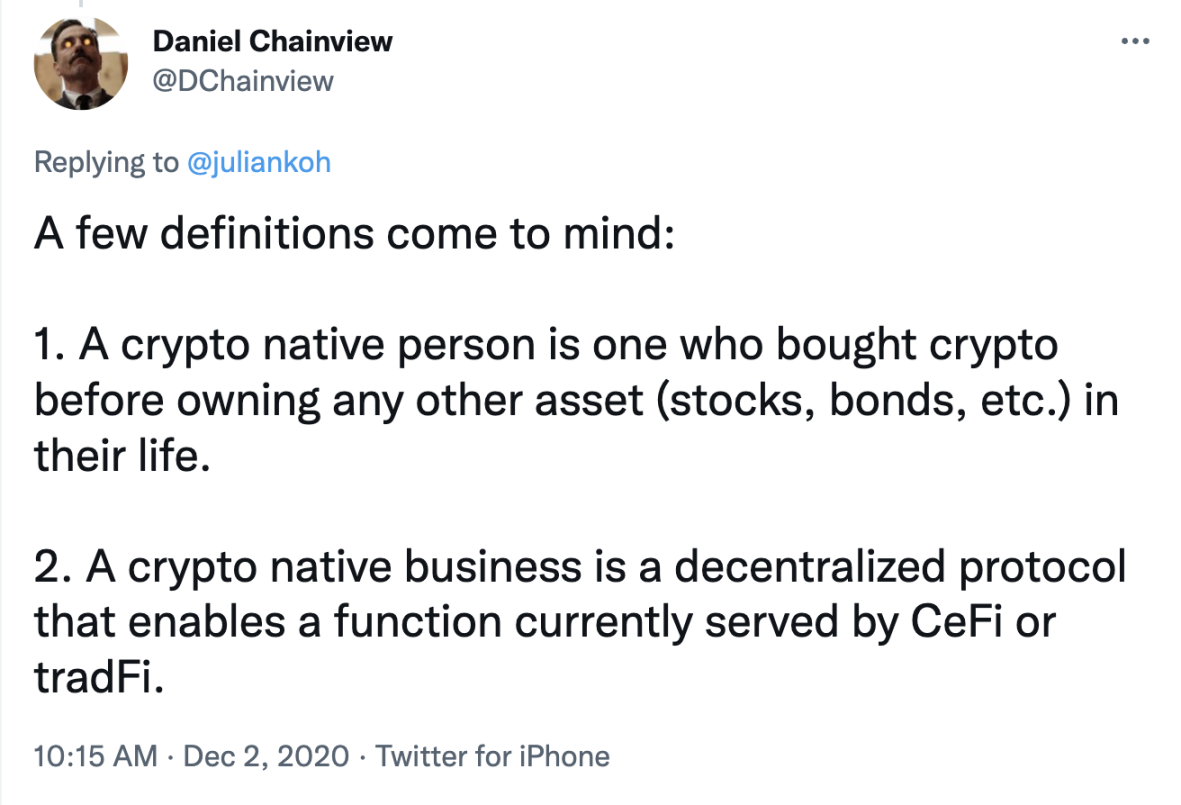
除了对于这个词表面的文义解释,Crypto Native 也代表了一种商业模式,Daniel 在 2020 年 12 月从 Crypto Native Person 和 Crypto Native Business 角度去说明了 Crypto-native 的定义:

Crypto Native Person 是指在拥有任何其他资产(股票、债券等)之前购买加密货币的人。

Crypto Native Business 是一种去中心化协议,它支持目前由 CeFi 或 tradFi 提供的功能。

Daniel Chainview 第一次将 Crypto-native 做出了划分并且给出了定义,即拥有特定的「buy」,「asset」,「decentralized」等等关键词的人或商业的集合体。这里 Crypto-native Business 被理解为 TradFi 或者 CeFi 提供去中心化业务。
原文链接

2020 年到 2022 年,DeFi、NFT 以及 GameFi 强势崛起,无数项目喷涌而出,给行业打了一剂兴奋剂。Crypto 从未有过如此的想象力和天价估值。但是热度终将过去,投机终将失败。当潮水退去,终归有人在裸泳。所有 Crypto Native 都需要重新审视 Crypto 行业的基本面和内在价值,回归初心。

Crypto Native 的同类关键词

去中心化的 Decentralized

与之相对的是 Centralized, Single-point。在这种理念的指导下,没有一个中心化的机构去做宏观上的调控。比如,比特币是由去中心化网络管理,所以它是独立并且无所畏惧的。它不惧怕个人、公司或国家对他的控制。例如,如果一个国家禁止比特币和所有其他加密货币,另一个国家可能会欣然接手,以此来吸引建立在区块链上的企业家,或者吸引想利用该国低价能源的矿工。即使世界各国政府联合起来完全禁止比特币和相关加密货币,但只要社会中的个人之间仍然存在联系和通信,加密货币也不会被根除。

去信任机制的 Trustless

与之相对的是 Trust Assumption, Trusted Setup, Trusted Parties。建立在加密货币行业基础上的交易最 Crypto Native 的方式是采用去信任机制从而提供了一个不同于传统体系的全新产品,这种产品只提供基础的规则和证明的方式而不会去做全面的主观的控制。本质上,加密产业提供了一种基于规则的高效的没有昂贵信任成本的全球人类合作形式。这个产业是基于客观的证明(数学或者密码学),而不是主观上的承诺,摒弃了曾经被广为信任或者深受信任的实体。典型的实例是 Fox Tech。作为以太坊扩容方案 zkRollup,Fox 采用零知识证明系统 zkFOAKS,过程无需任何受信任的实体参与(No Trusted Setup),通过纯密码学与数学手段来确保信息的一致性、完备性和可验证性,从而实现更安全、更高效且成本更低的效果。

无需许可的 Permissionless

与之相对的是 Permission。我们以 Web3 基础设施、基础资源为例。它最重要特征是有一个无需许可的没有门槛的去中心化的市场。所谓「无需许可」是指任何人都可以进入这个市场。这个市场最典型的形态具有双边关系,即提供资源的人和消费资源的人。Permissionless 意味着无论对谁对哪种角色来说,谁都可以来提供资源,且无论是谁都可以来消费资源。这是和 Web2 有着本质的区别。比如 AWS 这样的存储提供商是有提供商门槛的,只有他们家自己可以做这个中心化提供商,虽然它对所有消费端是开放,在消费端是没有门槛的,但我们不认为它是 Permissionless。而 Arweave 这样的去中心化存储允许供给端自由进入,我们会认为它是 Permissionless。Crypto Native 认为无论对谁,对哪种角色来说,谁都可以来提供资源,且谁都可以来消费资源。在 Web3 之前很少见到这样的市场结构,这个市场的供给端和消费端都变成 Permissionless。

个人主权 Individual Sovereignty

Crypto Native 还特别强调个人主权,这也是 Web3 和 Web2 的重大区别,尤其是指 Token 和数据的所属权。使用传统的 Web2 写文章、发帖子、聊天、评论,这些内容都会被审核并可能被删除。而在 Web3 时代,这些数据是属于用户自己的,并且数据确实具备一定的抗审查的能力,很难丢失。Web3 为什么能做出所属权而 Web2 难以做到?有一个很重要的技术是在数据产生的时候就具备了可验证性,它能让这些资产、数据具备所属权。当它们上链的那一刻,区块链就会生成可以验证的时间序列,从而在共识层面确定所属权。当我们的文章等各种内容都是发布在传统中央服务器、单点服务器,可能会有几个备份,但这些服务器全都是由一些服务商来管理的,服务商也可以做权属证明,但是数据所有权属完全属于这些中心化的实体。再看 Mirror 这个内容平台,它将 NFT 发到了以太坊,将内容存储在 Arweave 这样的去中心化存储上。哪怕有一天 Mirror 关掉,任何人都可以拿到数据重新启动平台并进行数据和资产的追溯、验证与确权。

现在越来越多的人在关心着如何讲好 Crypto 的故事,如何打破中心化金融、网络和社会的枷锁,如何建立一个自由、平等的世界。这种浪潮似乎在人类历史上从未如此激烈和广泛。Crypto Native 所隐含的深层次的目标,在于这个群体相信加密世界所带来的技术可以解决现实世界很多根深蒂固的疑难杂症。身处 Web3 世界大舞台的 Crypto Native 群体正在践行着 Decentralized 理念,打磨着 Trustless 产品,构建着 Permissionless 市场,从而缔造出一个有效保护个人主权的社会。这正是我从 Crypto Native 从业者眼里看到的那道光。


Trending Cryptos

Related Reads

Stablecoins and Agentic Commerce Can't Make It into Visa's Earnings Report

**Title: Stablecoins and Agentic – Not Yet on Visa's Financial Statements** **Summary:** On July 16, Visa announced the Visa Stablecoin Platform (VSP), a platform for managing stablecoin issuance and movement, starting with OpenUSD. However, 12 days later, in its FY2026 Q3 earnings call, CEO Ryan McInerney detailed VSP but mentioned no revenue model, timing, or clients. CFO Christopher Suh's financial report did not mention VSP. Analysts' questions largely ignored stablecoins, focusing instead on cross-border growth and core metrics. The article examines Visa's business model using a "highway" analogy: Visa builds the payment network (the road), sets rules, and collects "tolls." Its revenue comes from four main streams: Service Revenue, Data Processing Revenue, International Transaction Revenue, and Other Revenue. After client incentives, Visa's net take-rate has remained stable at ~29 basis points. Currently, Visa's only meaningful revenue from stablecoins comes from "U Cards" – cards linked to stablecoin wallets. In these transactions, stablecoins are converted to fiat *before* entering Visa's network, so they are processed as regular card transactions, contributing to the standard 29 bps fee. Visa's other stablecoin initiatives—settlement pilots (converting *Visa's own* net obligations to stablecoins) and the new VSP platform—do not yet generate revenue; they are operational improvements or future commercial offerings. Regarding Agentic Commerce, Visa's products (Agent Score, Token Assurance Framework) are "devices" allowing AI agents to use the *existing* payment network. They are billed as value-added services. Visa views agentic commerce primarily as AI agents acting on behalf of humans in traditional commerce (replacement), not the potentially new market of machine-to-machine transactions (creation). Strategically, CEO McInerney listed stablecoins and agentic as a *fourth-tier* investment priority, behind core areas like consumer payments and value-added services. They are components within existing strategies, not standalone growth engines with defined addressable markets. In contrast, Mastercard took a different approach by acquiring BVNK for ~$1.8B to gain immediate scale in stablecoin payment processing. Visa's strategy appears conservative: building optionality without major bets. Its core moat is its decades-old dispute resolution and consumer protection infrastructure. The market values Visa for its current robust consumer spending, growing value-added services, and share buybacks—not for its stablecoin or AI agent initiatives. The narrative hype around these topics exceeds their current financial significance for the company.

marsbit5m ago

Stablecoins and Agentic Commerce Can't Make It into Visa's Earnings Report

marsbit5m ago

This Investor Day, SanDisk's 'Stunning Numbers' Shook the Market

SanDisk's Investor Day Shocks Market with "Explosive" Long-Term Targets SanDisk stunned the market at its 2026 Investor Day by unveiling an extremely aggressive long-term financial model. The company targets **mid-to-high double-digit revenue growth** for fiscal years 2028-2030. More impressively, it forecasts non-GAAP gross margins of approximately **80%** and operating margins around **75%** during that period, with an adjusted free cash flow margin of about 50%. A key strategic shift is SanDisk's focus on profitability over sheer output volume. The company clarified it will **flexibly adjust salable bit output based on profit optimization needs**, not simply chase bit shipment growth. This approach aims to avoid oversupply, especially during technology node transitions. SanDisk also committed to returning **100% of excess cash to shareholders** after funding business growth. Confidence in these targets is bolstered by new business model (NBM) agreements with eight major clients, covering roughly **50% of FY2027 and two-thirds of FY2028 bit shipments**, aiming to reduce cyclical volatility. The company sees massive tailwinds from AI, particularly the shift from training to inference, which is reshaping data center memory hierarchies. It estimates the enterprise flash TAM could reach **1.2 zettabytes by 2030**. SanDisk is advancing technologies like its CMOS Bonded Array (CBA) strategy and High Bandwidth Flash (HBF) for AI inference workloads. The announcement triggered a sharp rally, with SanDisk's stock soaring nearly 18% intraday and lifting the broader storage sector.

marsbit6m ago

This Investor Day, SanDisk's 'Stunning Numbers' Shook the Market

marsbit6m ago

Bitwise Chief Investment Officer: Revenue Reigns Supreme, The Valuation Logic for Crypto is Being Rewritten

The valuation logic of crypto assets is shifting from speculative models to a focus on real revenue and earnings, according to Bitwise CIO Matt Hougan. For years, a key criticism was that crypto tokens lacked fundamental value as they didn't generate cash flows for holders, partly due to a restrictive regulatory environment. This changed following the 2023 Ripple lawsuit and subsequent regulatory shifts, allowing projects to direct protocol revenues to token holders. Hyperliquid pioneered this model, using ~99% of its fee revenue to buy back and burn its HYPE token, creating a direct link between network activity and token value. Its success has inspired widespread adoption. Uniswap now uses all fee revenue to burn UNI, Aave has implemented automated buybacks, and new platforms like shturl.c and Lighter have built revenue-sharing mechanisms from inception. Even layer-1 blockchains like Solana and Aptos are adjusting fee models to benefit token holders. Hougan draws a parallel to early internet companies that eventually monetized their user bases. He argues that top crypto platforms possess significant pricing power and that the market undervalues them because many investors, both inside and outside crypto, have not yet recognized this fundamental shift. While tokens carry different risks than equities (e.g., governance-based revenue rights), the growing alignment of revenue with token value could lead to a significant re-rating of crypto asset valuations in the coming 12-24 months.

marsbit14m ago

Bitwise Chief Investment Officer: Revenue Reigns Supreme, The Valuation Logic for Crypto is Being Rewritten

marsbit14m ago

Shanghai Automotive Chip 'Little Giant' to IPO, Aiming to Raise 3.489 Billion Yuan

"Shanghai-based auto chip 'Little Giant' Gatsland Aims for IPO, Seeking to Raise 3.489 Billion CNY" Gatsland Microelectronics, a Shanghai-based automotive-grade millimeter-wave radar and ultra-wideband (UWB) chip company recognized as a national-level "Little Giant" specializing in core technologies, has filed for an IPO on Shanghai's STAR Market. Founded in 2014, the company is a key player in China's automotive semiconductor sector. It achieved a milestone in 2017 by mass-producing the world's first automotive-grade 77GHz mmWave radar RF front-end single-chip using CMOS process technology, breaking the industry's reliance on GaAs and SiGe multi-chip solutions. Gatsland claims to be the fourth-largest global and second-largest domestic supplier of automotive mmWave radar chips, and a leader in CMOS-based solutions. Financially, Gatsland has shown strong revenue growth, with figures rising from 206 million CNY in 2023 to 632 million CNY in 2025. However, the company remains unprofitable, reporting net losses for the reported periods, including a loss of 193 million CNY in 2025. Despite this, it maintains high gross margins, averaging around 47%, which are notably above industry peers. Over 97% of its recent revenue comes from automotive mmWave radar chips. The company's products, including its Alps and Kunlun platform chips, are used in advanced driver assistance systems (ADAS), autonomous driving, and in-cabin sensing. Its chips have been adopted by major Chinese automakers like BYD, Geely, and NIO, and it has begun supplying European Tier 1 suppliers and international OEMs including Volvo and Rivian. Gatsland's customer base is highly concentrated, with its top five direct clients accounting for over 99% of sales in recent periods. Its supply chain also relies significantly on overseas partners for wafer fabrication, packaging, and EDA tools. Notably, the National Integrated Circuit Industry Investment Fund Phase II ("Big Fund II") is among its shareholders. The management team, including founder and CEO Chen Jiashu, holds strong academic and industry backgrounds from institutions like UC Berkeley and companies such as Texas Instruments. For its IPO, Gatsland plans to raise approximately 3.489 billion CNY to fund R&D and production projects for next-generation mmWave radar and high-precision UWB chips, as well as a new innovation center. The company operates in a highly competitive landscape dominated by international giants like Infineon, NXP, and TI. While it has gained significant market share in China, Gatsland acknowledges it still faces gaps in comprehensive R&D strength and global customer reach compared to these established players.

marsbit15m ago

Shanghai Automotive Chip 'Little Giant' to IPO, Aiming to Raise 3.489 Billion Yuan

marsbit15m ago

Tether Finally Gets Audited by a Big Four Firm, But USDT's Transparency Issues Are Far From Over

Tether announced that KPMG U.S. has completed its first independent audit of Tether International's financial statements as of December 31, 2025, issuing an unqualified opinion—the highest level of assurance. The audit confirms Tether's assets exceeded liabilities by $6.814 billion at that date, with physical verification of gold bars and examination of underlying records. This represents a significant step beyond the quarterly reserve attestations Tether previously received, moving to a full financial statement audit that examines internal controls, transaction sampling, and accounting policies. However, the article highlights several ongoing transparency questions. The full KPMG audit report has not been publicly released, preventing independent verification of details like asset classification or related-party transactions. The audit covers a specific entity, "Tether International, S.A. de C.V.," leaving the scope concerning Tether's complex corporate structure unclear. Furthermore, the $6.8 billion excess reserves confirmed for end-2025 had shrunk to approximately $4.1 billion by Q2 2026. Risks within the reserve composition, particularly concerning secured loans, persist even with an audit. The audit's data is also already 8 months old, while USDT's circulation has grown rapidly. Strategically, the audit is seen as a move to bolster Tether's position amid U.S. regulatory developments like the GENIUS Act, which mandates audits for stablecoin issuers but leaves a path for foreign entities like Tether. While the KPMG opinion is a strong credibility signal, the article concludes that full transparency and regulatory compliance require further steps, starting with the publication of the complete audit report.

marsbit45m ago

Tether Finally Gets Audited by a Big Four Firm, But USDT's Transparency Issues Are Far From Over

marsbit45m ago

Trading

Spot

Hot Articles

What is $BITCOIN

DIGITAL GOLD ($BITCOIN): A Comprehensive Analysis Introduction to DIGITAL GOLD ($BITCOIN) DIGITAL GOLD ($BITCOIN) is a blockchain-based project operating on the Solana network, which aims to combine the characteristics of traditional precious metals with the innovation of decentralized technologies. While it shares a name with Bitcoin, often referred to as “digital gold” due to its perception as a store of value, DIGITAL GOLD is a separate token designed to create a unique ecosystem within the Web3 landscape. Its goal is to position itself as a viable alternative digital asset, although specifics regarding its applications and functionalities are still developing. What is DIGITAL GOLD ($BITCOIN)? DIGITAL GOLD ($BITCOIN) is a cryptocurrency token explicitly designed for use on the Solana blockchain. In contrast to Bitcoin, which provides a widely recognized value storage role, this token appears to focus on broader applications and characteristics. Notable aspects include: Blockchain Infrastructure: The token is built on the Solana blockchain, known for its capacity to handle high-speed and low-cost transactions. Supply Dynamics: DIGITAL GOLD has a maximum supply capped at 100 quadrillion tokens (100P $BITCOIN), although details regarding its circulating supply are currently undisclosed. Utility: While precise functionalities are not explicitly outlined, there are indications that the token could be utilized for various applications, potentially involving decentralized applications (dApps) or asset tokenization strategies. Who is the Creator of DIGITAL GOLD ($BITCOIN)? At present, the identity of the creators and development team behind DIGITAL GOLD ($BITCOIN) remains unknown. This situation is typical among many innovative projects within the blockchain space, particularly those aligning with decentralized finance and meme coin phenomena. While such anonymity may foster a community-driven culture, it intensifies concerns about governance and accountability. Who are the Investors of DIGITAL GOLD ($BITCOIN)? The available information indicates that DIGITAL GOLD ($BITCOIN) does not have any known institutional backers or prominent venture capital investments. The project seems to operate on a peer-to-peer model focused on community support and adoption rather than traditional funding routes. Its activity and liquidity are primarily situated on decentralized exchanges (DEXs), such as PumpSwap, rather than established centralized trading platforms, further highlighting its grassroots approach. How DIGITAL GOLD ($BITCOIN) Works The operational mechanics of DIGITAL GOLD ($BITCOIN) can be elaborated on based on its blockchain design and network attributes: Consensus Mechanism: By leveraging Solana’s unique proof-of-history (PoH) combined with a proof-of-stake (PoS) model, the project ensures efficient transaction validation contributing to the network's high performance. Tokenomics: While specific deflationary mechanisms have not been extensively detailed, the vast maximum token supply implies that it may cater to microtransactions or niche use cases that are still to be defined. Interoperability: There exists the potential for integration with Solana’s broader ecosystem, including various decentralized finance (DeFi) platforms. However, the details regarding specific integrations remain unspecified. Timeline of Key Events Here is a timeline that highlights significant milestones concerning DIGITAL GOLD ($BITCOIN): 2023: The initial deployment of the token occurs on the Solana blockchain, marked by its contract address. 2024: DIGITAL GOLD gains visibility as it becomes available for trading on decentralized exchanges like PumpSwap, allowing users to trade it against SOL. 2025: The project witnesses sporadic trading activity and potential interest in community-led engagements, although no noteworthy partnerships or technical advancements have been documented as of yet. Critical Analysis Strengths Scalability: The underlying Solana infrastructure supports high transaction volumes, which could enhance the utility of $BITCOIN in various transaction scenarios. Accessibility: The potential low trading price per token could attract retail investors, facilitating wider participation due to fractional ownership opportunities. Risks Lack of Transparency: The absence of publicly known backers, developers, or an audit process may yield skepticism regarding the project's sustainability and trustworthiness. Market Volatility: The trading activity is heavily reliant on speculative behavior, which can result in significant price volatility and uncertainty for investors. Conclusion DIGITAL GOLD ($BITCOIN) emerges as an intriguing yet ambiguous project within the rapidly evolving Solana ecosystem. While it attempts to leverage the “digital gold” narrative, its departure from Bitcoin's established role as a store of value underscores the need for a clearer differentiation of its intended utility and governance structure. Future acceptance and adoption will likely depend on addressing the current opacity and defining its operational and economic strategies more explicitly. Note: This report encompasses synthesised information available as of October 2023, and developments may have transpired beyond the research period.

1.8k Total ViewsPublished 2025.05.13Updated 2025.05.13

What is $BITCOIN

Discussions

Welcome to the HTX Community. Here, you can stay informed about the latest platform developments and gain access to professional market insights. Users' opinions on the price of BTC (BTC) are presented below.

活动图片