盘点去中心化期权金库:这个DeFi垂直赛道有哪些头部玩家?

吴说区块链Published on 2022-11-28Last updated on 2022-11-28

Abstract

去中心化期权金库(DOV)是一揽子期权策略,将标的资产的波动率转化为期权费,以此为储户的收益。

去中心化期权金库(DOV)是一揽子期权策略,将标的资产的波动率转化为期权费,以此为储户的收益。与其他依赖 Token 奖励的传统 DeFi 产品不同,DOV 的收益来自交易波动率产生的真实损益。并且,加密资产的隐含波动率(IV)往往比 TradFi 的 IV 高,因此收入也比较可观。

DOV 出现之前,期权策略几乎只提供给机构投资者,他们通过场外交易或在 Deribit 等期权交易所执行。然而,期权策略的特性是非常适合量化交易,因此完全可以开放给普通投资者使用。DOV 就提供了这样的投资机会,用户只需将他们的资产存入金库,合约就会自动执行策略。

下文对 ETH、BNB Chain 和 Solana 上的龙头 DOV 应用进行了比较。

Ribbon Finance

目前运用最广的期权策略是 Covered Call,最早是 ETH 上的 Ribbon Finance 开始使用。投资者买入现货(蓝色)并卖出等量的看涨期权(黄色),组合头寸如下图所示:
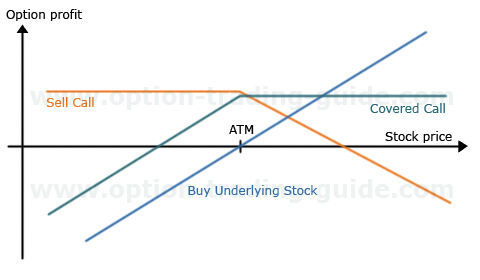
来源:http://www.option-trading-guide.com/coveredcalls.html

绿线代表组合头寸,当标的价格大于期权执行价(Strike),组合收益为恒定的期权费(Premium),而当价格小于执行价减期权费(Strike - Premium),组合收益由正转负。Covered Call 适合那些不愿意卖出资产但又对后市不乐观的投资者。

Ribbon Finance 是目前 TVL 最大的 DOV 产品,不过只开放 BTC、ETH 等核心资产。

Shield

Shield 是目前 BNB Chain 上 TVL 最大的 DOV,采取的是 Delta Neutral 策略。Delta 是资产价格对期权价格的一阶导影响,假设 Delta 为 0.5,则资产价格每变动一个单位,期权价格会同方向变动 0.5 个单位。由于 DOV 的目的是获取资产的波动率,因此必须对冲掉价格的影响。

简言之,对一个欧式看涨期权空头做对冲时,每卖出一份期权就需要买入 N(d1) 份资产。而用户存入的资产就起到了对冲的作用。

不过,Delta 是为不断变化的,这里就需要引入另一个概念,Gamma。Gamma 是资产价格对期权价格的二阶导影响,衡量的是 Delta 的变化量。如今,在 TradFi 市场上执行期权策略的机构不会简单地对 Delta 进行对冲,也需要保证 Gamma 为 0。这部分目前还没有体现在 DOV 的策略上。

相较 Ribbon Finance,Shield 的最大优势是定位于DOV发行平台,对任意拥有流动性(已上线的金库看,仅需DEX 流动性>30万美金)的长尾代币(Altcoin)开放,允许项目方或者做市商在无需许可的情况下通过场外期权对冲策略发行代币的期权金库。
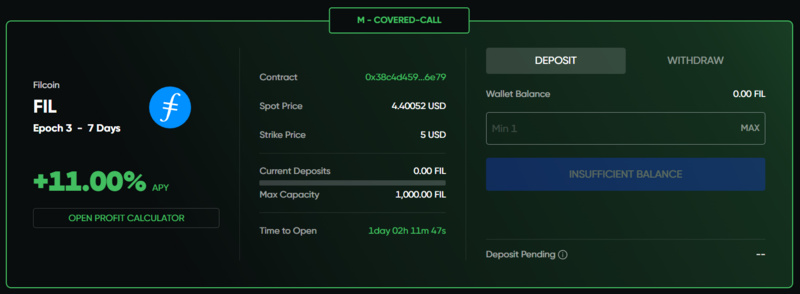
相比BTC、ETH等主流资产,项目方发行DOV的意义在于,通过场外期权做市服务首次使项目方可以在无需任何单方面补贴的情况下为社区提供一个可持续收益的代币使用新场景。因此,项目方期权金库(DOV)有机会成为继流动性挖矿和单币锁仓挖矿等传统DeFi激励方式后的新流行。

Friktion

Friktion 是目前 Solana 上最大的去中心化期权应用,其中超过 70% 的 TVL 集中在 Altcoin 上,这些 Token 通常在 CEX 上没有对应的期权产品,因此不会影响 CeFi 市场。

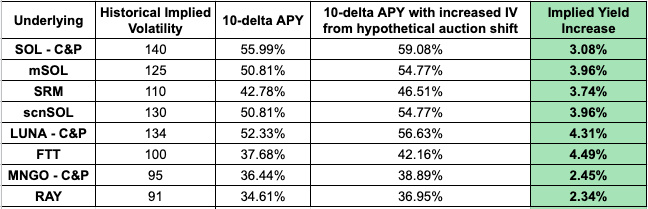
此外,Friktion 还实行了提前拍卖机制,在期权到期前 6 个小时卖出下一周的期权已获得更高的期权费。下方表格为官方通过历史回测做出的总结,回测表明提前 6 小时拍卖可以显著提升 Altcoin DOV 的隐含波动率(但无法提高 BTC 和 ETH 的隐含波动率,因为这两个 Token 在 CEX 上也有期权,价格不只受 DOV 影响)。
然后,随着 FTX 的崩溃,Solana 的生态也遭受沉重打击。

对 CeFi 期权市场的影响

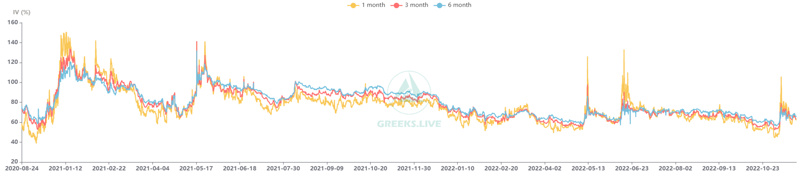
BTC ATM Implied Volatility
ETH ATM Implied Volatility
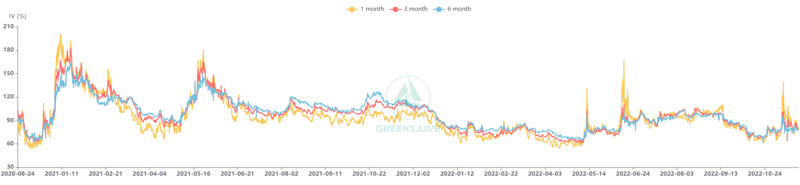
期权隐含波动率(IV)是衡量投资者对未来市场预期波动的有力工具,通常当大部分投资者对未来市场方向的判断和当下走势方向相同时 IV 会降低,而当预期与当下行情相悖时 IV 则为升高。

观察 BTC 期权与 ETH 期权的 IV 走势可以发现,自 2020 年第四季度以来,加密市场期权 IV 整体上在不断走低,除了类似去年 5 月和今年 5 月的市场暴跌行情。根本原因在于,IV 与期权价格成正比,当期权市场供过于求,期权价格就会下降,进而导致 IV 下降。

CeFi 市场上,期权的买卖双方通常能达成平衡,因此 IV 可以真实地反映投资者对未来的预期。然而随着 DeFi Option Vault(DOV)市场的不断扩大,这一切似乎发生了变化。

由于 DOV 卖方可获得额外收益,例如平台奖励或质押收益等,导致卖方市场有大量散户参与。且期权毕竟属于小众产品,买方通常是机构做市商,他们购买期权不是为了未来的利润,而是在 DOV 内购买便宜的 IV,并在 Deribit 链上出售相关期权,以此进行套利。因此,DOV 市场实际上供过于求,导致 IV 逐渐降低。

IV 的降低不仅影响传统期权市场,对 DOV 自身也产生负面影响。起初,DOV 选择出售 0.1 delta 的期权,执行价格离当前价格较远,风险较小。但随着期权价格的不断降低,卖方获利 空间越来越小,为了维持收益率,DOV 不得不提高 delta,这就导致执行价格与当前价格更接近从而扩大了风险。应对核心资产 DOV 收益逐渐降低的趋势,大多竞品选择将标的物扩展至其他 Token。

总结

DOV 产品的核心出发点就是为让用户放弃无限赚取收益的可能,通过将波动率转化为期权费使用户获利。

一般地, DOV 的 APY 集中在 10%-50%,其中 Altcoin 的更高。以 Curve、AAVE 或 Compound 为首的 DeFi 存款 APY 通常不会超过 10%,远低于 DOV 的 APY。而且,DOV 的收益不是依靠 Token 的通胀,而是通过组合策略套利产生利润,因此不会影响价格。

不过,这里我们所说的 Token 是指拥有 Holder 的 Token,即使是 Altcoin,也必须是有应用场景的 Token,而非那些以高 APY 吸引用户质押挖矿的庞氏 Token。因为虽然 DOV 的 APY 较高,但相较“挖矿 Token”动辄上万的 APY,恐怕还不具备吸引力。

上述的 Ribbon 竞品中,Shield 的创新度最高,其无许可机制可以吸收做市商在平台上进行锁仓。目前很少有 DeFi 协议能够不依靠 Token 的通胀为用户提供质押收益,Shield 的机制不仅解决了 Altcoin 流动性较低的问题,而且缓解了 DOV 对 CeFi 的影响(将大量 DOV 用户从 BTC 或 ETH 迁移至 Altcoin,提高前者的隐含波动率)。

不过,正如前文所述,DOV 的 APY 虽高,但相较庞氏挖矿的 APY 并无优势。因此前提是标的资产必须有上涨的潜力,否则 DOV 也无法拯救它。

Trending Cryptos

Related Reads

Ethereum Is Retracing the Path of the Internet and Linux: No One Yields, and the Neutral Party Ultimately Prevails

This article argues that Ethereum is following the historical path of open, neutral systems like the Internet and Linux, which eventually triumphed over proprietary, centrally-controlled alternatives. Major financial institutions like JPMorgan, Stripe, and Circle are building their own proprietary blockchains or networks (e.g., Tempo, Arc), but will never agree to build on a competitor's controlled infrastructure. This creates the perfect opportunity for Ethereum as the only neutral, credibly neutral settlement layer that no single entity controls. The piece draws parallels to the 1990s, when experts like Bill Gates predicted proprietary networks (from Microsoft, Oracle) would win over the open Internet, and when Sun Microsystems' Unix lost to the open-source "bazaar" development model of Linux. This model, described in Eric Raymond's "The Cathedral and the Bazaar," thrives on permissionless innovation where countless contributors improve the system, outpacing any centralized competitor. Ethereum embodies this through its decentralized development, broad validator distribution, and credible neutrality—rules that are transparent, equally applied, hard to change, and open to all. This has attracted over a million developers and major institutions like Coinbase, BlackRock, and JPMorgan, who choose Ethereum for its security, ecosystem, and sovereignty (the inability of any single party to change the rules). While proprietary chains offer initial speed and control, they inherit the downsides of both centralization and decentralization without the long-term innovation benefits. The article concludes that, just as open systems historically win, Ethereum is poised to become the foundational, neutral settlement layer for global finance.

marsbit2m ago

Ethereum Is Retracing the Path of the Internet and Linux: No One Yields, and the Neutral Party Ultimately Prevails

marsbit2m ago

Kalshi's Biggest Rival is Not Polymarket

Kalshi's CEO Tarek Mansour has identified the company's primary competitors not as the crypto-based prediction market Polymarket, but as established financial and gaming giants: CME Group, Robinhood, and DraftKings. This reflects a shift in the prediction market landscape, where the 2026 FIFA World Cup is expected to bring massive new trading volume. Traditional platforms are increasingly integrating prediction markets as a feature within their existing ecosystems. Robinhood has seen rapid growth with its prediction markets, contributing significantly to its "other transaction revenue." Similarly, Interactive Brokers (IBKR) integrates contracts from Kalshi and CME Group, while DraftKings and FanDuel (via CME) have launched their own prediction products. This allows these firms to leverage their vast user bases and infrastructure at low marginal cost, turning prediction markets from standalone apps into embedded functionalities. In response, prediction market platforms are evolving along two paths. First, they are expanding into new event categories like sports (e.g., the World Cup) and financial data to reduce reliance on election cycles. Second, they are moving towards becoming infrastructure and liquidity providers for distribution platforms. Kalshi's lead over Polymarket in trading volume is partly attributed to this channel strategy, integrating with brokers like Robinhood, Coinbase, and Webull. However, this strategy faces a challenge as distributors like Robinhood begin building their own in-house prediction market capabilities (e.g., Rothera), potentially threatening the value of pure infrastructure providers. The situation parallels historical tech battles, such as Zoom competing with Microsoft Teams and Google Meet, where embedded features in larger platforms reshape market dynamics. The future of standalone prediction market leaders like Kalshi and Polymarket will depend on their ability to navigate this new competitive landscape dominated by integrated financial and gaming titans.

链捕手9m ago

Kalshi's Biggest Rival is Not Polymarket

链捕手9m ago

Trends in US Stocks (June 22): Strait of Hormuz Agreement Changes Course, Thursday's PCE and Micron to Determine Chip Sector Direction

U.S. Stock Market Outlook (June 22): Strait of Hormuz Deal Falters, Thursday's PCE & Micron to Set Chip Sector Direction. Geopolitical tensions resurged over the weekend as Iran's IRGC announced the closure of the Strait of Hormuz, and its negotiation team walked out after threats from Trump, pausing U.S.-Iran talks. This renewed risk premium is weighing on U.S. equity futures ahead of the open. Last week's market was driven by chip stocks, with the Philly Semiconductor Index hitting a record high. While the Fed's hawkish tone was overshadowed by initial deal optimism, the S&P 500 gained 0.9% for the week. SpaceX debuted strongly but ended with two down days. Key events this week: The status of U.S.-Iran negotiations remains the immediate variable for oil and energy stocks. Monday sees Marvell and Flex added to the S&P 500. Tuesday's MSCI reclassification could benefit South Korean semiconductors and memory stocks. **Thursday, June 25th, is the critical day**, featuring the May Core PCE report and Micron's earnings. Hotter PCE data could solidify expectations for two 2024 rate hikes, while softer data would rapidly reprice rate cut bets. Micron's report is a key test for the AI narrative; the market will scrutinize its 2027 HBM supply visibility, HBM4 progress, and its position in Nvidia's Vera Rubin supply chain. Nvidia's AGM and a potential OpenAI GPT-5.6 release will make Thursday a pivotal 24 hours for AI. Friday concludes with the Russell reconstitution, elevating small-cap volatility. In summary, last week's gains face a true test. The path hinges on two concurrent threads: geopolitical developments with Iran and the AI narrative defined by Micron's guidance and Nvidia's updates. The chip sector's record highs are vulnerable if Thursday brings hot PCE data and conservative guidance from Micron. Conversely, positive outcomes could reaffirm the AI bull case, making this week's volatility a potential entry window.

marsbit1h ago

Trends in US Stocks (June 22): Strait of Hormuz Agreement Changes Course, Thursday's PCE and Micron to Determine Chip Sector Direction

marsbit1h ago

Trading

Spot
Futures

Hot Articles

What is $BITCOIN

DIGITAL GOLD ($BITCOIN): A Comprehensive Analysis Introduction to DIGITAL GOLD ($BITCOIN) DIGITAL GOLD ($BITCOIN) is a blockchain-based project operating on the Solana network, which aims to combine the characteristics of traditional precious metals with the innovation of decentralized technologies. While it shares a name with Bitcoin, often referred to as “digital gold” due to its perception as a store of value, DIGITAL GOLD is a separate token designed to create a unique ecosystem within the Web3 landscape. Its goal is to position itself as a viable alternative digital asset, although specifics regarding its applications and functionalities are still developing. What is DIGITAL GOLD ($BITCOIN)? DIGITAL GOLD ($BITCOIN) is a cryptocurrency token explicitly designed for use on the Solana blockchain. In contrast to Bitcoin, which provides a widely recognized value storage role, this token appears to focus on broader applications and characteristics. Notable aspects include: Blockchain Infrastructure: The token is built on the Solana blockchain, known for its capacity to handle high-speed and low-cost transactions. Supply Dynamics: DIGITAL GOLD has a maximum supply capped at 100 quadrillion tokens (100P $BITCOIN), although details regarding its circulating supply are currently undisclosed. Utility: While precise functionalities are not explicitly outlined, there are indications that the token could be utilized for various applications, potentially involving decentralized applications (dApps) or asset tokenization strategies. Who is the Creator of DIGITAL GOLD ($BITCOIN)? At present, the identity of the creators and development team behind DIGITAL GOLD ($BITCOIN) remains unknown. This situation is typical among many innovative projects within the blockchain space, particularly those aligning with decentralized finance and meme coin phenomena. While such anonymity may foster a community-driven culture, it intensifies concerns about governance and accountability. Who are the Investors of DIGITAL GOLD ($BITCOIN)? The available information indicates that DIGITAL GOLD ($BITCOIN) does not have any known institutional backers or prominent venture capital investments. The project seems to operate on a peer-to-peer model focused on community support and adoption rather than traditional funding routes. Its activity and liquidity are primarily situated on decentralized exchanges (DEXs), such as PumpSwap, rather than established centralized trading platforms, further highlighting its grassroots approach. How DIGITAL GOLD ($BITCOIN) Works The operational mechanics of DIGITAL GOLD ($BITCOIN) can be elaborated on based on its blockchain design and network attributes: Consensus Mechanism: By leveraging Solana’s unique proof-of-history (PoH) combined with a proof-of-stake (PoS) model, the project ensures efficient transaction validation contributing to the network's high performance. Tokenomics: While specific deflationary mechanisms have not been extensively detailed, the vast maximum token supply implies that it may cater to microtransactions or niche use cases that are still to be defined. Interoperability: There exists the potential for integration with Solana’s broader ecosystem, including various decentralized finance (DeFi) platforms. However, the details regarding specific integrations remain unspecified. Timeline of Key Events Here is a timeline that highlights significant milestones concerning DIGITAL GOLD ($BITCOIN): 2023: The initial deployment of the token occurs on the Solana blockchain, marked by its contract address. 2024: DIGITAL GOLD gains visibility as it becomes available for trading on decentralized exchanges like PumpSwap, allowing users to trade it against SOL. 2025: The project witnesses sporadic trading activity and potential interest in community-led engagements, although no noteworthy partnerships or technical advancements have been documented as of yet. Critical Analysis Strengths Scalability: The underlying Solana infrastructure supports high transaction volumes, which could enhance the utility of $BITCOIN in various transaction scenarios. Accessibility: The potential low trading price per token could attract retail investors, facilitating wider participation due to fractional ownership opportunities. Risks Lack of Transparency: The absence of publicly known backers, developers, or an audit process may yield skepticism regarding the project's sustainability and trustworthiness. Market Volatility: The trading activity is heavily reliant on speculative behavior, which can result in significant price volatility and uncertainty for investors. Conclusion DIGITAL GOLD ($BITCOIN) emerges as an intriguing yet ambiguous project within the rapidly evolving Solana ecosystem. While it attempts to leverage the “digital gold” narrative, its departure from Bitcoin's established role as a store of value underscores the need for a clearer differentiation of its intended utility and governance structure. Future acceptance and adoption will likely depend on addressing the current opacity and defining its operational and economic strategies more explicitly. Note: This report encompasses synthesised information available as of October 2023, and developments may have transpired beyond the research period.

416 Total ViewsPublished 2025.05.13Updated 2025.05.13

What is $BITCOIN

Discussions

Welcome to the HTX Community. Here, you can stay informed about the latest platform developments and gain access to professional market insights. Users' opinions on the price of BTC (BTC) are presented below.

活动图片