It’s time for crypto fans to stop supporting cults of personality

CointelegraphPublished on 2022-11-27Last updated on 2022-11-27

Abstract

From Sam Bankman-Fried to Bitboy, cryptocurrency fans have been too quick to support divas who gained notoriety on social media. It's a phenomenon that needs to end.

Many of the centralized cryptocurrency platforms that collapsed this year had something in common: a young, outspoken and cocky leader. Each gained outsized influence not by virtue of outsized intellect or talent but because of their piles of money and large Twitter followings. And each time, misplaced trust in their abilities resulted in disastrous consequences.

If crypto wants to avoid similar catastrophes in the future, it’s time for us to rearrange our leadership priorities. We need to ditch the cults of personality.

The theater of crypto on Twitter

Before FTX collapsed, founder Sam Bankman-Fried (SBF) had garnered a reputation as one of the loudest voices in the industry. He was active in the political world and frequently commented on what was happening in Web3.

But perhaps most notable was his active involvement in a myriad of Twitter feuds and spectacles. SBF first stepped into the spotlight as the successor of SushiSwap after Chef Nomi abruptly abandoned the project — a drama that played out almost entirely on Twitter’s public stage. His ensuing Twitter antics, combined with the image of unstoppable success that FTX was broadcasting far and wide, gained him more than a million followers.

But even as SBF’s influence grew, it seemed he just couldn’t resist shitposting, regularly engaging with other Twitter users who threw stones.
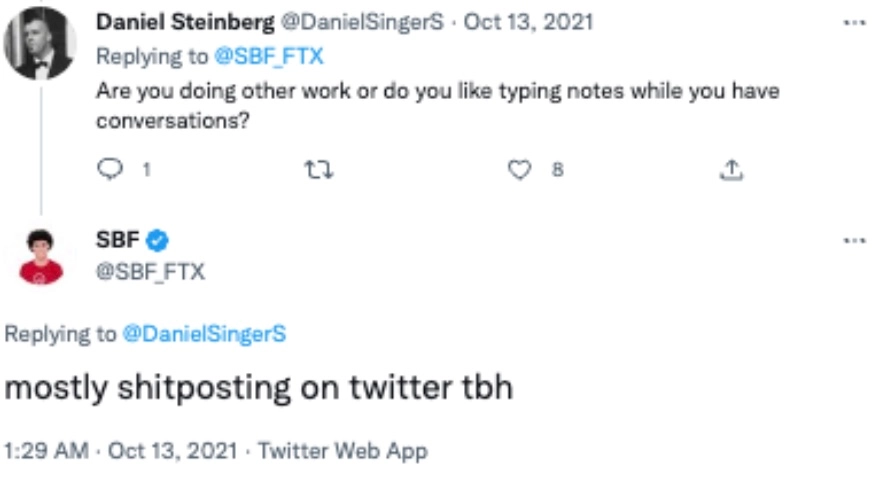
Indeed, SBF’s penchant for Twitter drama played an important role in exposing FTX’s insolvency. It was his recent spat with CZ that ultimately led to the run on FTX’s deposits. His attention-grabbing antics carried on through the current ordeal, culminating in a bizarre series of cryptic tweets.

The loudest voices in the room

While SBF is the latest example of an industry figure whose highly public Twitter presence led to a highly public downfall, he certainly isn’t the first. Do Kwon and Su Zu, who were both at the center of monumental collapses earlier this year, were also notorious trolls. Do Kwon infamously sent an arrogant series of tweets just before Terra’s downfall, while Su Zhu’s infamously elusive comments during the 2021 bull run didn’t age well, either.
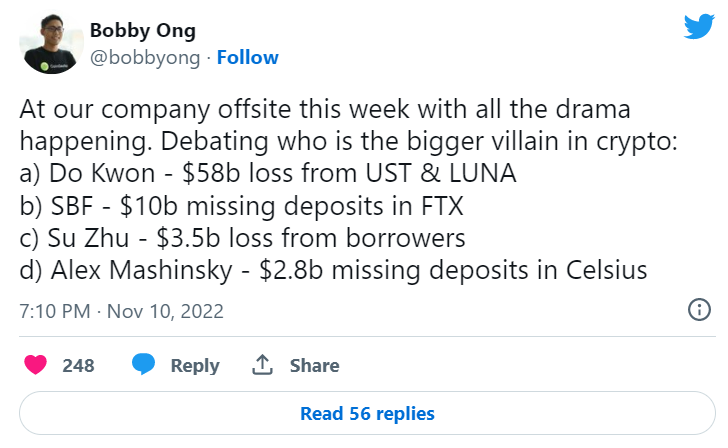
But, the leaders of failed platforms aren’t the only ones guilty of social media braggadocio. Binance’s CZ, after all, was just as guilty as SBF of engaging in their public Twitter feud earlier this month. Digital Currency Group’s Barry Silbert, who has been at the center of alarm related to the FTX fallout, has also garnered a reputation as a shitposter.

There are many, many more tweeters who have used online spectacle and trolling as a means of controlling the industry conversation. Think Ben Armstrong (aka “Bitboy”) and Jim Cramer, to name just a couple more. There’s a small army of them. And, even though many are purged in each bear market, their successors are increasingly turning into powerhouses too vocal and influential to ignore in the space.

We need to end the cults of personality

So what’s the solution? How can we better identify this personality type and use this recognition to avoid future pain?

Instead of focusing on building cults of personality, the crypto community needs to focus on platforms and leaders building products that use web3 primitives to solve problems in a manner that’s orders of magnitude better than anything we’ve experienced before. The crypto community needs to stop listening to the loudest voices in the room and start listening to the wiser, more experienced ones — even if they are sometimes quieter. And by the same token, we need builders with experience in creating real value for users to speak up more.

Ultimately, the answer lies with us and with the people that we, as an industry, choose to lionize. We need to learn how to identify and support builders building transparent, secure, high-quality applications and decentralized applications — regardless of how many followers they have.


Trending Cryptos

Related Reads

Foundation Steps Back, Ethlabs Steps Forward: Ethereum Undergoes Its Largest Restructuring in History

On June 23rd, the Ethereum ecosystem witnessed two major shifts, signaling a significant governance realignment. First, former Ethereum Foundation researchers established Ethlabs, a new independent non-profit. Backed by major ETH holders like Bitmine and SharpLink, Ethlabs aims to address practical needs for institutional adoption, including faster settlement, native asset issuance, cross-chain transactions, and mainnet scaling. Secondly, the Ethereum Foundation announced a major restructuring, laying off 54 employees (20% of its staff) to become a leaner entity focused on protocol governance and maintenance rather than being the primary builder. This move represents a pivotal correction. Criticisms had mounted over the Foundation's perceived slowness, lack of clear strategy, and over-reliance on Vitalik Buterin's influence. Ethlabs emerges as a more execution-oriented, "industrialized" layer focused on market adoption—bridging the gap between research and real-world use. Notably, Vitalik Buterin is absent from its list of supporters, interpreted as an intentional step to avoid excessive personal endorsement and allow the organization to build independent credibility. The Ethereum Foundation's downsizing and redefinition mark a retreat from its former central coordinating role. It now aims to share the "privilege of stewarding Ethereum" with other emerging groups like Ethlabs, the Ethereum Applications Guild, and The Ethereum Economic Zone. Analysts frame this dual shift as the Foundation ensuring Ethereum remains "correct" (credibly neutral), while Ethlabs must prove it remains "effective" (competitive and attractive for capital and adoption). This addresses community "shareholder-like anxiety" about ETH's market performance. While risks exist—such as concerns over shifting from Foundation centrality to large-holder influence—the consensus is that the greater risk for Ethereum was inaction, caught between technical idealism and organizational inertia. These steps aim to create a more multi-stakeholder, execution-driven future for the network.

链捕手47m ago

Foundation Steps Back, Ethlabs Steps Forward: Ethereum Undergoes Its Largest Restructuring in History

链捕手47m ago

Second Half of U.S. Crypto Policy: The Clarity Act Aims for 60 Votes, CFTC's "One-Person Commission" Becomes Biggest Variable

In a pivotal year for US crypto policy, the "CLARITY Act" is advancing in the Senate but faces a high hurdle, needing 60 votes to pass. Key challenges include bridging partisan divides on ethics and swaying undecided Republican senators within a tight legislative calendar of only about 40 working days. The policy "second half" involves intense negotiations on a broader framework for Web3 and DeFi, including crypto tax reforms and the Blockchain Regulatory Certainty Act. A significant uncertainty is the understaffed CFTC, operating with four commissioner vacancies, which complicates regulatory clarity. Meanwhile, the departure of key "crypto champions"—SEC Commissioner Hester Peirce and Senator Cynthia Lummis—will impact ongoing policy efforts. Industry experts are cautiously optimistic but realistic. Sara K. Weed notes that while progress is being made, CLARITY is unlikely to pass this Congress, pushing agencies like the SEC and CFTC to provide more guidance. Sulolit Mukherjee suggests meaningful crypto tax legislation is more likely to be attached to larger must-pass bills. Rashan Colbert discusses the jurisdictional debate over prediction markets, emphasizing the need for a regulatory framework that fosters their development as financial tools rather than treating them broadly as gambling. The clock is ticking, but opportunities remain for substantive progress through continued bipartisan dialogue and pragmatic efforts.

marsbit3h ago

Second Half of U.S. Crypto Policy: The Clarity Act Aims for 60 Votes, CFTC's "One-Person Commission" Becomes Biggest Variable

marsbit3h ago

Research Report Analysis: Morgan Stanley Details SanDisk SNDK, The Truth About Cloud Data Center Pricing Power and AI Inference Benefits

Morgan Stanley raised its price target for SanDisk (SNDK) from $1100 to $1750 on June 22, maintaining an Overweight rating. The upgrade is driven by AI inference demand reshaping the NAND market, particularly for KV Cache and context window storage in cloud data centers. These cloud clients exhibit price inelasticity and sign long-term contracts, granting SanDisk significant pricing power. SanDisk's New Business Model (NBM) agreements, covering over one-third of FY27 bit shipments with 3-5 year terms and fixed price/price collar structures, are crucial. They are projected to sustain gross margins around 80% even at floor prices, providing a buffer against cyclical downturns. Morgan Stanley forecasts gross margins to surge from 30.3% in FY25 to 86.7% in FY27e. With NAND supply expected to remain tight into 2026/2027 and cloud/data centers becoming the largest end-market, SanDisk holds supply-side pricing power. The company targets 15-19% bit growth via technology transitions, not capacity expansion. Revenue is projected to grow ~6.6x from FY25 to FY27, with EPS rising from $2.74 to $14.73, driven by high-margin cloud business. Key upside catalysts include faster enterprise SSD adoption and edge AI growth. Downside risks involve slower industry growth, competitor capex increases, market share loss, and competition from Chinese players like YMTC. The investment thesis rests on AI-driven structural demand, NBM's margin protection, and sustained supply tightness. The $1750 target implies ~28x FY27e P/E.

marsbit4h ago

Research Report Analysis: Morgan Stanley Details SanDisk SNDK, The Truth About Cloud Data Center Pricing Power and AI Inference Benefits

marsbit4h ago

Trading

Spot
Futures

Hot Articles

Discussions

Welcome to the HTX Community. Here, you can stay informed about the latest platform developments and gain access to professional market insights. Users' opinions on the price of ETH (ETH) are presented below.

活动图片