Ethereum bears have the upper hand according to derivatives data, but for how long?

CointelegraphPublished on 2022-11-23Last updated on 2022-11-23

Abstract

ETH bears continue to suppress Ethereum price, but institutional traders’ buying activity and exchanges’ aiming to provide more transparency could improve investor sentiment.

Ether price experienced an 11.9% decline from Nov. 20 to Nov. 22, bottoming at $1,074 — the lowest level seen since July. Currently, investors have reason to be concerned after crypto lending company Genesis reportedly faced difficulties raising money, triggering rumors of insolvency on Nov. 21.

However, a spokesperson for Genesis told Cointelegraph that there were no plans for imminent bankruptcy because the company continues to hold discussions with its creditors.

Unease about the centralization of decentralized finance (DeFi) surfaced after Uniswap Labs changed the privacy policy on Nov. 17, revealing that it collects publicly-available blockchain data, users' browser information, operating systems data and interactions with its service providers.

Adding to the fracas, the hacker behind the FTX exchange theft of $447 million has been spotted moving their Ether funds. On Nov. 20, the attacker transferred 50,000 ETH to a separate wallet and converted it to Bitcoin using two renBTC bridges.

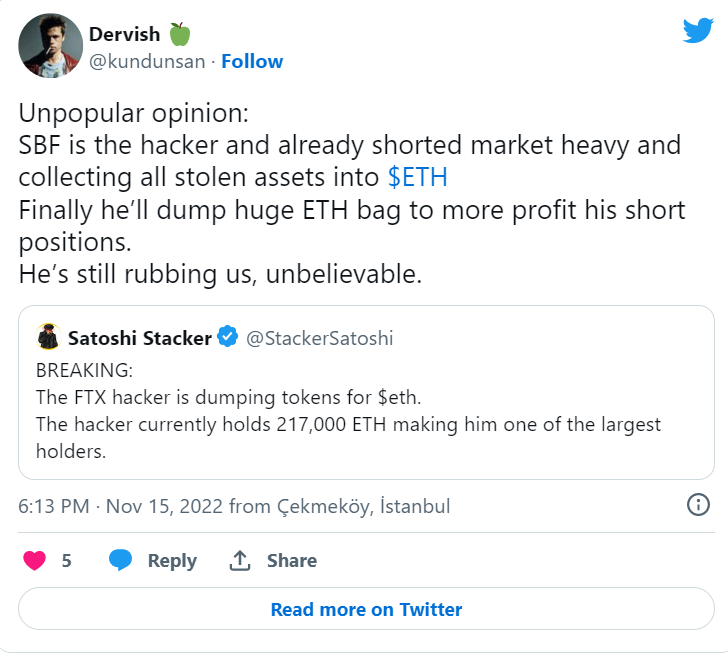
Traders fear that the hacker might be suppressing Ether's price to profit using leveraged short bets. The rumor was raised by @kundunsan on Nov. 15, even though the Twitter post did not gain exposure.
Let's look at Ether derivatives data to understand if the worsening market conditions have impacted crypto investors' sentiment.

Pro traders have been in panic mode since Nov. 10

Retail traders usually avoid quarterly futures due to their price difference from spot markets, but they are professional traders' preferred instruments because they prevent the fluctuation of funding rates that often occurs in a perpetual futures contract.
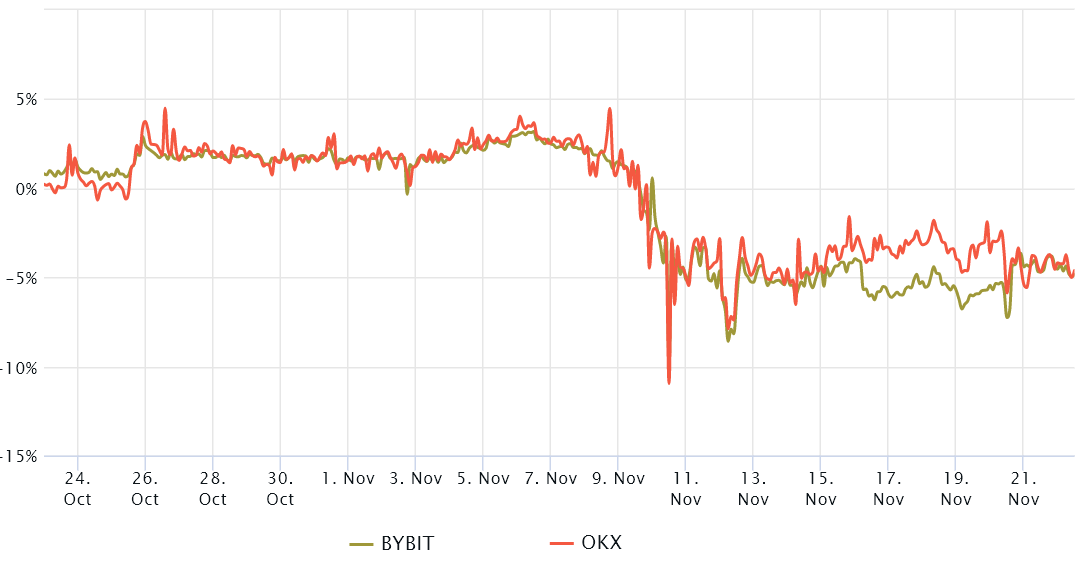
The three-month futures annualized premium should trade between +4% to +8% in healthy markets to cover costs and associated risks. The chart above shows that derivatives traders have been bearish since Nov. 10 since the Ether futures premium was negative.

Currently there is backwardation in the contracts and this situation is atypical and usually deemed bearish. The metric did not improve after ETH rallied 5% on Nov. 22, reflecting professional traders' unwillingness to add leveraged long (bull) positions.

Traders should also analyze Ether's options markets to exclude externalities specific to the futures instrument.

Options traders fear additional crashes

The 25% delta skew is a telling sign when market makers and arbitrage desks are overcharging for upside or downside protection.

In bear markets, options investors give higher odds for a price dump, causing the skew indicator to rise above 10%. On the other hand, bullish markets tend to drive the skew indicator below -10%, meaning the bearish put options are discounted.
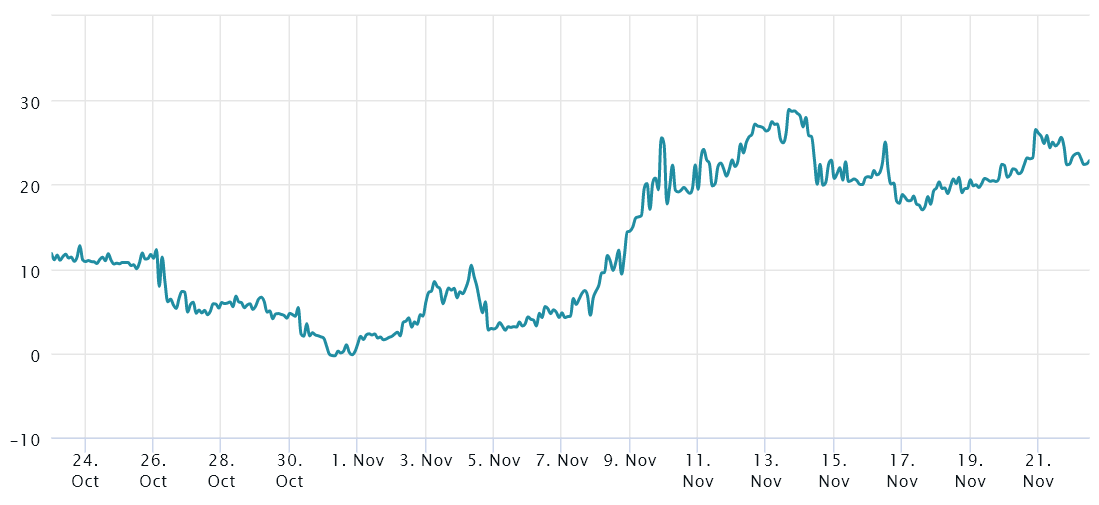
The delta skew has been above the 10% threshold since Nov. 9, signaling that options traders were less inclined to offer downside protection. The situation worsened over the following days as the delta skew indicator surged above 20%.

The 60-day delta skew currently stands at 23%, so whales and market makers are pricing higher odds of price dumps for Ether. Consequently, derivatives data shows low confidence right as Ether struggles to hold the $1,100 support.

According to the data, Ether bulls should not throw in the towel just yet because these metrics tend to be backward-looking. The panic that followed FTX's bankruptcy and the subsequent liquidity issues at Genesis might dissipate quickly if exchanges public proof of reserves and institutional investors addingBitcoin exposure during the dip are interpreted as positives by market participants.

With that said, at the moment Ether bears still have the upper hand according to ETH derivatives metrics.


Trending Cryptos

Related Reads

A Brief History of the Lithography Machine: How a Beam of Light Walked Sixty-Nine Years

A Brief History of Lithography: 69 Years of Light In July 2026, reports of a Chinese state-backed company producing five immersion DUV lithography machines sent shockwaves through Wall Street, wiping roughly $44 billion from ASML's market cap in a single day. This event signaled a crack in the long-held assumption of Western monopoly over advanced chipmaking equipment. The journey began in 1957 when Jay Lathrop coined the term "photolithography." Early contact aligners (1960s) gave way to PerkinElmer's revolutionary projection aligners in 1973, boosting yields dramatically. GCA's step-and-repeat system (1978) established the modern stepper blueprint. However, within a decade, Japanese firms like Nikon and Canon, supported by a strong domestic market, captured nearly 90% of the global market from American pioneers, who ultimately exited the business. ASML, founded in a leaky shed in 1984, rose to dominance through key strategic moves: the TWINSCAN dual-stage platform (2001) and the acquisition of SVG, gaining access to Intel. A pivotal moment came in the early 2000s with the industry at a 193nm wavelength impasse. While most invested in the costly 157nm path, TSMC's Burn Lin proposed immersion lithography—using water between the lens and wafer. ASML bet on this simpler idea and, with Zeiss, delivered the first commercial immersion tool in 2004, effectively ending the 157nm roadmap and leaving competitors behind. The subsequent push for Extreme Ultraviolet (EUV) lithography was an even greater marathon. Deemed the least promising option in 1997, EUV's development, led by ASML, required vacuum chambers, reflective optics, and a complex tin-droplet laser plasma source. Critical to its eventual success (first high-volume manufacturing in 2018) was the 2012 "Customer Co-Investment Program," where Intel, TSMC, and Samsung provided upfront funding and equity, sharing the immense risk and cost. Today, ASML holds a near-total monopoly in EUV and immersion DUV. The core lesson of this 69-year history is not merely one of technological invention but of sustained partnership. Successive leaders—PerkinElmer, GCA, Nikon—were not ultimately defeated by superior technology but by losing the vital connection to customers willing to tolerate years of iteration, fund long-term R&D, and integrate early, imperfect tools into their production lines. The "light" that completed the journey was always carried by those patient, invested partners.

marsbit17m ago

A Brief History of the Lithography Machine: How a Beam of Light Walked Sixty-Nine Years

marsbit17m ago

CryptoQuant Analyst Claims 'Frightening Scenario and Simultaneously Promising Signal for Bitcoin' Reveals Ultimate Bottom Point! Here Are the Details

Bitcoin, the leading cryptocurrency, entered a bear market after hitting a historic high of $126,000 in October 2025 and has since fallen over 50%. As BTC recently dropped to around $57,000, opinions diverge on whether the bottom has been reached, with some expecting a drop closer to $50,000. According to a pseudonymous CryptoQuant analyst, the Bitcoin bear market may be nearing its end. The analyst notes that as selling pressure following the all-time high weakens, price corrections are becoming shorter and recovery periods more substantial. The July decline was only slightly below lows seen in early February, and BTC has remained relatively stable around $60,000 since, indicating diminished seller influence. Positive technical signals are also cited, with MACD and RSI showing bullish signals, positive divergences, and oversold conditions, collectively suggesting a potential bottom formation for BTC. However, the analyst does not rule out a final sell-off in the short term. They suggest the ultimate market bottom could be around $51,336, corresponding to the 61.8% Fibonacci retracement level. The $50,000 area is highlighted as a crucial historical support zone, aligning with the average investor cost basis and the 200-week moving average—conditions similar to bottoms in previous bear markets. *This is not investment advice.

cryptonews.ru1h ago

CryptoQuant Analyst Claims 'Frightening Scenario and Simultaneously Promising Signal for Bitcoin' Reveals Ultimate Bottom Point! Here Are the Details

cryptonews.ru1h ago

Trading

Spot

Hot Articles

How to Buy UNI

Welcome to HTX.com! We've made purchasing Uniswap (UNI) simple and convenient. Follow our step-by-step guide to embark on your crypto journey.Step 1: Create Your HTX AccountUse your email or phone number to sign up for a free account on HTX. Experience a hassle-free registration journey and unlock all features.Get My AccountStep 2: Go to Buy Crypto and Choose Your Payment MethodCredit/Debit Card: Use your Visa or Mastercard to buy Uniswap (UNI) instantly.Balance: Use funds from your HTX account balance to trade seamlessly.Third Parties: We've added popular payment methods such as Google Pay and Apple Pay to enhance convenience.P2P: Trade directly with other users on HTX.Over-the-Counter (OTC): We offer tailor-made services and competitive exchange rates for traders.Step 3: Store Your Uniswap (UNI)After purchasing your Uniswap (UNI), store it in your HTX account. Alternatively, you can send it elsewhere via blockchain transfer or use it to trade other cryptocurrencies.Step 4: Trade Uniswap (UNI)Easily trade Uniswap (UNI) on HTX's spot market. Simply access your account, select your trading pair, execute your trades, and monitor in real-time. We offer a user-friendly experience for both beginners and seasoned traders.

7.7k Total ViewsPublished 2024.03.29Updated 2026.06.02

How to Buy UNI

Discussions

Welcome to the HTX Community. Here, you can stay informed about the latest platform developments and gain access to professional market insights. Users' opinions on the price of UNI (UNI) are presented below.

活动图片