量化以太坊价值:2030 年将达到 15000 美元?

FPublished on 2022-11-04Last updated on 2022-11-04

Abstract

应用传统估值框架为以太坊估值。

应用传统估值框架为以太坊估值。

随着技术、文化和金融不断融合,加密货币正在向区块链驱动的开放数字世界迈进。

以太坊是占主导地位的区块链,它在其广阔的生态系统中实现了良好的共生关系,当然这要归功以下原因:

先发优势

毫无疑问,中本聪通过比特币创造了历史。他通过对先驱密码学家的工作进行整合,引入与分布式账本相关的点对点数字货币,为去中心化经济奠定了最初的基础。

以太坊在设计上更进了一步,它是一种能够支持广泛多样应用程序的通用计算机。因此以太坊一直是孕育大部分加密货币创新的主阵地。

飞轮和网络效应

以太坊上诞生了一个充满活力的工具和应用程序生态系统,通过流畅 Solidity 语言为技术人才维持飞轮效应。

区块链实现了真正的正面网络效应,以太坊是杰出的领导者,即使在市场低迷的情况下,以太坊上的活跃开发者数量也比任何其他生态系统的平均数量多 6 倍。

针对安全性和可靠性进行优化

以太坊的架构旨在优先考虑安全性和去中心化。这鼓励了一些 L1 竞争对手通过优化高吞吐量或更灵活的系统设计来争夺市场份额。

但以太坊的方法使其成为最可靠的区块链,能够托管数千个应用程序并结算数万亿美元的经济带宽。

随着加密行业进一步渗透到主流,价值最高的交易者将进入以太坊生态。与此同时,为了给参与者提供更高频率、更低成本的服务,最引人注目的扩展基础设施也正在以太坊上构建。

无与伦比的经济能力(网络和资产)

以太坊无与伦比的经济能力以及向生态友好型的转变,将巩固其作为数万亿潜在交易价值的机构和公司首选的 Web3 资产和结算层的地位。

EVM 生态系统的 L2 和侧链也将推动作为核心账户单位和交换媒介的 ETH 代币需求,同时进一步推动对以太坊区块空间的使用。

以太坊网络有很多优势,那么如何才能量化它的当前价值?
以太坊估值

以太坊正在推出适用于建立在最安全结算层上数字时代的强大新工具。
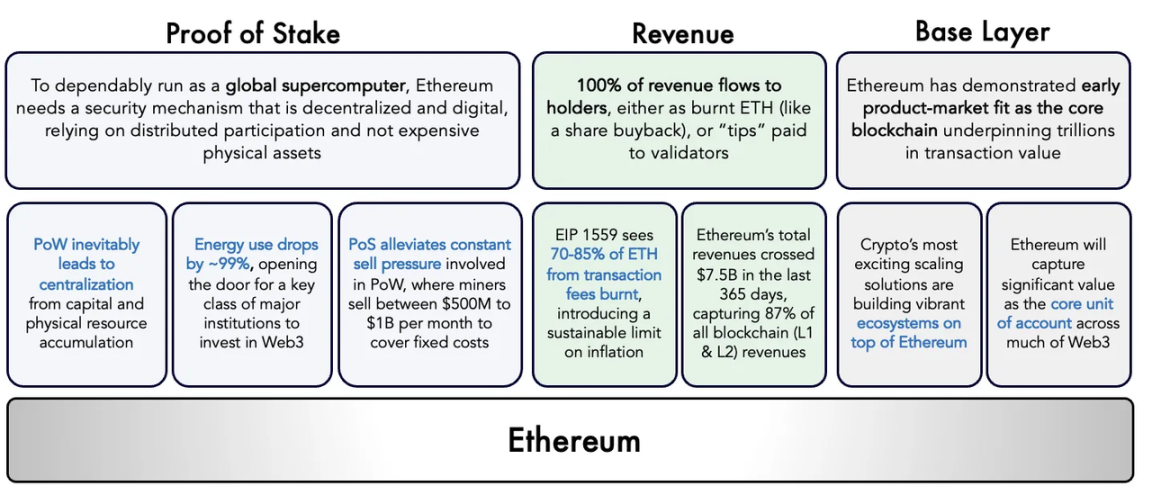
以太坊的现金流和持久的护城河使我们能够使用传统框架估算其价值。

模型假设

增长率和价值捕获

为了预测增长,我们利用受到市场广泛认可的研究模型,同时使用链上数据来量化现有的 Web3 渗透率。在预测未来的价值捕获时,我们使用了保守的前瞻性指标,这些指标既不能反映加密货币过去的显着增长,也不能反映未来的轨迹。

我们在 2022 年、2023 年和 2024 年捕捉长期的宏观、监管或特定于加密货币的不确定性时,选择的保守的估算方式。

加密货币仍处于起步阶段,未来几年可能会出现无数用例和初期行业。因此,我们的方法旨在捕捉整体扩张,而不会陷入当前的用例将持续的情况,或者试图预测每个核心市场在成熟时会是什么样子。

我们区分了质押者(从 ETH 的烧毁、小费和 MEV 中获取价值)和非质押者,后者的直接价值获取仅限于烧毁的 ETH,而现值在一系列 ETH 供应中波动较大。燃烧的估计值各不相同,但我们的研究表明,到 2030 年达到 1 亿销毁量是合理的预测。

货币溢价

数字资产不同于传统股票。一个由协议、dApp 和用户组成的充满活力的生态系统正在基于 ETH 代币构建。尽管许多人将推出自己的代币,但 ETH 仍然将作为主要的记账单位和交换媒介,以及核心资产负债表资产等。

此外,新兴市场的人们将越来越多地寻求 ETH 和 BTC 等无国界资产来应对货币贬值和机构腐败。虽然消费者也将转向其他加密资产,但以太坊的活跃度和实用性将是数百万人的合乎逻辑的选择。

术语

Web3 和 Crypto 并不完全是同义词。

Metaverse 是一个晦涩难懂的包罗万象的短语,可以用来代替任何实质性定义,我们避免使用该术语

Web2 的虚拟世界主要由孤岛组成,包括:

虚拟硬件 (VR/AR)

游戏世界(移动和云计算)

虚拟电子商务(数字资产)

传统游戏硬件(游戏机和 PC)

Web3 的前沿将在很大程度上是可互操作的,并在以下领域产生复合价值:

虚拟土地

Web3 游戏

创造者经济(包括音乐、艺术和社交)

时尚或化妆品 NFT

NFT 收藏品、头像、身份

以太坊估值模型

考虑到所有这些,我们现在可以开始建立一个详细的模型来通过不同垂直领域的总可用市场 TAM 估算以太坊的现金流。

以下是我们的模型基于今天的统计数据的输入。
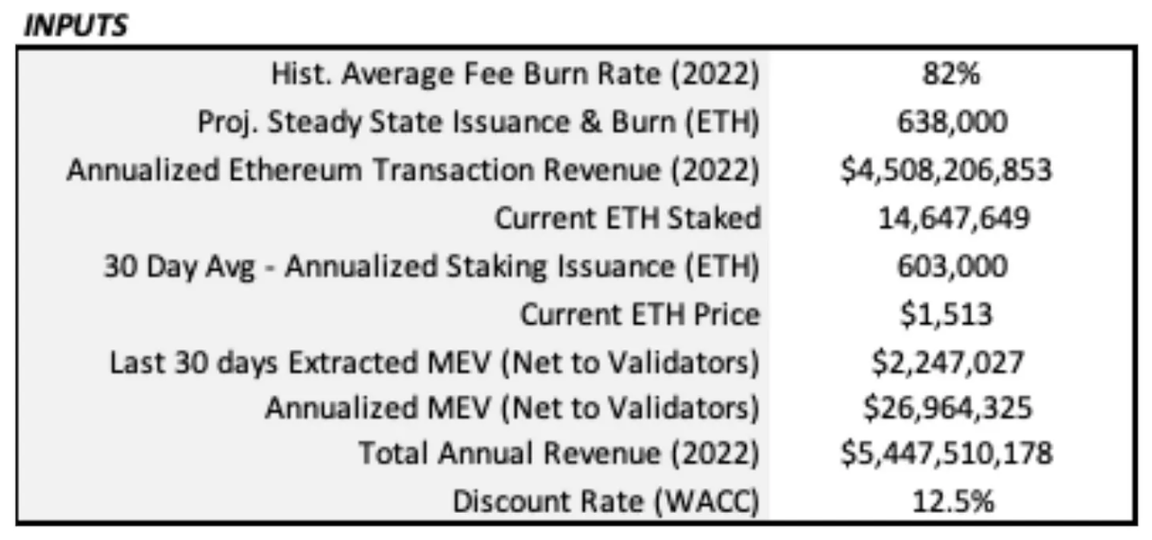
根据自下而上分析得出复合年增长率 CAGR
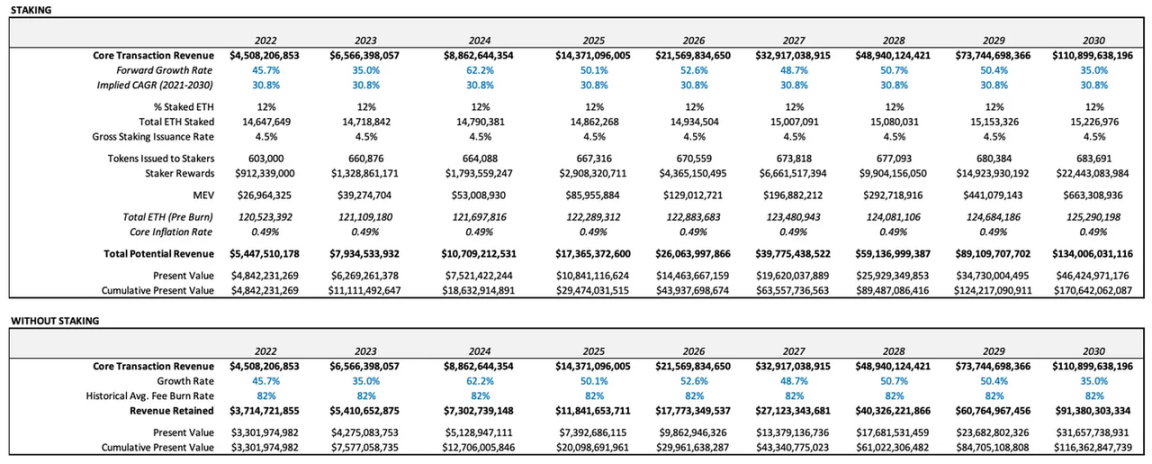
值得注意的是,为了给我们的预测提供更保守的基准,我们假设总质押的 ETH 的百分比保持不变。在实践中,利率应该会随着时间的推移而稳步上升,从而为货币溢价创造更有力的理由。

总而言之,以下是上述模型的关键输出。
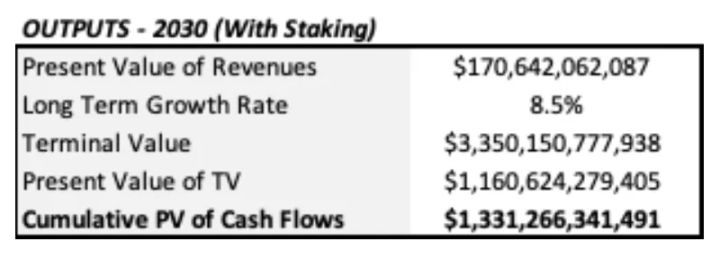
最后我们根据 ETH 的总供应量和预期的货币溢价进行价格预测。

截至撰写本文时,ETH 目前的价格约为 1500 美元。如果模型成立到 2030 年 ETH 将提供 10 倍的回报。

这个基本案例价格预测严格基于以太坊核心业务的现金流,即为在其之上构建的一系列应用程序销售安全的区块空间。

当我们考虑到货币溢价时,ETH 在不同机制中,需求量会不断增加,例如 ETH 锁定在 DeFi、ETH 燃烧、ETH 质押、购买 NFT 等,所以 10 倍回报只是基本情况。

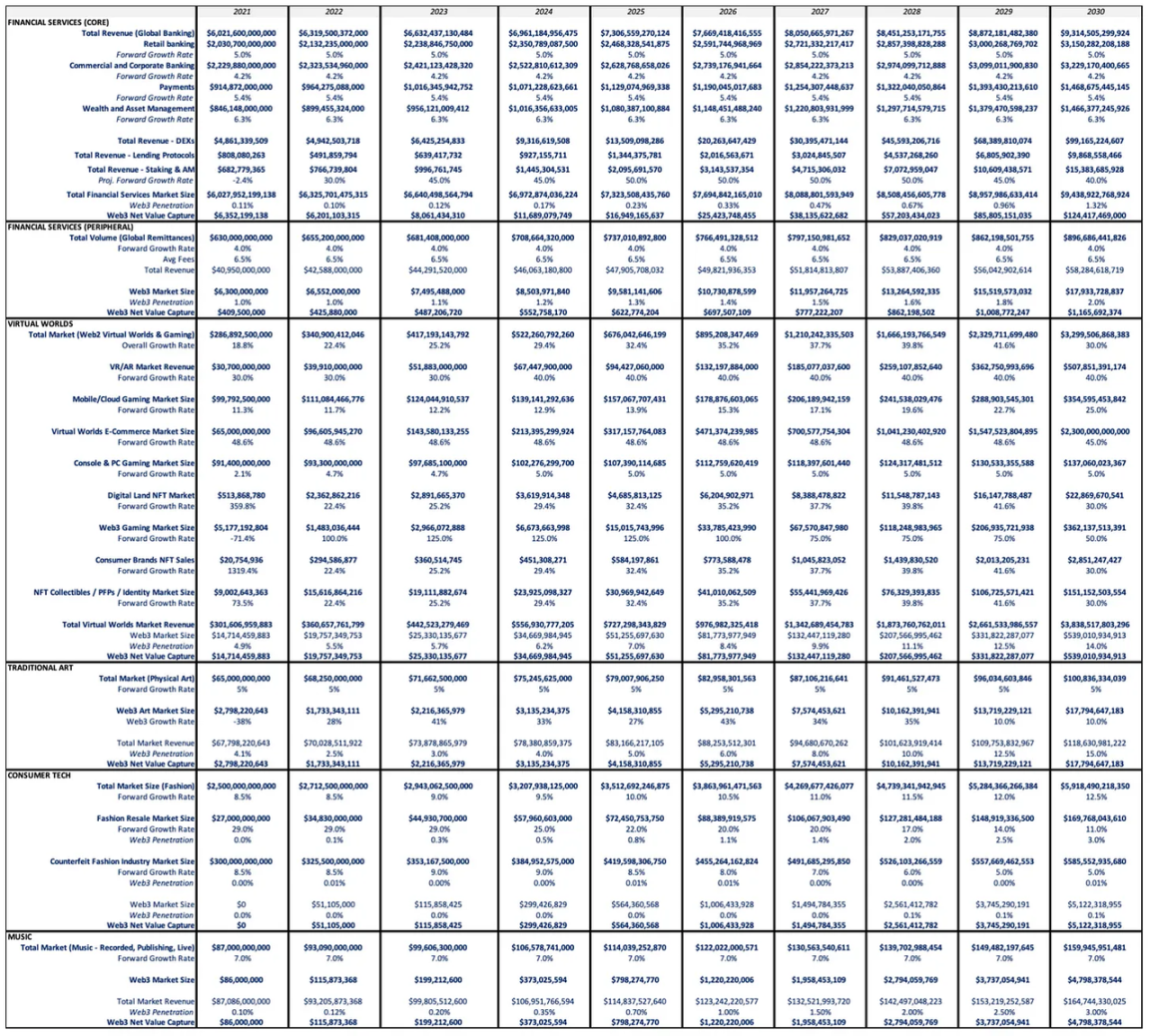
模型细节

深入研究这个繁琐的模型,了解 Archetype 如何评估以太坊的各种垂直市场。
风险与注意事项

竞争

虽然未来最终可能是多链占据主导地位,但我们相信以太坊仍将是杰出的领导者。随着数万亿价值迁移到 Web3,大部分最高价值将继续在安全性更高的以太坊主网上进行交易。

此外区块链自然会经历网络效应,根深蒂固的牵引力如用户、开发人员的数量和地位、监管认可、机构接受度等会吸引更多的活动和投资流入。

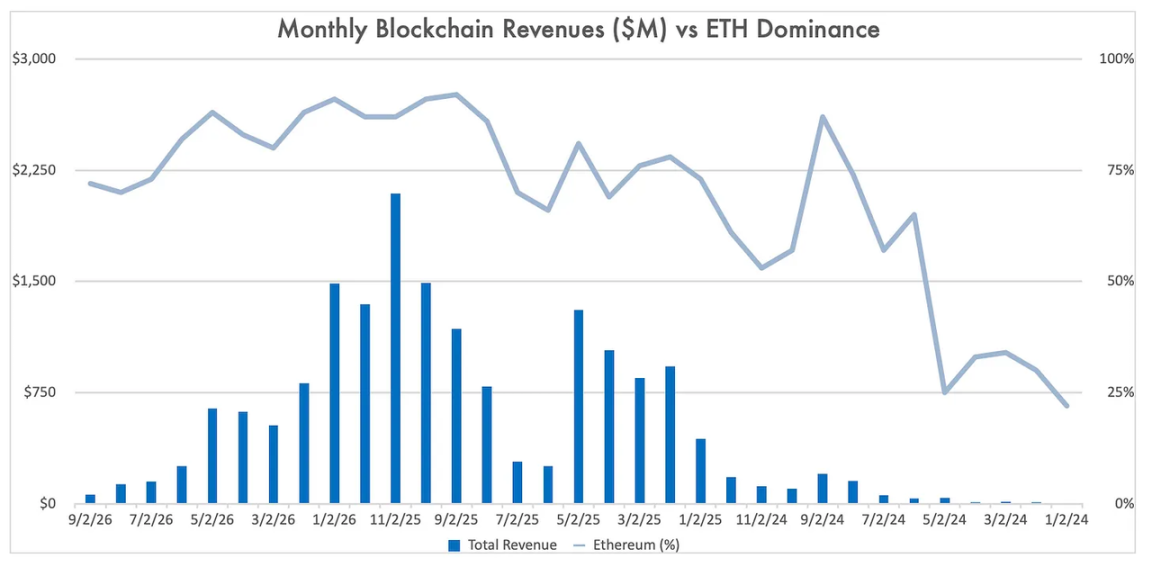
以太坊的 L2 扩展解决方案将对日常用户产生重要影响,同时我们也认识到由于竞争性区块链存在,我们在预计以太坊的主导地位十年后将从超过 80% 下降到非常保守的 60%,但我们仍然相信以太坊可能会保留更大的市场份额。

风险

监管威胁一直存在,包括从合理的最小审查到极端审查。也就是说监管明确性应该有利于采用率的大幅提高。

恶劣的宏观因素或加密市场系统性风险倾向于将流动性推向质押的 ETH,这被认为可以提供更好的风险调整后回报。因此整个 DeFi 的流动性可能会继续转向质押 ETH 提供的更安全收益,但这可能会在短期内挑战以太坊的生态系统。围绕流动性质押的创新可能会减轻这种压力。

随着竞争性区块链在去中心化、保障安全性后,优化速度和成本,他们可能会占据更大的市场份额。

我们仍然相信基于以太坊构建的扩展解决方案最终将为用户和项目提供更具吸引力的价值主张。

目前超过 60% 的 ETH 质押是通过 5 个平台和服务提供商完成的,其中 Lido 占据了总数的 30%。但 Lido 治理代币的所有权集中在可能受到审查的不到 10 个持有者身上。合并后以太坊在推动验证者去中心化方面还有大量工作要做。

参考资料

https://ultrasound.money/

https://tokenterminal.com/terminal/projects/ethereum

https://explore.flashbots.net/

https://beaconcha.in/charts/staked_ether

https://ethereum.org/en/upgrades/merge/issue/

https://dune.com/queries/877691

https://messari.io/asset/ethereum/charts/network-activity

https://etherscan.io/charts

https://www.mckinsey.com/industries/financial-services/our-insights/global-banking-annual-review

https://www.coinbase.com/institutional/research-insights/research/monthly-outlook/post-merge-metrics-october-2022


Trending Cryptos

Related Reads

Why Does No One Buy DeFi Insurance?

**Title: Why Isn't DeFi Insurance Being Bought?** DeFi insurance, which promised automated, unbiased payouts via smart contracts, has failed to gain traction. The core issue is economic: high premiums severely erode the yields that attract users to DeFi in the first place. For example, insuring a USDC deposit on Aave V3 could cost 1.5–2.5% of the annual yield, leaving a net return barely above a savings account. For riskier platforms like Maple Finance or Ethena, premiums can even turn net yields negative. Consequently, users often forgo insurance, as it nullifies their profit motive. The market also suffers from structural flaws. First, DeFi risks are highly correlated (e.g., an oracle failure can impact multiple protocols simultaneously), unlike the independent risks in traditional insurance. This makes large-scale events potentially catastrophic for insurers. Second, the total capital in DeFi insurance pools (e.g., Nexus Mutual's ~$81.5M) is minuscule compared to the hundreds of billions in total value locked (TVL), creating a massive capacity gap. A single major hack could drain the entire industry's reserves. Furthermore, the governance model where tokenholders vote on claims creates a conflict of interest, incentivizing them to deny payouts to protect their own funds. As a result, the sector is shrinking. While pioneers like Nexus Mutual are pivoting to preventative measures (bug bounties) and seeking external capital via reinsurance, the fundamental problems remain. DeFi insurance represents a public good—its stability benefits the entire ecosystem—but without a mechanism to share costs, a "tragedy of the commons" ensues where no one is willing to pay, leaving the system vulnerable.

marsbit16m ago

Why Does No One Buy DeFi Insurance?

marsbit16m ago

Trading

Spot
Futures

Hot Articles

What is $BITCOIN

DIGITAL GOLD ($BITCOIN): A Comprehensive Analysis Introduction to DIGITAL GOLD ($BITCOIN) DIGITAL GOLD ($BITCOIN) is a blockchain-based project operating on the Solana network, which aims to combine the characteristics of traditional precious metals with the innovation of decentralized technologies. While it shares a name with Bitcoin, often referred to as “digital gold” due to its perception as a store of value, DIGITAL GOLD is a separate token designed to create a unique ecosystem within the Web3 landscape. Its goal is to position itself as a viable alternative digital asset, although specifics regarding its applications and functionalities are still developing. What is DIGITAL GOLD ($BITCOIN)? DIGITAL GOLD ($BITCOIN) is a cryptocurrency token explicitly designed for use on the Solana blockchain. In contrast to Bitcoin, which provides a widely recognized value storage role, this token appears to focus on broader applications and characteristics. Notable aspects include: Blockchain Infrastructure: The token is built on the Solana blockchain, known for its capacity to handle high-speed and low-cost transactions. Supply Dynamics: DIGITAL GOLD has a maximum supply capped at 100 quadrillion tokens (100P $BITCOIN), although details regarding its circulating supply are currently undisclosed. Utility: While precise functionalities are not explicitly outlined, there are indications that the token could be utilized for various applications, potentially involving decentralized applications (dApps) or asset tokenization strategies. Who is the Creator of DIGITAL GOLD ($BITCOIN)? At present, the identity of the creators and development team behind DIGITAL GOLD ($BITCOIN) remains unknown. This situation is typical among many innovative projects within the blockchain space, particularly those aligning with decentralized finance and meme coin phenomena. While such anonymity may foster a community-driven culture, it intensifies concerns about governance and accountability. Who are the Investors of DIGITAL GOLD ($BITCOIN)? The available information indicates that DIGITAL GOLD ($BITCOIN) does not have any known institutional backers or prominent venture capital investments. The project seems to operate on a peer-to-peer model focused on community support and adoption rather than traditional funding routes. Its activity and liquidity are primarily situated on decentralized exchanges (DEXs), such as PumpSwap, rather than established centralized trading platforms, further highlighting its grassroots approach. How DIGITAL GOLD ($BITCOIN) Works The operational mechanics of DIGITAL GOLD ($BITCOIN) can be elaborated on based on its blockchain design and network attributes: Consensus Mechanism: By leveraging Solana’s unique proof-of-history (PoH) combined with a proof-of-stake (PoS) model, the project ensures efficient transaction validation contributing to the network's high performance. Tokenomics: While specific deflationary mechanisms have not been extensively detailed, the vast maximum token supply implies that it may cater to microtransactions or niche use cases that are still to be defined. Interoperability: There exists the potential for integration with Solana’s broader ecosystem, including various decentralized finance (DeFi) platforms. However, the details regarding specific integrations remain unspecified. Timeline of Key Events Here is a timeline that highlights significant milestones concerning DIGITAL GOLD ($BITCOIN): 2023: The initial deployment of the token occurs on the Solana blockchain, marked by its contract address. 2024: DIGITAL GOLD gains visibility as it becomes available for trading on decentralized exchanges like PumpSwap, allowing users to trade it against SOL. 2025: The project witnesses sporadic trading activity and potential interest in community-led engagements, although no noteworthy partnerships or technical advancements have been documented as of yet. Critical Analysis Strengths Scalability: The underlying Solana infrastructure supports high transaction volumes, which could enhance the utility of $BITCOIN in various transaction scenarios. Accessibility: The potential low trading price per token could attract retail investors, facilitating wider participation due to fractional ownership opportunities. Risks Lack of Transparency: The absence of publicly known backers, developers, or an audit process may yield skepticism regarding the project's sustainability and trustworthiness. Market Volatility: The trading activity is heavily reliant on speculative behavior, which can result in significant price volatility and uncertainty for investors. Conclusion DIGITAL GOLD ($BITCOIN) emerges as an intriguing yet ambiguous project within the rapidly evolving Solana ecosystem. While it attempts to leverage the “digital gold” narrative, its departure from Bitcoin's established role as a store of value underscores the need for a clearer differentiation of its intended utility and governance structure. Future acceptance and adoption will likely depend on addressing the current opacity and defining its operational and economic strategies more explicitly. Note: This report encompasses synthesised information available as of October 2023, and developments may have transpired beyond the research period.

431 Total ViewsPublished 2025.05.13Updated 2025.05.13

What is $BITCOIN

Discussions

Welcome to the HTX Community. Here, you can stay informed about the latest platform developments and gain access to professional market insights. Users' opinions on the price of BTC (BTC) are presented below.

活动图片