Why EOS Downward Trajectory In Last 30 Days May Not Hurt Its Coin

newsbtcPublished on 2022-10-26Last updated on 2022-10-26

Abstract

Since its all-time high on August 22, EOS has been steadily declining. The crypto market had crashed from March to June, but has since recovered. The market crisis has a lingering impact on modern investing.

Since its all-time high on August 22, EOS has been steadily declining. The crypto market had crashed from March to June, but has since recovered. The market crisis has a lingering impact on modern investing.

Coingecko reports that the token’s value has increased by 0.2% in the last 24 hours. Even on shorter time intervals, like the week or the biweek, the currency rose in value.

Nonetheless, these changes have done little to slow the downward trend. Investors and traders in EOS, though, may have reason to be optimistic.

The Stress Of September

As this is being written, EOS is being propped up by the $1.0055 area, which has slowed its decline since last month. The current price movement of the token is being influenced by the ongoing downturn.

The right side of the right triangle acts as a liquidity pool, and this is reflected in the coin’s price action as a XABCD harmonic pattern. As investors and traders buy the dip, demand is introduced, and the trend may turn bullish as a result.
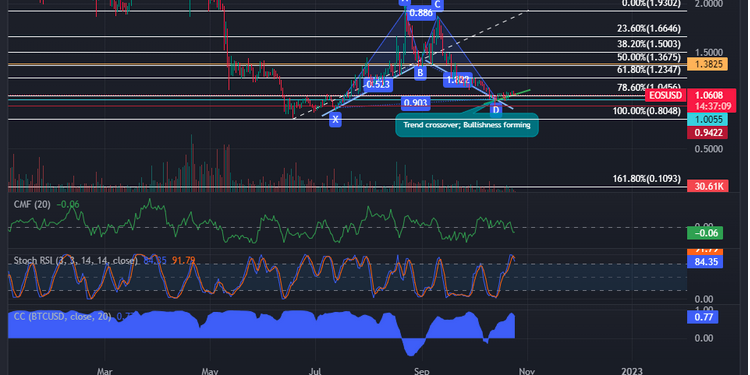
Meanwhile, the technicals also appear to be lacking. The CMF is currently negative, indicating that bears are in control of the market. This provides an undeniably formidable counterbalance to the potential bullish movement.

Immediate resistance at the 61.80 Fibonacci retracement level will be a challenging barrier to overcome.

Not Looking Good?

EOS’s predicament does not bode favorably for the alternative cryptocurrency. However, investors and traders can leverage a rising RSI, which indicates increased investor optimism.

Chaikin’s money flow index indicates that the token is gaining ground. The bears were rejected at the $0.9422 price range, which fits with the emerging upswing.

As of the time of writing, the Stoch RSI is on the overbought side of the indicator, indicating that the developing rally will be met by a market correction.

The EOS token is an excellent investment for traders and investors seeking to diversify their portfolios. Just last month, the cryptocurrency exchange PayBito added EOS to its list of tradable tokens, expanding EOS’s reach.

Investors should also be aware of the impact of macroeconomic conditions on EOS prices. The correlation between EOS and Bitcoin is 0.77, indicating a significant effect on EOS price fluctuations.
Trending Cryptos

Related Reads

US Calls for Restrictions on Sports Prediction Markets

The National Football League (NFL) has urged the U.S. Commodity Futures Trading Commission (CFTC) to tighten rules for prediction markets on sports events. In a July letter, the NFL argued that current proposals fail to adequately protect the integrity of games and market participants. Key demands include banning contracts on events easily manipulated by individuals (e.g., a kicker missing a field goal), clarifying definitions to prevent gambling-like contracts, and explicitly prohibiting trading based on non-public insider information. The league also called for restricted person lists, a ban on margin trading, advertising limits, stronger user protections, and a minimum age of 21. This push coincides with an ongoing jurisdictional dispute between the CFTC and several states. The CFTC claims exclusive federal oversight, classifying event contracts as swaps, while states argue these platforms violate local gambling laws. Recent legal actions in Michigan and Minnesota highlight the conflict, with a federal court temporarily blocking Minnesota from applying a new law to CFTC-registered platforms like Kalshi and Polymarket. Meanwhile, prediction markets are experiencing significant growth. In June, driven by events like the World Cup, Kalshi's trading volume exceeded $31 billion (85% from sports contracts), while Polymarket's global platform hit a monthly record of $10.8 billion. However, platforms face legal challenges, such as lawsuits from Kentucky accusing them of operating unlicensed sports betting disguised as prediction markets.

cryptonews.ru21m ago

US Calls for Restrictions on Sports Prediction Markets

cryptonews.ru21m ago

Peskov Says Russia Is Among Top Five Leaders in AI Race. What Do Global Rankings Say?

On July 27, 2026, Kremlin spokesman Dmitry Peskov stated that Russia remains among the top five countries in the global AI development race. He acknowledged Russian models still lag behind leading U.S. counterparts but claimed they have reached a "very high level," aiming to close the gap with "superhuman efforts." He highlighted the differing approaches of Russia's GigaChat, built from scratch, and Yandex, which initially used foreign technology. However, this claim is not supported by major international AI rankings. Stanford University's Global AI Vibrancy Tool (2024-25) ranks Russia 28th out of 36 countries. The top five are the U.S., China, India, South Korea, and the UK. The Stanford AI Index Report 2026 does not mention Russia's position, focusing instead on U.S. and Chinese leadership across various metrics like investments and model performance. In benchmarks, GigaChat ranks 25th on the Russian-language LM Arena. While it passed a financial analyst exam in December 2025, its business usage costs are reportedly tens to hundreds of times higher than China's DeepSeek. In related developments, President Putin signed a law on July 26, 2026, establishing a legal framework for sovereign AI models and granting developers access to state data. Previously, Russia joined 28 other nations, including China, to establish the World AI Cooperation Organization (WAICO) in Shanghai. The article notes that rankings vary due to different criteria, such as research, investment, infrastructure, or responsible AI governance. While Russian authorities are bolstering AI through legislation and international cooperation, independent analyses suggest the country faces significant challenges, including a hardware deficit for training models, which legal frameworks alone cannot resolve.

cryptonews.ru22m ago

Peskov Says Russia Is Among Top Five Leaders in AI Race. What Do Global Rankings Say?

cryptonews.ru22m ago

Trading

Spot

Hot Articles

What is $BITCOIN

DIGITAL GOLD ($BITCOIN): A Comprehensive Analysis Introduction to DIGITAL GOLD ($BITCOIN) DIGITAL GOLD ($BITCOIN) is a blockchain-based project operating on the Solana network, which aims to combine the characteristics of traditional precious metals with the innovation of decentralized technologies. While it shares a name with Bitcoin, often referred to as “digital gold” due to its perception as a store of value, DIGITAL GOLD is a separate token designed to create a unique ecosystem within the Web3 landscape. Its goal is to position itself as a viable alternative digital asset, although specifics regarding its applications and functionalities are still developing. What is DIGITAL GOLD ($BITCOIN)? DIGITAL GOLD ($BITCOIN) is a cryptocurrency token explicitly designed for use on the Solana blockchain. In contrast to Bitcoin, which provides a widely recognized value storage role, this token appears to focus on broader applications and characteristics. Notable aspects include: Blockchain Infrastructure: The token is built on the Solana blockchain, known for its capacity to handle high-speed and low-cost transactions. Supply Dynamics: DIGITAL GOLD has a maximum supply capped at 100 quadrillion tokens (100P $BITCOIN), although details regarding its circulating supply are currently undisclosed. Utility: While precise functionalities are not explicitly outlined, there are indications that the token could be utilized for various applications, potentially involving decentralized applications (dApps) or asset tokenization strategies. Who is the Creator of DIGITAL GOLD ($BITCOIN)? At present, the identity of the creators and development team behind DIGITAL GOLD ($BITCOIN) remains unknown. This situation is typical among many innovative projects within the blockchain space, particularly those aligning with decentralized finance and meme coin phenomena. While such anonymity may foster a community-driven culture, it intensifies concerns about governance and accountability. Who are the Investors of DIGITAL GOLD ($BITCOIN)? The available information indicates that DIGITAL GOLD ($BITCOIN) does not have any known institutional backers or prominent venture capital investments. The project seems to operate on a peer-to-peer model focused on community support and adoption rather than traditional funding routes. Its activity and liquidity are primarily situated on decentralized exchanges (DEXs), such as PumpSwap, rather than established centralized trading platforms, further highlighting its grassroots approach. How DIGITAL GOLD ($BITCOIN) Works The operational mechanics of DIGITAL GOLD ($BITCOIN) can be elaborated on based on its blockchain design and network attributes: Consensus Mechanism: By leveraging Solana’s unique proof-of-history (PoH) combined with a proof-of-stake (PoS) model, the project ensures efficient transaction validation contributing to the network's high performance. Tokenomics: While specific deflationary mechanisms have not been extensively detailed, the vast maximum token supply implies that it may cater to microtransactions or niche use cases that are still to be defined. Interoperability: There exists the potential for integration with Solana’s broader ecosystem, including various decentralized finance (DeFi) platforms. However, the details regarding specific integrations remain unspecified. Timeline of Key Events Here is a timeline that highlights significant milestones concerning DIGITAL GOLD ($BITCOIN): 2023: The initial deployment of the token occurs on the Solana blockchain, marked by its contract address. 2024: DIGITAL GOLD gains visibility as it becomes available for trading on decentralized exchanges like PumpSwap, allowing users to trade it against SOL. 2025: The project witnesses sporadic trading activity and potential interest in community-led engagements, although no noteworthy partnerships or technical advancements have been documented as of yet. Critical Analysis Strengths Scalability: The underlying Solana infrastructure supports high transaction volumes, which could enhance the utility of $BITCOIN in various transaction scenarios. Accessibility: The potential low trading price per token could attract retail investors, facilitating wider participation due to fractional ownership opportunities. Risks Lack of Transparency: The absence of publicly known backers, developers, or an audit process may yield skepticism regarding the project's sustainability and trustworthiness. Market Volatility: The trading activity is heavily reliant on speculative behavior, which can result in significant price volatility and uncertainty for investors. Conclusion DIGITAL GOLD ($BITCOIN) emerges as an intriguing yet ambiguous project within the rapidly evolving Solana ecosystem. While it attempts to leverage the “digital gold” narrative, its departure from Bitcoin's established role as a store of value underscores the need for a clearer differentiation of its intended utility and governance structure. Future acceptance and adoption will likely depend on addressing the current opacity and defining its operational and economic strategies more explicitly. Note: This report encompasses synthesised information available as of October 2023, and developments may have transpired beyond the research period.

1.1k Total ViewsPublished 2025.05.13Updated 2025.05.13

What is $BITCOIN

Discussions

Welcome to the HTX Community. Here, you can stay informed about the latest platform developments and gain access to professional market insights. Users' opinions on the price of BTC (BTC) are presented below.

活动图片