Massive Crypto Market Recovery Is Ahead, According to This Indicator

u.todayPublished on 2022-10-13Last updated on 2022-10-13

Abstract

According to on-chain insights, providers, whales and sharks are adding back some of the USDT they redistributed on the market.

The recovery of the cryptocurrency market is a long-awaited event that will finally drag the digital asset industry back to the green zone and make it profitable once again. Santiment has shared a sign of an upcoming recovery.

USDT returning to market
According to on-chain insights, providers, whales and sharks are adding back some of the USDT they redistributed on the market. As the supply returns to whales' addresses, we are seeing a slight recovery of the first cryptocurrency.
Historically, Bitcoin and USDT have been showing a strong correlation to each other. With the growth of the USDT supply on whale addresses, Bitcoin has been entering an uptrend, which is why the current increase of the supply on addresses is considered a bullish sign by Santiment.
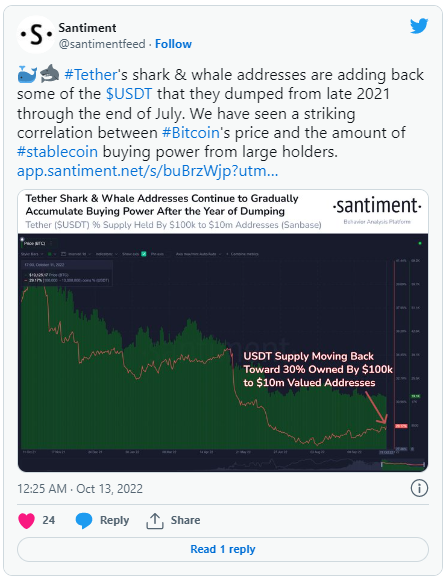

The rise of the stablecoin supply on the market is always considered a rise in the buying power of market participants as stable crypto assets cannot be used in any other way but gaining exposure to more volatile assets like Bitcoin, Ethereum and others.
Unfortunately, the currency USDT supply is nowhere near the values we saw prior to the plunge that happened in late 2021. The recovery of those values will most likely take months of accumulation.
In terms of price performance, Bitcoin has not been showing any positivity on the market since September, when the price of the first cryptocurrency rallied above $20,000. A variety of macro-financial events this week most likely creates pressure on risky assets like BTC and cryptocurrencies in general, which is why a fast-paced recovery is not likely to happen.

Trending Cryptos

Related Reads

Fed Turns Hawkish, Wall Street Capitulates, Citi Stands as 'Last Holdout': Insists on Resuming Rate Cuts in October

Amid a surprisingly hawkish shift from the Fed and most of Wall Street capitulating on rate cut expectations, Citigroup stands as a notable outlier, holding firm to its forecast for monetary easing to restart this October. Following the June FOMC meeting, where the "dovish bias" was removed and the dot plot shifted dramatically, markets priced in nearly 37bps of tightening for 2026. Major banks like Deutsche Bank and Goldman Sachs revised their calls, predicting rate hikes as soon as September. Citigroup, however, maintains a baseline scenario for a 25bps rate cut in October, followed by two more cuts in December and January 2027. Its counter-consensus view rests on three key arguments: 1) Plunging oil prices are eliminating a major inflation upside risk. 2) Rising initial jobless claims are mirroring seasonal weakening patterns seen in 2024-2025, signaling a labor market cool-down. 3) The strong core PCE is an "outlier," heavily influenced by AI-related prices and equity market gains rather than broad consumer price pressures, with other inflation metrics showing more moderation. While Wall Street largely "surrenders" to the hawkish Fed narrative, with Deutsche Bank forecasting two hikes and Goldman Sachs warning of potential back-to-back moves, Citigroup remains the "last holdout," betting that disinflationary forces will pave the way for cuts before year-end.

marsbit2m ago

Fed Turns Hawkish, Wall Street Capitulates, Citi Stands as 'Last Holdout': Insists on Resuming Rate Cuts in October

marsbit2m ago

Open Systems Will Ultimately Prevail: Why Ethereum Is the Next Linux?

The article "Open Systems Will Ultimately Prevail: Why Ethereum Is the Next Linux?" argues that Ethereum, like Linux before it, will triumph over closed, proprietary systems in finance due to its open, permissionless, and credibly neutral nature. It draws a historical parallel: just as the open internet defeated corporate private networks and Linux outcompeted proprietary Unix systems, open financial infrastructure like Ethereum will surpass private blockchains. The core advantage lies in the "bazaar" development model (as described in Eric Raymond's "The Cathedral and the Bazaar"), where decentralized, permissionless innovation by a global community of developers outpaces the controlled "cathedral" approach of centralized entities. This model fosters rapid innovation, as seen with Ethereum standards like ERC-20 and applications like Uniswap, which were built without needing permission. Ethereum's key, irreplicable strength is its credible neutrality: transparent, equally applicable, immutable rules that allow anyone to participate. This ensures sovereign independence, meaning no single entity (company, government) can control or change its core rules—a critical feature for global financial infrastructure. In contrast, private blockchains and consortium chains (like SWIFT or various bank-led projects) suffer from platform risk, central control, and an inability to attract broad developer ecosystems, leading to frequent failures. The article notes that major institutions (e.g., BlackRock, JPMorgan, Coinbase, Robinhood) are already building on Ethereum or its Layer 2 networks, recognizing its security, developer ecosystem, and network effects. While critics argue finance requires accountable, controlled systems, the response is that compliance (KYC, regulations) can be built at the application layer on top of a neutral settlement layer like Ethereum, just as secure commerce was built on the open internet via HTTPS. Ultimately, the thesis is that attempting to build walled-garden, proprietary financial networks is a flawed strategy that stifles innovation. The winning approach is to build applications on top of open, credibly neutral infrastructure like Ethereum, which is poised to become the foundational settlement layer for global finance.

Foresight News13m ago

Open Systems Will Ultimately Prevail: Why Ethereum Is the Next Linux?

Foresight News13m ago

The Computing Power Dilemma in the Sino-US AI Rivalry

The Sino-US AI rivalry faces a fundamental bottleneck: the widening compute power gap. While Chinese AI chip companies have seen investment surges, their current focus remains largely on the less demanding inference market. The real challenge lies in the high-end training chip sector, crucial for developing cutting-edge large language models (LLMs), where Nvidia holds a near-monopoly. The compute disparity is stark. US tech giants like Meta, Google, and xAI command massive GPU clusters, enabling them to train trillion-parameter models rapidly. Estimates suggest US data center count and total compute capacity significantly outstrip China's. This "brute force" advantage allows for faster model iteration and exploration of larger parameter scales, with top US models reportedly leading their Chinese counterparts by 8 to 15 months. Chinese alternatives, such as Huawei's Ascend and others from companies like Moore Thread and Biren, are emerging. They show promise in inference and some training scenarios, closing the performance gap with mid-range Nvidia products. However, the core hurdle extends beyond raw chip performance to the entrenched software ecosystem, exemplified by Nvidia's CUDA platform. The path forward involves "walking on two legs": navigating import restrictions while heavily investing in the domestic chip industry. Though still in a catch-up phase, China's vast market, talent pool, and capital are fostering progress. The ultimate test is whether Chinese firms can build a competitive hardware-software ecosystem to power the next generation of AI.

marsbit19m ago

The Computing Power Dilemma in the Sino-US AI Rivalry

marsbit19m ago

He Kaiming's Team's New Work: After Deleting VAE and Private Data, Text-to-Image Generation Becomes Even Stronger

KaiMing He's team introduces **MiniT2I**, a minimalist text-to-image (T2I) model that challenges the complexity of mainstream approaches. It eliminates components commonly considered essential: the VAE encoder-decoder, AdaLN conditioning mechanisms, auxiliary losses, private training data, and post-training alignment stages like RL/DPO. Instead, it uses a pure flow-matching objective trained directly on RGB pixels. The model employs a simplified **MM-JiT** Transformer architecture. It removes AdaLN blocks for conditioning and instead prepends two lightweight text adapter blocks to a standard pre-norm Transformer, allowing frozen T5 text features to adapt to the denoiser. Training follows a two-stage, LLM-like paradigm using only public datasets: pre-training on LLaVA-recaptioned CC12M for coverage, followed by fine-tuning on ~120k high-quality image-text pairs. With just 258M parameters (B/16), MiniT2I achieves competitive scores (0.87 on GenEval, 84.2 on DPG-Bench), outperforming larger pixel-space models. Scaling to 912M parameters (L/16) yields results comparable to SD3-Medium (~2B parameters) in style, composition, and imagination, though it lags in text rendering and named entities due to public data limitations. Key advantages include lower computational cost (~570 GFLOPs vs. ~1379 for latent models) and architectural simplicity. Acknowledged limitations include patch boundary artifacts in pixel space, side effects of high CFG scales, resolution ceilings for sequences longer than 1024 tokens, and the aforementioned data bottlenecks. The work demonstrates that high-performance T2I generation is possible with a radically simplified, publicly reproducible baseline.

marsbit24m ago

He Kaiming's Team's New Work: After Deleting VAE and Private Data, Text-to-Image Generation Becomes Even Stronger

marsbit24m ago

Trading

Spot
Futures

Hot Articles

What is $BITCOIN

DIGITAL GOLD ($BITCOIN): A Comprehensive Analysis Introduction to DIGITAL GOLD ($BITCOIN) DIGITAL GOLD ($BITCOIN) is a blockchain-based project operating on the Solana network, which aims to combine the characteristics of traditional precious metals with the innovation of decentralized technologies. While it shares a name with Bitcoin, often referred to as “digital gold” due to its perception as a store of value, DIGITAL GOLD is a separate token designed to create a unique ecosystem within the Web3 landscape. Its goal is to position itself as a viable alternative digital asset, although specifics regarding its applications and functionalities are still developing. What is DIGITAL GOLD ($BITCOIN)? DIGITAL GOLD ($BITCOIN) is a cryptocurrency token explicitly designed for use on the Solana blockchain. In contrast to Bitcoin, which provides a widely recognized value storage role, this token appears to focus on broader applications and characteristics. Notable aspects include: Blockchain Infrastructure: The token is built on the Solana blockchain, known for its capacity to handle high-speed and low-cost transactions. Supply Dynamics: DIGITAL GOLD has a maximum supply capped at 100 quadrillion tokens (100P $BITCOIN), although details regarding its circulating supply are currently undisclosed. Utility: While precise functionalities are not explicitly outlined, there are indications that the token could be utilized for various applications, potentially involving decentralized applications (dApps) or asset tokenization strategies. Who is the Creator of DIGITAL GOLD ($BITCOIN)? At present, the identity of the creators and development team behind DIGITAL GOLD ($BITCOIN) remains unknown. This situation is typical among many innovative projects within the blockchain space, particularly those aligning with decentralized finance and meme coin phenomena. While such anonymity may foster a community-driven culture, it intensifies concerns about governance and accountability. Who are the Investors of DIGITAL GOLD ($BITCOIN)? The available information indicates that DIGITAL GOLD ($BITCOIN) does not have any known institutional backers or prominent venture capital investments. The project seems to operate on a peer-to-peer model focused on community support and adoption rather than traditional funding routes. Its activity and liquidity are primarily situated on decentralized exchanges (DEXs), such as PumpSwap, rather than established centralized trading platforms, further highlighting its grassroots approach. How DIGITAL GOLD ($BITCOIN) Works The operational mechanics of DIGITAL GOLD ($BITCOIN) can be elaborated on based on its blockchain design and network attributes: Consensus Mechanism: By leveraging Solana’s unique proof-of-history (PoH) combined with a proof-of-stake (PoS) model, the project ensures efficient transaction validation contributing to the network's high performance. Tokenomics: While specific deflationary mechanisms have not been extensively detailed, the vast maximum token supply implies that it may cater to microtransactions or niche use cases that are still to be defined. Interoperability: There exists the potential for integration with Solana’s broader ecosystem, including various decentralized finance (DeFi) platforms. However, the details regarding specific integrations remain unspecified. Timeline of Key Events Here is a timeline that highlights significant milestones concerning DIGITAL GOLD ($BITCOIN): 2023: The initial deployment of the token occurs on the Solana blockchain, marked by its contract address. 2024: DIGITAL GOLD gains visibility as it becomes available for trading on decentralized exchanges like PumpSwap, allowing users to trade it against SOL. 2025: The project witnesses sporadic trading activity and potential interest in community-led engagements, although no noteworthy partnerships or technical advancements have been documented as of yet. Critical Analysis Strengths Scalability: The underlying Solana infrastructure supports high transaction volumes, which could enhance the utility of $BITCOIN in various transaction scenarios. Accessibility: The potential low trading price per token could attract retail investors, facilitating wider participation due to fractional ownership opportunities. Risks Lack of Transparency: The absence of publicly known backers, developers, or an audit process may yield skepticism regarding the project's sustainability and trustworthiness. Market Volatility: The trading activity is heavily reliant on speculative behavior, which can result in significant price volatility and uncertainty for investors. Conclusion DIGITAL GOLD ($BITCOIN) emerges as an intriguing yet ambiguous project within the rapidly evolving Solana ecosystem. While it attempts to leverage the “digital gold” narrative, its departure from Bitcoin's established role as a store of value underscores the need for a clearer differentiation of its intended utility and governance structure. Future acceptance and adoption will likely depend on addressing the current opacity and defining its operational and economic strategies more explicitly. Note: This report encompasses synthesised information available as of October 2023, and developments may have transpired beyond the research period.

418 Total ViewsPublished 2025.05.13Updated 2025.05.13

What is $BITCOIN

Discussions

Welcome to the HTX Community. Here, you can stay informed about the latest platform developments and gain access to professional market insights. Users' opinions on the price of BTC (BTC) are presented below.

活动图片