数据详解 Arbitrum 二季度网络状况

NansenPublished on 2022-10-13Last updated on 2022-10-13

Abstract

Arbitrum 是一个 Optimistic rollup,是以太坊区块链的众多扩展解决方案之一。

概况

Optimistic Rollups

Arbitrum 是一个 Optimistic rollup,是以太坊区块链的众多扩展解决方案之一。 Optimistic Rollups 假设验证者没有恶意并且交易正确发布。 为确保断言有效,任何人都可以在大约一周的时间内质疑交易索赔的有效性。 然后将争议缩小到单行指令并在 L1 链上执行以验证正确性。 欺诈节点将被削减其质押份额,其部分将分配给挑战的获胜者。 提供不正确状态转换证据的过程称为欺诈证明。 这是像 Arbitrum 这样的 Optimistic rollup 工作原理的基础,它减少了主 L1 链上的工作量,因为并非所有交易都需要重新执行,并激励节点表现良好。

生态系统 Ecosystem

Arbitrum 拥有一个动态的 dApp 和工具生态系统,可以在 Arbitrum One Portal 目录中查看。 自 2022 年 8 月 12 日起,Tracer DAO 更名为 Mycelium。

随着 Arbitrum Nitro 即将推出,开发人员可以期待通过使用 Geth 而不是定制设计的语言 Arbitrum 虚拟机 (AVM) 来获得更无缝的体验。 该团队预计链上的吞吐量会增加,同时费用会降低,从而允许更多团队进一步构建当前的生态系统。

关键进展:2022 Q2

Arbitrum Nitro

2022 年 7 月 16 日,Offchain Labs 发布了一份关于在下个月成功迁移 Rinkeby 测试网后将 Arbitrum One 升级到 Nitro 技术堆栈的报告。

Arbitrum Nitro 对当前 AVM 架构和 ArbOS 进行了一些更改。

流行的 WebAssembly (WASM) 架构将取代旧的、定制设计的 AVM 架构。

定制的 EVM 模拟器也将被 Geth 取代,Geth 是运行以太坊节点的最流行的软件客户端之一。

最后,ArbOS 将缩小尺寸并用 Go 重写,从而为交易提供更优化的批处理和压缩系统。

随着 Nitro 的这些升级,Arbitrum 团队预计吞吐量会提高 7 倍,同时费用也会显着降低。

Arbitrum Odyssey

Arbitrum Odyssey 宣布与 Project Galaxy(一个 web3 凭证数据网络)以及插画家 Ratwell 和 Sugoi 合作。

这是通过 Arbitrum 生态系统进行的互动探索,用户将在其中执行多项链上任务,并在 Arbitrum 链上的各种 dApp 中导航以获得一些独家 NFT。

该计划计划运行九周,最终形成最终的 Arbi NFT; 但是,Arbitrum Odyssey 已暂停并等待 Nitro 升级在主网上上线。 根据这条推文,到目前为止已完成任务的用户仍将在整个旅程中保持进度。

Arbitrum Nova – AnyTrust 链

AnyTrust 技术基于通过数据可用性委员会确保的最小信任假设。 该委员会将负责管理链下交易数据并提供该数据支持批次。

为批量交易签署数据可用性证书 (DACerts) 并发布此 DACert 而不是所有交易导致 L1 链上的存储需求更小,交易费用更便宜。

DACert 也将是委员会负责根据要求提供批次数据的声明。

如果委员会无法达成共识,该链将恢复为 Arbitrum 汇总协议。

数据执行将在 L2 链上执行,经过一段充满挑战的时期后,新的汇总状态将在以太坊上得到确认。

与基于 Arbitrum Rollup 技术构建 Arbitrum One 的方式类似,Arbitrum Nova 是建立在 AnyTrust 技术基础上的新链,将与 Nitro 一起推出。 它与 EVM 完全兼容,并且在任一链上的开发都将尽可能无缝。

它更适合对成本敏感的游戏和社交应用程序,这些应用程序的交易量和频率更高。

Nansen 链上数据

日交易数量
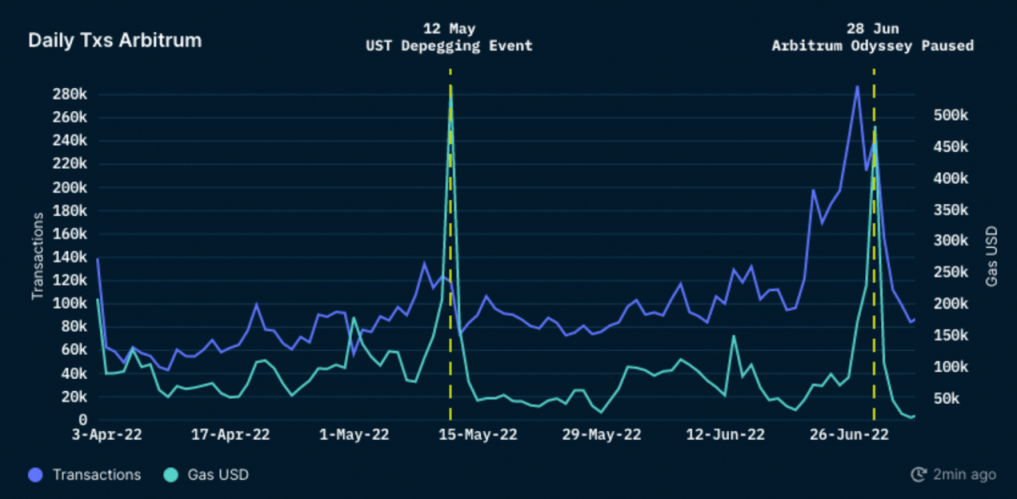
Arbitrum 上的交易量一直保持在每天 4 万至 10 万笔交易的范围内,从 6 月 26 日到 6 月 28 日出现了急剧上升趋势。Arbitrum 上的 Gas 也遵循了类似的模式。 在 5 月 12 日的 UST 脱钩事件中,gas 急剧增加,而交易量下降。 相比之下,6 月 28 日的第二次 gas 峰值相应增加了交易数量,这可能是由于 Arbitrum Odyssey 在 2022 年第二季度末暂停,以便从他们最近的推文中整合 Nitro 升级。

日交易数量 VS 以太坊
Source: Nansen

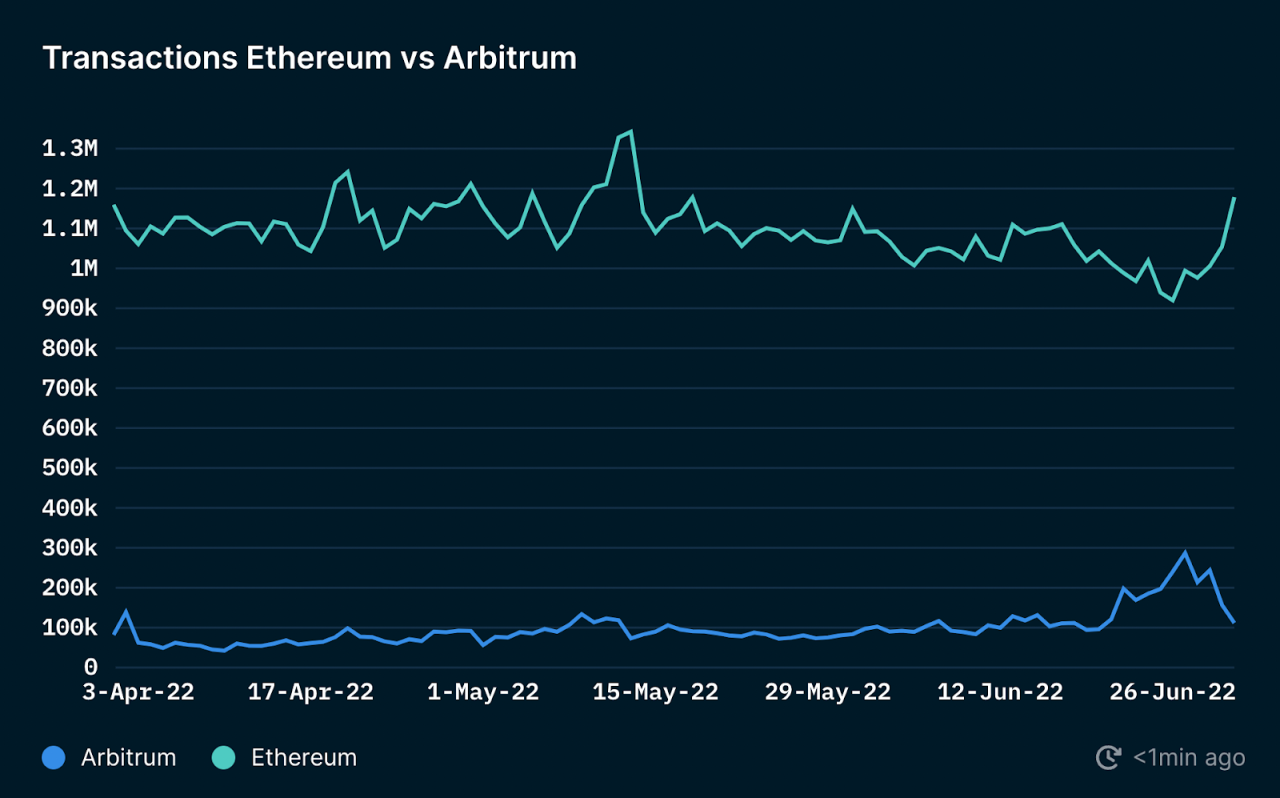
将交易数量与以太坊的交易数量进行比较,以太坊的交易量较高,但两条链的交易量均呈横向波动,Arbitrum 和以太坊分别徘徊在 100k - 200k 和 1m - 1.2m 之间。 有趣的是,在 6 月 19 日至 6 月 28 日期间,以太坊上的交易量下降,而 Arbitrum 上的交易量增加,与 Arbitrum Odyssey 同期。 这可能是在 Nitro 升级后 Arbitrum Odyssey 何时恢复的一个机会。

在 Arbitrum 上的聪明钱
Source: Nansen

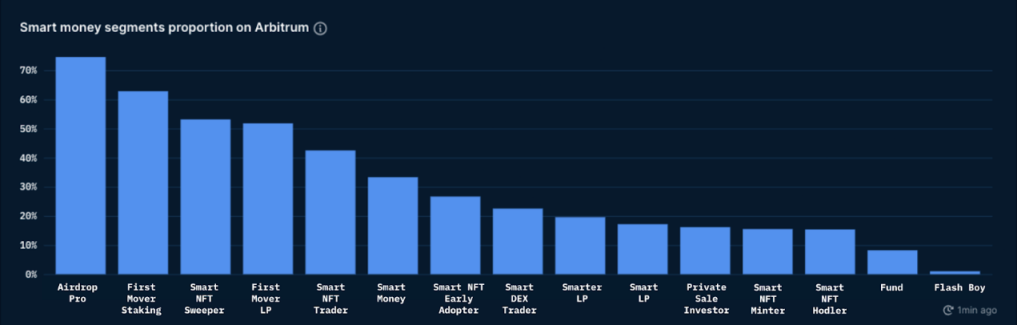
跟进在以太坊上被标记为 Smart Money 的地址,此图表还显示了此类地址在 Arbitrum 上的比例。 迄今为止,Airdrop Pro 标签的重叠地址比例最高,这表明许多钱包可能正在等待 Arbitrum 追随今年早些时候发布其原生代币的 Optimism 的脚步。

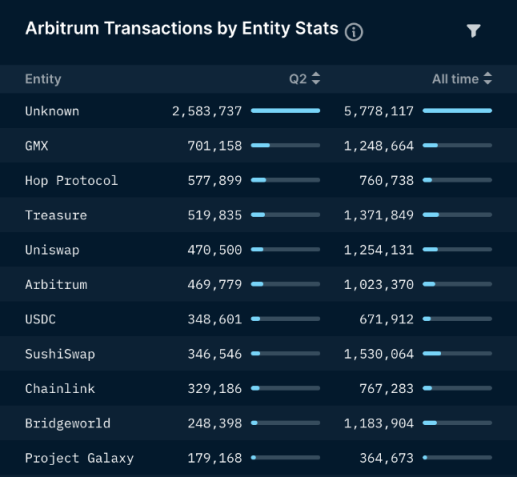
按用户数量和交易数的 Top 项目方
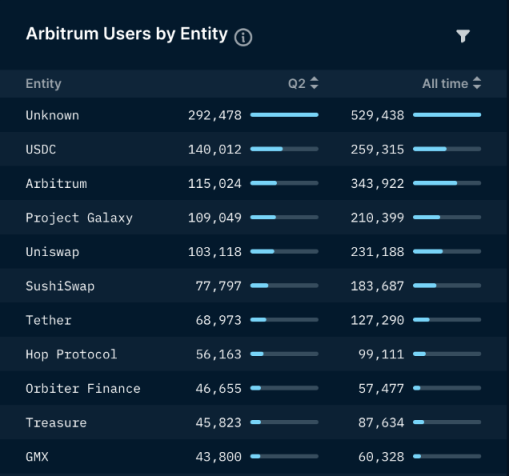
除了 Smart Money,我们还可以使用 Nansen 标签来根据 Arbitrum 上的用户数量和交易数量来分析正在与之交互的顶级项目方。 此处显示的许多项目方都是 Arbitrum Odyssey 的一部分,并且可能表明该活动在引导用户与 Arbitrum 生态系统中提供的 dApp 进行交互方面的有效性。 除了 Swap 交易和跨链桥之外,GMX 和 Treasure 作为有趣的项目脱颖而出,为 Arbitrum 的交易量做出了贡献。 最后,顶部列出的「未知」是指所有未标记实体的总和,而不是单个未知项目方。

Arbitrum 上知名项目方

GMX

GMX 是一个去中心化的现货和永久交易所,提供低掉期费用和零价格影响交易。 交易由一个多资产池支持,该池从做市、杠杆交易和掉期费用中赚取费用。 它的定价得到了 Chainlink 预言机以及主要交易所的汇总价格的支持。

GMX 被纳入 Arbitrum Odyssey 以及对质押者和流动性提供者的强烈激励,使得 GMX 的交易量和关注度都有所增加。

此外,由于在 Avalanche 和 Arbitrum 这两条链上都部署了 GMX,GMX 能够进入不同的社区并利用两条链的低费用。

Treasury

Treasure 是 Arbitrum 上一个元宇宙项目为中心的去中心化 NFT 生态系统。 列出的每个项目都在各自的生态系统中使用代币 MAGIC,这是 Treasure 的原生代币,充满了传说和社区。

Trove 是一个围绕 Treasure 生态系统构建的 NFT 市场,扩展了 Treasure 的知名品牌,并正式推出了其 alpha 版本,它体现了从艺术、摄影和音乐等更广泛的 NFT。

Trove 还旨在通过创建一个「游戏世界」来游戏化市场体验,让收藏家和建设者通过他们的资产、社区和共享体验自由表达。

结论

尽管市场情绪低迷,Arbitrum 团队还是能够通过 Arbitrum Odyssey 与用户互动,探索其充满活力的生态系统,并在此过程中奖励他们。 再加上 Nitro 和 Nova 即将进行的基础设施升级,Arbitrum 巩固了其作为开发者游乐场的地位,并展示了其作为以太坊链扩展解决方案的潜力,具有更高的吞吐量和更低的费用。


Trending Cryptos

Related Reads

Chip Stocks Lead U.S. Market Decline: Is AI Trading Being Hit by Both Interest Rates and Returns?

Chip stocks led a broad decline in US markets, with the Nasdaq dropping 2.2% and the S&P 500 falling 1.4%. This selloff reflects a dual challenge for the once-high-flying AI hardware trade: rising interest rate expectations and growing investor impatience for clear returns from massive AI capital expenditures. The pressure was most acute on hardware leaders. Nvidia fell about 4%, dipping below a $5 trillion market cap, while Micron plunged 13.2% ahead of its earnings report. Declines across memory, storage, AI, and mobile chips indicated a sector-wide retreat. The selloff spread globally, with South Korea's KOSPI index dropping nearly 10% as key suppliers SK Hynix and Samsung recorded double-digit losses. Investors appeared to be taking profits from the most crowded trades first. Macro headwinds intensified as market expectations shifted toward a more aggressive Federal Reserve. Forecasts for multiple rate hikes in 2026 pressured high-valuation tech stocks, which rely on long-term growth projections that become less attractive as discount rates rise. Concurrently, investors are scrutinizing the profit potential of the immense AI spending by cloud giants like Alphabet, Amazon, and Meta. While these expenditures drive demand for chips and hardware, the market is now questioning whether AI services will generate sufficient returns to justify the ongoing costs. This adjustment is not necessarily a bubble burst but a recalibration. AI demand fundamentals remain, but the narrative of endless growth can no longer fully offset concerns over higher interest rates and a longer path to profitability. Near-term direction may hinge on Micron's upcoming earnings guidance and incoming inflation data, which will influence both the AI demand outlook and the Fed's policy path. The market is transitioning from blindly buying growth to demanding clearer visibility on returns.

marsbit55m ago

Chip Stocks Lead U.S. Market Decline: Is AI Trading Being Hit by Both Interest Rates and Returns?

marsbit55m ago

OpenAI's New Paper: How to Train an AI that "Doesn't Deteriorate Under Pressure"?

OpenAI's new paper "Reinforcement Learning Towards Broadly and Persistently Beneficial Models" explores training AI to maintain safe, helpful, and honest behavior even under pressure, in unseen scenarios, or after being fine-tuned for harmful purposes. Moving beyond simple rule-based "don'ts," the research focuses on cultivating "beneficial traits" like honesty, risk-awareness, corrigibility, and transparency. It investigates if reinforcement learning (RL), often prone to "reward hacking" where models exploit loopholes, can instead be used to instill robust, generalized positive behaviors. Researchers created a multi-domain synthetic dialogue dataset covering areas like healthcare and law. They trained a model by replacing 5% of standard RL data with "beneficial trait" data. This model outperformed the baseline in 83% of 53 evaluations, showing average gains of 9.1% in alignment, safety, and helpfulness. Crucially, improvements generalized: a model trained only on healthcare "good behavior" data also performed better in 17 out of 19 non-healthcare alignment tests. The paper also tests "alignment persistence." When subjected to adversarial prompts or harmful fine-tuning, the beneficial trait model showed greater resilience, with smaller performance drops and less "spillover" of bad behavior to unrelated tasks. While not a complete solution, this work suggests a shift from post-hoc correction to proactively shaping robust, principled AI behavior, a critical step for deploying models in high-stakes, complex decision-making scenarios.

marsbit58m ago

OpenAI's New Paper: How to Train an AI that "Doesn't Deteriorate Under Pressure"?

marsbit58m ago

Semiconductor Stock Rebound: Is the Technical Correction Over or a Trend Reversal?

The core of recent semiconductor stock volatility is not about daily price swings, but rather the market questioning whether AI-driven semiconductor pricing has entered a new phase. Following a sharp sell-off in Korean stocks on June 23rd, led by Samsung and SK Hynix, a subsequent rebound is seen more as a technical positioning adjustment rather than a confirmed trend reversal. The key variable is HBM (High Bandwidth Memory), essential for AI chips. Its supply-demand imbalance granted memory makers significant pricing power. The current market focus is on whether this dynamic remains strong enough to justify elevated valuations. All eyes are on Micron's upcoming earnings report. The critical factor is not whether results meet already high expectations, but whether the company's guidance confirms that AI memory pricing power, order visibility, and future margins are still expanding. Micron's outlook will serve as a crucial test for the broader AI semiconductor chain, including Samsung, SK Hynix, and other infrastructure players. The recent bounce appears to be a pre-earnings positioning repair. For it to evolve into a sustained uptrend, concrete evidence is needed that the AI infrastructure expansion cycle's fundamentals—particularly for high-end memory—remain robust and can continue to surpass elevated market expectations. The risk is that strong demand alone may not be sufficient if future guidance hints at peaking momentum or increasing supply-side pressures.

marsbit1h ago

Semiconductor Stock Rebound: Is the Technical Correction Over or a Trend Reversal?

marsbit1h ago

Trading

Spot
Futures

Hot Articles

How to Buy NFT

Welcome to HTX.com! We've made purchasing AINFT (NFT) simple and convenient. Follow our step-by-step guide to embark on your crypto journey.Step 1: Create Your HTX AccountUse your email or phone number to sign up for a free account on HTX. Experience a hassle-free registration journey and unlock all features.Get My AccountStep 2: Go to Buy Crypto and Choose Your Payment MethodCredit/Debit Card: Use your Visa or Mastercard to buy AINFT (NFT) instantly.Balance: Use funds from your HTX account balance to trade seamlessly.Third Parties: We've added popular payment methods such as Google Pay and Apple Pay to enhance convenience.P2P: Trade directly with other users on HTX.Over-the-Counter (OTC): We offer tailor-made services and competitive exchange rates for traders.Step 3: Store Your AINFT (NFT)After purchasing your AINFT (NFT), store it in your HTX account. Alternatively, you can send it elsewhere via blockchain transfer or use it to trade other cryptocurrencies.Step 4: Trade AINFT (NFT)Easily trade AINFT (NFT) on HTX's spot market. Simply access your account, select your trading pair, execute your trades, and monitor in real-time. We offer a user-friendly experience for both beginners and seasoned traders.

7.1k Total ViewsPublished 2024.03.29Updated 2026.06.02

How to Buy NFT

What is Altura NFT?

Altura: Providing One-Stop NFT Solutions for Game Developers

56.0k Total ViewsPublished 2024.06.12Updated 2024.06.12

What is Altura NFT?

What is AINFT

EternaFi Agents and $AINFT: A Comprehensive Analysis of AI-Powered NFT Infrastructure in the Web3 Ecosystem The intersection of artificial intelligence (AI) and blockchain technology is rapidly evolving, establishing innovative platforms that redefine ownership models and economic participation. EternaFi Agents, along with its native token $AINFT, exemplifies a groundbreaking approach to the tokenization of AI infrastructures through the means of non-fungible tokens (NFTs). Launched in July 2025 by the development team at Nova Club, EternaFi merges the advancements of AI with the decentralized financial mechanisms of blockchain, presenting a unique investment opportunity for participants within the web3 ecosystem. This article aims to provide an in-depth assessment of EternaFi Agents, covering its core components, functionality, and significance within the crypto landscape. Introduction and Project Overview EternaFi Agents stands as a salient example of how blockchain technology can democratize access to advanced AI capabilities. The project endeavors to reshape the paradigm of AI ownership by diversifying economic participation, making sophisticated AI systems accessible to a larger pool of stakeholders. At its core, the project tokenizes a proprietary large language model (LLM) developed by Nova Club, allowing NFT holders to gain fractional exposure to the model's economic performance. By utilizing NFTs representing stakes in the LLM, EternaFi Agents fosters a model wherein stakeholders not only participate in AI service consumption but also enjoy sharing in the economic rewards generated by the platform. This transformative approach enables the development of sustainable revenue models for AI services, all the while promoting broad community engagement and facilitating transparent governance. What is EternaFi Agents? EternaFi Agents represents an AI-NFT infrastructure project that aims to blend the capabilities of AI with blockchain technology in a coherent ecosystem. The essential feature of this project is the creation of NFTs that serve as financial instruments, representing fractions of ownership in Nova Club's proprietary AI infrastructure. Each NFT symbolizes direct exposure to the economic performance of the underlying AI system, providing a lucrative opportunity for investors. The project operates on the Base blockchain, known for its scalability and efficiency, thus ensuring manageable transaction costs while facilitating a seamless operational experience. One of the notable features includes a revenue-sharing mechanism, wherein NFT holders can receive portions of subscription income generated by the AI services provided on the platform. This innovative approach establishes a connection between the success of the AI services and the economic dividends distributed among the holders, thus ensuring an alignment of interests across the community. Who is the Creator of EternaFi Agents? The creative force behind EternaFi Agents is Nova Club, a development team based in Singapore proficient in the amalgamation of AI and blockchain technology. Their prior experience in AI development and cryptocurrency analysis gives credence to the project, contributing a breadth of expertise to the creation of EternaFi Agents. Nova Club’s mission centers on democratizing access to cutting-edge AI technologies while building sustainable economic models that benefit users alongside developers. Their commitment to transparency, community governance, and innovation is reflected in the design and implementation of the EternaFi platform, aiming to establish a unique ecosystem that fosters positive engagement and long-term value creation. Who are the Investors of EternaFi Agents? The specific details concerning investors or investment organizations backing EternaFi Agents are not publicly available. However, EternaFi has adopted an inclusive approach to funding its development through the sale of NFTs to the public, allowing a wide array of participants to invest in the ecosystem. The project’s architecture ensures that core infrastructure is funded responsibly while allowing community members to partake in the ownership and economic returns generated from the AI services. This model emphasizes community engagement by aligning the interests of investors and project developers, creating a collaborative environment where long-term participation is incentivized. How Does EternaFi Agents Work? EternaFi Agents operates through a multifaceted ecosystem where NFTs serve as a primary means of ownership representation within the project. Each NFT holder is entitled to a share of the monthly subscription income produced by the underlying AI-powered platform, thereby positioning NFT ownership as a lucrative investment vehicle. Revenue Generation Mechanism The primary source of revenue generation for the EternaFi platform stems from subscription fees related to the AI services provided. Users can access various tiered services, ranging from basic market analysis tools to comprehensive AI-assisted trading solutions. These services are monetized and form the basis for the revenue-sharing framework, which distributes profits to NFT holders through automated smart contracts. An innovative feature of the EternaFi ecosystem is the revenue-sharing mechanism that operates transparently, ensuring that rewards are allocated based on verifiable metrics from the AI platform's operations. This creates a direct link between the performance of AI services and the returns available to community investors, establishing a sustainable economic model. Staking and Vesting Mechanisms Participants within EternaFi can engage in staking their NFTs to unlock additional economic benefits. The vesting schedule is designed to promote long-term commitment among participants, rewarding those who exhibit ongoing support for the project. This ensures a robust alignment of interests and fosters a sense of community engagement essential for achieving the project's long-term goals. Transparent Governance EternaFi Agents embraces decentralized governance, allowing NFT holders to play an active role in decision-making regarding the platform's development and future directions. The governing structure includes community voting mechanisms, providing NFT holders with the opportunity to influence significant decisions and contributing to a collaborative approach to project growth. Timeline of EternaFi Agents The development trajectory of EternaFi Agents showcases a systematic approach toward building a sustainable AI infrastructure while meeting the needs of community participants. Below is a timeline of important milestones in the project’s history: July 2025: Launch of EternaFi Agents, including the public sale of NFTs and deployment of the $AINFT token on the Base blockchain. Q4 2025: Establishment of market infrastructure including liquidity pools and launch of staking dashboards for NFT holders. 2026: Initiation of community engagement programs, expanding AI capabilities, and integration with cross-chain technologies. Q4 2026: Implementation of the dividend distribution system, allowing NFT holders to reap economic benefits from their investments. These milestones signify the focus on establishing a functional and participative ecosystem while ensuring continuous evolution to meet market demands. Technological Infrastructure and Blockchain Integration EternaFi Agents is anchored in an advanced technological framework combining AI systems with blockchain capabilities. Operating on the Base blockchain, the project leverages the advantages of scalability and low transaction costs. The underlying smart contract architecture governs the NFT ownership, revenue sharing, and community management features, ensuring efficiency and transparency. AI System Development The proprietary large language model underpinning EternaFi Agents has been independently developed and designed to cater to revenue-generating applications without reliance on proprietary external frameworks. This endeavor reflects a commitment to creating a versatile and adaptable AI infrastructure capable of delivering meaningful services to users, thus generating economic value for investors. Security Measures The robustness of EternaFi’s security infrastructure is paramount. Regular audits and stringent security measures ensure the integrity of the AI systems and blockchain mechanisms, safeguarding against potential vulnerabilities while fostering confidence among participants. Conclusion EternaFi Agents signifies a landmark innovation within the realm of artificial intelligence and blockchain technology, opening avenues for community ownership and economic participation in advanced AI capabilities. The project’s comprehensive strategy to tokenize AI infrastructure via NFTs establishes a precedent for future decentralized ecosystems. By harmonizing technical sophistication with user-centric economic models, EternaFi not only fosters engagement but also generates a sustainable revenue-sharing framework for community participants. The significance of EternaFi extends well beyond its operational success as it exemplifies how blockchain can democratize cutting-edge AI technologies, paving the way for future ventures in this intersectional space. The evolution of EternaFi Agents may herald a new era of AI development characterized by participant-driven governance, sustainable economic models, and transparent verification, ultimately contributing to the broader democratization of AI and technology accessibility across industries.

4.1k Total ViewsPublished 2025.08.14Updated 2025.08.14

What is AINFT

Discussions

Welcome to the HTX Community. Here, you can stay informed about the latest platform developments and gain access to professional market insights. Users' opinions on the price of NFT (NFT) are presented below.

活动图片