Crypto Strategist Says New Bitcoin Trend Underway, Predicts Next Rally Will Catch Traders off Guard

dailyhodlPublished on 2022-10-12Last updated on 2022-10-12

Abstract

A popular crypto strategist and trader says Bitcoin (BTC) is gearing up for a rally...

A popular crypto strategist and trader says Bitcoin (BTC) is gearing up for a rally that leaves many traders on the sidelines.
Pseudonymous analyst Kaleo tells his 535,200 Twitter followers that he’s looking at Bitcoin’s inverted chart.

Traders sometimes look at the inverted chart of an asset to check on their bias from a different perspective.
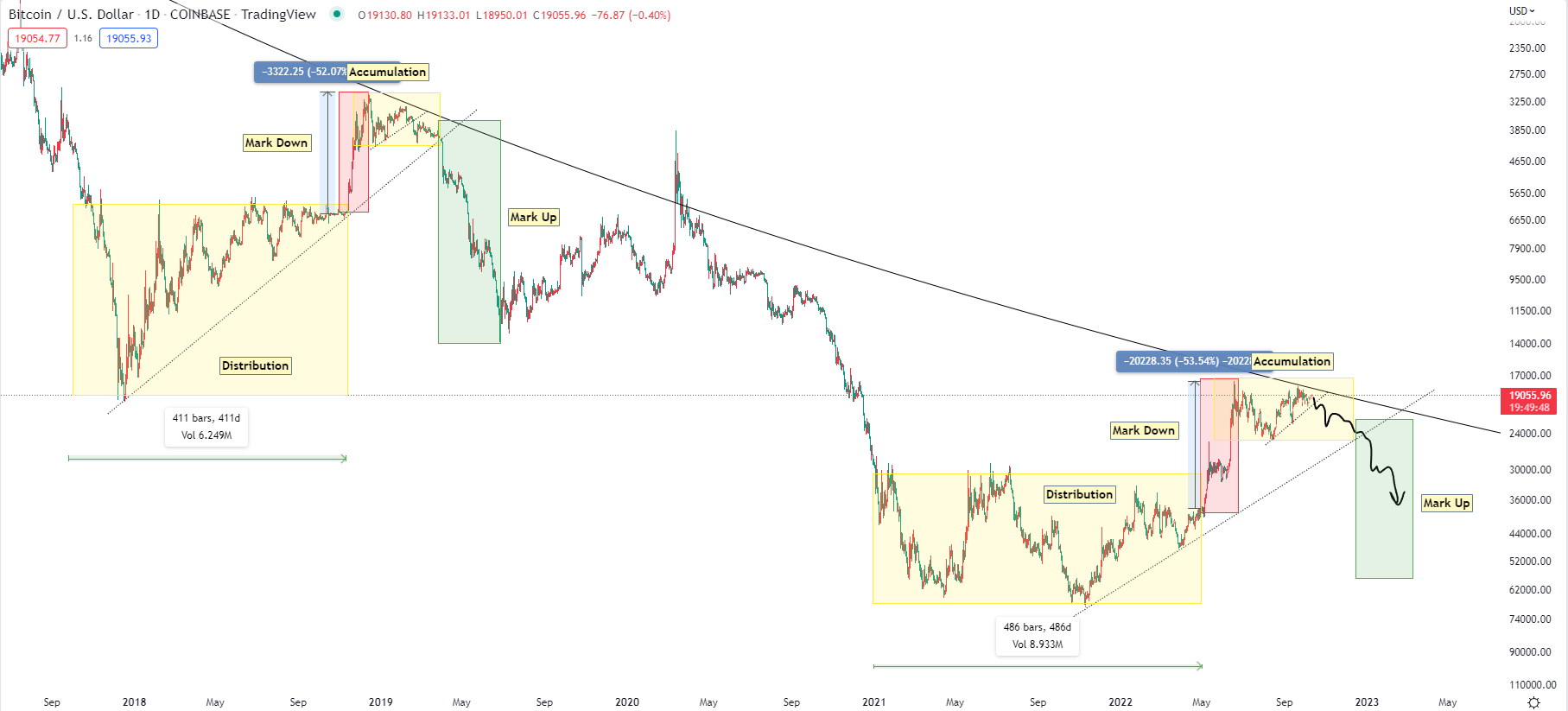
According to Kaleo, a new Bitcoin trend is underway as the leading crypto asset sets the stage for a massive move up.
“I’m seeing more 2018 bear market fractal comparisons being used for this range, and I’m really not a fan of the idea at all. In my opinion, we’ve already seen that major breakdown. We’re in the accumulation phase. The markup will catch everyone off guard.” 

Image

Source: Kaleo/Twitter Looking at the analyst’s chart, Bitcoin appears to be close to igniting a rally that sends BTC to around $40,000, an over 100% surge from current prices.
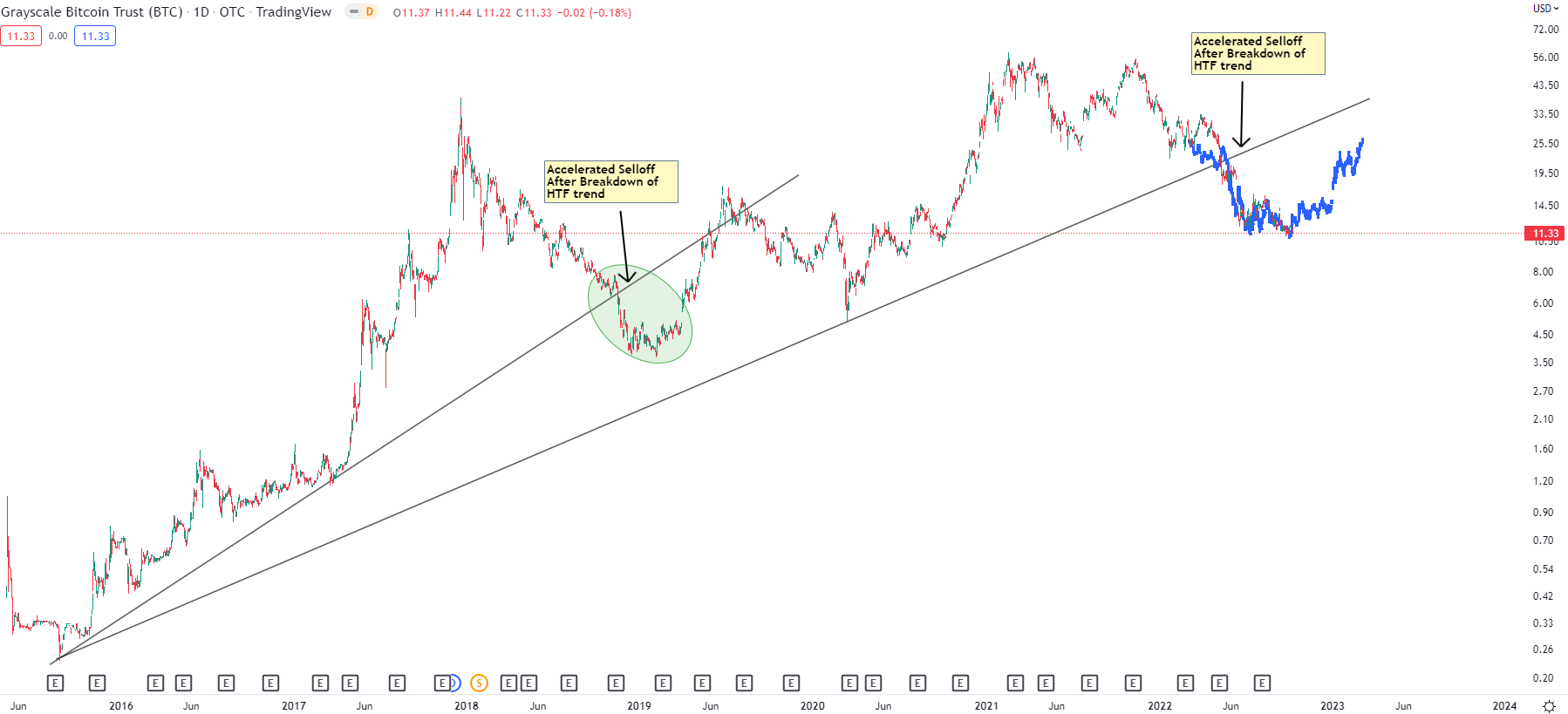
The crypto strategist is also tracking the performance of the Grayscale Bitcoin Trust (GBTC), a financial instrument designed for institutional investors to gain exposure to Bitcoin without holding the underlying asset.
According to Kaleo, GBTC’s recent price action is a close copy of its performance during the latter stages of the 2018 bear market, suggesting that the asset is bottoming out and preparing for a recovery rally.
“Here’s another high timeframe fractal on the GBTC chart to support my bullish bias.”

Image

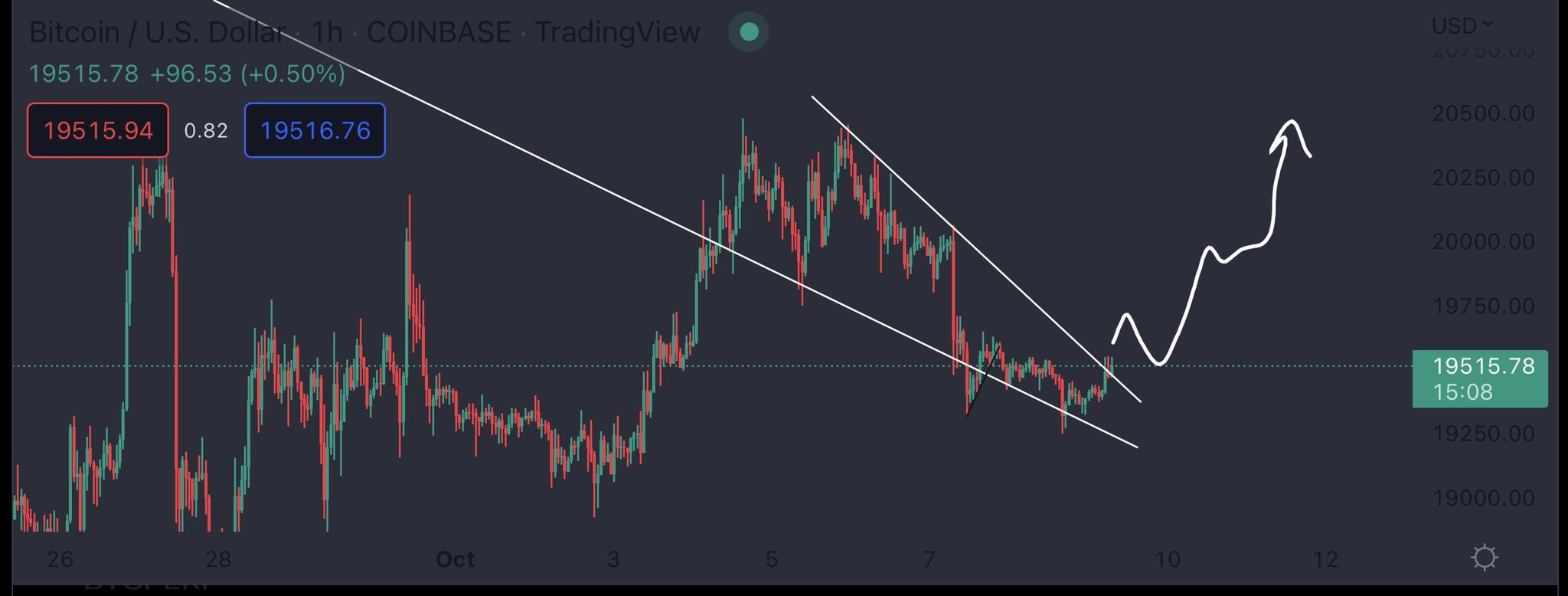
Source: Kaleo/Twitter In the short term, Kaleo predicts a Bitcoin rally to $20,000.
“Squeeze it back above $20,000.” 

Image

Source: Kaleo/Twitter At time of writing, Bitcoin is changing hands for $19,082, flat on the day.

Trending Cryptos

Related Reads

Idle Macs Can Also Make Money? An Overview of Eigen Labs' Decentralized AI Inference Network Darkbloom

AI inference is becoming a crucial layer of internet infrastructure, yet it remains largely dependent on costly, capacity-limited centralized systems with potential security risks. Meanwhile, millions of powerful computers sit idle globally. Eigen Labs' Darkbloom network aims to utilize this idle capacity by enabling distributed AI inference on Mac computers, specifically those with Apple Silicon chips. Darkbloom's architecture consists of three components: users who send inference requests, a coordinator (operated by Eigen Labs) that routes these requests, and providers (Mac owners) whose machines run the models and return outputs without being able to see the request content. The system prioritizes privacy through a hardened provider process, software integrity checks, and hardware-supported attestation based on Apple's security architecture to ensure verifiable privacy. Economically, Darkbloom differs from traditional models. It leverages existing hardware, with marginal costs primarily driven by electricity, allowing it to offer pricing roughly 50% lower than major API aggregators. Providers keep 100% of the inference revenue, and the project does not rely on token subsidies; earnings come solely from real AI inference demand. However, early-stage earnings are modest, with top providers currently earning under $6 per day, influenced by factors like hardware specs, uptime, and network demand. The network currently supports models like Google's Gemma 4 and OpenAI's GPT-OSS via OpenRouter. To participate as a provider, users need an Apple Silicon Mac running macOS 14 or later, must install the Darkbloom provider software, and keep the machine online with a stable internet connection.

marsbit11m ago

Idle Macs Can Also Make Money? An Overview of Eigen Labs' Decentralized AI Inference Network Darkbloom

marsbit11m ago

Which Crypto Sectors Have Been "Eaten" by AI Agents?

The article examines which crypto sectors have been increasingly dominated by AI Agents and which remain human-centric. In certain high-speed, efficiency-driven areas, AI Agents have taken clear control. This includes derivatives/perpetuals trading, where bots outperform humans significantly (e.g., a contest showed 0% of AI Agents were liquidated vs. 43% of humans), arbitrage/MEV extraction, and yield optimization (with ~68% of new DeFi protocols in Q1 2026 featuring autonomous AI Agents). Spot trading and portfolio optimization are also seeing heavy Agent adoption. However, the shift is not universal. In "battleground" sectors, both Agents and humans coexist. In prediction markets, Agents dominate short-term arbitrage, but humans still outperform in long-term, nuanced judgment calls. In DeFi lending, while liquidation is automated, core deposit/borrow decisions remain largely human-driven. Sectors still firmly led by human activity include stablecoin payments and card-based spending (driven by real-world economic activity and remittances) and wallets, which serve as the crucial human-verification and approval layer. The rise of Agents increases the need for robust human-Agent verification layers. Projects like World/AgentKit, t54, Self Protocol, and Kite AI are building infrastructure to create trust, security, and accountability by binding Agents to verified human identities. In conclusion, while AI Agents have decisively "eaten" speed and optimization-focused crypto sectors, human judgment, trust, and real-world context remain dominant in areas that create broad economic value, such as payments and identity. The future likely involves a symbiotic relationship where Agents require human verification and oversight to operate effectively.

Foresight News17m ago

Which Crypto Sectors Have Been "Eaten" by AI Agents?

Foresight News17m ago

After Rising 11 Times in a Year, Micron's Earnings Report Becomes a Stress Test for the AI Memory Market

**Micron's Upcoming Earnings: A Crucial Test for the AI Memory Rally** Investors in AI memory stocks face a critical moment on June 24th, when Micron Technology reports quarterly earnings. The stock, having surged approximately 11-fold from $103 to $1,134 over the past year, carries immense market expectations. Wall Street consensus forecasts a staggering ~932% year-over-year jump in EPS to around $19.72 and ~270% revenue growth to ~$345 billion, largely driven by sold-out HBM (High Bandwidth Memory) capacity through 2026. Analysts have aggressively revised estimates upward over the last 90 days, with EPS expectations rising 68%. This creates a high bar: even strong results risk a sell-off if they fail to meet these elevated projections. Notably, price forecasts from institutions like Citi (predicting ~200% DRAM price increases in 2026) are already among the most bullish on Wall Street, not conservative. The key metric to watch is gross margin, guided to a record ~81%. Such peak profitability raises questions about sustainability in the historically cyclical memory sector. While management has signaled continued strength, the stock's direction post-earnings will likely hinge more on forward guidance for the next quarter and details on HBM capacity expansion for 2027, rather than the already-anticipated stellar past results. The report represents a major pressure test for the high-flying AI memory trade.

marsbit21m ago

After Rising 11 Times in a Year, Micron's Earnings Report Becomes a Stress Test for the AI Memory Market

marsbit21m ago

Trading

Spot
Futures

Hot Articles

What is $BITCOIN

DIGITAL GOLD ($BITCOIN): A Comprehensive Analysis Introduction to DIGITAL GOLD ($BITCOIN) DIGITAL GOLD ($BITCOIN) is a blockchain-based project operating on the Solana network, which aims to combine the characteristics of traditional precious metals with the innovation of decentralized technologies. While it shares a name with Bitcoin, often referred to as “digital gold” due to its perception as a store of value, DIGITAL GOLD is a separate token designed to create a unique ecosystem within the Web3 landscape. Its goal is to position itself as a viable alternative digital asset, although specifics regarding its applications and functionalities are still developing. What is DIGITAL GOLD ($BITCOIN)? DIGITAL GOLD ($BITCOIN) is a cryptocurrency token explicitly designed for use on the Solana blockchain. In contrast to Bitcoin, which provides a widely recognized value storage role, this token appears to focus on broader applications and characteristics. Notable aspects include: Blockchain Infrastructure: The token is built on the Solana blockchain, known for its capacity to handle high-speed and low-cost transactions. Supply Dynamics: DIGITAL GOLD has a maximum supply capped at 100 quadrillion tokens (100P $BITCOIN), although details regarding its circulating supply are currently undisclosed. Utility: While precise functionalities are not explicitly outlined, there are indications that the token could be utilized for various applications, potentially involving decentralized applications (dApps) or asset tokenization strategies. Who is the Creator of DIGITAL GOLD ($BITCOIN)? At present, the identity of the creators and development team behind DIGITAL GOLD ($BITCOIN) remains unknown. This situation is typical among many innovative projects within the blockchain space, particularly those aligning with decentralized finance and meme coin phenomena. While such anonymity may foster a community-driven culture, it intensifies concerns about governance and accountability. Who are the Investors of DIGITAL GOLD ($BITCOIN)? The available information indicates that DIGITAL GOLD ($BITCOIN) does not have any known institutional backers or prominent venture capital investments. The project seems to operate on a peer-to-peer model focused on community support and adoption rather than traditional funding routes. Its activity and liquidity are primarily situated on decentralized exchanges (DEXs), such as PumpSwap, rather than established centralized trading platforms, further highlighting its grassroots approach. How DIGITAL GOLD ($BITCOIN) Works The operational mechanics of DIGITAL GOLD ($BITCOIN) can be elaborated on based on its blockchain design and network attributes: Consensus Mechanism: By leveraging Solana’s unique proof-of-history (PoH) combined with a proof-of-stake (PoS) model, the project ensures efficient transaction validation contributing to the network's high performance. Tokenomics: While specific deflationary mechanisms have not been extensively detailed, the vast maximum token supply implies that it may cater to microtransactions or niche use cases that are still to be defined. Interoperability: There exists the potential for integration with Solana’s broader ecosystem, including various decentralized finance (DeFi) platforms. However, the details regarding specific integrations remain unspecified. Timeline of Key Events Here is a timeline that highlights significant milestones concerning DIGITAL GOLD ($BITCOIN): 2023: The initial deployment of the token occurs on the Solana blockchain, marked by its contract address. 2024: DIGITAL GOLD gains visibility as it becomes available for trading on decentralized exchanges like PumpSwap, allowing users to trade it against SOL. 2025: The project witnesses sporadic trading activity and potential interest in community-led engagements, although no noteworthy partnerships or technical advancements have been documented as of yet. Critical Analysis Strengths Scalability: The underlying Solana infrastructure supports high transaction volumes, which could enhance the utility of $BITCOIN in various transaction scenarios. Accessibility: The potential low trading price per token could attract retail investors, facilitating wider participation due to fractional ownership opportunities. Risks Lack of Transparency: The absence of publicly known backers, developers, or an audit process may yield skepticism regarding the project's sustainability and trustworthiness. Market Volatility: The trading activity is heavily reliant on speculative behavior, which can result in significant price volatility and uncertainty for investors. Conclusion DIGITAL GOLD ($BITCOIN) emerges as an intriguing yet ambiguous project within the rapidly evolving Solana ecosystem. While it attempts to leverage the “digital gold” narrative, its departure from Bitcoin's established role as a store of value underscores the need for a clearer differentiation of its intended utility and governance structure. Future acceptance and adoption will likely depend on addressing the current opacity and defining its operational and economic strategies more explicitly. Note: This report encompasses synthesised information available as of October 2023, and developments may have transpired beyond the research period.

416 Total ViewsPublished 2025.05.13Updated 2025.05.13
What is $BITCOIN

Discussions

Welcome to the HTX Community. Here, you can stay informed about the latest platform developments and gain access to professional market insights. Users' opinions on the price of BTC (BTC) are presented below.

活动图片