加密采用两极分化:拉美走庄康大道,欧洲通往死胡同

PanewsPublished on 2022-10-08Last updated on 2022-10-08

Abstract

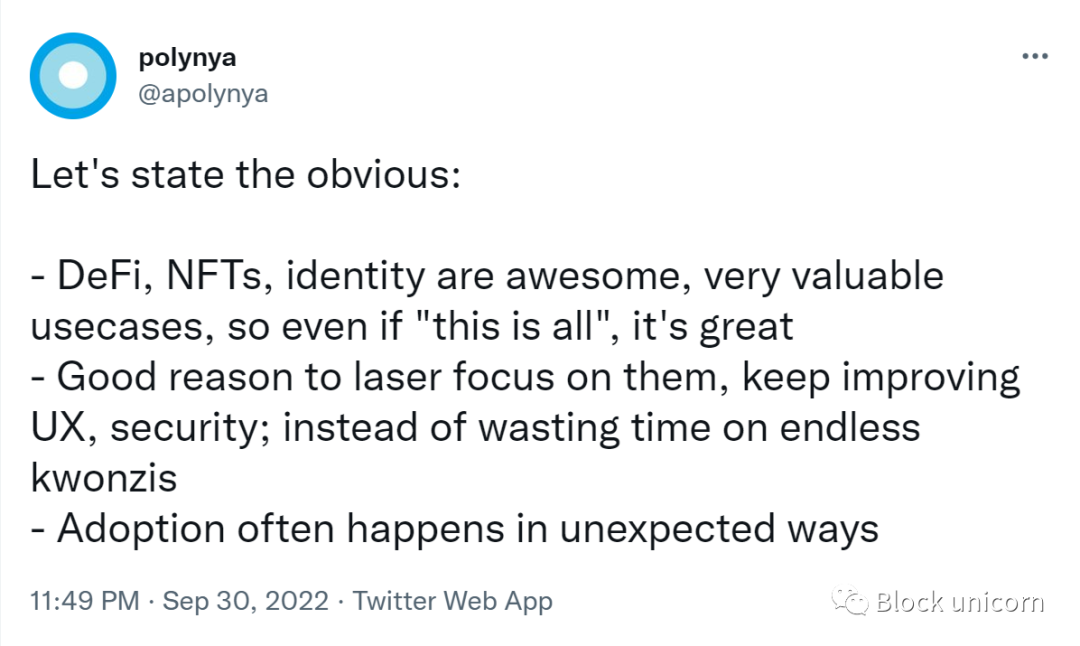
Polynya在上图的推文里完美地框定了这篇帖子:到目前为止,我们到目前为止所做的可能就是我们使用区块链所取得的全部成果。

Polynya在上图的推文里完美地框定了这篇帖子:到目前为止,我们到目前为止所做的可能就是我们使用区块链所取得的全部成果。我们正在研究的技术要么徘徊在改变世界的边缘,要么永远停留在书呆子世界的边缘。我们已经成功地吸引了全世界的注意力,但如果我们要采取行动并兑现承诺的话,我们需要迅速转向,否则就会冒着走进我所说的以欧洲为中心的加密技术的死胡同的风险。

尽管我还找不到确凿的数据来说明这一点,但根据我和我在这个领域的同行的真实经验,大部分投资于Crypto的风投资金流向了欧洲和北美的团队。我们不断地看到来自相同背景的同一类人一遍又一遍地建造着相同的东西。如果该行业想要创新的用例和采用,它需要将注意力和资本转移到正在解决需要解决方案的问题的建设者身上。该行业可以继续构建更多的L1、zkEVMs和NFT平台,也可以投资于推动下一代区块链创新,而这些创新将不可避免地来自拉丁美洲。

我相信,新兴地区将是加密和区块链的大部分开创性用例的发源地。为什么?因为需要孕育创新。所谓的“发展中国家”经历的金融、政治和社会问题,再加上日益成熟的区块链生态系统,将为我们这个时代一些影响最大的应用程序的开发创造了一个成熟的环境。

拉丁美州是加密的原爆点

新兴地区受到了金融和社会压力的影响。拉丁美洲尤其令人感兴趣,因为消费者表现出的行为使他们热衷于探索基于加密的替代方案,例如移动优先的数字支付基础设施、大量使用新银行应用程序和跨境汇款支付。

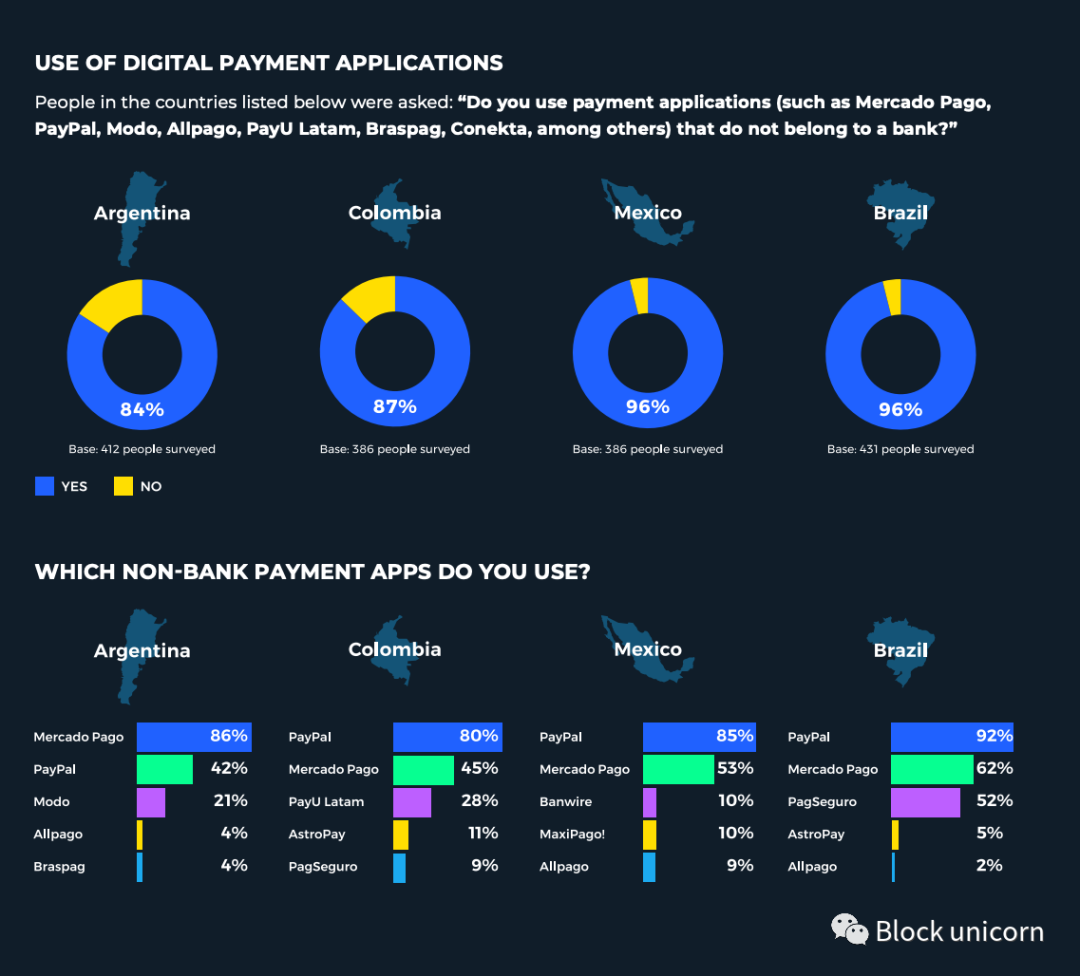
当你查看有关移动金融、替代付款方式和银行业务的特定国家数据时,这些技术的理由就变得更加令人信服。根据Rapyd发布的一项研究,96%的墨西哥人和巴西人经常使用PayPal、Modo和MercadoPago等非银行支付应用。尽管拉美人口只占世界人口的8%,但在2021年,拉美人收到的汇款占全球汇款总额的20%。拉丁美洲已经通过移动电话中广泛使用在线消费者支付系统,如巴西的PicsPay,哥伦比亚的PSE,以及阿根廷、巴西、智利、哥伦比亚、墨西哥、秘鲁、乌拉圭和委内瑞拉的Mercado Pago。随着移动设备上数字支付的普及、跨境汇款以及传统金融中日益增长的不安全感,拉丁美洲完全有条件通过加密和区块链中新的、高影响力的用例来打开全球采用的大门。

一种全球的、无需许可的P2P支付基础设施可以为汇款服务费、处理时间和严重的货币贬值提供替代方案,并为拉丁美洲的6.66亿人提供安全的金融基础设施。然而,实现广泛采用的唯一方法是为月平均收入约500美元的人群构建安全、可扩展且负担得起的解决方案。具体地说,这意味着交易只需一分钱的零头,而且dApp UX应该具有与标准的现代Web应用程序相同的外观和感觉。如Fuel、Bichonomy、Lens、Mirror和Geo等团队正在寻找创新的方法,通过并行交易执行、无Gas费交易、批量交易签名和抽象化初次用户的钱包创建流程来改善用户体验。

超越拉丁美洲的银行
(来源:Rapyd)

拉丁美洲被证明是新技术的早期采用者,包括电子银行和非银行支付服务、电子商务平台、基于互联网的文本应用程序和加密技术。根据Rapyd的报告,来自阿根廷、巴西、哥伦比亚和墨西哥的1687名受访者接受了问卷调查,而近一半的人仍然没有银行账户。因此,新时代银行和非银行的支付应用程序在全拉丁美洲所有年龄段和社会经济阶层的用户中的受欢迎程度和使用率继续增长。在巴西和哥伦比亚,大多数交易是通过手机进行的,社交商务(即是使用社交媒体应用进行的购买行为。)的采用正在呈指数级增长。

Mercado Pago是在拉丁美洲发生的高度适应性创新的光辉典范。它是一个数字支付平台,旨在辅助电子商务平台MercadoLibre。Mercado Pago已经从一个专门为Mercado Libre而创建的支付平台中成长起来,并提供从支付处理和网关服务到移动支付和信用卡的各种金融服务。而Picspay是在巴西占主导地位的数字支付应用程序,拥有超过6000万用户,每月交易额为68亿BRL,相当于约1,318,442,480美元(来源:PicPay)。在哥伦比亚,个人和企业之间的日常支付都可以使用PSE进行。这项移动ACH服务允许用户通过借记他们的银行账户进行在线购物和支付。

数字支付的普及并不局限于上述的国家:98%的巴西银行客户,94%的墨西哥和哥伦比亚银行客户,以及89%的阿根廷银行客户表示经常使用在线支付(来源:Rapyd,第7-10页)。这一趋势也不仅限于银行提供的服务,该地区非银行支付应用的使用率也极高。96%的墨西哥人和巴西人、87%的哥伦比亚人和84%的阿根廷人经常使用PayPal、Modo和MercadoPago等应用程序(Rapyd,第6页)。我将这些数据简单地说出来:拉美裔已经很大程度上在传统银行系统的范围之外运作。

区块链超越国界
(来源:Chainalysis)

拉丁美地区的独特之处在于,其居民严重依赖跨境汇款(付款人和收款人位于不同国家的跨境支付)作为一种收入手段。拉美裔通常会移民到其他国家工作,并定期通过汇款服务寄钱回国。根据世界银行发布的一份报告,2021年流向拉丁美洲和加勒比地区的汇款达到1310亿美元,比2020年显著增长了25%。根据世界银行的数据,2021年的汇款几乎占了洪都拉斯和萨尔瓦多国内生产总值的25%,占危地马拉国内生产总值的14.8%。然而,消费者为如此频繁地使用汇款服务付出了代价:为每笔交易平均5%的费用买单(来源:Americas MI)。

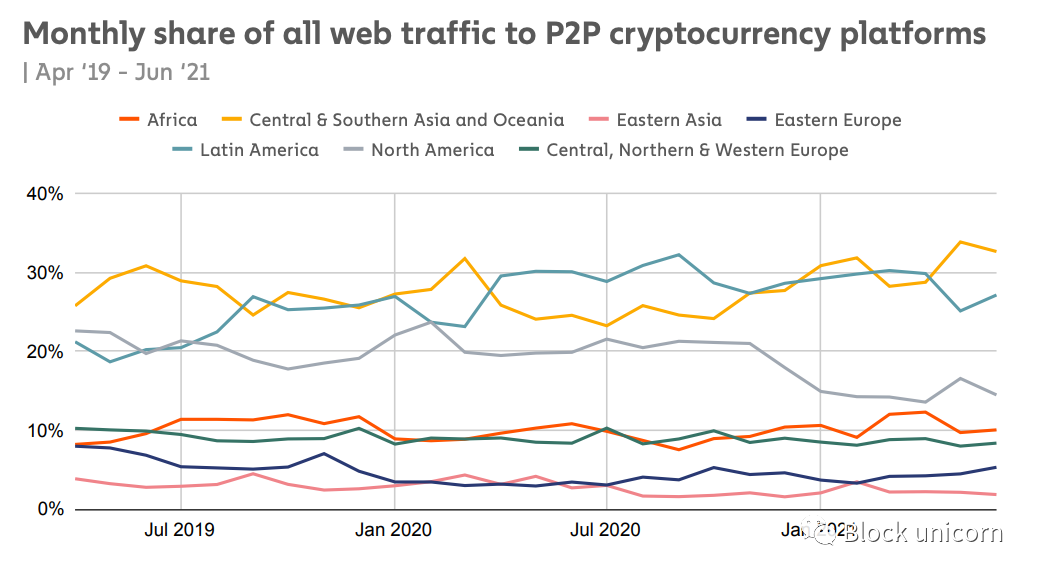
Chainalysis报告里两个有趣的数据点表明,用户已经转向使用P2P加密支付作为将资金汇回原籍国的常见方式。首先,拉丁美洲的P2P加密活动高于平均水平,推动约28%的网络流量流向P2P加密货币平台。其次,在拉丁美洲所获利的所有价值中,11%来自国内,89%来自国外。加密交易费为跨境转移资金提供了更经济实惠的价格,区块链技术提供了更快的交易速度,使拉丁美州成为让数百万用户获得成本、速度和安全性的理想环境,也使其能够利用新技术成功嵌入拉美生活方式。

今年早些时候,我在哥伦比亚的圣安德烈斯岛,而那里居住着大约6.1万人。在岛上,只有一家汇款服务提供商,等待汇款到大陆或国外的人在大楼周围一直排着长队。在那次旅行中,我在巴拿马的圣卡塔利纳待了一段时间,这是一个小渔镇,现在每年都会吸引成千上万的冲浪游客。但是镇上或附近的镇上都没有自动取款机,而最近的自动取款机大约需要1.5小时的车程。这个社区依赖一个非正式的现金市场,从经营当地杂货店的女士那里购买现金。它现在是一个旅游小镇,但许多企业只经营现金,如果你在出发前没有带现金,你就得找人买现金或长途跋涉去到圣地亚哥取钱。这种独特的(但在拉丁美州的部分地区很常见)情况为社区从这些区块链中受益创造了条件。

金融、政治、文化和加密的交集
(来源:Chainalysis)

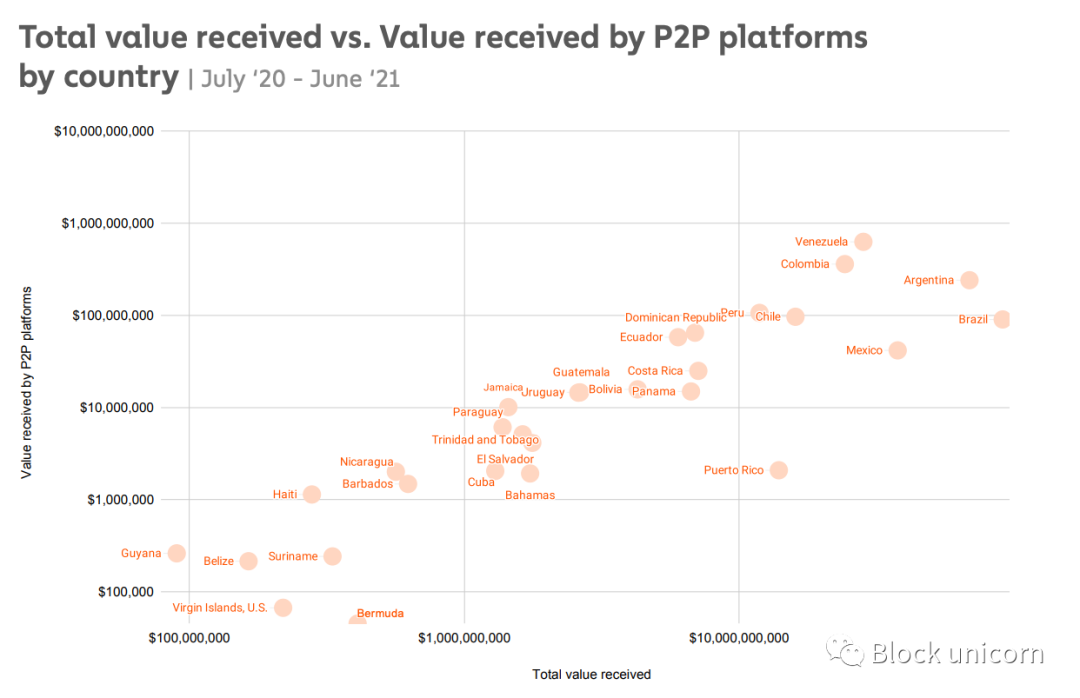
由于日益增长的不安全感和政治不稳定,拉丁美州的人们在报告中表示愿意试验与银行无关的数字支付解决方案(来源:Rapyd)。在Chainalysis全球加密采用指数2021年版中,通过测量所获得的链上价值、所获得的链上零售价值和P2P交易所的交易量,拉丁美洲国家占前20个国家中的4个。而Chainalysis的报告进一步指出,委内瑞拉在该指数中排名靠前,主要是因为该国在P2P平台上的巨大交易量。委内瑞拉在过去两年面临一段经济动荡加剧的时期,2018年通货膨胀率为2,000,000%。尽管委内瑞拉在该指数中排名第七,且拉丁美洲占了前20名国家和地区的20%,但拉丁美洲并未位居DeFi应用程序用户的榜首。这表明在地理位置上采用加密技术更多是出于存储价值的需要,而不是访问DeFi应用程序。

上图显示了每个拉丁美国家/地区获得的总价值与通过P2P平台获得的总价值的对比。里面清楚地表明,P2P加密交易率较高的国家与目前正在经历社会经济和社会政治冲突时期的国家是同一批国家。阿根廷、委内瑞拉和哥伦比亚今年都面临着创纪录的货币贬值。哥伦比亚和巴西今年的选举都动摇了两国的核心。尽管Chainalysis的报告没有具体分析P2P交易的采用与一个国家基本结构的重大变化之间的关系。但许多报告的数据表明,政治不稳定或社会不平等程度最高的国家在本土使用加密交易的比率远远高于相同地区不稳定程度较低或没有不稳定的国家。

适应或是消亡

拉丁美洲对数字支付和跨境汇款的严重依赖,再加上机构信任度较低,使该地区在考虑该行业应该为其建立的客户细分市场和我们应该寻求授权的开发商时处于中心舞台。今年我们取得了巨大的进展,首次在多个拉丁美洲国家举办了大规模的以太坊开发者大会,并取得了巨大的成功。

多样性(经验的多样性,而不仅仅是思想的多样性)是创新的催化剂。世界上每个地区都面临着独特的挑战和机遇,为生活在该地区的人们提供独特的生活体验。无论我们如何努力,全球西方永远无法提供拉丁美洲所能提供的区块链创新水平,原因很简单,因为拉丁美洲的创新主要是由需求驱动的。

最后,以欧洲为中心的加密是一条通往死胡同的道路。要么适应,要么死亡。

Related Reads

Has the 'Digital Gold' Narrative for BTC Failed?

**Title: Has the "Digital Gold" Narrative for Bitcoin Failed?** The article argues that Bitcoin's "digital gold" narrative remains valid despite a recent sharp price decline (from a peak near $126k in Oct 2025 to briefly under $61k in Feb 2026). It presents a long-term investment framework based on three core points: **1. Viewing Bitcoin as an Asset:** Bitcoin is presented as a superior potential store of value compared to gold. Key arguments are its absolute scarcity (21 million cap), superior portability, and transparent auditability via its public ledger. While acknowledging its current use in early, volatile stages (~3-4% global adoption), the author draws parallels to the early, disruptive phases of the internet and e-commerce. **2. Understanding the Recent Downturn:** The current ~50% correction is framed as a predictable, consensus-driven cycle following its post-halving peak (the 2024 halving preceded the Oct 2025 high). A crucial factor is a historic "changing of hands": the influx of new institutional buyers via ETFs allowed early, low-cost holders (miners, OG believers) to take profits. The author notes that while severe, Bitcoin's historical drawdowns (e.g., 93% in 2011, 77% in 2021-22) have been progressively smaller, suggesting maturing holder structure and decreasing volatility over time. **3. The Long-Term Perspective:** The long-term thesis hinges on Bitcoin capturing a portion of gold's market value. With Bitcoin's market cap at ~$1.4 trillion (at $70k) versus gold's ~$20 trillion, significant upside potential exists if the "digital gold" narrative is partially realized. However, the author strongly cautions that short-term risks remain, the bottom is unpredictable, and high volatility is inherent. The real risk is not Bitcoin failing but poor personal position management (over-leverage, wrong capital) and a lack of deep understanding, which can force investors out during severe downturns. The conclusion uses Amazon's 95% crash post-2000 dot-com bubble and subsequent 42x recovery as an analogy. The ultimate question is not if Bitcoin's price will rise, but if an investor's strategy and conviction can withstand the volatility to see the long-term play out. The recent divergence (gold up, Bitcoin down) is posed not as a narrative failure, but as potential evidence of this ongoing, painful transition from a speculative asset to a mainstream allocation.

marsbit1h ago

Has the 'Digital Gold' Narrative for BTC Failed?

marsbit1h ago

Has BTC's 'Digital Gold' Narrative Failed?

The article discusses Bitcoin's "digital gold" narrative, its recent price drop, and long-term outlook through the perspective of "Jason". It argues the narrative is not a failure but that Bitcoin represents a superior, new asset class due to its fixed supply (21 million), portability, and auditability. The piece compares its current ~3-4% global adoption rate to early internet/e-commerce, suggesting significant growth potential. Regarding the 2025-2026 price decline (from ~$126k to briefly under $61k), the author views it as a predictable, consensus-driven sell-off within Bitcoin's ~4-year cycle post-halving, exacerbated by a major "handover" from early, low-cost holders to new institutional buyers via ETFs. A key observation is that historical peak-to-trough drawdowns have lessened over time (e.g., 93% in 2011 to ~50% in 2026), indicating maturing volatility as holder structure changes. For the long term, the author uses a simple framework: Bitcoin's total market cap (~$1.4T at $70k) is only about 7% of gold's (~$20T). Even capturing 30-50% of gold's value would imply substantial upside. However, the article strongly cautions against viewing this as investment advice, emphasizing extreme volatility and the critical importance of risk management, position sizing, and deep fundamental understanding to survive severe drawdowns. It concludes by drawing a parallel to Amazon's 95% crash in 2000 and subsequent 42x recovery, stressing that the key is surviving market cycles to realize long-term potential.

链捕手1h ago

Has BTC's 'Digital Gold' Narrative Failed?

链捕手1h ago

From Code to Cognition: A Ten-Thousand-Word Guide to the Evolution of the Robot Brain

"From Code to Cognition: The Evolution of Robot Brains" The journey of robotic intelligence has shifted dramatically from manually coded systems to AI-driven brains. For decades, robots relied on layered software stacks—perception, state estimation, planning, control—each handcrafted. While predictable, they lacked adaptability. The 2010s saw deep learning revolutionize perception (e.g., object detection) and control (via reinforcement learning), but learned skills remained narrow. The arrival of Large Language Models (LLMs) marked a turning point. LLMs acted as high-level planners, interpreting natural language instructions and generating sequences of actions for traditional robotic systems to execute. However, true integration came with Visual-Language-Action (VLA) models, which fused vision, language, and motion prediction into a single network. Pioneered by models like RT-2 and open-source projects like OpenVLA, VLAs enable robots to reason and act directly from visual input and commands. The most advanced humanoid robots now employ a "dual-brain" architecture: a slow-thinking, large VLA (System 2) for reasoning and planning, and a fast-reacting, small network (System 1) for high-frequency motion control, sometimes with an even lower-level System 0 for balance. This split balances cognition with the physics of real-time movement. Computation is split between onboard hardware (e.g., NVIDIA Jetson) for safety-critical control loops and cloud/edge servers for non-critical tasks like learning and interfaces. A crucial driver is the open-source ecosystem—models like GR00T and OpenVLA allow startups to build upon pre-trained brains and fine-tune them with their own data, accelerating development. Despite progress, current systems struggle with recovery from errors, sample inefficiency, and long-horizon tasks. This has spurred the rise of **World Models**—neural networks that predict the consequences of actions. By simulating possible futures before acting (like NVIDIA Cosmos or Meta V-JEPA), robots can plan, recover, and generalize better. This represents the next frontier: shifting intelligence from learned reactions to an internal model of physics and cause-and-effect. The field is rapidly evolving. While not yet at its "ChatGPT moment," the convergence of cheaper hardware, scalable simulation, and world models points toward robots that are increasingly capable, adaptive, and useful. The question is shifting from "what can robots do?" to "what *should* they do?"

marsbit1h ago

From Code to Cognition: A Ten-Thousand-Word Guide to the Evolution of the Robot Brain

marsbit1h ago

AI Bubble Is Bursting

The AI Bubble is Bursting: A Necessary Purge on the Path to Ubiquitous Intelligence Market volatility has reignited debates about an AI bubble, with figures like Ray Dalio pointing to high valuations. However, this parallels the dot-com bubble, which, despite its crash, laid the physical infrastructure for today's internet era. The current AI investment frenzy, with tech giants planning trillions in infrastructure spending far outstripping current AI application revenues, appears similarly imbalanced. This 'bubble' is seen as an inevitable phase for a disruptive technology, paying the "innovation tax." Critically, AI inference costs have plummeted over 99.7% since 2023, making intelligence nearly free at the margin. This hasn't reduced spending but has instead unlocked massive new demand, as seen in enterprise AI cloud expenditure tripling. This follows the Jevons Paradox: efficiency gains lead to greater total consumption. The market is now entering a cleansing phase, weeding out speculative ventures lacking real moats. The deeper shift is a move from capital expenditure (CapEx) on hardware to value creation in operational expenditure (OpEx) through AI applications that solve real industry problems. While infrastructure valuations are high, rapid earnings growth from widespread AI adoption across sectors—from manufacturing and finance to law and healthcare—may digest these valuations over time. Ultimately, this creative destruction will leave behind robust infrastructure and optimized models, cheaply powering an AI-augmented future for all industries, much as the internet became indispensable after its own bubble burst. The core productive potential remains undiminished.

链捕手2h ago

AI Bubble Is Bursting

链捕手2h ago

Trading

Spot
Futures

Hot Articles

How to Buy NFT

Welcome to HTX.com! We've made purchasing AINFT (NFT) simple and convenient. Follow our step-by-step guide to embark on your crypto journey.Step 1: Create Your HTX AccountUse your email or phone number to sign up for a free account on HTX. Experience a hassle-free registration journey and unlock all features.Get My AccountStep 2: Go to Buy Crypto and Choose Your Payment MethodCredit/Debit Card: Use your Visa or Mastercard to buy AINFT (NFT) instantly.Balance: Use funds from your HTX account balance to trade seamlessly.Third Parties: We've added popular payment methods such as Google Pay and Apple Pay to enhance convenience.P2P: Trade directly with other users on HTX.Over-the-Counter (OTC): We offer tailor-made services and competitive exchange rates for traders.Step 3: Store Your AINFT (NFT)After purchasing your AINFT (NFT), store it in your HTX account. Alternatively, you can send it elsewhere via blockchain transfer or use it to trade other cryptocurrencies.Step 4: Trade AINFT (NFT)Easily trade AINFT (NFT) on HTX's spot market. Simply access your account, select your trading pair, execute your trades, and monitor in real-time. We offer a user-friendly experience for both beginners and seasoned traders.

6.9k Total ViewsPublished 2024.03.29Updated 2026.06.02

How to Buy NFT

What is Altura NFT?

Altura: Providing One-Stop NFT Solutions for Game Developers

55.9k Total ViewsPublished 2024.06.12Updated 2024.06.12

What is Altura NFT?

What is AINFT

EternaFi Agents and $AINFT: A Comprehensive Analysis of AI-Powered NFT Infrastructure in the Web3 Ecosystem The intersection of artificial intelligence (AI) and blockchain technology is rapidly evolving, establishing innovative platforms that redefine ownership models and economic participation. EternaFi Agents, along with its native token $AINFT, exemplifies a groundbreaking approach to the tokenization of AI infrastructures through the means of non-fungible tokens (NFTs). Launched in July 2025 by the development team at Nova Club, EternaFi merges the advancements of AI with the decentralized financial mechanisms of blockchain, presenting a unique investment opportunity for participants within the web3 ecosystem. This article aims to provide an in-depth assessment of EternaFi Agents, covering its core components, functionality, and significance within the crypto landscape. Introduction and Project Overview EternaFi Agents stands as a salient example of how blockchain technology can democratize access to advanced AI capabilities. The project endeavors to reshape the paradigm of AI ownership by diversifying economic participation, making sophisticated AI systems accessible to a larger pool of stakeholders. At its core, the project tokenizes a proprietary large language model (LLM) developed by Nova Club, allowing NFT holders to gain fractional exposure to the model's economic performance. By utilizing NFTs representing stakes in the LLM, EternaFi Agents fosters a model wherein stakeholders not only participate in AI service consumption but also enjoy sharing in the economic rewards generated by the platform. This transformative approach enables the development of sustainable revenue models for AI services, all the while promoting broad community engagement and facilitating transparent governance. What is EternaFi Agents? EternaFi Agents represents an AI-NFT infrastructure project that aims to blend the capabilities of AI with blockchain technology in a coherent ecosystem. The essential feature of this project is the creation of NFTs that serve as financial instruments, representing fractions of ownership in Nova Club's proprietary AI infrastructure. Each NFT symbolizes direct exposure to the economic performance of the underlying AI system, providing a lucrative opportunity for investors. The project operates on the Base blockchain, known for its scalability and efficiency, thus ensuring manageable transaction costs while facilitating a seamless operational experience. One of the notable features includes a revenue-sharing mechanism, wherein NFT holders can receive portions of subscription income generated by the AI services provided on the platform. This innovative approach establishes a connection between the success of the AI services and the economic dividends distributed among the holders, thus ensuring an alignment of interests across the community. Who is the Creator of EternaFi Agents? The creative force behind EternaFi Agents is Nova Club, a development team based in Singapore proficient in the amalgamation of AI and blockchain technology. Their prior experience in AI development and cryptocurrency analysis gives credence to the project, contributing a breadth of expertise to the creation of EternaFi Agents. Nova Club’s mission centers on democratizing access to cutting-edge AI technologies while building sustainable economic models that benefit users alongside developers. Their commitment to transparency, community governance, and innovation is reflected in the design and implementation of the EternaFi platform, aiming to establish a unique ecosystem that fosters positive engagement and long-term value creation. Who are the Investors of EternaFi Agents? The specific details concerning investors or investment organizations backing EternaFi Agents are not publicly available. However, EternaFi has adopted an inclusive approach to funding its development through the sale of NFTs to the public, allowing a wide array of participants to invest in the ecosystem. The project’s architecture ensures that core infrastructure is funded responsibly while allowing community members to partake in the ownership and economic returns generated from the AI services. This model emphasizes community engagement by aligning the interests of investors and project developers, creating a collaborative environment where long-term participation is incentivized. How Does EternaFi Agents Work? EternaFi Agents operates through a multifaceted ecosystem where NFTs serve as a primary means of ownership representation within the project. Each NFT holder is entitled to a share of the monthly subscription income produced by the underlying AI-powered platform, thereby positioning NFT ownership as a lucrative investment vehicle. Revenue Generation Mechanism The primary source of revenue generation for the EternaFi platform stems from subscription fees related to the AI services provided. Users can access various tiered services, ranging from basic market analysis tools to comprehensive AI-assisted trading solutions. These services are monetized and form the basis for the revenue-sharing framework, which distributes profits to NFT holders through automated smart contracts. An innovative feature of the EternaFi ecosystem is the revenue-sharing mechanism that operates transparently, ensuring that rewards are allocated based on verifiable metrics from the AI platform's operations. This creates a direct link between the performance of AI services and the returns available to community investors, establishing a sustainable economic model. Staking and Vesting Mechanisms Participants within EternaFi can engage in staking their NFTs to unlock additional economic benefits. The vesting schedule is designed to promote long-term commitment among participants, rewarding those who exhibit ongoing support for the project. This ensures a robust alignment of interests and fosters a sense of community engagement essential for achieving the project's long-term goals. Transparent Governance EternaFi Agents embraces decentralized governance, allowing NFT holders to play an active role in decision-making regarding the platform's development and future directions. The governing structure includes community voting mechanisms, providing NFT holders with the opportunity to influence significant decisions and contributing to a collaborative approach to project growth. Timeline of EternaFi Agents The development trajectory of EternaFi Agents showcases a systematic approach toward building a sustainable AI infrastructure while meeting the needs of community participants. Below is a timeline of important milestones in the project’s history: July 2025: Launch of EternaFi Agents, including the public sale of NFTs and deployment of the $AINFT token on the Base blockchain. Q4 2025: Establishment of market infrastructure including liquidity pools and launch of staking dashboards for NFT holders. 2026: Initiation of community engagement programs, expanding AI capabilities, and integration with cross-chain technologies. Q4 2026: Implementation of the dividend distribution system, allowing NFT holders to reap economic benefits from their investments. These milestones signify the focus on establishing a functional and participative ecosystem while ensuring continuous evolution to meet market demands. Technological Infrastructure and Blockchain Integration EternaFi Agents is anchored in an advanced technological framework combining AI systems with blockchain capabilities. Operating on the Base blockchain, the project leverages the advantages of scalability and low transaction costs. The underlying smart contract architecture governs the NFT ownership, revenue sharing, and community management features, ensuring efficiency and transparency. AI System Development The proprietary large language model underpinning EternaFi Agents has been independently developed and designed to cater to revenue-generating applications without reliance on proprietary external frameworks. This endeavor reflects a commitment to creating a versatile and adaptable AI infrastructure capable of delivering meaningful services to users, thus generating economic value for investors. Security Measures The robustness of EternaFi’s security infrastructure is paramount. Regular audits and stringent security measures ensure the integrity of the AI systems and blockchain mechanisms, safeguarding against potential vulnerabilities while fostering confidence among participants. Conclusion EternaFi Agents signifies a landmark innovation within the realm of artificial intelligence and blockchain technology, opening avenues for community ownership and economic participation in advanced AI capabilities. The project’s comprehensive strategy to tokenize AI infrastructure via NFTs establishes a precedent for future decentralized ecosystems. By harmonizing technical sophistication with user-centric economic models, EternaFi not only fosters engagement but also generates a sustainable revenue-sharing framework for community participants. The significance of EternaFi extends well beyond its operational success as it exemplifies how blockchain can democratize cutting-edge AI technologies, paving the way for future ventures in this intersectional space. The evolution of EternaFi Agents may herald a new era of AI development characterized by participant-driven governance, sustainable economic models, and transparent verification, ultimately contributing to the broader democratization of AI and technology accessibility across industries.

3.9k Total ViewsPublished 2025.08.14Updated 2025.08.14

What is AINFT

Discussions

Welcome to the HTX Community. Here, you can stay informed about the latest platform developments and gain access to professional market insights. Users' opinions on the price of NFT (NFT) are presented below.

活动图片