Basel Study Shows World's Largest Banks Are Exposed to $9 Billion in Crypto Assets

newsbtcPublished on 2022-10-02Last updated on 2022-10-02

Abstract

The study, called “Banks’ exposures to cryptoassets – a novel dataset,” was written by secretariat Renzo Corrias.

Basel Study Shows World's Largest Banks Are Exposed to $9 Billion in Crypto Assets

A first-of-its-kind study published by the Basel Committee on Banking Supervision details that the world’s largest financial institutions are exposed to roughly €9.4 billion (US$9 billion) in crypto assets. The research paper authored by the Basel Committee’s secretariat Renzo Corrias further explains that out of all the banks’ total risk exposure, cryptocurrency exposure is estimated to be around 0.01% of total exposures.

Banks Have $9 Billion in Cryptocurrency Exposure Equating to Roughly 0.01% of Total Risk Exposure

A recent study published by the Basel Committee on Banking Supervision (BCBS) explains that the world’s top banks are exposed to around $9 billion worth of cryptocurrencies. The BCBS is a global organization made up of members tied to the world’s central banks and financial institutions from a myriad of jurisdictions.
Basel Study Shows World's Largest Banks Are Exposed to $9 Billion in Crypto Assets

The study, called “Banks’ exposures to cryptoassets – a novel dataset,” was written by secretariat Renzo Corrias. The research aims to create a primary global standard on the “prudential treatment of banks’ [crypto asset] exposures.”

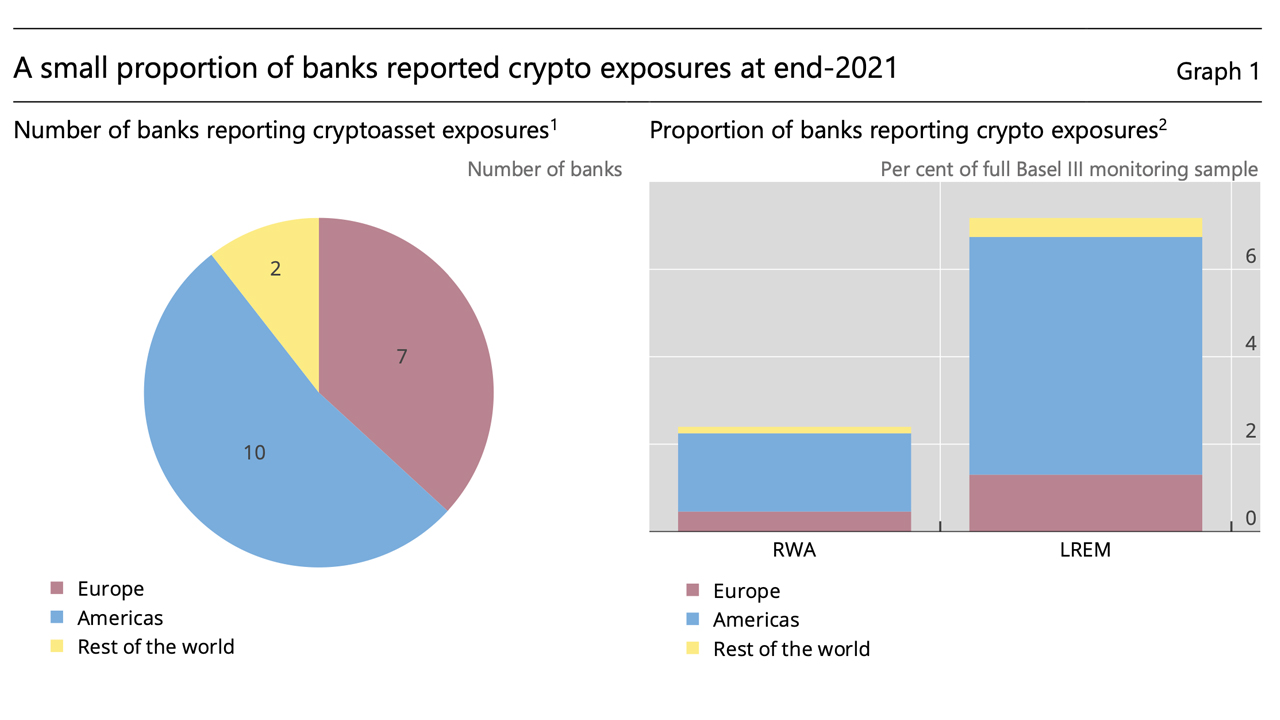
“Total [crypto asset] exposures reported by banks amount to approximately €9.4 billion. In relative terms, these exposures make up only 0.14% of total exposures on a weighted average basis across the sample of banks reporting [crypto asset] exposures,” the report written by Corrias details. “When considering the whole sample of banks included in the Basel III monitoring exercise (ie also those that do not report [crypto asset] exposures), the amount shrinks to 0.01% of total exposures.”
Basel Study Shows World's Largest Banks Are Exposed to $9 Billion in Crypto Assets

The BCBS shows that 19 banks worldwide submitted data for the research, and approximately ten financial institutions derived from the Americas. Seven banks stemmed from Europe, and two banks came from the rest of the world. Corrias notes that the banks represent a small group of financial institutions out of the collective 182 banks the BCBS considered for its Basel III monitoring exercise.
Basel Study Shows World's Largest Banks Are Exposed to $9 Billion in Crypto Assets

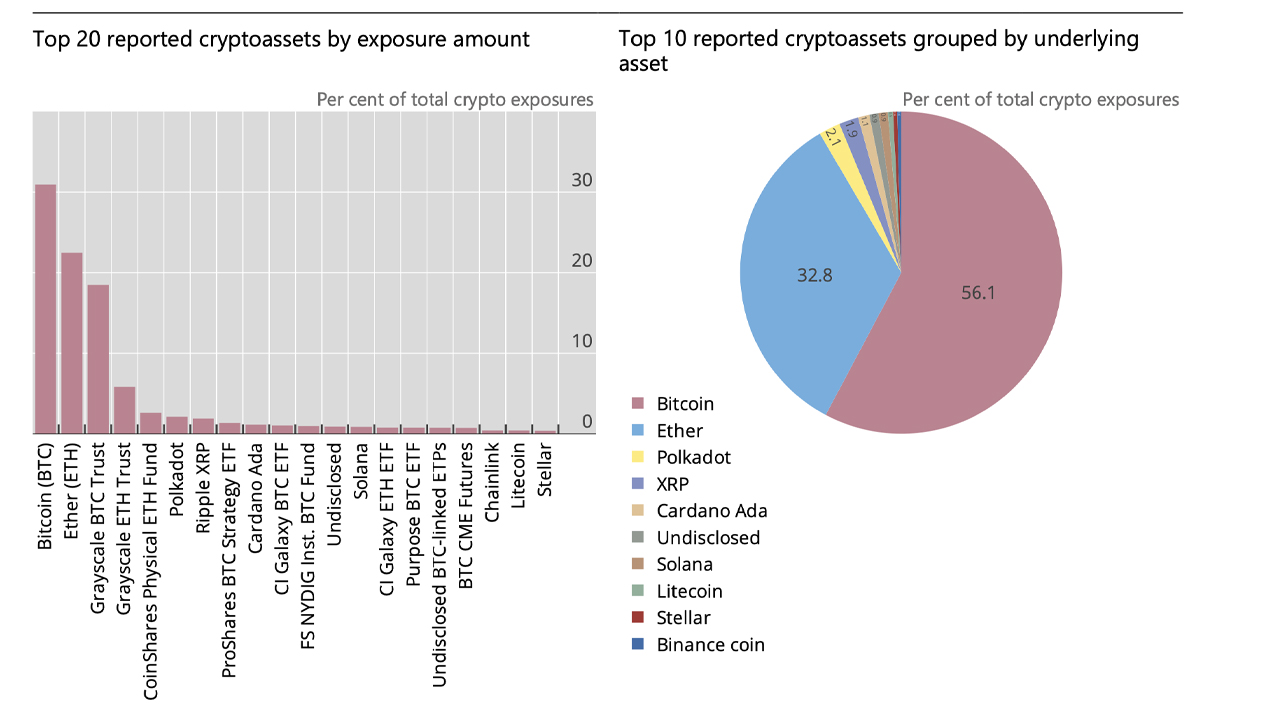
The crypto asset exposure the banks reported mostly consisted of bitcoin (BTC) which was around 31% of exposures, and ethereum (ETH) which accounted for 22% of exposures. In addition to exposure to USD-backed stablecoins, banks are also associated with crypto assets like xrp (XRP), cardano (ADA), solana (SOL), litecoin (LTC), and stellar (XLM).

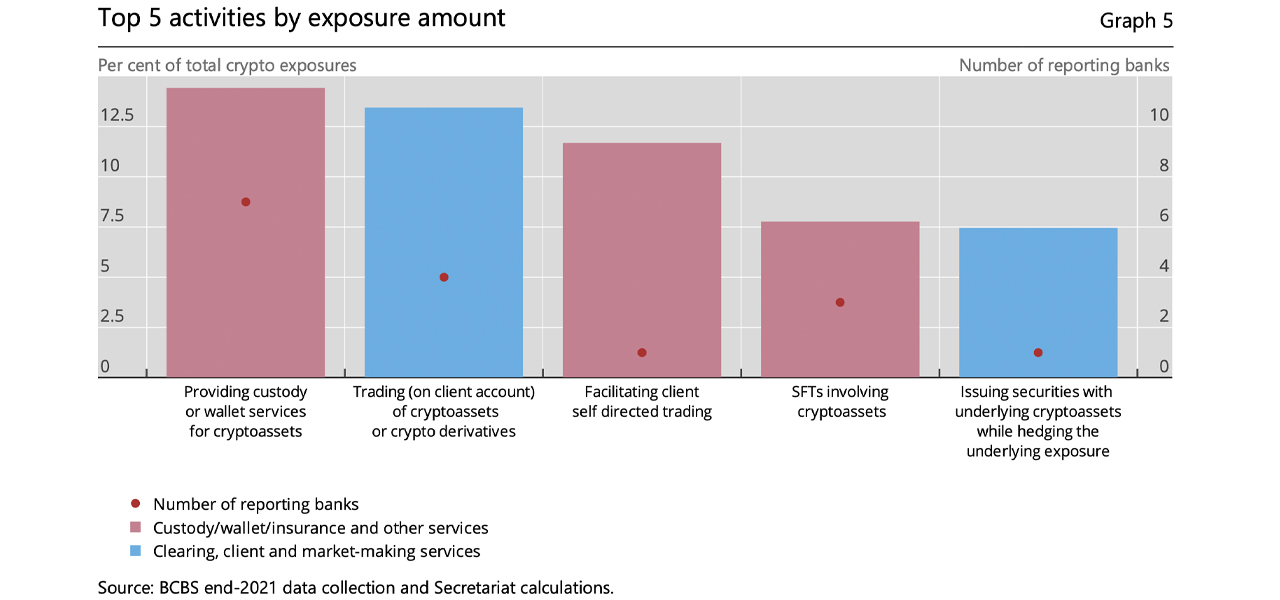
Corrias explains that the banks’ exposure to crypto is comprised of three different categories which include crypto holdings and lending, clearing and market-making services, and custody/wallet/insurance services. Out of the top five activities that add to the banks’ crypto exposure, the top service is “providing custody or wallet services for [crypto assets].”


Trending Cryptos

Related Reads

Kalshi's Biggest Rival is Not Polymarket

Kalshi's CEO Tarek Mansour has identified the company's primary competitors not as the crypto-based prediction market Polymarket, but as established financial and gaming giants: CME Group, Robinhood, and DraftKings. This reflects a shift in the prediction market landscape, where the 2026 FIFA World Cup is expected to bring massive new trading volume. Traditional platforms are increasingly integrating prediction markets as a feature within their existing ecosystems. Robinhood has seen rapid growth with its prediction markets, contributing significantly to its "other transaction revenue." Similarly, Interactive Brokers (IBKR) integrates contracts from Kalshi and CME Group, while DraftKings and FanDuel (via CME) have launched their own prediction products. This allows these firms to leverage their vast user bases and infrastructure at low marginal cost, turning prediction markets from standalone apps into embedded functionalities. In response, prediction market platforms are evolving along two paths. First, they are expanding into new event categories like sports (e.g., the World Cup) and financial data to reduce reliance on election cycles. Second, they are moving towards becoming infrastructure and liquidity providers for distribution platforms. Kalshi's lead over Polymarket in trading volume is partly attributed to this channel strategy, integrating with brokers like Robinhood, Coinbase, and Webull. However, this strategy faces a challenge as distributors like Robinhood begin building their own in-house prediction market capabilities (e.g., Rothera), potentially threatening the value of pure infrastructure providers. The situation parallels historical tech battles, such as Zoom competing with Microsoft Teams and Google Meet, where embedded features in larger platforms reshape market dynamics. The future of standalone prediction market leaders like Kalshi and Polymarket will depend on their ability to navigate this new competitive landscape dominated by integrated financial and gaming titans.

链捕手6m ago

Kalshi's Biggest Rival is Not Polymarket

链捕手6m ago

Trends in US Stocks (June 22): Strait of Hormuz Agreement Changes Course, Thursday's PCE and Micron to Determine Chip Sector Direction

U.S. Stock Market Outlook (June 22): Strait of Hormuz Deal Falters, Thursday's PCE & Micron to Set Chip Sector Direction. Geopolitical tensions resurged over the weekend as Iran's IRGC announced the closure of the Strait of Hormuz, and its negotiation team walked out after threats from Trump, pausing U.S.-Iran talks. This renewed risk premium is weighing on U.S. equity futures ahead of the open. Last week's market was driven by chip stocks, with the Philly Semiconductor Index hitting a record high. While the Fed's hawkish tone was overshadowed by initial deal optimism, the S&P 500 gained 0.9% for the week. SpaceX debuted strongly but ended with two down days. Key events this week: The status of U.S.-Iran negotiations remains the immediate variable for oil and energy stocks. Monday sees Marvell and Flex added to the S&P 500. Tuesday's MSCI reclassification could benefit South Korean semiconductors and memory stocks. **Thursday, June 25th, is the critical day**, featuring the May Core PCE report and Micron's earnings. Hotter PCE data could solidify expectations for two 2024 rate hikes, while softer data would rapidly reprice rate cut bets. Micron's report is a key test for the AI narrative; the market will scrutinize its 2027 HBM supply visibility, HBM4 progress, and its position in Nvidia's Vera Rubin supply chain. Nvidia's AGM and a potential OpenAI GPT-5.6 release will make Thursday a pivotal 24 hours for AI. Friday concludes with the Russell reconstitution, elevating small-cap volatility. In summary, last week's gains face a true test. The path hinges on two concurrent threads: geopolitical developments with Iran and the AI narrative defined by Micron's guidance and Nvidia's updates. The chip sector's record highs are vulnerable if Thursday brings hot PCE data and conservative guidance from Micron. Conversely, positive outcomes could reaffirm the AI bull case, making this week's volatility a potential entry window.

marsbit1h ago

Trends in US Stocks (June 22): Strait of Hormuz Agreement Changes Course, Thursday's PCE and Micron to Determine Chip Sector Direction

marsbit1h ago

OpenAI's "Most Open" Move: Codex No Longer Exclusively Favors GPT

OpenAI has significantly opened up its Codex programming agent by introducing a "model provider" configuration layer that allows users to connect it with various open-source models, not just its proprietary GPT. Through a configuration file or a simple `--oss` command-line flag, Codex can now route requests to local services like Ollama or LM Studio, or to third-party APIs such as Mistral or DeepSeek. This move is seen as one of OpenAI's most "open" steps, potentially lowering costs and enhancing privacy for developers who can run code generation offline. However, integration isn't seamless for all models. Codex primarily uses OpenAI's newer Responses API, while many open-source models rely on the older Chat Completions interface. This creates compatibility issues, especially for advanced features like function calling. The developer community is already building "routing" or adapter layers (e.g., CC Switch, LiteLLM) to translate between these protocols, enabling hybrid setups where GPT handles planning and open-source models handle execution. Analysts interpret this as a strategic shift for OpenAI: from competing solely on model superiority to controlling the platform and interface standards. By making Codex a flexible, pluggable entry point for AI-assisted programming, OpenAI aims to become the central hub in the developer toolchain ecosystem, even as users gain the freedom to switch underlying models.

marsbit2h ago

OpenAI's "Most Open" Move: Codex No Longer Exclusively Favors GPT

marsbit2h ago

Trading

Spot
Futures

Hot Articles

Discussions

Welcome to the HTX Community. Here, you can stay informed about the latest platform developments and gain access to professional market insights. Users' opinions on the price of ETH (ETH) are presented below.

活动图片