$7 Billion Iran Bet Forces U.S. to Tighten Rules on Prediction Markets

marsbitPublished on 2026-03-16Last updated on 2026-03-16

Abstract

Polymarket and Kalshi, two prediction market platforms, are reportedly seeking funding at valuations of around $20 billion each. This coincides with increased regulatory scrutiny from U.S. lawmakers and the CFTC, driven by controversial contracts related to Iran. Approximately $529 million was wagered on contracts predicting the timing of an Iranian attack, and $150 million on contracts related to the potential ouster of Supreme Leader Khamenei. Six accounts allegedly profited around $1.2 million from well-timed trades just hours before an attack on Iranian officials. These events have intensified concerns about insider trading, market manipulation, and the use of sensitive or classified information. In response, U.S. legislators are drafting bills to restrict certain event contracts, while the CFTC is advancing new regulatory frameworks. Despite the controversy, prediction markets are gaining traction as information products. Major media outlets like CNBC and Dow Jones have partnered with these platforms to integrate predictive data into their reporting. However, the integration of such data into mainstream media raises questions about fairness, trust, and the potential influence on public perception. The core challenge lies in balancing innovation and growth with regulatory oversight, especially when contracts involve geopolitical events, assassinations, or military actions. The U.S. must decide whether to heavily regulate these markets or outright ban certain contract...

Written by: Andjela Radmilac

Compiled by: Saoirse, Foresight News

Polymarket and Kalshi are seeking funding at valuations that would place them among the top consumer fintech companies, while U.S. regulators are simultaneously accelerating the development of new rules for such products. It is reported that both companies are in early-stage funding negotiations, with valuations expected to reach approximately $20 billion each.

This funding boom coincides with a political storm.

Iran-related contracts have turned prediction markets from a niche forecasting tool into a controversial focal point involving insider information and war speculation. A Reuters investigation into the markets on Polymarket related to the timing of the attack and Khamenei's ouster found that approximately $529 million was wagered on contracts related to the timing of the attack, and about $150 million was bet on contracts related to Khamenei; meanwhile, sources indicate that six accounts, through precisely timed trades, collectively profited about $1.2 million.

Now, U.S. lawmakers are drafting relevant bills, and the U.S. Commodity Futures Trading Commission (CFTC) has also stated it will advance new regulatory rules.

Wall Street believes that event probability prediction will become part of the information system; but Washington is blocking it because it fears this system could benefit the wrong people at the worst possible time.

Why Wall Street is Bullish on Prediction Markets

Prediction markets can convert attention into trades, earn fees from those trades, and simultaneously generate real-time probability data, packaged as information products.

It is this data product that moves prediction markets out of the "gambling" category and classifies them as information tools similar to market data, polls, and financial terminals—because their output format is highly similar to market quotes.

Mainstream media have begun partnering with these platforms:

  • CNBC has signed a multi-year agreement with Kalshi to integrate its probability data into television and digital content starting in 2026.
  • Dow Jones has reached an exclusive deal with Polymarket to introduce prediction data into platforms like The Wall Street Journal and Barron's, treating contract prices as news infrastructure on par with earnings reports, interest rates, and election coverage.

These partnerships also amplify the impact of scandals: once probability data is embedded in mainstream media, it influences public perception of an event's likelihood and urgency. This is also why regulators believe platforms must adhere to higher standards in fairness, monitoring, and settlement.

This explains why, even as Iran-related trades spark political controversy, the valuations of both companies are rising.

Iran Incident Makes Prediction Markets a Washington Headache

The biggest advantage of prediction markets is early access to information. And the Iran-related contracts clearly show that these platforms are touching on sensitive information that the government tries to control.

On March 2, bets on the attack timing-related contracts reached $529 million, and contracts related to Khamenei's death and ouster reached about $150 million. Just hours before the attack on Iranian officials, six accounts suddenly injected funds and profited $1.2 million through these contracts.

As the conflict escalated, multiple reports pointed out that a large number of newly registered accounts made precise bets on Iran-related events. Such reports have thrust Polymarket from a crypto-niche platform directly into the sights of government regulation and law enforcement.

The core issues these platforms now face are: trust and fairness.

For prediction markets to function, users must believe the rules are stable, outcomes are determined consistently, and there is no insider advantage. Once the subject of trading is military action, the trust issue escalates into a political problem—because the motive for trading early could become a motive for leaking sensitive or even classified information.

This is also why the policy response has rapidly escalated.

Representative Mike Levin and Senator Chris Murphy are already drafting legislation aimed at restricting prediction markets. Congress will directly define which event contracts can be legally traded.

Additionally, CFTC Chairman Michael Selig stated that the agency has submitted an advance notice of proposed rulemaking to the White House Office of Management and Budget and is about to introduce a regulatory framework for prediction markets, which could affect all aspects from contract design to monitoring and enforcement.

The choice facing Washington is clear:

  • Acknowledge prediction markets as legal event contracts, strengthen regulation, clarify restrictions, and allow the industry to expand orderly under rules;
  • Directly prohibit contract categories related to war, assassination, and leader ousters because such trading极易 (is highly prone to) trigger insider trading and foster不良动机 (bad motives).

The data below reveals why this conflict is difficult to resolve:
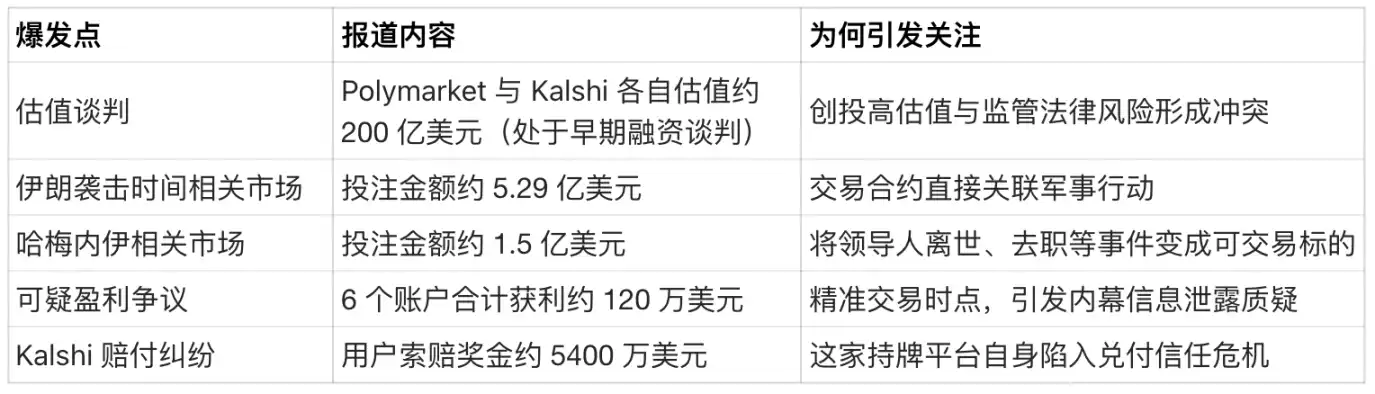
Kalshi's own dispute also shows that regulation alone cannot fully solve the trust problem.

On March 5, Kalshi faced a class-action lawsuit where users accused the platform of refusing to pay approximately $54 million in winnings—users had bet that Iran's supreme leader would step down before March 1. The plaintiffs claimed the platform only activated a "death-related exception clause" after the Iranian leader was attacked, using it to refuse payment.

But Kalshi stated that its rules regarding trades on leader deaths were already clear, and it had refunded fees and compensated users for losses, meaning users did not lose money.

This is precisely the contradictory dilemma currently facing investors and policymakers.

Investors hope the industry will achieve growth, expand its reach, and justifiably integrate probability prediction data into the mainstream information system.

Users hope that when event outcomes are controversial and emotionally charged, the platform rules will be stable and credible.

Regulators希望杜绝 (hope to eliminate) these markets turning sensitive state actions into tradable products, avoiding situations where "access to confidential intelligence yields optimal trading returns." Because once these trading prices begin to influence the public information environment, the associated risks evolve into a governance challenge.


Related Questions

QWhat is the total amount of money involved in the Iran-related contracts on Polymarket, and how was it distributed between the two main types of contracts?

AApproximately $679 million was involved in Iran-related contracts on Polymarket. This includes about $529 million bet on contracts related to the timing of an attack and approximately $150 million on contracts concerning the ousting or death of Supreme Leader Khamenei.

QWhy are US regulators and lawmakers moving to create new rules for prediction markets, specifically in response to the Iran-related events?

AUS regulators and lawmakers are moving to create new rules because the Iran-related contracts highlighted the risk of prediction markets being used for trading on sensitive or even classified information related to military actions and political assassinations. This raises concerns about insider trading, the potential to incentivize the leaking of state secrets, and the platforms' influence on public perception when their data is integrated into mainstream media.

QHow have mainstream media organizations partnered with prediction market platforms like Kalshi and Polymarket, and what does this signify for the industry?

AMainstream media organizations have formed significant partnerships with these platforms. CNBC has a multi-year deal with Kalshi to integrate its probability data into its TV and digital programming starting in 2026. Dow Jones has an exclusive partnership with Polymarket to bring prediction data to platforms like The Wall Street Journal and Barron's, treating the contract prices as part of their news infrastructure. This signifies the industry's attempt to legitimize itself as a provider of valuable information tools rather than mere gambling platforms.

QWhat specific incident involving six accounts on Polymarket raised suspicions of insider trading related to the Iran events?

AJust hours before a high-level Iranian official was attacked, six accounts suddenly deposited funds and placed bets on the relevant contracts. These accounts collectively profited approximately $1.2 million from their precisely timed trades, raising strong suspicions of insider trading based on non-public information about the impending event.

QWhat is the core dilemma facing investors, users, and regulators regarding the future of prediction markets, as illustrated by the article?

AThe core dilemma is a three-way conflict of interests: Investors want the industry to grow and for its probability data to be widely adopted into the mainstream information ecosystem. Users demand that platform rules remain stable and trustworthy, especially when settling emotionally charged and controversial events. Regulators aim to prevent these markets from turning sensitive state actions into tradable products, fearing it creates incentives for leaking机密情报 (classified intelligence) and poses a significant governance risk when trading prices begin to influence public opinion and the information environment.

Related Reads

380,000 Apps Exposed, 2,000+ Apps Leaked Secrets: AI Programming Turns 'Intranet' into Public Internet

Israeli cybersecurity firm RedAccess uncovered a severe data exposure trend linked to "vibe coding" or AI-powered software development tools. Their research found approximately 38,000 publicly accessible web applications built with platforms like Lovable, Base44, Netlify, and Replit. Of these, an estimated 2,000 apps exposed sensitive corporate and personal data, including medical records, financial information, internal strategic documents, and customer chat logs. In some cases, access even granted administrative privileges. The core issue stems from default privacy settings that make applications public by default, combined with a lack of built-in security controls (like authentication) in the AI-generated code. This allows employees without security expertise—"citizen developers"—to easily create and deploy applications that bypass standard corporate security reviews. The exposed apps, often indexed by search engines, are trivially discoverable. While some platform providers (Replit, Lovable, Wix/Base44) argue that security configuration is the user's responsibility and question the validity of some findings, security researchers confirm the widespread reality of such exposures. This pattern, also noted in prior studies, highlights a critical security gap as AI democratizes app creation, potentially leading to massive, unintentional data leaks.

marsbit10m ago

380,000 Apps Exposed, 2,000+ Apps Leaked Secrets: AI Programming Turns 'Intranet' into Public Internet

marsbit10m ago

Attracting Global Capital, Asia's New 'Super Cycle' Is Unfolding

Investors are turning to Asia as the next frontier for global equity growth, with a new "super cycle" unfolding across the region. Driven by the AI revolution, Asian markets, particularly South Korea, have seen significant rallies. According to Morgan Stanley analysis, the underlying drivers of Asia's industrial cycle are shifting from traditional sectors like real estate and manufacturing to massive investments in AI infrastructure, energy security and transition, and supply chain resilience. Fixed asset investment in Asia is projected to grow from around $11 trillion in 2025 to $16 trillion by 2030, with a 7% annual growth rate from 2026-2030. The AI wave is a primary catalyst, driving immense capital expenditure for chips, servers, data centers, and power systems. Asia is central to this hardware supply chain. In China, AI investment is focused on building a full-system domestic capability, with the local AI chip market potentially reaching $86 billion by 2030. Beyond AI, China's export story is expanding from EVs and batteries to robotics. The country already captures about half of new global industrial robot demand and over 90% of humanoid robot shipments. This growth phase mirrors the early stages of China's EV export boom. Simultaneously, energy security investments, spurred by AI's massive power needs, are rising, with China benefiting from its leadership in solar, batteries, and EVs. Regional defense spending is also increasing structurally, supporting demand for advanced manufacturing. The main beneficiaries are China, South Korea, and Japan, positioned in core supply chain areas. However, risks remain, including potential overcapacity, profit margin pressures from competition, persistent technological restrictions, geopolitical friction, and workforce displacement due to AI-driven automation. Market volatility is also expected to increase as investor expectations diverge on the realization of these capital investment and export themes.

marsbit11m ago

Attracting Global Capital, Asia's New 'Super Cycle' Is Unfolding

marsbit11m ago

Funding Weekly Report | 14 Public Funding Events, Kalshi Completes $10B New Funding Round at $220B Valuation Led by Coatue Management

Weekly Funding Roundup: 14 Deals and $10.49B+ in Total Funding, Led by Kalshi's $1B Round Last week (5.4-5.10) saw 14 notable funding events in the global blockchain ecosystem, raising over $10.49 billion in total. Key highlights include Kalshi, a prediction market platform, securing a $1 billion round led by Coatue Management, reaching a $22 billion valuation. The platform now boasts ~2 million MAUs and $178B in annualized trading volume. In DeFi, regulated on-chain reinsurer OnRe raised $5 million in Series A funding, and Bitcoin-backed credit protocol Saturn Credit completed a $2 million seed round. For Infrastructure & Tools, OpenTrade raised $17 million to expand its stablecoin yield infrastructure, and RWA platform Balcony secured $12.7 million to deploy its property settlement service in the US. Centralized Finance saw one deal: AI-driven trading platform Stockcoin.ai completed a seed round led by Amber Group. In the prediction market sector alongside Kalshi, AI-powered platform Elastics raised $2 million. Other notable deals include SC Ventures' strategic investment in crypto market maker GSR and Centrifuge securing a "seven-figure" investment from Coinbase to become a core RWA partner for Base. On the investor side, Haun Ventures raised a new $1 billion fund targeting crypto and AI, and Multi Investment raised ~$616 million to focus on blockchain and Web3 investments.

marsbit1h ago

Funding Weekly Report | 14 Public Funding Events, Kalshi Completes $10B New Funding Round at $220B Valuation Led by Coatue Management

marsbit1h ago

Trading

Spot
Futures
活动图片




