Fantom Foundation Releases Statement Following Andre Cronje's Exit: Details

u.todayPublished on 2022-03-11Last updated on 2022-03-11

Abstract

Fantom Foundation, the nonprofit behind the development of high-perfromance blockchain Fantom (FTM) and associated dApps, released a statement to make things clear before the resignation of Andre Cronje.

Contents

  • Fantom (FTM) development continuing and accelerating
  • Here's how Andre Cronje's departure affected the altcoins
    Fantom Foundation, the nonprofit behind the development of high-perfromance blockchain Fantom (FTM) and associated dApps, released a statement to make things clear before the resignation of Andre Cronje.
    Fantom (FTM) development continuing and accelerating
    According to the official statement shared by Fantom Foundation on its blog, there was a lot of "miscommunication" after media outlets started to spin the narrative of Andre Cronje's decision to leave DeFi segment.
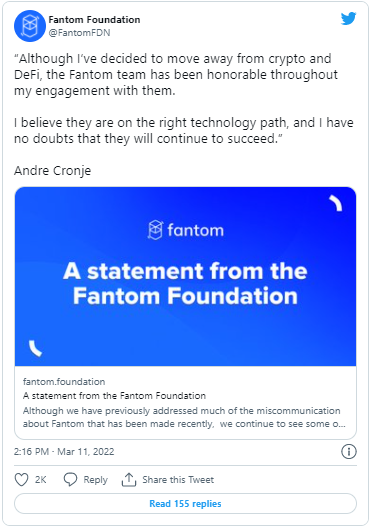

Largely, this statement is set to explain that the influence of Andre Cronje's decision on Fantom's progress and promotion should not be exaggerated.
As per the document, neither Cronje nor his colleague Anton Nell were core developers of Fantom (FTM). Like other products that had been curated by Cronje, Fantom (FTM) has its own team to be responsible for Fantom's future.
As such, the roadmap of Fantom is still valid: the team is even expanding its human and technical resources:
Fantom's technology development is continuing as normal. In fact, it is accelerating, with new hires being made.

Here's how Andre Cronje's departure affected the altcoins
Also, Fantom's representatives stressed that media outlets that spread the misinformation had their articles retracted in "one-two hours."
As covered by U.Today previously, Andre Cronje and Anton Nell decided to quit all activities in the decentralized finance segment. They left their advisory positions at Yearn.Finance, Solidly and so on.

YFI, FTM, KP3R and other native cryptocurrencies of the products associated with these devs simultaneously posted double-digit losses in almost no time.
Known as "DeFi Dad," South African engineer Andre Cronje is one of the most influential developers in DeFi: he is an architect of the Yearn.Finance (YFI) protocol.

Related Reads

After Marvell's 32% Surge, the Chinese Chip Family Behind It Emerges

The stock price of Marvell Technology surged 32.5% on June 2nd, driven by NVIDIA CEO Jensen Huang highlighting its custom ASICs and optical interconnects as core to AI data center architecture. This event brought attention to the Chinese semiconductor family behind Marvell: the Dai siblings. The story centers on three siblings, all UC Berkeley graduates, whose three-decade entrepreneurial journey aligns with major semiconductor industry shifts. In 1995, youngest sister Dai Wei Li co-founded Marvell with her husband Sehat Sutardja and his brother, focusing on storage controllers. Eldest brother Dai Wei Min founded EDA company Ultima, later sold to Cadence, and later founded VeriSilicon (芯原) in China, becoming a leading semiconductor IP provider. Second brother Dai Wei Jin co-founded EDA firm Silicon Perspective (sold to Cadence) and GPU IP company Vivante, later acquired by VeriSilicon. The combined "Dai-Sutardja" family network extends beyond Marvell. Their ventures and investments form a comprehensive ecosystem for the post-Moore's Law, chiplet era. Key holdings include: Dream Big Semiconductor (AI SuperNICs, acquired by Arm), Alphawave (high-speed SerDes IP, acquired by Qualcomm), and Silicon Box (a chiplet advanced packaging foundry). VeriSilicon itself thrives on the AI ASIC and IP boom in China. Collectively, the family's AI infrastructure-related portfolio is estimated at over $22 billion. Their strategy represents a distinct path: building critical components for open standards and key manufacturing capacity in the chiplet era, rather than pursuing standalone AI chip dominance. While this path may not create the next NVIDIA, it has enabled repeated successful exits and sustained influence within the global semiconductor industry.

marsbit1h ago

After Marvell's 32% Surge, the Chinese Chip Family Behind It Emerges

marsbit1h ago

Microsoft is Afraid of Being Marginalized by AI Giants

Microsoft, once the defining force of the PC era, now faces a familiar challenge in the AI age: the risk of being relegated to a profitable but invisible infrastructure provider. This anxiety was laid bare at Build 2026, where CEO Satya Nadella unveiled a major strategic pivot. The catalyst was a quiet April agreement that dissolved Microsoft's exclusive licensing and cloud-hosting deal with OpenAI, its once-vital partner. This erased Microsoft's key AI moat. With OpenAI and Anthropic defining AI applications and gaining enterprise traction—even within Microsoft's own ranks—Nadella had to answer: without exclusivity, what is Microsoft's role? The answer was a suite of seven in-house AI models, a developer-focused AI workstation (Surface RTX Spark Dev Box), and, most crucially, the Agent 365 platform for enterprise AI governance. The models, notably targeting Anthropic's strengths in coding and enterprise, signal a defensive move. However, the broader strategy is to make the models themselves less decisive. Financially, Microsoft's AI revenue is strong, driven largely by Azure running others' models. Yet its user-facing products like Copilot show weak penetration and engagement. Microsoft earns infrastructure money but lacks direct user mindshare. Nadella's core fear is being "hollowed out." As OpenAI and Anthropic prepare for IPOs and gain financial independence, they may build their own infrastructure, threatening Azure's lucrative AI revenue stream. Microsoft's window is to entrench itself deeper: not as the model creator, but as the indispensable platform for securely deploying, managing, and governing all AI models within the enterprise through Agent 365. Build 2026 revealed Microsoft's bet: in the AI era, the ultimate power lies not in any single model, but in the enterprise "operating system" that controls them. Nadella is determined to ensure Microsoft is the driver of this new era, not just a passenger.

marsbit1h ago

Microsoft is Afraid of Being Marginalized by AI Giants

marsbit1h ago

CPU, Quietly Returning to the Center of the AI Computing Power Stage

Over the past three years, AI computing power narratives have been dominated by GPUs. However, starting in 2026, this story began to shift. While training large models remains GPU-intensive, the rapid growth of inference and AI agent workloads, which require high levels of task orchestration, concurrency, and data flow management, has highlighted a renewed critical role for CPUs. These are tasks GPUs are not designed to handle. Intel's recent launch of the Xeon 6+ processor, built on its Intel 18A process and featuring up to 288 efficiency cores (E-cores), exemplifies this strategic pivot. It is positioned not as a mere companion to GPUs but as the essential "control plane" for AI infrastructure, optimized for high-density, energy-efficient, and high-throughput workloads characteristic of AI agents and inference. This "CPU resurgence" is not about CPUs outperforming GPUs in raw computation. It reflects a systemic bottleneck: as AI scales from training single models to deploying countless intelligent agents, the demand for coordination and data handling surges. Major cloud providers are also developing their own high-density ARM-based server CPUs for similar workloads. However, Intel's success with this strategy faces significant challenges. Competition includes NVIDIA's integrated CPU-GPU solutions, the expanding adoption of cloud vendors' in-house ARM CPUs, and the crucial market test of Intel's 18A manufacturing process against rivals like TSMC's N2. In conclusion, CPUs are indeed reclaiming a central, though redefined, role in AI compute—managing the complex orchestration that enables massive-scale AI deployment. While the trend is clear, which company will ultimately lead this CPU resurgence remains an open question to be decided in the data centers of 2027 and beyond.

marsbit1h ago

CPU, Quietly Returning to the Center of the AI Computing Power Stage

marsbit1h ago

Trading

Spot
Futures

Hot Articles

How to Buy YFI

Welcome to HTX.com! We've made purchasing yearn.finance (YFI) simple and convenient. Follow our step-by-step guide to embark on your crypto journey.Step 1: Create Your HTX AccountUse your email or phone number to sign up for a free account on HTX. Experience a hassle-free registration journey and unlock all features.Get My AccountStep 2: Go to Buy Crypto and Choose Your Payment MethodCredit/Debit Card: Use your Visa or Mastercard to buy yearn.finance (YFI) instantly.Balance: Use funds from your HTX account balance to trade seamlessly.Third Parties: We've added popular payment methods such as Google Pay and Apple Pay to enhance convenience.P2P: Trade directly with other users on HTX.Over-the-Counter (OTC): We offer tailor-made services and competitive exchange rates for traders.Step 3: Store Your yearn.finance (YFI)After purchasing your yearn.finance (YFI), store it in your HTX account. Alternatively, you can send it elsewhere via blockchain transfer or use it to trade other cryptocurrencies.Step 4: Trade yearn.finance (YFI)Easily trade yearn.finance (YFI) on HTX's spot market. Simply access your account, select your trading pair, execute your trades, and monitor in real-time. We offer a user-friendly experience for both beginners and seasoned traders.

2.1k Total ViewsPublished 2024.03.29Updated 2026.06.02

How to Buy YFI

Discussions

Welcome to the HTX Community. Here, you can stay informed about the latest platform developments and gain access to professional market insights. Users' opinions on the price of YFI (YFI) are presented below.

活动图片