February saw a steady run of applications in the blockchain sector despite declining macroeconomic conditions triggered by the conflict in Ukraine. DeFi recovered slowly, with some blockchains and cryptocurrencies showing a modest recovery.
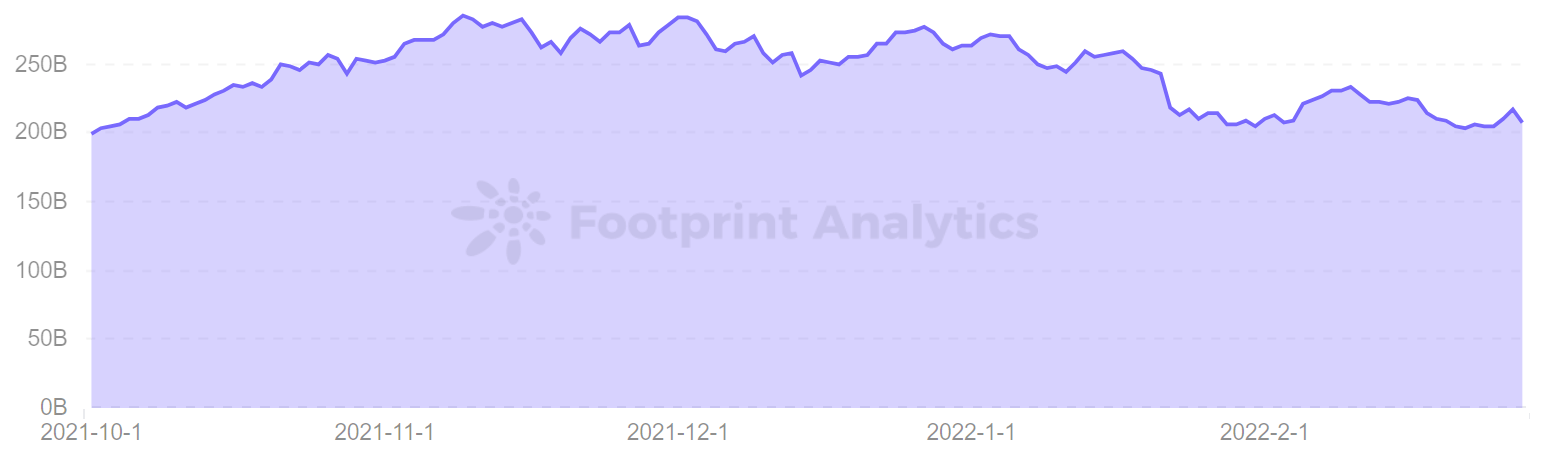
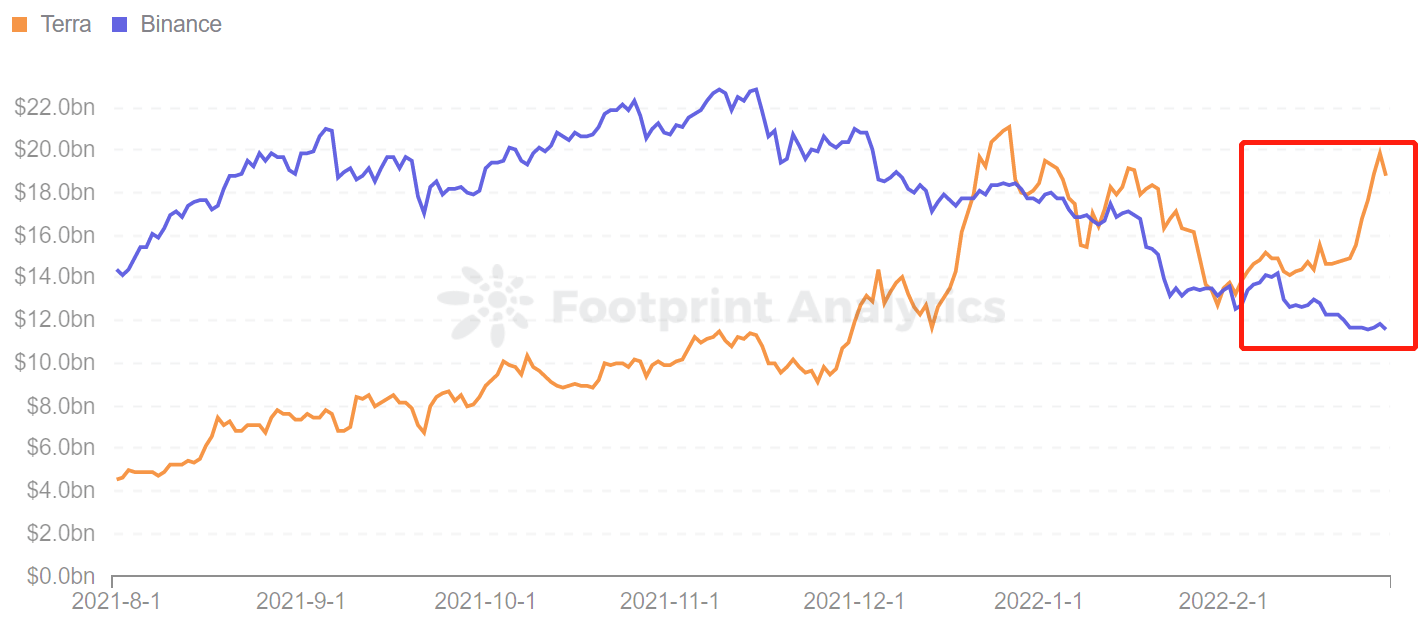
Footprint Analytics data shows DeFi’s TVL at $207.2 billion, up 1.06% MoM, while BTC and ETH are up about 10% MoM. Most notably, Terra surpassed BNB Chain to become the No. 2 blockchain on the network with $18.83 billion, and the price of its token, LUNA, soared to $91, up 75.8% MoM.
Conversely, the NFT market is cooling in terms of the monthly trading volume. This report will analyze the overall situation of the crypto market in February according to data.
BTC, ETH Up About 10%, Liquidation Funds Down 95.53%
In February, the price of BTC hovered between $37,000 and $44,000 and the price of ETH between $2,600 and $3,200, neither of which had recovered from last November’s peak.
Here’s how the Russian invasion of Ukraine affected the price of BTC and ETH:
- On Feb. 24, Russia announced a “military operation”, causing BTC and ETH prices to fall along with global financial markets.
- In late February, cryptocurrencies were increasingly used to fund humanitarian and military aid as the Russia-Ukraine conflict and ensuing economic sanctions exposed the need for a decentralized ecosystem, and cryptocurrency prices clearly increased.
According to Footprint Analytics price trends, as of Feb. 28, the price of BTC was $43,286 and the price of ETH was $2,929.53, up about 10% sequentially. This also means that cryptocurrency prices are highly correlated with national policies and macroeconomic conditions.
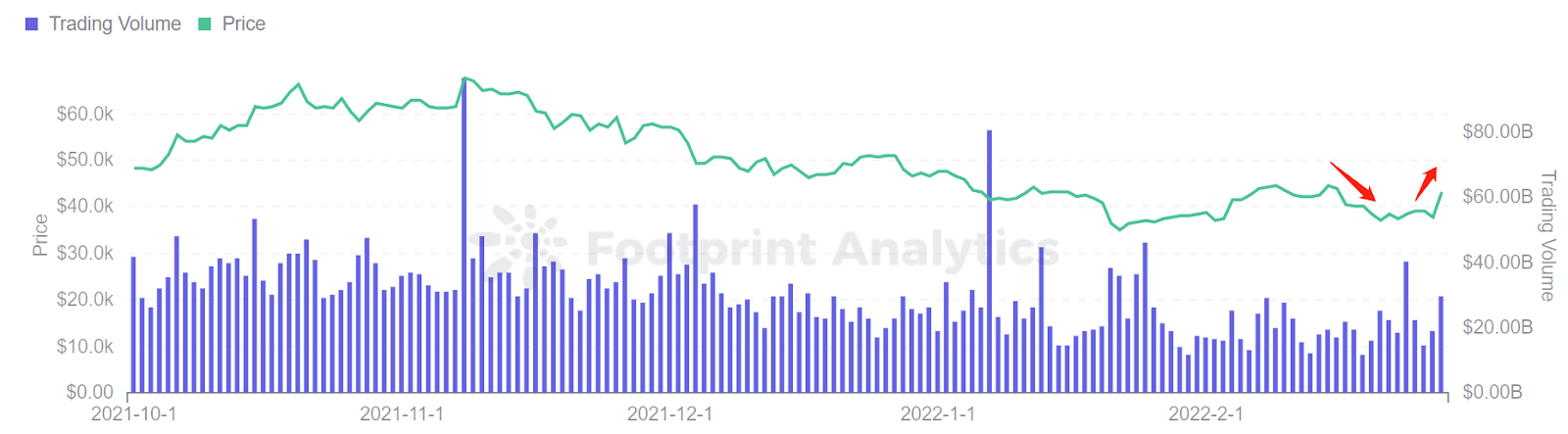

Footprint Analytics – Price & Trading Volume of BTC
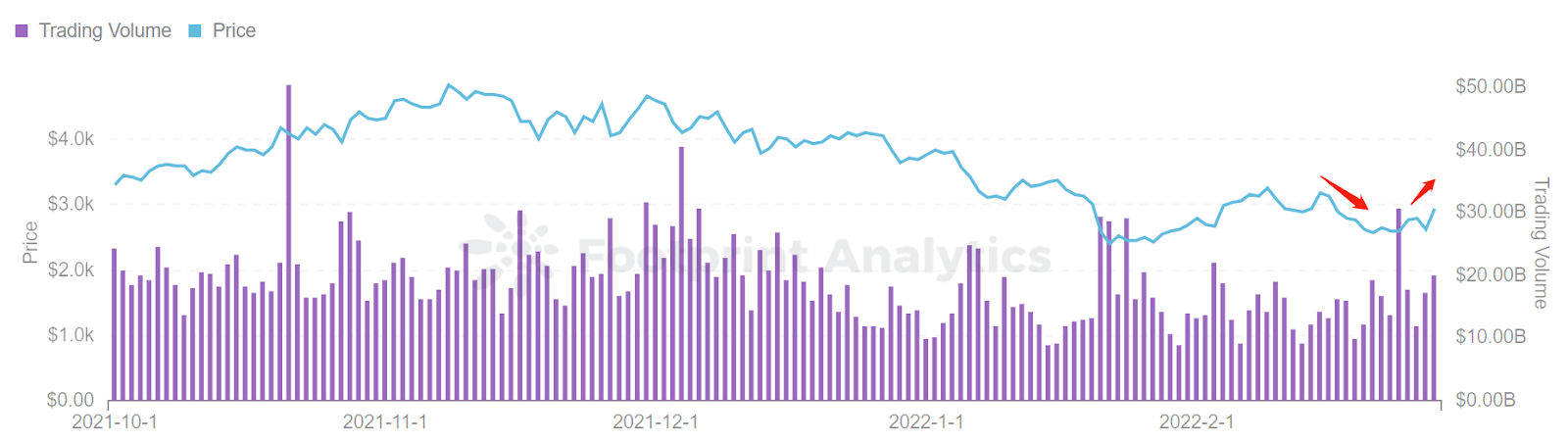

Footprint Analytics – Price & Trading Volume of ETH
The conflict between Russia and Ukraine is what triggered the liquidation of more than 80% of investors in the AAVE lending agreement on Feb. 24. However, compared to January, the amount liquidation in February fell from $425 million to $18.96 million, a decrease of 95.53%.
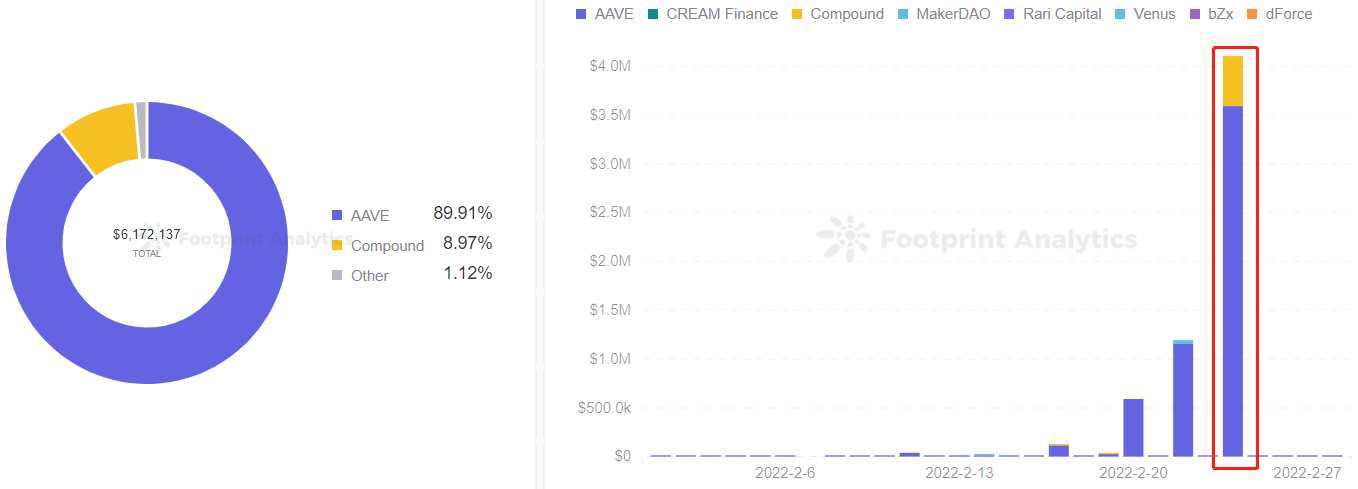
Footprint Analytics – Liquidation Amount of BTC by Protocols
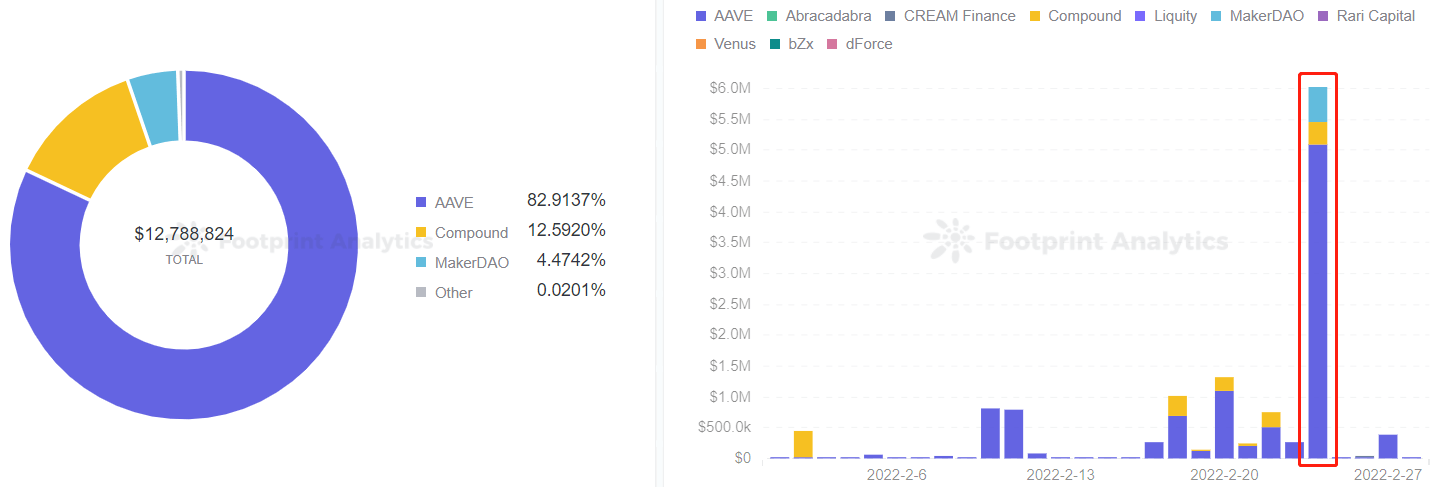
Footprint Analytics – Liquidation Amount of ETH by Protocols
DeFi Slowly Recovering, Up 1.06% MoM
Following the trend of a full downturn in the DeFi market in January, February saw a slow recovery.
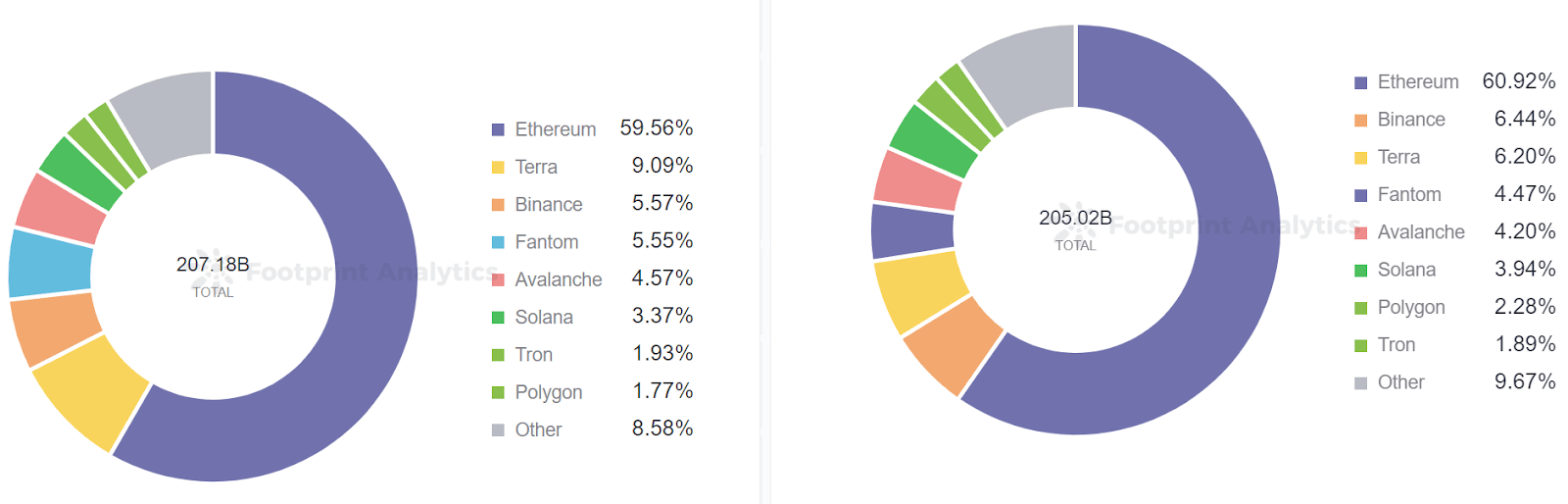
TVL recovered to $207.18 billion from $205.02 billion, ending the month with a slight 1.06% increase in TVL. Despite the modest increase in TVL, the overall size of the market remains above $200 billion.
Footprint Analytics – TVL of DeFi
Lido’s Single Currency Staking Model Helps Terra Overtake BNB Chain
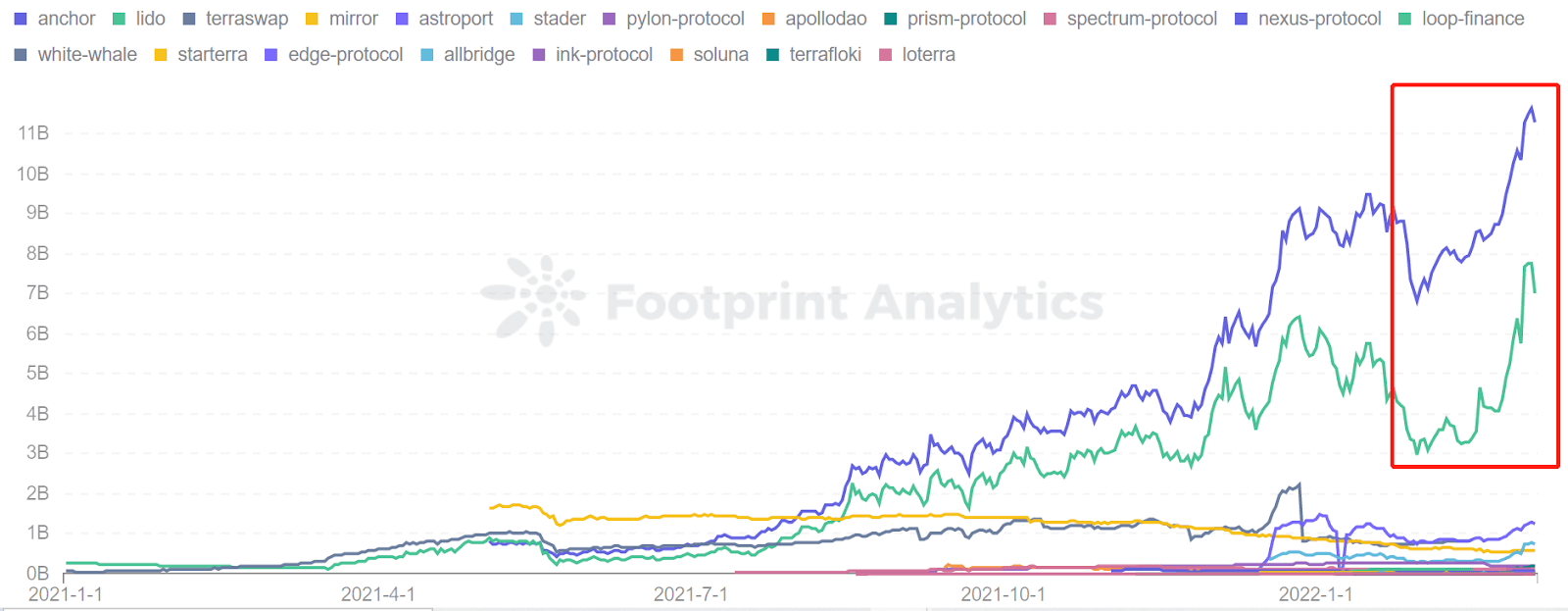
Terra overtook BNB Chain for the second spot with $18.83 billion in lockup volume in eight months and pulled away from BNB Chain in February. Of course, Terra TVL’s growth is fueled by the Lido and Anchor protocols.
Footprint Analytics – TVL for BNB Chain & Terra
Footprint Analytics – Market Share of TVL for Chains
LUNA is Terra’s native token and, as of Feb. 28, the price of LUNA has increased from $52.31 at the beginning of the month to $91.01, up 75.8% MoM.
LUNA’s growth is due to two main factors:
- Terra and Luna Foundation Guard (LFG), the non-profit organization supporting Terra, announced on Feb. 23 a $1 billion LUNA Token sale to help develop the Terra ecosystem to create a decentralized foreign exchange reserve to protect the UST (TerraUSD) peg to the U.S. dollar.
- Lido supports several mainstream blockchains, and the largest share of Lido TVL is currently Terra (about 55%). Lido also has innovative tokenomics, which support staking single currency (e.g. staking LUNA to get 1:1 price stLUNA) to external contracts for a higher APY.
Footprint Analytics – Terra TVL by Protocol
Fixed-Rate Lido and Anchor, Fastest Growing in DeFi
Curve and MakerDAO are still untouchable, they are tied to a stablecoin and their stability is trusted by most users.
Among the many DeFi protocols, the most prominent and fastest-growing are Lido (+46%) and Anchor (+52%), with TVLs of $11.2 billion and $10.3 billion respectively, outpacing protocols such as Compound and Uniswap v3. Both Lido and Anchor are deployed on Terra, which uses an algorithmic stablecoin as an entry point to give users a UST stablecoin for saving and lending.
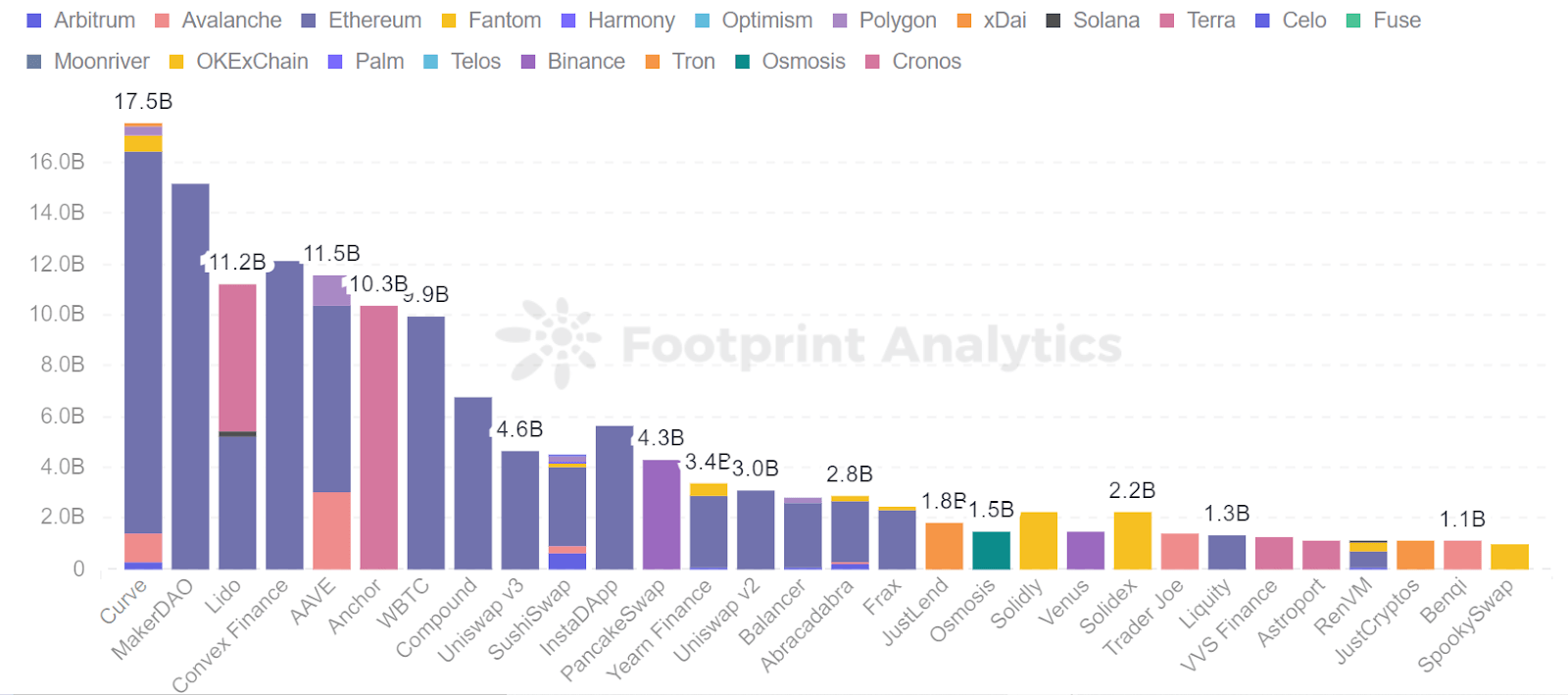
Footprint Analytics – TVL by Protocols(Feb. 28, 2022)
NFT Trading Volume Down 67% in February Compared to January
According to Footprint Analytics data, NFT transaction volume in February was $2.787 billion, down a whopping 67% from January.
Does it appear that investor interest in NFT is declining? Actually, for NFTs, since January’s numbers were at a high level, the drop in February’s trading volume may have been a simple pullback.
On top of that, investors’ attention has shifted to cryptocurrencies amid the conflict between Russia and Ukraine, and they see BTC as a safe haven
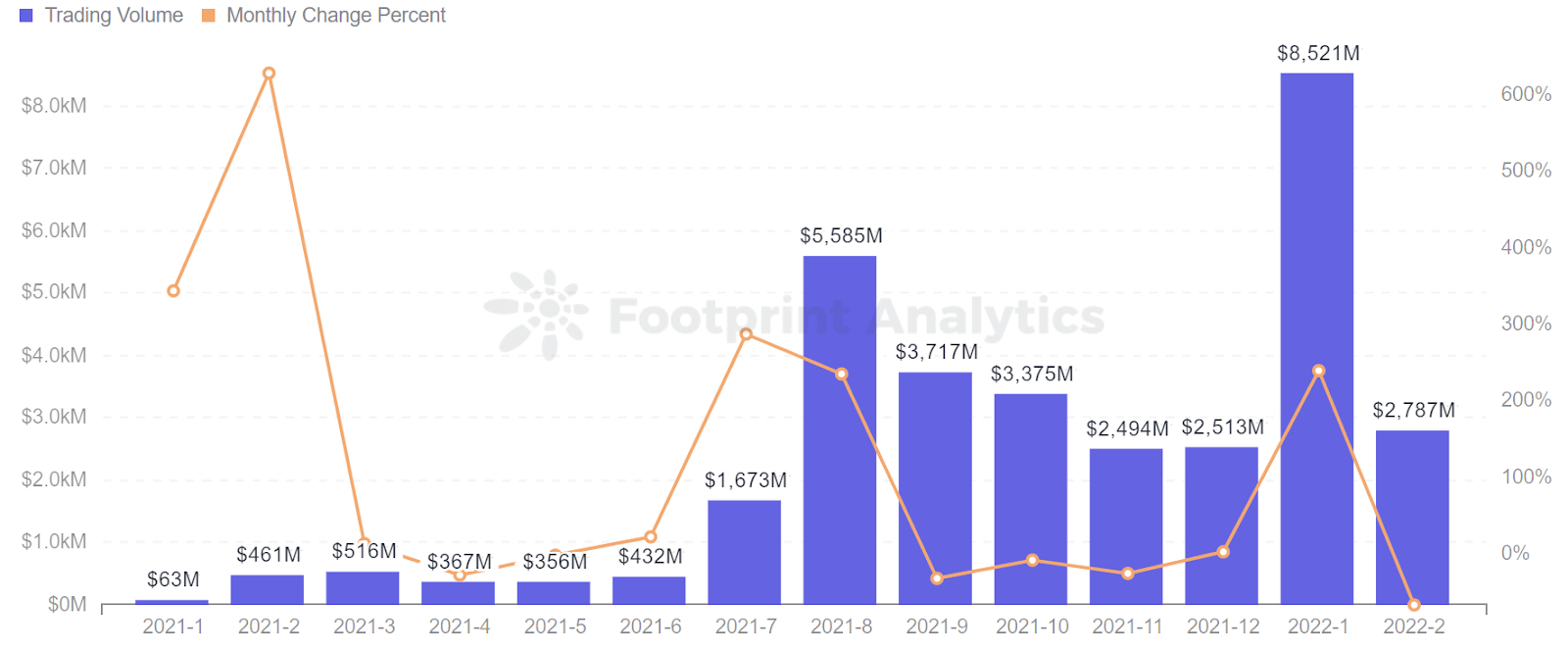
Footprint Analytics – NFT Monthly Trading Volume
OpenSea Becomes a Target for LooksRare and X2Y2
In February, OpenSea’s trading volume growth slowed significantly, especially since Feb. 14, when the average daily trading volume trended downward. This may be related to the phishing attacks on OpenSea and the volatile global market situation.
However, the slowdown in OpenSea has led to the rise of emerging exchanges LooksRare and X2Y2. In early February, LooksRare managed to attract a major share of OpenSea’s NFT trading volume, but the short-term incentive program did not threaten OpenSea’s dominance
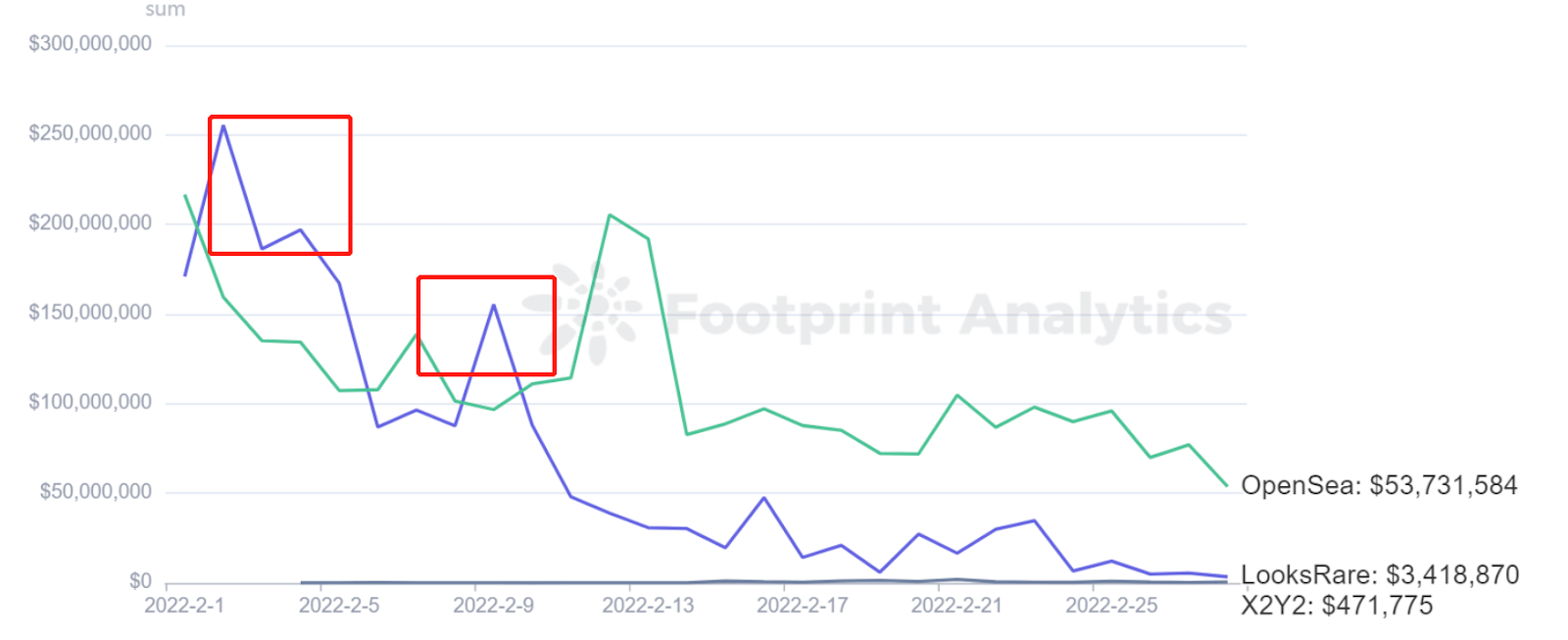
Footprint Analytics – Comparison of Volumes in February
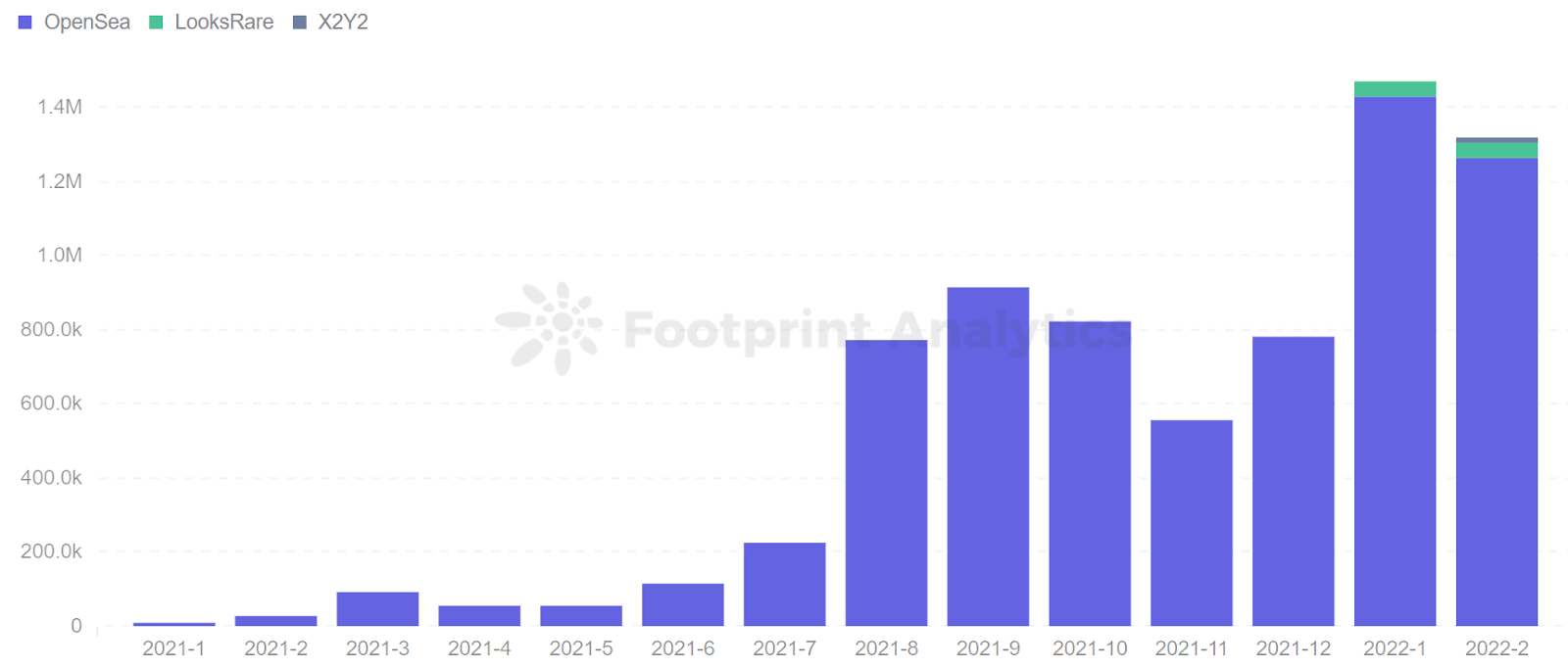
Footprint Analytics – Monthly Number of Users
Terraforms and Meebits are the Most Prominent NFT Projects
According to Footprint Analytics, Terraforms and Meebits saw a spike in transactions from Feb. 16 to 21, with volume reaching $56 million.
Older NFT programs such as Axie Infinity and Bored Ape Yacht Club have more consistent trading volumes and are the most engaged by users.
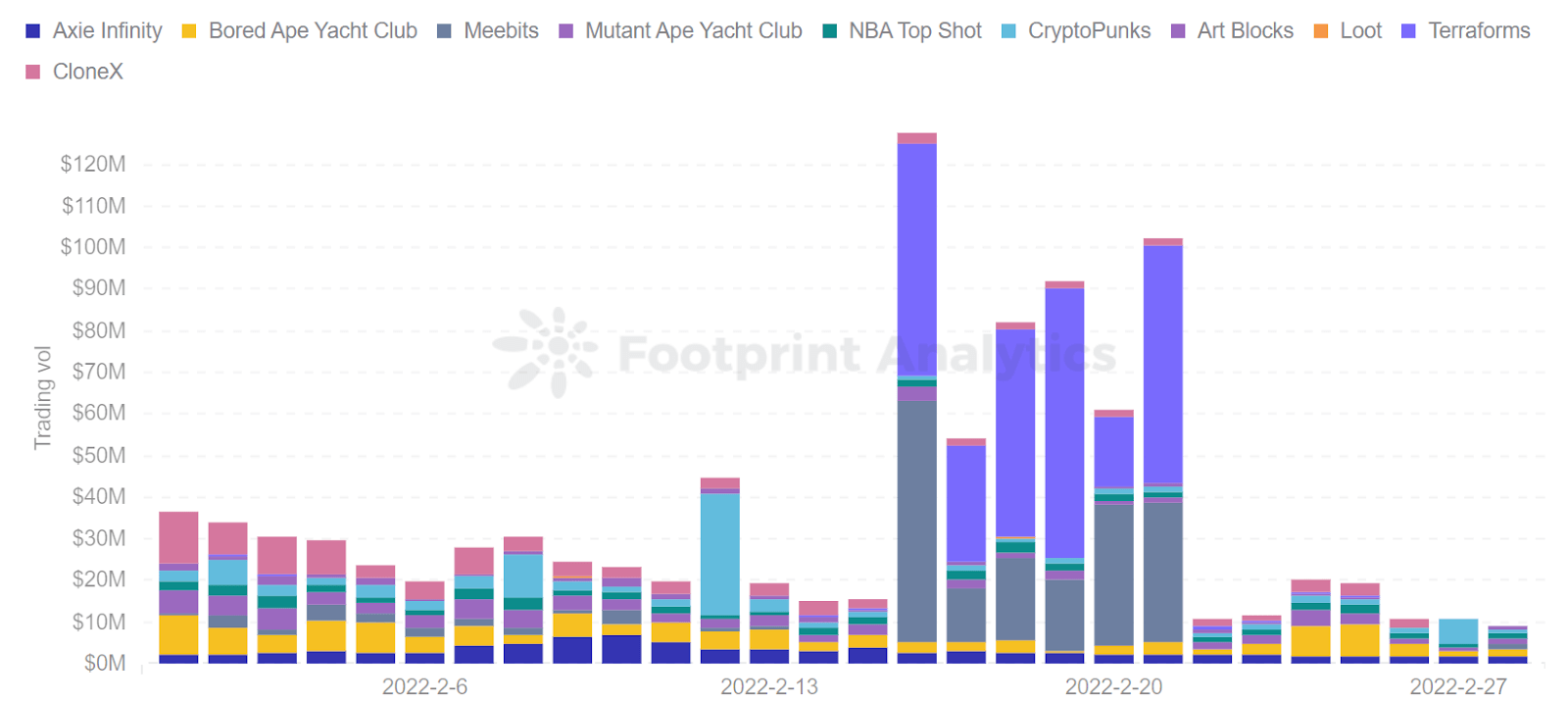
Footprint Analytics – Monthly Top 10 NFT Trading Volume
Monthly Investment Volume Fell 19.6% MoM
Data shows that investments in February were $4.7 billion, down 19.6% compared to January. In terms of investment sectors, the NFT sector saw the biggest drop as investors have shifted their attention to cryptocurrencies and reduced their investments in NFT.
In contrast, Web3-based technologies are becoming more important as decentralized systems become more mainstream. In addition, a16z is also the largest investor in the Web3 sector, with a team of former officials from across the U.S. government. This drove the largest increase in Web3 investments in February (+79% MoM).
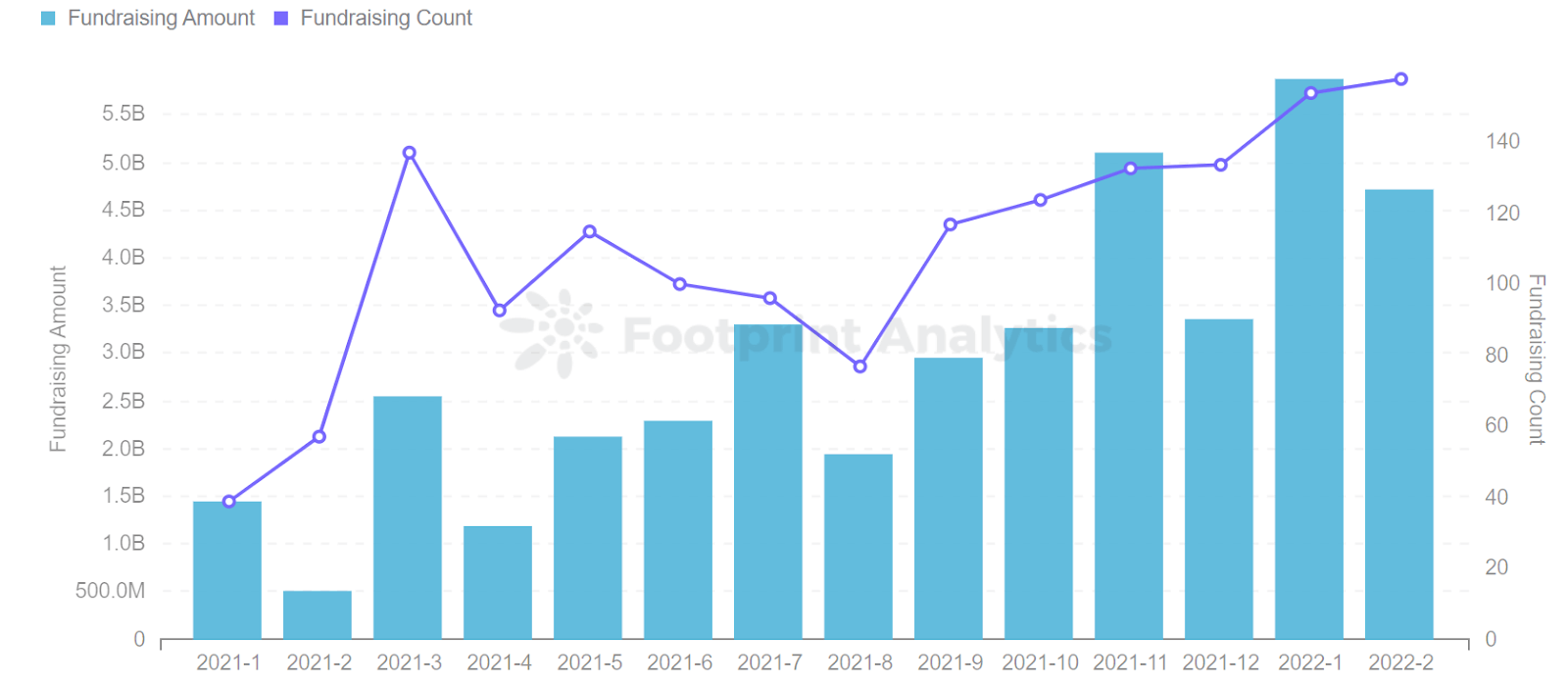
Footprint Analytics – Funding Monthly Investment Trend
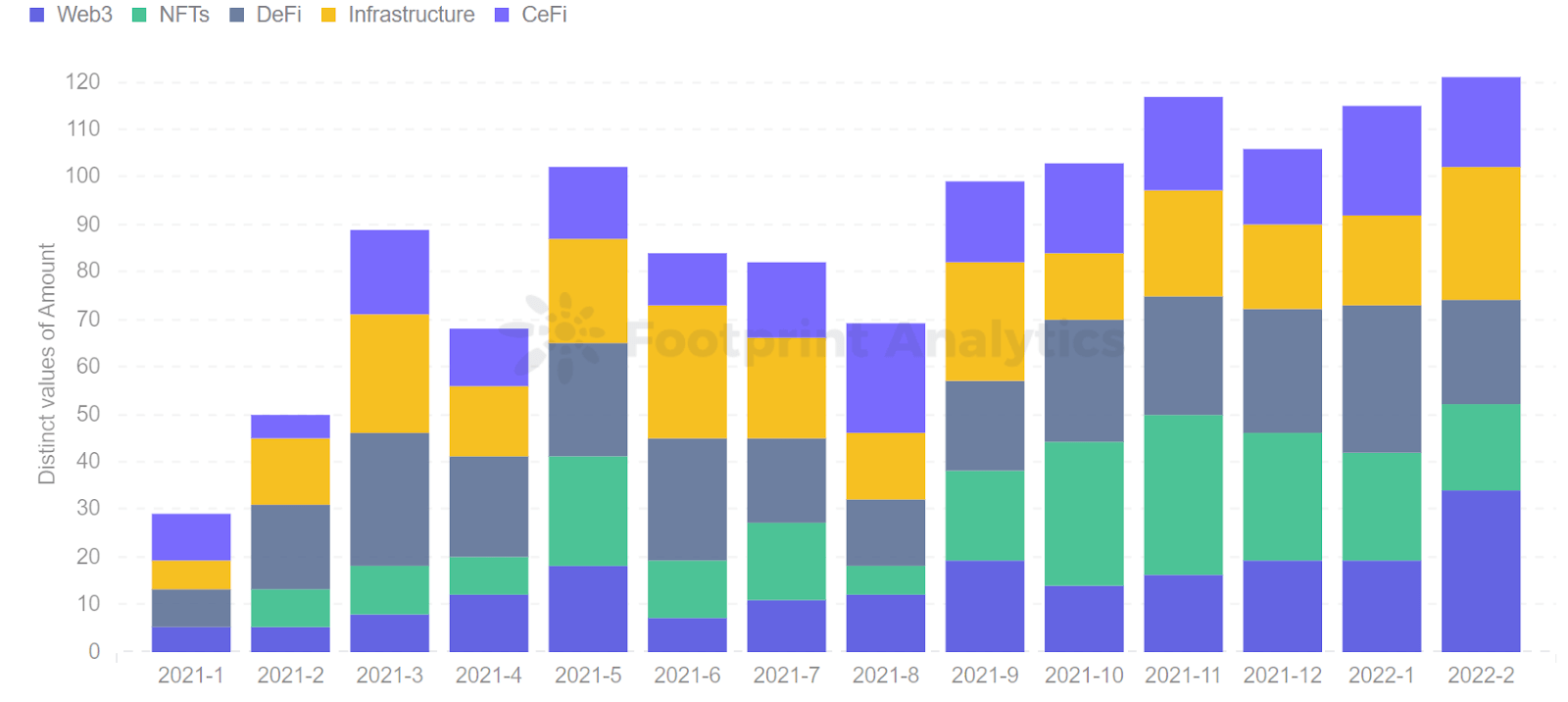
Footprint Analytics – Funding Monthly Investment by Category
Summary
In February, despite the bearish environment, adoption in the blockchain sector continued steadily and trend slightly upwards. In addition, the Russian-Ukrainian conflict and economic sanctions exposed the need for a decentralized ecosystem.
On the other hand, NFTs faced a sharp drop in trading volume and a shift of investors to the Web3 sector, expecting it to recover to its January peak in March.
February Events Review
Nations
- Ukraine has raised $16.7M in cryptocurrency donations
- ECB President calls for approval of cryptocurrency regulatory framework to avoid Russia evading sanctions
- South Africa to finalize amendments to financial law in 2022 involving cryptocurrency-related regulations
- Argentina’s Central Bank sets new rules for digital wallets
- Bitcoin legal tender bill to be proposed in Mexico
Fundraising
- Blockchain storage app ArDrive completes $17.2M seed round led Arweave team
- Web3 infrastructure provider Aligned completes $34M in financing with Gsr and Others
- Hack VC raises $200M fund to back Early-stage crypto startups
- NFT platform ucollex completes $10M series a financing led by Animoca Brands
- Brazilian crypto exchange foxbit raises $21M in Series A Funding
- Payment Technology Company Flutterwave announced that it had completed a $250M Series D Financing at a Valuation of $3B, led by B Capital Group
Blockchain
- The number of ETH locked in the ZkSync L2 Network has exceeded 90,000, and the TVL has reached $75M
- Terra, CEO Do Kwon ordered to comply ith SEC subpoena related to mirror protocol investigation
- TVL of Avalanche Bridge reaches $6.238B
- Eden Network, Ethereum’s Priority Trading Network, releases a POS chain expansion plan
DeFi
- Short positions see $143M in liquidations as BTC, ETH gain 10%
- Yearn.Finance has been deployed on the Ethereum Layer 2 solution Arbitrum
- PancakeSwap DEX reportedly set to block users from Iran
- MakerDAO launches $10M bug Bounty on Immunefi
- Wavebridge releases Chainlink node to bring digital asset index data to DeFi
NFT
- OpenSea phishing email attack again, the official reminder to pay attention to the risk
- Top NFT game Axie Infinity generated $1.3B in revenue last year
- ENS domain name ‘defi.eth’ traded on OpenSea for 40 ETH
- Indian media giant’s fully Faltoo NFTs sell out in 48 hours
- NFT marketplace X2Y2 begins vampire attack on OpenSea
- CryptoPunk #5822 was sold for 8,000 ETH, the highest price in the history of this series of NFTs
Security
- Multichain recovers $2.6M stolen funds, to reimburse losses on condition
- Titano Finance was hacked for 4828.7 BNB