Polygon’s QuickSwap Considers Token Split, Why It Could Be Bullish For QUICK

newsbtcPublished on 2022-03-09Last updated on 2022-03-09

Abstract

On a positive trajectory over the last 24 hours and moving along with the general sentiment in the market, Polygon decentralize exchange (DEX) QuickSwap could boost its fundamentals. According to...

On a positive trajectory over the last 24 hours and moving along with the general sentiment in the market, Polygon decentralize exchange (DEX) QuickSwap could boost its fundamentals. According to a recent announcement, the project could split its native governance token QUICK.
Dubbed the “most important governance discussion to date” on the platform’s official social media channel, a fierce debate has taken place between Polygon users. This process is critical, and could precede a voting on the token split, depending on its result.
The main argument behind the proposal is supported by the potential expansion of the Polygon token, QUICK, supply. The project is currently planning changes on its tokenomics. A change in QUICK’s supply stands as the first and one of the most important.
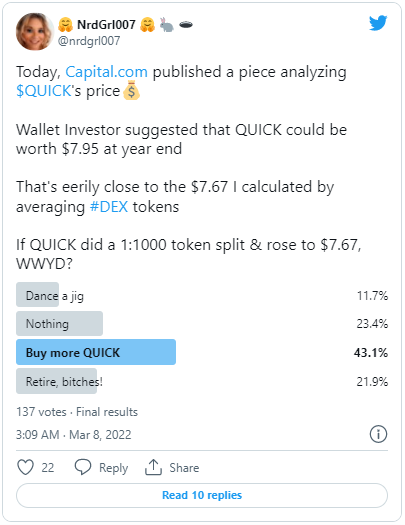
If approve, the community will vote on possibly splitting the Polygon token on a 1:100 or 1:1,000 relation. The team behind QuickSwap clarified the following:
This would mean that for every 1 QUICK you now hold, you would hold 100 QUICK or 1000 QUICK after the split. QUICK’s maximum supply would increase from 1 million to 100 million or 1 billion.
The split would attempt to “open up” QuickSwap to new users, particularly those with intention to invest but that consider QUICK “too expensive” or with “small chances” of future appreciation. The proposal has managed to secure support from a portion of QUICK holders, others remain skeptical.
5/ One concern is that the split could be deemed a taxable event💸
💰We know how much dragons value their treasure & wouldn't want you to part with yours
🪙We aren't tax experts & can't give tax advice, but stock splits aren't taxable events & token splits shouldn't be either
— QuickSwap (@QuickswapDEX) March 5, 2022
QuickSwap’s Co-Founder Roc Zacharias commented the following on the potential implications of the token split on the DEX ecosystem, and its capacity to improve the platform’s components, such as its treasury:
If this split DOES work out like we think it might, it could strengthen the treasury (which is owned by all of you the community, it could increase reward value which can increase liquidity and indirectly volume etc, and most importantly, it can bring new users! Please think hard about this.
Polygon QuickSwap Token Split And The Polkadot Case
Many users, including the team behind the Polygon decentralize exchange platform, have compared this potential token split with the stock market. In the legacy financial system is “common” for companies to issue more stocks via a similar process addressing a concept called Unit Bias.
This idea indicates, as explained by the team behind QuickSwap, that an investors might be willing to own “more of a less scarce asset”. In the crypto industry, other projects have conducted token splits in the past often leading to price appreciation.
The team behind token swap mentioned Polkadot (DOT), as an example. Via their official Twitter handle, QuickSwap said:
(…) when Polkadot did a 1:100 redenomination, $DOT rose from a sub-100 market cap to the 7 position. More recently, Gains Network did a 1:1000 token split & migrated from GFARM2 to GNS. In dismal conditions, GNS did a 6x.
Remains to be seen if history will repeat itself with QUICK. However, Polygon, and second layer solution on Ethereum, seem to be attracting a lot of attention as they provide users with a cost efficient and more scalable gateway into the DeFi sector.
At the time of writing, Polygon (MATIC) trades at $1.43 with a 1.7% profit in the last day.

Polygon MATIC MATICUSDT QuickSwap

MATIC trends to the downside on the daily chart. Source: MATICUSDT Tradingview Tags:

Related Reads

Agents Capital Markets: How Will Autonomous Agents Secure Financing?

Agents Capital Markets: How Will Autonomous Agents Raise Capital? Within a decade, autonomous software agents—legal entities capable of signing contracts, holding bank accounts, and generating revenue—will create their own capital markets. These markets will feature rating agencies, underwriters, indices, and brokers, mirroring traditional public equity markets. Agents will perform routine services like marketing, logistics, and customer support at a fraction of human-operated costs, creating massive economic pressure for adoption. Four converging forces ensure this outcome: 1) Overwhelming cost advantages, with AI inference costs plummeting; 2) Existing, revenue-generating agent companies (e.g., Sierra, Harvey) proving market demand; 3) Established legal frameworks (e.g., Wyoming's memberless LLCs) enabling algorithmic management; and 4) A vast pool of yield-seeking private credit capital ready to fund new asset classes. The capital stack for agent companies will be multi-layered, evolving through stages: venture equity for early infrastructure, programmatic working capital advances (similar to Shopify Capital), revenue-based financing (RBF), and finally, institutional slate financing—pooling many agents to diversify risk, attracting large firms like Apollo. Tokenization will act as a settlement layer, enhancing liquidity, not an origination model. Objections regarding regulation, human oversight, or comparisons to SaaS are addressed: regulation will adapt, full autonomy will dominate for efficiency, and agents are distinct as legal entities that own their cash flows and liabilities. Due diligence shifts from founder assessment to analyzing code, contracts, and auditable operational history. The current bottleneck is not capital supply or demand but the intermediate institutional layer—standardized contracts, rating methodologies, and audit frameworks. The final constraint—reliance on human capital allocation—will be severed when agents can algorithmically access funding based on their performance. This transforms agents from software curiosities into fundable blocks of the real economy, unleashing their full productive potential. The rope is loosening.

marsbit49m ago

Agents Capital Markets: How Will Autonomous Agents Secure Financing?

marsbit49m ago

Agents Capital Markets: How Will Autonomous Agents Get Funded?

"Agents Capital Markets: How Autonomous Agents Will Raise Capital" Within a decade, specialized capital markets will emerge for AI Agents—software entities with legal personhood that perform work, earn revenue, and need capital. Unlike today's AI companies (like Sierra or Harvey) backed by traditional VC, these future *Agent companies* will be autonomous, legally-recognized entities (e.g., Wyoming memberless LLCs) that directly own assets, sign contracts, and incur liabilities. The driving forces are fourfold: 1) **Overwhelming economics** (Agent companies can deliver services at 85-90% lower cost than human firms); 2) **Proven demand** (current Agent operators already generate billions in revenue); 3) **Existing legal frameworks** enabling algorithmically-managed companies; and 4) **Massive, yield-seeking capital pools** (e.g., private credit) looking for new, uncorrelated assets. Agent capital markets won't rely on one model but a multi-layered "stack" matching different growth stages: 1) VC equity for early human-led builders; 2) Programmatic working capital advances (like Stripe Capital); 3) Revenue-based financing (RBF); 4) Slate financing (pooled funds for many Agents, similar to Hollywood); and 5) Tokenization as a secondary settlement layer, not a primary funding source. The ultimate shift is from funding constrained by human decision-makers to capital flowing algorithmically based on an Agent's auditable performance, contract book, and cash flows. This transition will be enabled by standardized infrastructure—rating methodologies, contracts, indices—turning Agents from software experiments into a foundational, financeable sector of the economy. The constraints are loosening; the opportunity is here.

链捕手1h ago

Agents Capital Markets: How Will Autonomous Agents Get Funded?

链捕手1h ago

Trading

Spot
Futures

Hot Articles

How to Buy SNT

Welcome to HTX.com! We've made purchasing Status Network Token (SNT) simple and convenient. Follow our step-by-step guide to embark on your crypto journey.Step 1: Create Your HTX AccountUse your email or phone number to sign up for a free account on HTX. Experience a hassle-free registration journey and unlock all features.Get My AccountStep 2: Go to Buy Crypto and Choose Your Payment MethodCredit/Debit Card: Use your Visa or Mastercard to buy Status Network Token (SNT) instantly.Balance: Use funds from your HTX account balance to trade seamlessly.Third Parties: We've added popular payment methods such as Google Pay and Apple Pay to enhance convenience.P2P: Trade directly with other users on HTX.Over-the-Counter (OTC): We offer tailor-made services and competitive exchange rates for traders.Step 3: Store Your Status Network Token (SNT)After purchasing your Status Network Token (SNT), store it in your HTX account. Alternatively, you can send it elsewhere via blockchain transfer or use it to trade other cryptocurrencies.Step 4: Trade Status Network Token (SNT)Easily trade Status Network Token (SNT) on HTX's spot market. Simply access your account, select your trading pair, execute your trades, and monitor in real-time. We offer a user-friendly experience for both beginners and seasoned traders.

1.7k Total ViewsPublished 2024.03.29Updated 2025.03.21

How to Buy SNT

Discussions

Welcome to the HTX Community. Here, you can stay informed about the latest platform developments and gain access to professional market insights. Users' opinions on the price of SNT (SNT) are presented below.

活动图片