大摩研报解读:黄金提前触及 4450 美元目标价,央行购金提供底部支撑

marsbitPublished on 2026-08-21Last updated on 2026-08-21

Abstract

黄金已触及摩根士丹利第四季度目标价4450美元/盎司。7-8月,因美联储加息概率下降,黄金ETF转为净流入。中国、波兰等国央行持续购金,提供底部支撑。摩根士丹利预计金价2027年可能突破5000美元。 近期金价走势与实际利率框架脱钩,开始为收益率上行背后的财政担忧定价。未来主导因素中,美联储政策路径仍影响ETF资金流向,而央行购金、期货空头头寸处于低位及财政担忧等结构性因素正构成新的支撑。 通往5000美元的路径已打开,但短期波动仍是常态。美国通胀数据可能引发对加息路径的重新定价,导致金价回调。当前黄金ETF流入是对加息概率下降的反应,持续性有待观察。基准判断是,在美联储按兵不动、央行购金持续及财政担忧深化的叠加作用下,金价中枢将上移。

撰文:Rita

黄金已触及摩根士丹利第四季度目标价4450美元/盎司,比预期更快。

8月20日,大摩发布大宗商品快评。7月至8月,美联储加息概率下降带动黄金ETF净流入70吨,逆转了5月至6月93吨的净流出。

央行同样在行动。中国央行年内购金60吨,为2023年以来最高;波兰增持82吨,总持仓达632吨,正接近700吨的目标。

大摩预计金价2027年可突破5000美元/盎司。上行路径存在波动风险。

金价走势正在脱离实际利率框架

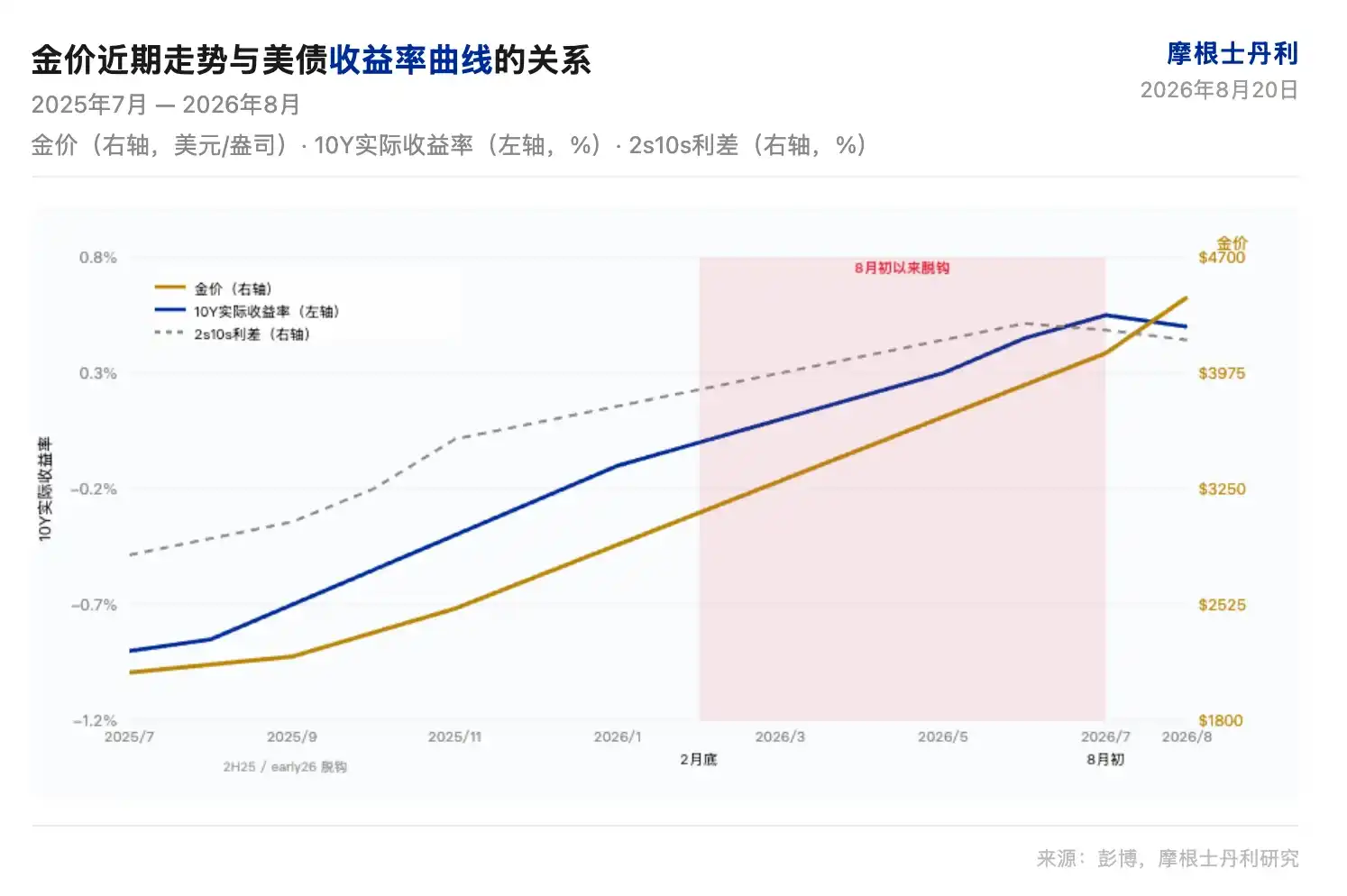
2月底至8月初,黄金与10年期实际利率保持稳定的负相关。8月初开始,金价在长端利率持平时继续上行。类似脱钩在2025年下半年和2026年初曾出现过。

当时美联储降息压低短端利率,政府债务上升、货币贬值担忧和通胀预期共同支撑了长端利率,收益率曲线陡峭化,金价同步走强。这一次,长端利率上升更多受油价和科技债发行推动,但市场对政府债务的关注同样在回升。

大摩判断,金价正在为收益率上行背后的财政担忧定价,而非收益率本身。
美联储路径仍是主导,结构性因素正成为新支撑

美联储政策路径主导ETF资金流向。即将公布的美国通胀数据和美联储官员沟通信号,将决定加息预期走向。大摩美国经济学家预计美联储2026年全年按兵不动,利率侧的压力有限。

黄金的驱动因素正在变化。除实际利率框架外,三个结构性因素构成新支撑:央行购金持续,2026年上半年全球央行净买入345吨,与大摩全年700吨预测一致;COMEX(纽约商品交易所)黄金期货空头头寸降至2020年4月以来最低,短期空头回补空间收窄,但空头力量已被充分消化;收益率曲线陡峭化背后的财政担忧,正在成为金价的隐形催化剂。

5000美元路径已打开,短期波动是常态

美国通胀数据是短期波动的主要来源。若通胀超预期,市场可能重新定价美联储加息路径,触发金价回调。COMEX空头头寸处于历史低位,意味着短期空头回补驱动的快速上涨空间有限。黄金ETF流入更多是对加息概率下降的反应,而非对降息的预期。这与降息周期的典型模式不同,流入的持续性存在不确定性。

大摩的基准判断:美联储按兵不动、央行购金持续、财政担忧定价深化,三者叠加将推动金价中枢上移。短期波动不会改变这一方向。
免责声明

本文系潮向研究对第三方券商研究报告(摩根士丹利,2026年8月20日)的整理与解读,结合公开市场信息的整理。文中引述的评级、目标价、盈利预测及相关判断,均为该券商分析师的观点,仅代表其所属机构立场,不代表潮向研究的观点,也不构成任何投资建议。

市场有风险,决策需独立。本文不应作为买卖任何证券的依据。

Trending Cryptos

Related Questions

Q摩根士丹利对金价设定的第四季度目标价是多少?为何说提前触及?

A摩根士丹利设定的第四季度目标价是4450美元/盎司。文章指出,黄金价格在报告发布前已经达到了这一水平,速度快于该机构的预期,因此称为“提前触及”。

Q根据大摩的报告,近期推动黄金ETF资金流向变化的主要因素是什么?

A根据报告,推动近期黄金ETF资金流向变化的主要因素是市场对美联储加息概率的预期变化。7月至8月,因加息概率下降,黄金ETF转为净流入70吨,逆转了5月至6月的净流出态势。

Q文章中提到,金价正在脱离实际利率框架。当前金价上行为何种因素定价?

A文章指出,当前金价的上行并非由实际利率本身驱动,而是在为长端收益率上行背后的财政担忧定价。具体来说,是对政府债务上升、货币贬值担忧和通胀预期等因素的担忧在支撑金价。

Q大摩报告认为,除了实际利率,目前对黄金构成新支撑的三个结构性因素是什么?

A摩根士丹利报告提出的三个结构性新支撑因素是:1. 全球央行持续购金(如2026年上半年净买入345吨);2. COMEX黄金期货空头头寸已降至历史低位,空头力量被消化;3. 收益率曲线陡峭化背后反映的财政担忧,成为金价的隐形催化剂。

Q大摩对于金价的中长期展望(2027年)是什么?短期面临的主要波动风险是什么?

A摩根士丹利预计,金价在2027年可能突破5000美元/盎司。短期面临的主要波动风险来自美国通胀数据,如果通胀超预期,可能引发市场对美联储加息路径的重新定价,从而触发金价回调。同时,黄金ETF流入的持续性也存在不确定性。

Related Reads

Is RWA Still Meaningful Without DeFi?

The article "Would RWA Still Matter Without DeFi?" argues that tokenizing real-world assets (RWA) alone, like putting a barcode on a container, is not transformative. True value emerges when these tokenized assets are integrated into decentralized finance (DeFi) ecosystems, enabling valuation, financing, hedging, trading, and loss management in a programmable, automated manner. Tokenization provides digital representation, but DeFi provides utility through leverage, liquidity, and composability. The core challenge lies in aligning the different "time clocks" of blockchain (fast, 24/7), traditional markets (limited hours), and asset redemption (slow processes), which creates liquidation risks and gaps. Effective RWA integration requires more than a token; it needs a full stack: legally enforceable rights, reliable data oracles, clear transfer rules, executable secondary liquidity, appropriate collateral parameters, and credible loss resolution paths. Liquidity is defined not by total value locked (TVL) but by the ability to exit a position under stress within a required timeframe. Risk management for RWAs must be modeled as a dependency graph, monitoring interconnected nodes like issuers, custodians, oracles, and liquidity pools for early warning signs beyond just price data. While tokenized government bonds serve as an initial "ping test," the future lies in more complex assets like computing power and energy, which require bespoke risk models. Tokenized stocks paired with perpetual futures present a major test, combining global equity ownership with crypto-native leverage, necessitating robust architectural safeguards like isolation and dynamic collateral rules. The conclusion is that without DeFi, RWA tokenization offers limited value—improving distribution and transparency. The significant opportunity arises when tokenized assets become functional components within open, programmable capital markets, where they can be used as collateral and facilitate complex financial strategies. The token is merely the barcode; the market operating system is the real machine.

marsbit9m ago

Is RWA Still Meaningful Without DeFi?

marsbit9m ago

Government Intervention in the Bond Market: What Does It Mean?

On August 19, 2026, the U.S. Treasury unexpectedly announced it would at least double the size of its long-term Treasury buyback operations, starting September 9. The move triggered an immediate market reaction, with the 30-year yield falling 9 basis points. This intervention came against a backdrop of the 30-year yield hitting a 19-year high of 5.34% the previous day, driven by persistent inflation, high oil prices, deteriorating U.S. fiscal health with public debt surpassing $40 trillion, and a global "buyers' strike" for long-dated bonds. Treasury buybacks involve the government repurchasing older, less liquid bonds from the market via reverse auctions to improve market functioning, not to reduce overall debt. While the action provided tactical relief and signaled the Treasury's willingness to intervene, analysts caution it does not address core structural issues: massive fiscal deficits, high borrowing needs, and fading demand from traditional buyers like foreign central banks. For investors, the announcement offered short-term support for long-duration bond ETFs and boosted assets like gold, which rose 2.7%. However, it's unlikely to significantly lower mortgage rates or alter the challenging environment for long-term bonds. The key takeaway is the distinction between a tactical market operation and the unresolved structural pressures that continue to push yields higher, requiring close monitoring of upcoming economic data, Treasury auctions, and potential signals of more aggressive policy measures.

marsbit13m ago

Government Intervention in the Bond Market: What Does It Mean?

marsbit13m ago

After 'Bessent Put', How Far Is the U.S. from Restarting QE?

Following an unscheduled announcement from the U.S. Treasury Department on August 19th, investor discussions have intensified regarding the potential for future policy interventions in long-term bond markets. The Treasury increased the maximum size of its regular buyback operations for 10-to-30 year bonds from $2 billion to $4 billion, citing a desire to improve liquidity. This move came shortly after a surge in long-term yields, with the 30-year Treasury yield briefly touching 5.34%. Market analysts, rather than focusing on the modest operational size, have interpreted the timing—outside the normal quarterly communication window—as a significant signal. The move has been dubbed the "Bessent Put," implying the market's growing expectation that Treasury officials, led by Deputy Secretary Josh Bessent, may act to prevent a disorderly rise in long-term borrowing costs. This perception represents a potential shift in the market's view of the government's "policy reaction function." The underlying pressures on long-term bonds are multifaceted, including large fiscal deficits, increased Treasury supply, a rise in corporate debt issuance for AI infrastructure (creating a "crowding out" effect), and uncertainty around foreign holdings, particularly from Japan. Geopolitical risks in the Middle East further complicate the policy landscape, potentially creating conflicting pressures between fighting inflation and managing financing costs. However, the article clarifies that this Treasury buyback program is distinct from Quantitative Easing (QE). It is a debt management operation, not a Federal Reserve balance sheet expansion. While the announcement opens the door for market speculation about more forceful tools like Yield Curve Control (YCC) or a return to QE, analysts note that conditions would need to deteriorate significantly for such measures to be implemented. For now, the "Bessent Put" reflects a change in market expectations about possible policy boundaries, not an imminent launch of new monetary stimulus.

marsbit13m ago

After 'Bessent Put', How Far Is the U.S. from Restarting QE?

marsbit13m ago

Is Stablecoin Really Necessary for Cross-border Payments?

"Is Stablecoin Truly Necessary for Cross-Border Payments? While stablecoins are often praised as superior for cross-border transfers—especially if the recipient desires crypto—their advantage is less clear in traditional cross-currency scenarios (e.g., USD to Mexican Peso). The existing correspondent banking system is slow and costly (≈15% fees) due to multiple intermediaries. Modern fintech solutions like Wise have dramatically improved this by using a netting model: they hold local currency pools and settle payments domestically, avoiding actual cross-border fund movement. This offers near-instant transfers with low, transparent fees (averaging ~0.52%). The 'stablecoin sandwich' model (convert fiat to stablecoin, transfer on-chain, convert to local fiat) offers similar user experience but doesn't inherently provide major cost or speed advantages over fintech. Its on-chain transfer is cheap, but fiat conversion spreads remain. Stablecoin's real innovation is 'unbundling' the cross-border payment stack. Instead of requiring a proprietary global network like Wise, businesses only need reliable on- and off-ramps in specific corridors. This lowers market entry barriers, fosters competition among local providers, and can drive down costs, particularly for niche or underserved corridors (e.g., US to Africa). While vertical integration may reoccur, the open, permissionless nature of the underlying blockchain layer makes monopolistic pricing difficult. The long-term benefit is the potential redistribution of value—previously captured as intermediary rents—to consumers through lower costs."

marsbit17m ago

Is Stablecoin Really Necessary for Cross-border Payments?

marsbit17m ago

Ethereum Finally 'Bounces Back'! ETH Returns to the Golden Line, What's Different About This Rally?

Ethereum has surged above $2,300, a level not seen in over three months, marking a significant recovery and technical breakthrough by reclaiming key resistance levels, including the weekly EMA50 for the first time in the current bear market. The rally has been fueled by a combination of factors: improved market risk appetite, positive regulatory sentiment, and a major short squeeze where over 88% of recent ETH liquidations were short positions. The ETH/BTC ratio has also broken its long-term downtrend, indicating renewed strength for Ethereum relative to Bitcoin. Fundamentally, Ethereum spot ETFs have shown strong inflows, outperforming their Bitcoin counterparts in recent months. Wall Street institutions like Morgan Stanley and JPMorgan have notably increased their ETH exposure, while several banks have added or expanded positions in ETH ETFs. On-chain fundamentals remain robust, with the proportion of staked ETH reaching a new all-time high of nearly 33.7%. Data indicates long-term holding sentiment, as small wallet holdings increased while large outflows were often directed towards staking or contracts, not selling. However, potential headwinds include declining staking yields and community debate over proposals to adjust staking rewards at high participation levels. The upcoming Glamsterdam upgrade, featuring improvements to validator exit efficiency, could enhance liquidity and further attract institutional stakers. While the rebound is supported by sentiment, capital flows, and fundamentals, its sustainability hinges on continued positive developments.

marsbit18m ago

Ethereum Finally 'Bounces Back'! ETH Returns to the Golden Line, What's Different About This Rally?

marsbit18m ago

Trading

Spot

Hot Articles

What is $BANK

Bank AI: A Revolutionary Step in the Future of Banking Introduction In an era marked by rapid advancements in technology, Bank AI stands at the intersection of artificial intelligence (AI) and banking services. This innovative project seeks to redefine the financial landscape, enhancing operational efficiency, security measures, and customer experiences through the power of AI. As we embark on this exploration of Bank AI, we will delve into what the project entails, its operational dynamics, its historical context, and significant milestones. What is Bank AI? At its core, Bank AI represents a transformative initiative aimed at integrating artificial intelligence into various banking operations. This project harnesses the capabilities of AI to automate processes, improve risk management protocols, and enhance customer interaction through personalised services. The primary objectives of Bank AI include: Automation of Banking Functions: By leveraging AI technologies, Bank AI aims to automate routine tasks, reducing the burden on human resources and enhancing efficiency. Enhanced Risk Management: The project utilises AI algorithms to predict and identify risks, thereby fortifying security measures against fraud and other threats. Personalisation of Banking Services: Bank AI focuses on offering tailored financial products and services by analysing customer data and behaviours. Improving Customer Experience: The implementation of AI-driven solutions, such as chatbots and virtual assistants, aims to provide users with more human-like interactions, revolutionising the way customers engage with banks. With these goals, Bank AI positions itself as a crucial player in rendering banking more efficient, secure, and user-centric. Who is the Creator of Bank AI? Details regarding the creator of Bank AI remain unknown. As such, no specific individual or organisation has been identified in the available information. The anonymity surrounding the project's inception raises questions but does not detract from its ambitious vision and objectives. Who are the Investors of Bank AI? Similar to the project's creator, specific information regarding the investors or supporting organisations of Bank AI has not been disclosed. Without this information, it is challenging to outline the financial backing and institutional support that might be propelling the project forward. Nevertheless, the importance of having a robust investment foundation is pivotal for sustaining development in such an innovative field. How Does Bank AI Work? Bank AI operates on several innovative fronts, focusing on unique factors that differentiate it from traditional banking frameworks. Below are key operational features: Automation: By applying machine learning algorithms, Bank AI automates various manual processes within banks. This results in reduced operational costs and allows human workers to redirect their efforts towards more strategic activities. Advanced Risk Management: The integration of AI into risk management practices equips banks with tools to accurately predict potential threats such as fraud, ensuring that customer information and assets remain secure. Tailored Financial Recommendations: Through continuous learning from customer interactions, the AI systems develop a nuanced understanding of user needs, enabling them to offer tailored advice on financial decisions. Enhanced Customer Interactions: Utilizing chatbots and virtual assistants powered by AI, Bank AI enables a more engaging customer experience, allowing users to have their queries resolved quickly, thus reducing wait times and improving satisfaction levels. Together, these operational features position Bank AI as a pioneer in the banking sector, establishing new benchmarks for service delivery and operational excellence. Timeline of Bank AI Understanding the trajectory of Bank AI requires a look at its historical context. Below is a timeline highlighting important milestones and developments: Early 2010s: The conceptualisation of AI integration into banking services began to gain attention as banking institutions recognised the potential benefits. 2018: A marked increase in the implementation of AI technologies occurred when banks started using AI tools like chatbots for basic customer service and risk management systems for improved security handling. 2023: The sophistication of AI continued to advance, with generative AI being introduced for more complex tasks such as document processing and real-time investment analysis. This year marked a significant leap in the capabilities afforded to banks by AI technology. 2024-Current Status: As of this year, Bank AI is on an upward trajectory, with ongoing research and developments poised to further enhance capabilities in banking operations. Continued exploration of AI applications hints at exciting developments yet to come. Key Points About Bank AI Integration of AI in Banking: Bank AI focuses on adopting artificial intelligence to streamline banking processes and improve user experiences. Automation and Risk Management Focus: The project strongly emphasises these areas, aiming to shift the burden of routine tasks while enhancing security frameworks through predictive analytics. Personalised Banking Solutions: By harnessing customer data, Bank AI enables tailored banking services that cater to individual user needs. Commitment to Development: Bank AI remains committed to ongoing research and development efforts, ensuring its adaptability and ongoing relevance as technology continues to evolve. Conclusion In summary, Bank AI exemplifies a crucial step forward in the banking industry, leveraging artificial intelligence to reshape operational paradigms, enhance security, and promote customer satisfaction. Despite gaps in information surrounding the creator and investors, the clear objectives and functional mechanisms of Bank AI provide a strong foundation for its ongoing evolution. As AI technology continues to advance and merge with the banking sector, Bank AI is well-positioned to significantly impact the future of financial services, enhancing the way we understand and interact with banking.

409 Total ViewsPublished 2024.04.06Updated 2024.12.03

What is $BANK

Discussions

Welcome to the HTX Community. Here, you can stay informed about the latest platform developments and gain access to professional market insights. Users' opinions on the price of BANK (BANK) are presented below.

活动图片