Les ETF sur Bitcoin et Ethereum attirent 706 millions de dollars alors que la demande pour les cryptomonnaies explose

cryptonews.ruPublished on 2026-08-20Last updated on 2026-08-20

Abstract

La percée des prix a rapidement stimulé l'activité des ETF. Le Bitcoin dépassant 70 000 $ et l'Ether 2 000 $ ont attiré d'importants investissements institutionnels. Huit ETF spot américains sur Bitcoin ont enregistré des entrées de fonds, totalisant 706 millions de dollars sur la session. Le leader, l'ETF IBIT de BlackRock, a capté 284,74 millions $. Les ETF sur Ether ont également connu une forte session, avec 122,12 millions $ pour le fonds ETHA de BlackRock. Aucun fonds majeur sur Bitcoin ou Ether n'a subi de sorties. L'activité commerciale a bondi, avec un volume des ETF Bitcoin atteignant 6,89 milliards $. Les actifs nets combinés des ETF Bitcoin et Ether ont augmenté pour atteindre 84,31 et 12,06 milliards $ respectivement. Les ETF sur XRP et Solana ont également bénéficié de la tendance haussière, avec de modestes entrées. À l'inverse, les ETF sur Hyperliquid ($HYPE) ont connu des sorties, malgré une brève hausse de prix suite à des commentaires réglementaires favorables. Cette session démontre le retour rapide de l'élan haussier lorsque la dynamique des prix et la demande institutionnelle convergent.

La hausse rapide des prix a rapidement conduit à un regain d'activité des ETF.

Le dépassement par le Bitcoin du seuil des 70 000 dollars a attiré de nouveau des investissements institutionnels significatifs : huit fonds américains au comptant ont drainé des capitaux frais, et aucun n'a fait état de sorties de fonds. L'Ethereum a rejoint la hausse lorsque le prix $ETH a dépassé les 2 000 dollars, contribuant ainsi à l'une des séances communes les plus fortes pour les deux plus grands marchés d'ETF sur cryptomonnaies ces derniers mois.

BlackRock en tête des entrées de capitaux pour le Bitcoin avec 517 millions de dollars

L'ETF IBIT de BlackRock est resté l'instrument le plus populaire, attirant 284,74 millions de dollars, soit plus de la moitié des entrées journalières pour le Bitcoin. Le fonds ARKB de ARK 21Shares a attiré 77,71 millions de dollars, et le FBTC de Fidelity 62,41 millions de dollars. Ils ont été suivis par le BITB de Bitwise avec 35,60 millions de dollars.

Le GBTC et le Bitcoin Mini Trust de Grayscale ont attiré respectivement 21,18 millions de dollars et 19,66 millions de dollars. Le MSBT de Morgan Stanley a attiré 9,98 millions de dollars, et l'EZBC de Franklin Templeton a clôturé la liste des entrées avec 5,92 millions de dollars.

Dans le sillage de ce mouvement des prix, l'activité commerciale a fortement augmenté. Le chiffre d'affaires des ETF sur Bitcoin a atteint 6,89 milliards de dollars, et l'actif net total a augmenté pour atteindre 84,31 milliards de dollars, soit environ 5 milliards de dollars de plus que le niveau de mardi. Cette semaine, les ETF sur Bitcoin ont attiré exactement 1 milliard de dollars sur trois séances de bourse.
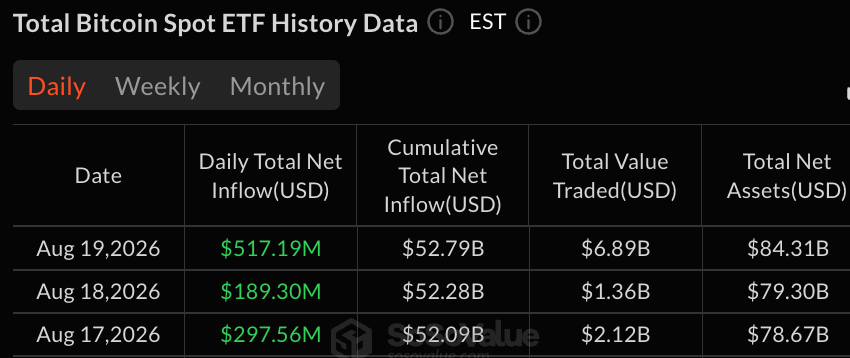
En trois jours d'entrées de capitaux continues, les ETF sur Bitcoin ont attiré 1 milliard de dollars.

Les ETF sur Ethereum ont affiché une croissance tout aussi significative. Le fonds ETHA de BlackRock a attiré 122,12 millions de dollars, et le fonds FETH de Fidelity 36,54 millions de dollars. Le fonds Ether Mini Trust de Grayscale a attiré 16,04 millions de dollars, et le fonds ETHB de BlackRock 9,71 millions de dollars.

Des entrées plus modestes ont été enregistrées par le MSSE de Morgan Stanley, l'ETHE de Grayscale et l'EZET de Franklin Templeton. Aucun des fonds sur Ethereum n'a enregistré de sorties de fonds. Le volume total des transactions a atteint 2,14 milliards de dollars, et l'actif net a augmenté pour atteindre 12,06 milliards de dollars.

$XRP et Solana montent malgré les ventes de $HYPE

Les ETF sur $XRP ont attiré 2,35 millions de dollars, répartis presque également entre le fonds $XRP de Bitwise et le fonds XRPZ de Franklin Templeton. L'actif net a de nouveau dépassé le milliard pour atteindre 1,01 milliard de dollars.

Les ETF sur Solana ont clôturé la journée avec des entrées de capitaux de 2,10 millions de dollars. Le fonds BSOL de Bitwise a attiré 5,63 millions de dollars, compensant ainsi des sorties de fonds de 3,12 millions de dollars du GSOL de Grayscale et d'environ 415 000 dollars du QSOL d'Invesco.

Les fonds ETF sur $HYPE ont défié la tendance générale, enregistrant des sorties de fonds de 1,97 million de dollars.

Cette vague de ventes s'est produite dans un contexte de signal favorable des autorités de régulation concernant Hyperliquid. S'exprimant lors d'un événement à la Maison Blanche avec des dirigeants du secteur technologique, le président Donald Trump a déclaré que le président de la CFTC, Mike Selig, travaillait à attirer Hyperliquid aux États-Unis « en pleine conformité avec la loi ». Suite à ces déclarations, le prix de $HYPE a brièvement bondi d'environ 62 à 72,30 dollars, soit une hausse d'environ 16%.

La séance de mercredi a démontré à quelle vitesse la dynamique haussière pouvait revenir lorsque les prix et la demande institutionnelle coïncident. La majeure partie des capitaux a été attirée par le Bitcoin et l'Ethereum, tandis que $XRP et Solana ont également profité de l'appétit général pour le risque.

end-content

Trending Cryptos

Related Questions

QQuel est le montant total des capitaux attirés par les ETF sur le Bitcoin et l'Ethereum mentionnés dans l'article ?

ALes ETF sur le Bitcoin et l'Ethereum ont attiré 706 millions de dollars de capitaux frais.

QQuel ETF sur le Bitcoin a attiré le plus de capitaux et quel était le montant ?

AL'ETF IBIT de Blackrock est resté l'outil le plus populaire, attirant 284,74 millions de dollars.

QQuelle a été l'évolution des actifs nets des ETF sur le Bitcoin après la séance décrite ?

ALes actifs nets combinés des ETF sur le Bitcoin ont augmenté pour atteindre 84,31 milliards de dollars, soit environ 5 milliards de plus que le niveau de mardi.

QCombien de jours consécutifs d'afflux de capitaux les ETF sur le Bitcoin ont-ils connu pour atteindre 1 milliard de dollars ?

ALes ETF sur le Bitcoin ont attiré 1 milliard de dollars sur trois jours de séances de négociation consécutives.

QQuel événement a provoqué une brève hausse d'environ 16% du prix du $HYPE selon l'article ?

ALe président Donald Trump a déclaré que le président de la CFTC, Mike Selig, travaillait à faire venir Hyperliquid aux États-Unis 'en pleine conformité avec la loi', ce qui a fait bondir le prix d'environ 62 $ à 72,30 $.

Related Reads

Kaito Reboots 'Talk-to-Earn Economy', but Many Are Hesitant to Install the New Plugin

Kaito AI has launched a new browser extension called Kaito Pulse, aiming to revitalize what the community terms the "talk-to-earn" or "social-fi" economy on X (formerly Twitter). The plugin displays users' on-chain trading activity, such as positions from platforms like Polymarket, directly within the X timeline. This aims to create a new "attention + behavior verification" system, shifting focus from who generates the most discussion to whose discussions are backed by credible, verifiable actions. However, the launch quickly sparked significant privacy concerns within the crypto community. Critics, led by an analysis from user "Ultra," allege the extension's code enables deep data collection. This includes potential device fingerprinting (using GPU, hardware, and audio data), tracking of X user behavior (browsing paths, clicks, engagement), and verification processes that could access sensitive data from third-party accounts like ChatGPT, Claude, and trading platforms. The debate centers on whether such extensive verification is necessary to combat fake engagement and AI-generated content, or if it constitutes an unacceptable privacy sacrifice. In response, Kaito founder Yu Hu stated the design follows data minimization principles. He claimed Kaito Pulse does not collect or store users' raw data but instead uses verification techniques, including zkTLS, to generate proofs of identity or behavior without exposing the underlying information. Yu Hu acknowledged that some permission descriptions could be misleading and promised improvements in future versions. The controversy highlights a core dilemma for social-fi projects: platforms need more user data to distinguish real influence from artificial hype, but users must decide how much privacy they are willing to trade for potential rewards and ranking within these new incentive systems.

Odaily星球日报8m ago

Kaito Reboots 'Talk-to-Earn Economy', but Many Are Hesitant to Install the New Plugin

Odaily星球日报8m ago

After Two and a Half Years of Entrepreneurship and Full AI Adoption, the Company Has Actually Become More 'Traditional'

"After 2.5 years of running my company, achieving near 100% AI adoption with Agents in roles like finance, HR, and operations, we've paradoxically become more 'traditional.' We learned that establishing a thick AI middle layer creates bottlenecks. Instead, we advocate for a 'thin platform, thick frontline' model, empowering employees closest to problems to use AI tools themselves, fostering ownership and initiative. The true foundation isn't the AI models, but the unique data and context a company accumulates—our most vital, irreplaceable asset, requiring diligent governance. As AI handles repetitive, describable tasks, human roles revert to their core: building genuine relationships, trust, and brand reputation through authentic communication, which AI cannot accelerate. A critical question is where the time saved by AI goes. It must be returned—to clients, to creative work, to employees' own lives—rather than just fueling higher output demands. For managers, AI strips away execution-focused busywork, exposing the necessity to define clear goals, make tough judgments, and take ultimate responsibility. Onboarding newcomers presents a challenge: while AI can generate 80% solutions instantly, we must deliberately design paths for them to develop judgment, understand context, and safely learn from mistakes. Ultimately, AI's organizational value isn't about replacing people but removing unnecessary friction, allowing more meaningful human connection. The real test of an 'AI-era' company isn't its tech stack, but how it treats people: delegating creative power, returning saved time, fostering growth, and upholding accountability. The core luxury and purpose of our work remains authentic human relationships."

marsbit16m ago

After Two and a Half Years of Entrepreneurship and Full AI Adoption, the Company Has Actually Become More 'Traditional'

marsbit16m ago

US Stock Market Trends (August 21): Long-Term Bond Repo Fails, Walmart's Warning Drags Dow Down 700 Points

**U.S. Market Trends (Aug 21): Long-Term Bond Relief Fizzles, Walmart Drags Dow Down 700 Points** U.S. stocks fell sharply, with the Dow plunging over 700 points, as relief from the Treasury's long-term bond buyback plan proved fleeting. Major indexes declined as long-end Treasury yields and oil prices resumed their upward climb, reigniting inflation fears and pressure on high-valuation assets. The key catalyst was the rapid reversal in the bond market. The Treasury's expanded buyback program briefly calmed markets, but 30-year yields quickly rebounded near 5.26%, approaching recent 20-year highs. This signaled that liquidity interventions cannot overcome structural pressures from massive U.S. debt, fiscal deficits, and competing capital demands from AI infrastructure spending. Simultaneously, rising oil prices (WTI +2.3%) on geopolitical tensions renewed inflation concerns, squeezing consumer spending power. This pressure was highlighted by Walmart's 9% stock plunge. Despite beating earnings estimates, its weak U.S. same-store sales growth and lowered annual guidance exposed caution among lower-income consumers. Tech stocks faced broad pressure. The "Magnificent Seven" giants broadly declined, with Moderna crashing over 23% a day after a massive rally on vaccine trial news, exemplifying swift profit-taking. However, select semiconductor names (e.g., Marvell, Micron) gained on specific AI-related catalysts, indicating a more discerning market moving beyond hype to scrutinize real cash flows and capital expenditure sustainability. Bitcoin surged past $72,000, while gold seesawed near $4,500/oz. Alibaba's earnings showed strong AI cloud revenue growth but significant cash outflow due to infrastructure investments. The market's core takeaway is that Treasury actions provide only temporary relief, not a trend reversal. Focus now shifts to whether long-term yields can stabilize below 5.3% and to upcoming Federal Reserve commentary for clues on the rate path. Sustainable equity recovery hinges on the bond market calming and major tech stocks showing concurrent strength.

marsbit18m ago

US Stock Market Trends (August 21): Long-Term Bond Repo Fails, Walmart's Warning Drags Dow Down 700 Points

marsbit18m ago

547 Million OP Tokens Transferred from User Airdrop to Ecosystem Fund: DAO Voting Becoming Sham Democracy

An Optimism governance vote approved the controversial transfer of 546.9 million OP tokens (12.7% of total supply, ~24% of circulating supply) from the remaining "User Airdrop" allocation to the Foundation-controlled "Strategic Ecosystem Fund." The vote passed with a decisive 849,000 OP vote from "Test in Prod," a core development team fully funded by the Optimism Collective, cast just 17 minutes before the deadline. The Foundation argued that broad user airdrops are ineffective for the current institutional expansion phase and that the funds are needed as a flexible "war chest" to secure enterprise clients like Bitpanda and Dunamu. Critics, including L2BEAT and researcher Polynya, opposed the move. They cited the Foundation's overly broad mandate, a lack of clear link to token holder interests, insufficient assessment of past ecosystem fund expenditures (~686M OP spent), and the rewriting of the original distribution promise made to users. The incident highlights deeper governance concerns beyond low voter turnout. It raises questions about the independence of votes from entities financially dependent on the Foundation and the ethical limits of DAO governance—specifically, whether a majority vote can legitimately redefine foundational promises and minority expectations. The move signals a shift from community-focused airdrops to enterprise-driven strategy, eroding user trust amid OP's significant price decline.

marsbit38m ago

547 Million OP Tokens Transferred from User Airdrop to Ecosystem Fund: DAO Voting Becoming Sham Democracy

marsbit38m ago

Trading

Spot

Hot Articles

Discussions

Welcome to the HTX Community. Here, you can stay informed about the latest platform developments and gain access to professional market insights. Users' opinions on the price of ETH (ETH) are presented below.

活动图片