Cette nuit où les cryptomonnaies ont flambé : qu’a dit Trump ?

Odaily星球日报Published on 2026-08-20Last updated on 2026-08-20

Abstract

Lors d'une réunion à la Maison Blanche le 20 août rassemblant des dirigeants de l'industrie cryptographique, des régulateurs et des figures de la finance traditionnelle, le président Trump a prononcé un discours soulignant l'engagement de son administration en faveur des crypto-monnaies et de l'innovation financière. Il a remercié les participants, dont les PDG de Coinbase, Robinhood, Kraken, Ripple, Gemini, a16z, ainsi que les dirigeants de la SEC et de la CFTC. Trump a vivement critiqué l'approche régulative de l'administration Biden précédente, affirmant avoir mis fin à la "guerre contre les crypto-monnaies" en licenciant l'ancien président de la SEC, Gary Gensler. Il a énuméré les actions de son gouvernement : l'interdiction des CBDC, le lancement du "Project Crypto" pour moderniser la réglementation, la création d'une réserve stratégique de Bitcoin pour le Trésor américain et l'adoption du "GENIUS Act" pour favoriser les stablecoins adossés au dollar. Trump a insisté sur la volonté d'établir un cadre réglementaire clair pour que l'innovation reste aux États-Unis, affirmant que le pays est désormais leader dans les domaines de la crypto, de l'IA et des marchés prédictifs, devançant largement la Chine. Il a également lié la forte performance des marchés actions et la création d'emplois à ces politiques, appelant le Congrès à adopter le "CLARITY Act" pour consolider cet avantage et ouvrir la voie à la prochaine génération d'innovations. Le discours s'est conclu sur un to...

Cet article est tiré de :Discours de Trump à la Maison Blanche

Compilation | Odaily Planet Daily (@OdailyChina) ; Traducteur | Azuma (@azuma_eth)

Note de la rédaction : Tôt le matin du 20 août (heure de Pékin), une réunion a été organisée à la Maison Blanche avec des dirigeants de l'industrie des cryptomonnaies. Donald Trump y a assisté et a prononcé un discours. Des responsables gouvernementaux de la SEC et de la CFTC, des représentants du secteur comme Robinhood, Coinbase, Ripple, Gemini, a16z, ainsi que des dirigeants de la finance traditionnelle tels que l'Intercontinental Exchange et le Nasdaq ont participé à la réunion.

Sous l'effet de ce signal clair et positif, l'industrie des cryptomonnaies a connu une forte hausse pendant la nuit. Le BTC a brièvement franchi les 70 000 dollars, et l'ETH a grimpé de près de 20 %. Pour plus de détails, voir « Le taureau est là : les quatre moteurs du rallye généralisé du marché crypto en une nuit ».

Voici ci-dessous les déclarations prononcées par Trump lui-même lors de la réunion, compilées par Odaily Planet Daily.
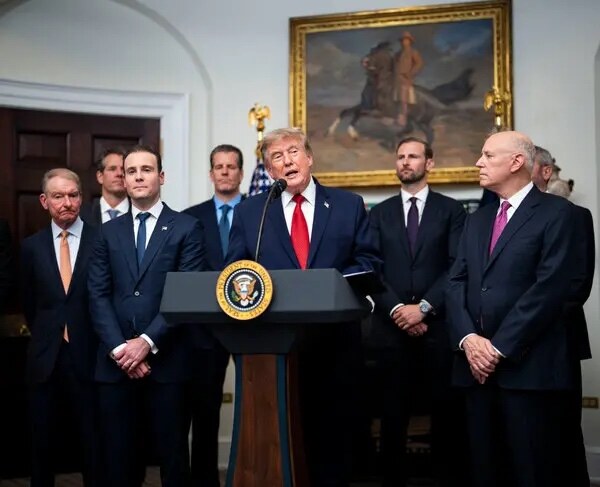
Sérieusement, il y a ici aujourd'hui des personnes très importantes. Si vous aimez le monde de la finance comme moi – et j'adore vraiment la finance –, toutes les personnes ici présentes sont des figures majeures de la finance. Et c'est incroyable, vous ne connaissez peut-être pas certaines d'entre elles, mais toute personne du milieu financier connaît probablement chacune d'entre elles.

Merci beaucoup à tous d'être venus aujourd'hui. Nous sommes très heureux d'accueillir certaines des personnes les plus talentueuses des secteurs de la finance, des cryptomonnaies et de la technologie américaines.

À Washington, D.C., nous nous apprêtons à tenir la première réunion du Comité consultatif pour l'innovation de la Commodity Futures Trading Commission (CFTC). C'est un comité composé de personnes très intelligentes qui vont nous faire des recommandations sur ce qu'il faut faire.

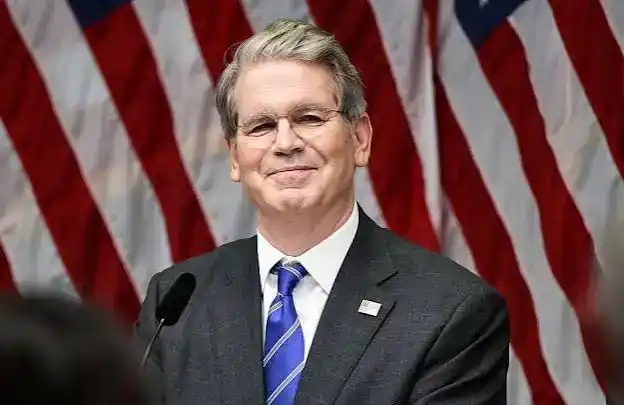
N'est-ce pas, Paul (s'adressant au président de la SEC, Paul Atkins) ? Ils vont nous dire certaines choses.

Mais je pense que Paul comprend probablement ces questions mieux que quiconque, et il fait un travail remarquable. Nous sommes tous très satisfaits de Paul, et je suppose que vous êtes du même avis. Il est vraiment formidable.

Des marchés des cryptomonnaies et des marchés de prédiction à la finance traditionnelle et à la finance décentralisée, les personnes présentes dans cette salle veillent à ce que l'avenir des marchés commerciaux soit inventé et perfectionné ici, aux États-Unis.

Nous sommes en concurrence avec de nombreux autres pays pour le contrôle de ces marchés, leur part de marché, ainsi que les profits, les emplois et tout ce qui en découle. Et nous nous en sortons très bien. Nous sommes en tête dans tous les domaines, y compris l'intelligence artificielle, et de très loin. Nous souhaitons maintenir cette avance.

Je tiens à remercier le président de la CFTC, Michael Selig, pour son leadership exceptionnel. (Cherche quelqu'un) Michael, approche... (puis le remarque soudain à proximité) Oh, tu es si proche, je t'avais presque pas reconnu.
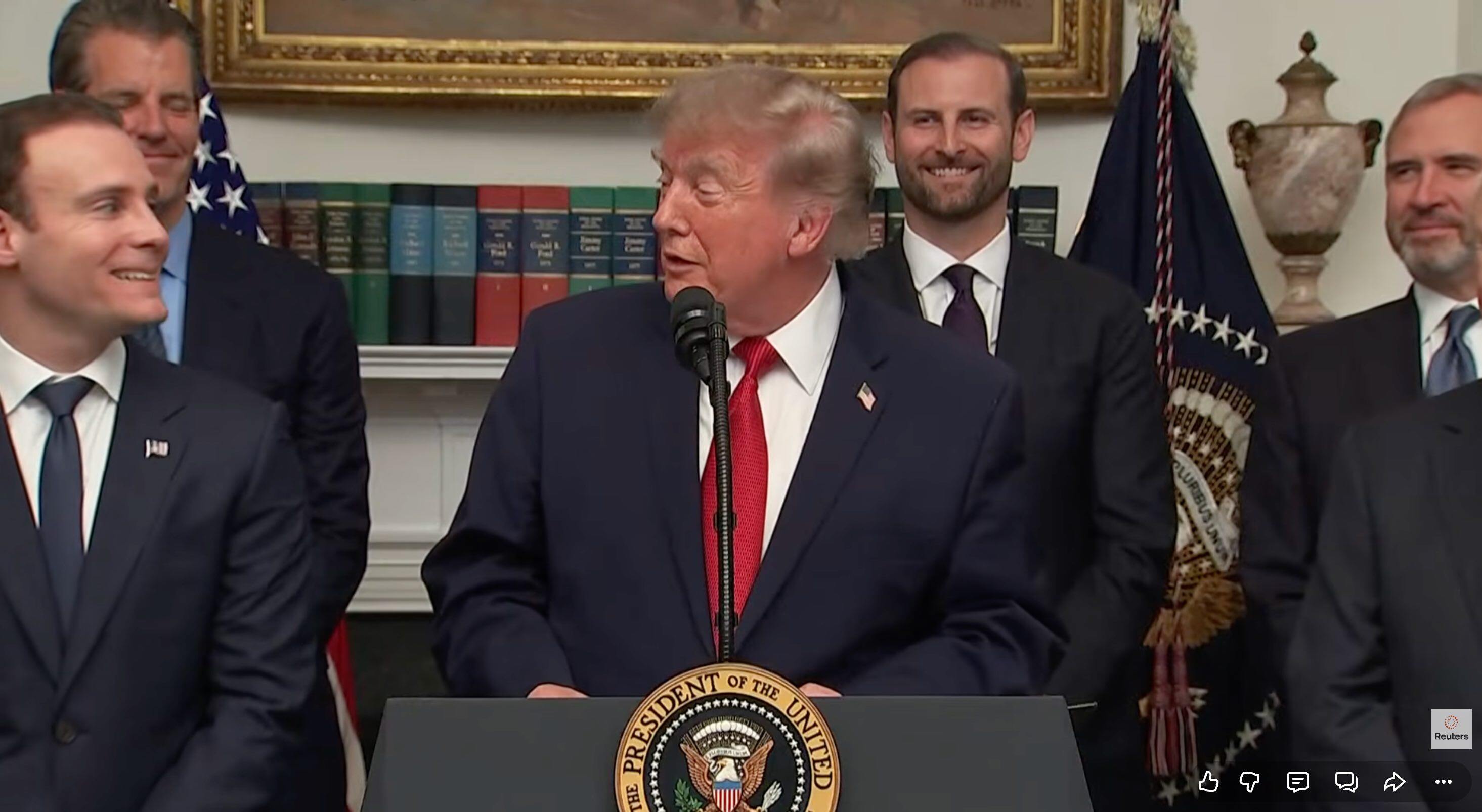
Je veux aussi remercier une personne très spéciale, quelqu'un qui est respecté de tous depuis longtemps. J'avais espéré qu'il occupe ce poste – je le souhaitais avant même qu'il ne devienne président de la SEC.

Paul Atkins, toi aussi, tu fais un travail exceptionnel, et tu t'en sors bien dans tout ce que tu entreprends. Tu as beaucoup fait pour le pays. Alors je veux te remercier chaleureusement. Bon travail. Merci.

Nous souhaitons également la bienvenue à Patrick Witt, directeur exécutif du Comité consultatif présidentiel sur les actifs numériques... ainsi qu'à de nombreux leaders de l'industrie, dont le PDG de Coinbase, Brian Armstrong, l'un des meilleurs dans ce domaine.

(S'adressant à Brian) Où es-tu ? Où es-tu passé ? Oh, tu as bonne mine. Tu parais beaucoup plus jeune. En bonne forme.
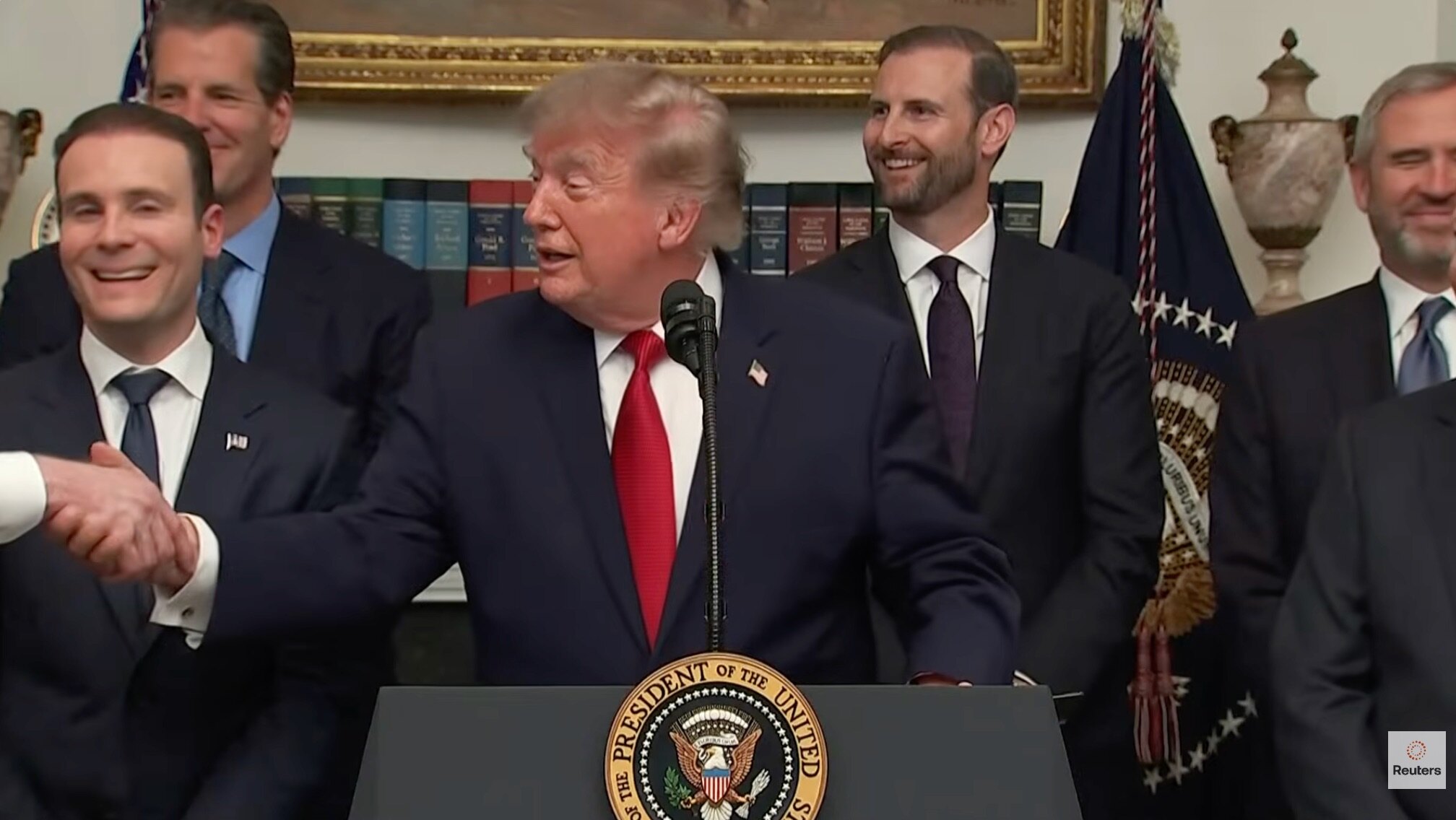
Et Jeff Sprecher, PDG de l'Intercontinental Exchange. Ils ont une petite organisation dans leur portefeuille, appelée le New York Stock Exchange. Oui, il possède le NYSE. C'est un actif assez intéressant, n'est-ce pas ?

Et Adena Friedman, PDG du Nasdaq. Merci beaucoup. Tu fais du bon travail.

Et Vlad Tenev, PDG de Robinhood. Merci. Ravi de te rencontrer.

Et Arjun Sethi, PDG de Kraken. (Regarde de gauche à droite) Où que tu sois, merci beaucoup.

Merci à tous. C'est un groupe de personnes très talentueuses. Nous avons ici d'autres personnes que nous aurions souhaité voir également.

(Continue à chercher dans la salle) Où est Mike (faisant référence à Mike Belshe) ? Il est le cofondateur, PDG, CTO et président de BitGo. BitGo est un acteur majeur dans l'espace crypto.

Et Brad Garlinghouse, PDG de Ripple. Brad, merci beaucoup.

Sergey Nazarov, cofondateur de Chainlink Labs. Merci beaucoup, Sergey, bon travail.

(Cherche à nouveau le PDG de Kraken) Arjun, es-tu là ? Oh, Arjun, je suis encore ici, et toi aussi, tu n'es pas parti.
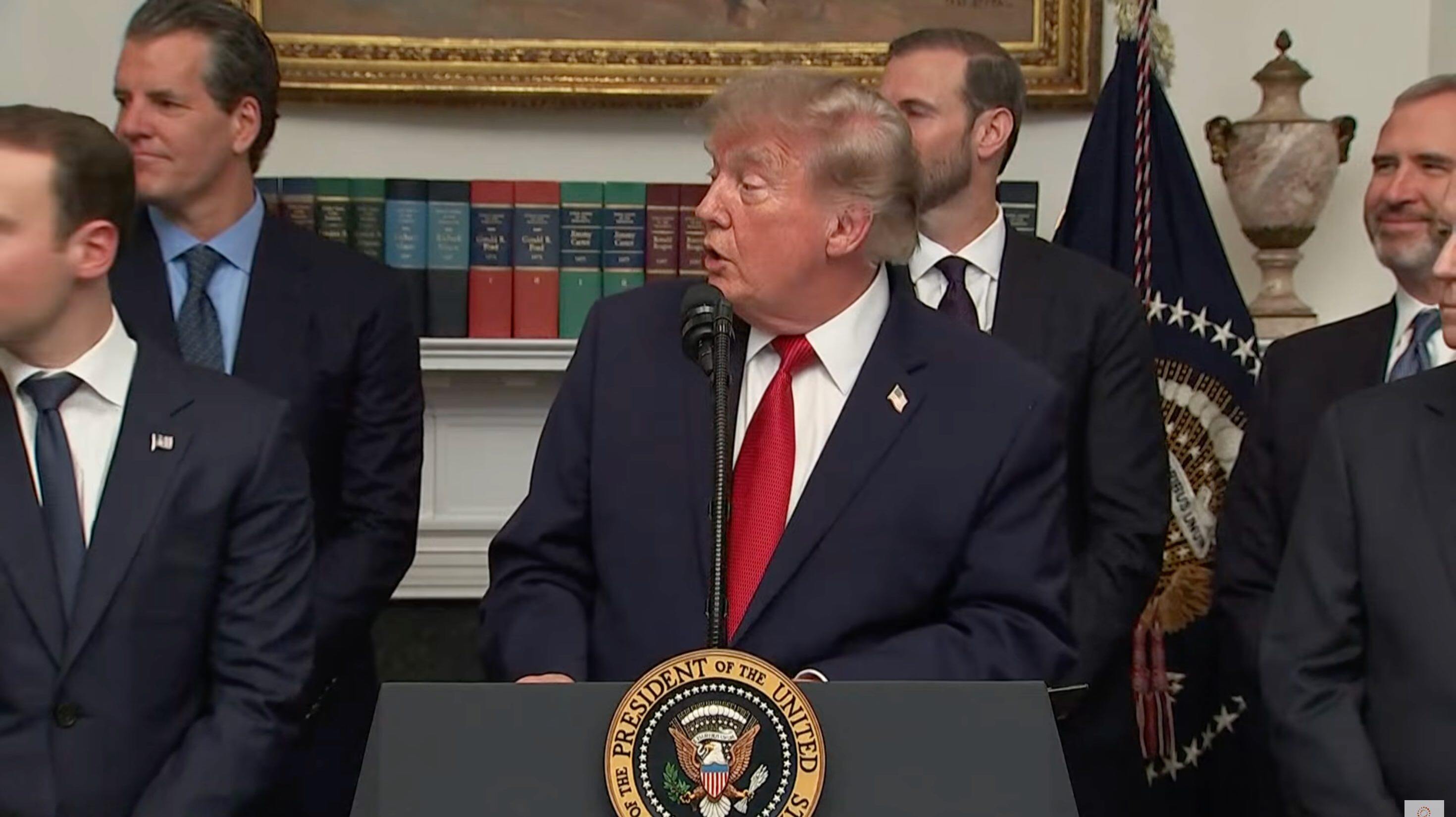
Peter Smith (faisant référence au PDG de Blockchain.com) est également là.

Et Tyler et Cameron Winklevoss (faisant référence aux deux cofondateurs de Gemini), deux personnes très talentueuses et investisseurs exceptionnels. Chris Dixon (faisant référence au partenaire gérant de a16z crypto) est également ici.

Je pense avoir à peu près nommé tout le monde. Si j'ai oublié quelqu'un, au fait... ils m'ont donné quatre listes, donc c'est un peu compliqué. Vous ne voudriez certainement pas, à l'époque de l'« administration corrompue de Joe Biden », qu'un même nom soit prononcé plus de trois fois de suite.

L'esprit d'innovation qui a enfanté l'Amérique a été attaqué comme jamais auparavant. Cela a été particulièrement vrai dans le domaine des cryptomonnaies et des autres fintech émergentes, où nous étions sur le point de nous faire totalement distancer par la Chine et d'autres pays.

La gauche radicale a tenté d'étouffer ces développements par une réglementation dévastatrice, des restrictions brutales et des méthodes d'armement. Ils ont utilisé des moyens politiques pour réprimer et ont continuellement ciblé ce secteur, finissant par repousser l'innovation à l'étranger.

Ils voulaient simplement chasser l'innovation. Mais vers la fin de la campagne – si vous vous en souvenez – ils ont soudainement déclaré qu'ils adoraient les cryptomonnaies, parce qu'ils ont soudain réalisé que plus de 100 millions de personnes commençaient à préférer Trump, simplement parce que je soutenais les cryptomonnaies.

Ils étaient contre les cryptomonnaies, puis ils sont soudainement devenus très favorables. Mais à ce moment-là, il était déjà trop tard.

Ces jours sont révolus. C'était une période très difficile, en particulier pour beaucoup de personnes financières compétentes et intègres.

Dès le premier jour, nous avons renvoyé le président incontrôlable de la SEC de l'administration Biden, Gary Gensler.

Je pense que nous préférons Paul (applaudissements dans la salle), n'est-ce pas ?
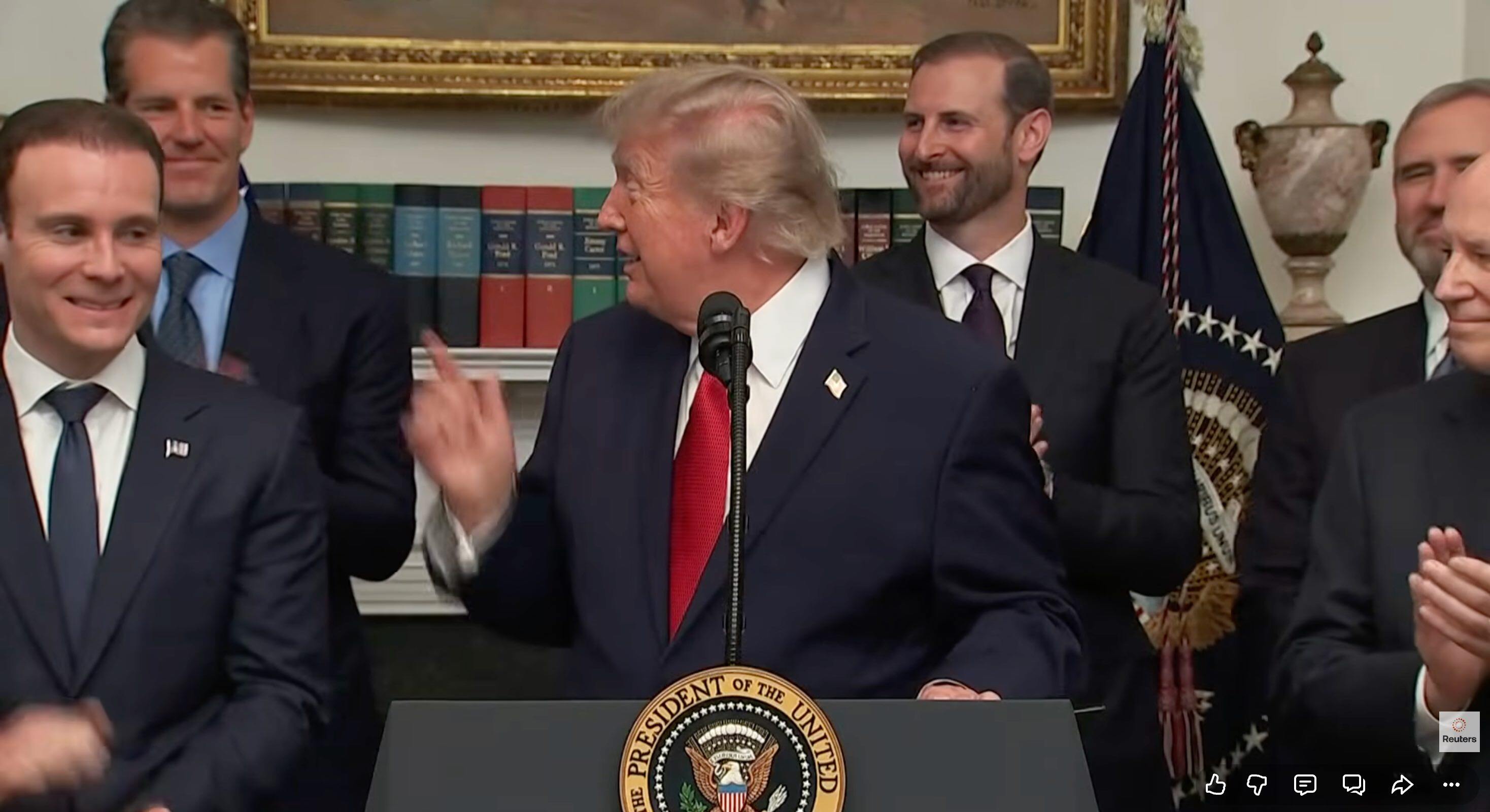
Le principal responsable (faisant référence au président de la SEC) est devenu plus intelligent. Au fait, Paul est en effet bien plus intelligent, mais quoi qu'il en soit, nous avons viré Gensler, nous l'avons simplement mis à la porte. Nous avons mis fin à ce qu'on appelait l'« Opération Choke Point 2.0 » – c'est le nom qu'ils avaient donné à cette opération à l'époque, c'était une forme d'armement politique.

Nous avons mis fin une fois pour toutes à la guerre contre les cryptomonnaies. Et maintenant, l'industrie crypto prospère. Elle se porte extrêmement bien, et personne ne peut l'arrêter.

La Chine souhaite bien sûr pénétrer ce domaine, et elle essaie encore maintenant.

J'ai signé un décret historique interdisant toute tentative d'établir une monnaie numérique de banque centrale (MNBC).

Nous avons lancé le « Project Crypto » pour moderniser les règles pertinentes, permettant aux marchés financiers américains d'entrer dans l'ère de la technologie blockchain.

J'ai créé la Réserve stratégique américaine de Bitcoin (U.S. Strategic Bitcoin Reserve), faisant du Bitcoin un actif permanent du Trésor américain. Cette politique s'est avérée étonnamment efficace.

J'ai également créé le Stock d'actifs numériques américain (U.S. Digital Asset Stockpile) pour la garde de tous les autres actifs numériques. C'est exactement sa mission, et les résultats sont impressionnants.

Il y a environ un an cet été, j'ai signé une loi historique appelée le « GENIUS Act ». C'est le nom que je lui ai donné. Je ne voulais pas utiliser mon propre nom, alors je l'ai appelé la loi « Génie » (GENIUS).

Cette loi a ouvert la voie à l'adoption généralisée des stablecoins adossés au dollar. Cette politique fonctionne extrêmement bien, et chaque Américain bénéficie énormément du fait que les États-Unis sont un centre financier mondial, et nous souhaitons maintenir cette position. Nous prenons une avance considérable.

Les progrès que nous avons réalisés au cours des 16 derniers mois sont si importants que personne n'ose y croire.

De plus, l'afflux d'investissements vers les États-Unis est désormais plus important que pour tout autre pays, à n'importe quelle période de l'histoire. Les capitaux affluent par milliers de milliards.

La domination économique américaine a généré des milliers de milliards d'investissements, créé des millions d'emplois et élargi l'accès au crédit et aux capitaux pour chacun, donnant à chaque Américain la chance de réaliser le « rêve américain ».

Nous entendons souvent le terme « rêve américain » ces jours-ci. Les jeunes redécouvrent le rêve américain. Il y a deux ans, ils n'y pensaient pas.

Les nouvelles fintech étendent cette domination américaine au 21e siècle. C'est pourquoi nous nous engageons à établir un cadre réglementaire clair pour les innovateurs et les bâtisseurs – comme ceux qui sont avec moi aujourd'hui – afin qu'ils puissent opérer en toute confiance sur le sol américain.

Ils n'ont pas besoin d'aller dans d'autres pays pour faire des affaires.

Nous veillons à ce que les États-Unis maintiennent non seulement leur position de leader incontesté dans le domaine du Bitcoin et des cryptomonnaies, mais aussi dans les marchés de prédiction, l'intelligence artificielle et bien d'autres technologies.

Et nous prenons la tête dans chaque domaine. Je vous le dis, en matière d'IA, nous avons une avance considérable sur la seconde place, qui est la Chine.

Je ne veux jamais sous-estimer la Chine. Mais actuellement, nous avons une très grande avance. Le président Xi Jinping sera en visite le 24 septembre, nous attendons cette rencontre, nous parlerons probablement d'IA, et de beaucoup d'autres choses.

Mais nous nous en sortons très bien actuellement, en grande partie grâce à vous tous ici présents, ainsi qu'à quelques autres membres du comité qui seront présents dans deux semaines.

En mai dernier, le président de la CFTC, Michael, a approuvé le premier véritable contrat à terme perpétuel sur Bitcoin, listé sur un marché régulé par la CFTC. C'était la première étape.

J'ai appris que Michael travaille également dur pour permettre à Hyperliquid d'entrer aux États-Unis de manière totalement conforme et légale. Il y travaille très activement.

Nous souhaitons vraiment voir les taux d'intérêt baisser.

Vous savez, autrefois, les taux étaient comme ça – beaucoup sont peut-être trop jeunes pour s'en souvenir – chaque fois que nous annoncions de bonnes données économiques, les taux baissaient.

La théorie à l'époque était que la valeur des actifs devenait meilleure, plus intéressante pour l'investissement, mais maintenant, chaque fois que nous annonçons des données solides (et nous en annonçons constamment), ils augmentent les taux par peur de l'inflation, alors qu'ils ne devraient absolument pas le faire.

Ils ne devraient pas faire ça, ils devraient laisser les taux baisser.

Lorsque vous annoncez de bonnes données économiques, vous ne devriez pas en augmenter les taux pour autant. Ils pensent toujours qu'ils doivent augmenter les taux pour contenir l'inflation, mais la croissance économique et le succès ne provoquent pas l'inflation, celle-ci est causée par d'autres facteurs.

Nous avons hérité de l'administration Biden le plus haut niveau d'inflation de l'histoire des États-Unis. Cela a fait grimper les prix et tout le reste, et nous réduisons tout cela.

Mais à mesure que les États-Unis réussissent, les taux devraient pouvoir baisser, et non augmenter parce que les États-Unis réussissent.

Dans le même temps, nous sommes aux tout premiers stades d'une révolution financière. Regardez certaines choses qui se passent actuellement dans le domaine financier, les fintech ont un immense potentiel pour créer plus d'emplois, plus d'opportunités et plus de richesse, dont tous les Américains peuvent bénéficier. Et c'est précisément ce qu'elles font – créer des emplois et une immense richesse.

Je pense que rien n'illustre mieux cela que le marché boursier. En très peu de temps, environ un an et demi, notre marché boursier a atteint 80 jours de records historiques consécutifs.

Je n'ai pas regardé aujourd'hui, peut-être que je ne devrais pas, je ne veux pas regarder, mais j'ai entendu dire que c'était bon aujourd'hui.

(Interpellant le PDG de l'Intercontinental Exchange) Jeff, le marché boursier a atteint 80 records historiques, personne n'a jamais vu ça auparavant, n'est-ce pas ?

Et je pense que nous l'élevons à un autre niveau, peut-être un niveau supérieur – vu son importance.

Les comptes de retraite 401(k) ont atteint des niveaux records pendant environ 40% de ma présidence. Cela affecte des dizaines de millions d'Américains, les comptes 401(k) sont maintenant à des niveaux records.

Donc, il y a deux ans, notre pays était « mort ». Et maintenant, notre pays est le plus dynamique du monde. Aucun autre pays n'est proche de nous. Aucun autre pays ne peut rivaliser. Chaque pays le reconnaîtrait.

Donc maintenant, nous avons besoin que le Congrès passe à l'étape suivante et adopte le « CLARITY Act ». Une version équitable du « CLARITY Act » serait une législation structurante historique.

C'est un projet de loi sur la structure des marchés très, très puissant. Il nous permettra de rester en avance sur la Chine, et en avance sur tous les autres pays. En même temps, il ouvrira la porte à la prochaine vague d'innovation et à la prochaine génération d'innovateurs.

Lecture connexe

« Interprétation de la nouvelle réglementation crypto de la SEC : les levées de fonds inférieures à 5 millions pour les jetons ne nécessitent pas d'enregistrement, le retour de la saison des altcoins ? »


Trending Cryptos

Related Questions

QQuel événement a déclenché la forte hausse des cryptomonnaies dont parle l'article ?

ALa forte hausse des cryptomonnaies a été déclenchée par une réunion à la Maison Blanche, à laquelle le président Trump a assisté et prononcé un discours, envoyant un signal positif au secteur.

QQuelles sont les deux principales actions que Trump affirme avoir entreprises pour soutenir le secteur de la cryptomonnaie ?

ATrump affirme avoir signé un décret historique interdisant toute tentative de création d'une monnaie numérique de banque centrale (CBDC) et avoir créé la Réserve stratégique américaine de Bitcoin pour en faire un actif permanent du Trésor américain.

QQuelle loi Trump mentionne-t-il avoir signée pour favoriser l'adoption des stablecoins adossés au dollar ?

AIl mentionne avoir signé une loi historique appelée le 'GENIUS Act', qui a ouvert la voie à une large adoption des stablecoins adossés au dollar.

QSelon le discours de Trump, quelle était l'attitude de l'administration Biden précédente envers les cryptomonnaies ?

ASelon Trump, l'administration Biden précédente avait une attitude hostile, utilisant une réglementation étouffante, des restrictions sévères et des moyens 'armés' pour réprimer le secteur et chasser l'innovation vers l'étranger.

QQuel est le prochain objectif législatif que Trump appelle de ses vœs pour le secteur, mentionné à la fin de son discours ?

AIl appelle le Congrès à adopter le 'CLARITY Act', un projet de loi sur la structure des marchés qu'il décrit comme ayant le potentiel d'être une législation d'architecture historique pour maintenir la prééminence américaine.

Related Reads

Is RWA Still Meaningful Without DeFi?

The article "Would RWA Still Matter Without DeFi?" argues that tokenizing real-world assets (RWA) alone, like putting a barcode on a container, is not transformative. True value emerges when these tokenized assets are integrated into decentralized finance (DeFi) ecosystems, enabling valuation, financing, hedging, trading, and loss management in a programmable, automated manner. Tokenization provides digital representation, but DeFi provides utility through leverage, liquidity, and composability. The core challenge lies in aligning the different "time clocks" of blockchain (fast, 24/7), traditional markets (limited hours), and asset redemption (slow processes), which creates liquidation risks and gaps. Effective RWA integration requires more than a token; it needs a full stack: legally enforceable rights, reliable data oracles, clear transfer rules, executable secondary liquidity, appropriate collateral parameters, and credible loss resolution paths. Liquidity is defined not by total value locked (TVL) but by the ability to exit a position under stress within a required timeframe. Risk management for RWAs must be modeled as a dependency graph, monitoring interconnected nodes like issuers, custodians, oracles, and liquidity pools for early warning signs beyond just price data. While tokenized government bonds serve as an initial "ping test," the future lies in more complex assets like computing power and energy, which require bespoke risk models. Tokenized stocks paired with perpetual futures present a major test, combining global equity ownership with crypto-native leverage, necessitating robust architectural safeguards like isolation and dynamic collateral rules. The conclusion is that without DeFi, RWA tokenization offers limited value—improving distribution and transparency. The significant opportunity arises when tokenized assets become functional components within open, programmable capital markets, where they can be used as collateral and facilitate complex financial strategies. The token is merely the barcode; the market operating system is the real machine.

marsbit8m ago

Is RWA Still Meaningful Without DeFi?

marsbit8m ago

Government Intervention in the Bond Market: What Does It Mean?

On August 19, 2026, the U.S. Treasury unexpectedly announced it would at least double the size of its long-term Treasury buyback operations, starting September 9. The move triggered an immediate market reaction, with the 30-year yield falling 9 basis points. This intervention came against a backdrop of the 30-year yield hitting a 19-year high of 5.34% the previous day, driven by persistent inflation, high oil prices, deteriorating U.S. fiscal health with public debt surpassing $40 trillion, and a global "buyers' strike" for long-dated bonds. Treasury buybacks involve the government repurchasing older, less liquid bonds from the market via reverse auctions to improve market functioning, not to reduce overall debt. While the action provided tactical relief and signaled the Treasury's willingness to intervene, analysts caution it does not address core structural issues: massive fiscal deficits, high borrowing needs, and fading demand from traditional buyers like foreign central banks. For investors, the announcement offered short-term support for long-duration bond ETFs and boosted assets like gold, which rose 2.7%. However, it's unlikely to significantly lower mortgage rates or alter the challenging environment for long-term bonds. The key takeaway is the distinction between a tactical market operation and the unresolved structural pressures that continue to push yields higher, requiring close monitoring of upcoming economic data, Treasury auctions, and potential signals of more aggressive policy measures.

marsbit12m ago

Government Intervention in the Bond Market: What Does It Mean?

marsbit12m ago

After 'Bessent Put', How Far Is the U.S. from Restarting QE?

Following an unscheduled announcement from the U.S. Treasury Department on August 19th, investor discussions have intensified regarding the potential for future policy interventions in long-term bond markets. The Treasury increased the maximum size of its regular buyback operations for 10-to-30 year bonds from $2 billion to $4 billion, citing a desire to improve liquidity. This move came shortly after a surge in long-term yields, with the 30-year Treasury yield briefly touching 5.34%. Market analysts, rather than focusing on the modest operational size, have interpreted the timing—outside the normal quarterly communication window—as a significant signal. The move has been dubbed the "Bessent Put," implying the market's growing expectation that Treasury officials, led by Deputy Secretary Josh Bessent, may act to prevent a disorderly rise in long-term borrowing costs. This perception represents a potential shift in the market's view of the government's "policy reaction function." The underlying pressures on long-term bonds are multifaceted, including large fiscal deficits, increased Treasury supply, a rise in corporate debt issuance for AI infrastructure (creating a "crowding out" effect), and uncertainty around foreign holdings, particularly from Japan. Geopolitical risks in the Middle East further complicate the policy landscape, potentially creating conflicting pressures between fighting inflation and managing financing costs. However, the article clarifies that this Treasury buyback program is distinct from Quantitative Easing (QE). It is a debt management operation, not a Federal Reserve balance sheet expansion. While the announcement opens the door for market speculation about more forceful tools like Yield Curve Control (YCC) or a return to QE, analysts note that conditions would need to deteriorate significantly for such measures to be implemented. For now, the "Bessent Put" reflects a change in market expectations about possible policy boundaries, not an imminent launch of new monetary stimulus.

marsbit13m ago

After 'Bessent Put', How Far Is the U.S. from Restarting QE?

marsbit13m ago

Is Stablecoin Really Necessary for Cross-border Payments?

"Is Stablecoin Truly Necessary for Cross-Border Payments? While stablecoins are often praised as superior for cross-border transfers—especially if the recipient desires crypto—their advantage is less clear in traditional cross-currency scenarios (e.g., USD to Mexican Peso). The existing correspondent banking system is slow and costly (≈15% fees) due to multiple intermediaries. Modern fintech solutions like Wise have dramatically improved this by using a netting model: they hold local currency pools and settle payments domestically, avoiding actual cross-border fund movement. This offers near-instant transfers with low, transparent fees (averaging ~0.52%). The 'stablecoin sandwich' model (convert fiat to stablecoin, transfer on-chain, convert to local fiat) offers similar user experience but doesn't inherently provide major cost or speed advantages over fintech. Its on-chain transfer is cheap, but fiat conversion spreads remain. Stablecoin's real innovation is 'unbundling' the cross-border payment stack. Instead of requiring a proprietary global network like Wise, businesses only need reliable on- and off-ramps in specific corridors. This lowers market entry barriers, fosters competition among local providers, and can drive down costs, particularly for niche or underserved corridors (e.g., US to Africa). While vertical integration may reoccur, the open, permissionless nature of the underlying blockchain layer makes monopolistic pricing difficult. The long-term benefit is the potential redistribution of value—previously captured as intermediary rents—to consumers through lower costs."

marsbit17m ago

Is Stablecoin Really Necessary for Cross-border Payments?

marsbit17m ago

Ethereum Finally 'Bounces Back'! ETH Returns to the Golden Line, What's Different About This Rally?

Ethereum has surged above $2,300, a level not seen in over three months, marking a significant recovery and technical breakthrough by reclaiming key resistance levels, including the weekly EMA50 for the first time in the current bear market. The rally has been fueled by a combination of factors: improved market risk appetite, positive regulatory sentiment, and a major short squeeze where over 88% of recent ETH liquidations were short positions. The ETH/BTC ratio has also broken its long-term downtrend, indicating renewed strength for Ethereum relative to Bitcoin. Fundamentally, Ethereum spot ETFs have shown strong inflows, outperforming their Bitcoin counterparts in recent months. Wall Street institutions like Morgan Stanley and JPMorgan have notably increased their ETH exposure, while several banks have added or expanded positions in ETH ETFs. On-chain fundamentals remain robust, with the proportion of staked ETH reaching a new all-time high of nearly 33.7%. Data indicates long-term holding sentiment, as small wallet holdings increased while large outflows were often directed towards staking or contracts, not selling. However, potential headwinds include declining staking yields and community debate over proposals to adjust staking rewards at high participation levels. The upcoming Glamsterdam upgrade, featuring improvements to validator exit efficiency, could enhance liquidity and further attract institutional stakers. While the rebound is supported by sentiment, capital flows, and fundamentals, its sustainability hinges on continued positive developments.

marsbit17m ago

Ethereum Finally 'Bounces Back'! ETH Returns to the Golden Line, What's Different About This Rally?

marsbit17m ago

Trading

Spot

Hot Articles

What is LINON

Linde plc Tokenized Stock (Ondo): Revolutionizing Traditional Equity Access Through Blockchain Innovation The emergence of Linde plc Tokenized Stock (Ondo), represented by the ticker $LINON, signifies a monumental shift in the fusion of traditional financial structures and decentralized finance (DeFi). This innovative financial instrument showcases the tremendous potential of blockchain technology to democratize access to traditional equity markets while ensuring the security and regulatory compliance necessary for institutional-grade financial products. Through Ondo Finance's pioneering tokenization platform, $LINON provides a seamless pathway for global investors to engage with one of the world's leading industrial gas companies, Linde plc, creating a blockchain-native representation of the underlying equity. Introduction to Linde plc Tokenized Stock The landscape of financial markets is witnessing a groundbreaking transformation through the tokenization of real-world assets. Linde plc Tokenized Stock (Ondo) epitomizes this revolutionary approach by bridging the gap between conventional stock ownership and blockchain-enabled financial infrastructure. The $LINON token allows investors to gain exposure to one of the prominent industrial companies worldwide through decentralized technology. Operating within Ondo Finance's comprehensive ecosystem, $LINON symbolizes a practical application of tokenization technology that enhances accessibility, efficiency, and global connectivity in traditional financial markets. By leveraging blockchain infrastructure, this tokenized stock enables international investors to participate in U.S. equity markets, overcoming traditional barriers associated with cross-border investing. The significance of $LINON goes beyond technological innovation; it represents a fundamental shift in asset structuring, distribution, and trading in the digital age. This tokenized stock maintains all the economic benefits associated with traditional Linde plc shares while offering improved liquidity, programmable compliance features, and seamless integration with decentralized finance protocols. The development of $LINON indicates a growing acceptance of blockchain technology as a viable means for traditional finance, exemplifying how even well-established assets like Linde plc can integrate into blockchain systems. This approach preserves the core attributes that appeal to investors while introducing advanced capabilities that enhance the overall investment proposition. Project Overview and Objectives Linde plc Tokenized Stock (Ondo) encapsulates a strategic effort to democratize access to traditional equity markets through advanced blockchain technologies. The primary objective of $LINON is to provide approved global investors seamless access to the economic exposure associated with Linde plc shares, furthering an effort to create a more inclusive financial ecosystem. Beyond the digital representation of traditional assets, $LINON endeavors to eliminate barriers of geography and time zones that limit investor participation. Its design ensures that blockchain technology can elevate traditional investment vehicles without undermining the security or compliance requirements expected by investors. Key goals of the project include enhanced liquidity provision, programmable compliance mechanisms, and interoperability with other blockchain networks. Each $LINON token is fortified by actual Linde plc securities housed at U.S.-registered broker-dealers, allowing holders to reap economic advantages akin to traditional stockholders, such as dividend reinvestment. Furthermore, $LINON aims to establish new industry standards for institutional-grade tokenized securities, paving the way for traditional assets to embrace blockchain technology while remaining compliant with regulatory frameworks. By associating itself with a company as reputable as Linde plc, the project opens avenues for exploring tokenized equities catering to both conservative institutional players and daring retail investors. Project Creator and Development Team The vision for Linde plc Tokenized Stock (Ondo) comes from Nathan Allman, founder and CEO of Ondo Finance. His background in traditional finance coupled with expertise in blockchain technology positions him uniquely to navigate the complexities of asset tokenization. Allman's academic journey began at Brown University, focusing on Economics and Biology, equipping him with valuable analytical skills. His time at Goldman Sachs in the Digital Assets division strengthened his understanding of the interplay between financial institutions and emerging technologies, laying the groundwork for his later endeavors in alternative investment strategies. Under Allman's guidance, Ondo Finance has emerged as a leader in asset tokenization, launching $LINON as a flagship example of the company's larger mission towards revolutionizing traditional financial systems using blockchain technology. His commitment to leveraging blockchain for creating institutional-grade financial products has shaped the landscape of real-world asset tokenization. Investment and Funding Structure The growth of Ondo Finance, the platform powering Linde plc Tokenized Stock (Ondo), is bolstered by robust financial backing from prestigious venture capital firms and strategic investors. This strong investment foundation underpins the development of the key infrastructure essential for compliant tokenized securities like $LINON. In August 2021, Ondo Finance secured $4 million in seed funding led by a major venture capital firm, which enabled the company to commence platform development and establish the necessary regulatory processes for tokenizing real-world assets. This early investment cemented Ondo Finance's credibility within the industry. The Series A funding round followed, garnering $20 million with participation from renowned firms committed to transformative technology companies. This backing demonstrated substantial institutional confidence in Ondo Finance's vision, allowing it to hone its approach to asset tokenization through mechanisms that ensure compliance and accessibility. Noteworthy contributors, including institutional investors and experienced partners, have added significant value to Ondo Finance’s development efforts. Their involvement underscores the confidence across sectors in Ondo Finance's approach to bridging traditional finance with blockchain innovations. Technical Infrastructure and Innovation The technical architecture that underpins Linde plc Tokenized Stock (Ondo) represents a sophisticated melding of traditional finance systems and cutting-edge blockchain technology. The architecture's foundation is built on the Ethereum network, renowned for its security and programmability—both critical for intricate financial instruments. The $LINON tokenization process comprises creating a blockchain-native representation of Linde plc shares that preserves economic benefits while augmenting investor capabilities. Each token corresponds to actual shares held at U.S.-registered broker-dealers, creating a compliant custody structure that legitimizes the asset's existence and value. Automated compliance systems are integrated into the tokenization process, managing critical components such as know-your-customer (KYC) verification and anti-money laundering (AML) protocols. This incorporation of programmable compliance empowers $LINON to uphold regulatory standards essential for institutional proliferation. Cross-chain interoperability characterizes the advanced technical features of $LINON. While initially deployed on Ethereum, the framework is designed for expansion to other networks such as Solana and BNB Chain. This adaptability enhances liquidity and accessibility, allowing investors to select their preferred blockchain ecosystems. Historical Timeline and Development Crafting the history of Linde plc Tokenized Stock (Ondo) unfolds in parallel with the evolution of Ondo Finance's tokenization platform. The timeline's inception dates back to March 2021 when Nathan Allman laid the foundations for creating institutional-grade financial products on blockchain infrastructure. The initial funding round in August 2021 provided crucial resources for developing the platform and establishing partnerships necessary for effective tokenization. By January 2023, Ondo Finance launched its tokenized treasury products, establishing mechanisms that would facilitate future tokenized equities such as $LINON. A pivotal milestone arose in February 2025 when Ondo Chain—a Layer 1 blockchain designed specifically for asset tokenization—was introduced. This infrastructure enhances capabilities vital for institutional markets, demonstrating Ondo Finance's long-term commitment to tokenization. Subsequently, the launch of Ondo Global Markets in September 2025 marked the official debut of $LINON. This milestone showcased the successful transition from development to active trading, enabling investors around the world to access American financial markets seamlessly. Ongoing development plans include a targeted expansion of available tokenized assets to over 1,000 by the end of 2025, pointing to a bright future for Ondo Finance's ecosystem and its mission to broaden tokenized equity accessibility. Regulatory Compliance and Legal Framework The legal architecture governing Linde plc Tokenized Stock (Ondo) emphasizes a sophisticated approach to regulatory compliance, allowing tokenized securities to be implemented within a blockchain-based framework. The legal structure governing $LINON spans multiple jurisdictions while maintaining a robust legal footing. Compliance systems ensure that only eligible investors can access the token, enforced through automated verification that aligns with international regulations. This innovative regulatory technology promises real-time enforcement of complex requirements, considerably enhancing efficiency in operating within the regulatory landscape. The custody framework undergirding $LINON ensures that the underlying shares are securely held at U.S.-registered broker-dealers, complying with necessary regulations while delivering blockchain-driven access to investors. The token maintains its economic equivalency and security through this carefully structured custody arrangement. KYC and AML compliance systems are embedded within the smart contract architecture, ensuring integrity and adherence to regulatory practices while fostering transparency for investors. The jurisdictional restrictions mark a commitment to navigating the evolving landscape of international securities laws. Market Impact and Industry Significance The advent of Linde plc Tokenized Stock (Ondo) holds profound implications for the broader financial landscape, symbolizing a clear shift towards blockchain-enabled markets. $LINON serves as a proof-of-concept for integrating traditional companies into blockchain ecosystems, showcasing the potential benefits such as broader accessibility and improved efficiency. The market's response to $LINON indicates a growing acceptance of tokenization among institutional investors, contributing to the emergence of an expanding sector wherein traditional assets can be interconnected with blockchain innovations. The success of $LINON further solidifies market confidence, indicating an overarching shift towards recognizing asset tokenization as a transformative force in finance. Future Development and Expansion Plans The future trajectory for Linde plc Tokenized Stock (Ondo) centers around the expansion of the tokenization ecosystem and enhanced infrastructure supporting blockchain-enabled financial services. Plans for cross-chain integration usher in new opportunities for liquidity and flexibility within the investment framework, with existing capabilities poised for continuous enhancement. With the introduction of Ondo Chain, Ondo Finance aims to transition $LINON to an optimized blockchain environment specifically designed for asset tokenization. This new infrastructure heralds exciting prospects for the development of institutional-grade financial products, ensuring ongoing compatibility with contemporary investment strategies. Further integration with decentralized finance protocols signifies a commitment to empowering $LINON holders through advanced financial strategies. The anticipated expansion of available tokenized assets promises to broaden investor access, enhancing the utility and appeal of the platform. In alignment with ambitions for regulatory expansion, ongoing efforts to secure approvals for new jurisdictions will enhance investor access, further positioning $LINON at the forefront of the burgeoning tokenization market. Conclusion Linde plc Tokenized Stock (Ondo), as represented by the $LINON token, stands at the intersection of traditional finance and blockchain innovation. It embodies a transformative milestone in how financial assets are structured, distributed, and engaged within modern investment ecosystems. The technical sophistication behind $LINON, combined with its regulatory compliance framework, illustrates that asset tokenization can improve financial infrastructure rather than simply digitizing existing products. This pioneering effort not only enhances investor access to U.S. equity markets but also signifies an evolution of how traditional financial services can integrate blockchain technology. As the asset tokenization market grows exponentially, with prospects suggesting significant valuation increases, $LINON paves the way for a future where tokenized securities become standard fixtures in the financial landscape. The trajectory of $LINON will undoubtedly influence how traditional finance adapts to a transformed, blockchain-powered world.

4.6k Total ViewsPublished 2025.12.05Updated 2025.12.05

What is LINON

What is CRMON

Salesforce Tokenized Stock (Ondo): Revolutionising Traditional Equity Access Through Blockchain Innovation The emergence of Salesforce Tokenized Stock (CRMON) marks a pivotal advancement in integrating traditional financial markets with blockchain technology. This innovative approach offers investors unprecedented access to equity exposure through tokenisation. Developed by Ondo Finance, CRMON provides tokenholders with economic exposure equivalent to holding Salesforce stock (CRM) while automatically reinvesting dividends. This effectively bridges the gap between conventional equity markets and decentralised finance (DeFi). Introduction and Comprehensive Overview of Salesforce Tokenized Stock In recent years, the financial landscape has dramatically transformed due to blockchain technology, fundamentally altering how investors access and interact with traditional assets. The development of Salesforce Tokenized Stock (CRMON) is a prime example of this evolution, representing a sophisticated fusion of conventional equity markets with cutting-edge distributed ledger technology. CRMON is a tokenised version of Salesforce stock, emerging from the innovative work of Ondo Finance, a leading platform in the real-world asset tokenisation sector that positions itself as a bridge between traditional finance and decentralised systems. Designed to provide tokenholders with economic exposure that mirrors the performance of the underlying Salesforce stock, CRMON incorporates automatic dividend reinvestment mechanisms. This eliminates many traditional barriers associated with international equity investment, such as complex brokerage relationships, currency conversion challenges, and restricted trading hours. The tokenisation process reimagines stock ownership as a blockchain-native asset while maintaining its economic equivalence with the underlying security, offering enhanced portability and integration capabilities within decentralised finance ecosystems. CRMON transcends its individual utility as an investment instrument to represent a fundamental shift in how financial markets can operate in an increasingly digital world. By maintaining full backing through U.S.-registered broker-dealers and implementing robust compliance frameworks, CRMON demonstrates that tokenised securities can achieve the regulatory standards necessary for institutional adoption while delivering the technological advantages of blockchain infrastructure. Understanding Tokenized Real-World Assets and CRMON's Strategic Position Tokenised real-world assets signify one of the most significant innovations in modern finance, fundamentally reimagining how traditional securities are represented, traded, and utilised within digital ecosystems. CRMON operates as a tokenised equity instrument correlating directly with Salesforce stock while optimising accessibility and efficiency. This aligns with Ondo Finance's broader mission to democratise access to institutional-grade financial products through innovative tokenisation strategies. The tokenisation process guarantees complete economic equivalence with the underlying Salesforce equity. Each CRMON token represents a proportional claim on Salesforce stock held by qualified custodians, with dividend payments automatically reinvested to maintain continuous exposure to total return performance. This structure simplifies dividend management and ensures that tokenholders receive the full economic benefit of their equity exposure, encompassing both capital appreciation and income generation. Ondo Finance's strategy in tokenising Salesforce stock demonstrates its expertise in creating compliant, institutional-grade products that meet traditional financial markets' stringent requirements. The platform’s focus on merging regulatory compliance with blockchain benefits positions it at the forefront of decentralised finance, captivating both institutional and retail investors seeking blockchain-native solutions. The Technology and Innovation Framework Behind CRMON The technological infrastructure supporting CRMON integrates blockchain technology with traditional financial mechanisms, delivering institutional-grade security and compliance while maintaining the operational advantages of decentralised systems. Built on the Ethereum blockchain, CRMON utilises robust smart contract capabilities to ensure transparent, secure operations. The smart contract architecture incorporates layered security and compliance mechanisms, enabling automated compliance checks and real-time asset backing verification. Integration with oracle services maintains accurate pricing and dividend information, ensuring CRMON reflects the underlying Salesforce stock's accurate performance. This architecture delivers automated dividend reinvestments and other corporate actions, eliminating manual processing requirements and directly enhancing tokenholder benefits. Ondo Finance ensures CRMON's security structure includes daily third-party verification of holdings, independent collateral agents, and a multiple-layer custody system through partnerships with established financial institutions. This framework safeguards tokenholder interests against operational risks while providing robust asset backing. The user interface enhances integration capabilities, allowing seamless interaction between CRMON and various decentralised finance protocols, as well as cryptocurrency exchanges. This interoperability enables users to leverage their tokenised equity across multiple platforms, creating sophisticated investment strategies that marry traditional equity characteristics with blockchain-native innovation. Leadership and Corporate Structure of Ondo Finance The leadership team behind CRMON and Ondo Finance blends expertise from traditional finance and blockchain technology, presenting a robust combination of skills essential for successfully bridging conventional markets with decentralised finance. Nathan Allman, the founder and CEO, emerged from a distinguished financial background before establishing Ondo Finance in 2021. Allman's experience includes notable roles at major financial institutions, including significant contributions to developing cryptocurrency market services. His insights into regulatory compliance were paramount in developing products like CRMON that successfully unify traditional securities with blockchain technology. With a team of professionals boasting substantial experience in both conventional finance and blockchain sectors, Ondo Finance's leadership comprises diverse expertise that covers every aspect of tokenised asset development. Justin Schmidt serves as President and COO, contributing unique operational expertise, while Chris Tyrell brings essential compliance knowledge. Investment Landscape and Funding History The investment landscape surrounding Ondo Finance reflects significant institutional confidence in its mission to tokenise real-world assets. The company has raised substantial funds through various investment rounds, attracting leading venture capital firms and strategic investors that recognise the transformative potential of tokenised securities like CRMON. Notably, Ondo Finance completed a successful Series A funding round in 2022, led by well-known venture capital firms. This funding success validates Ondo Finance's innovative approach to creating compliant, institutional-grade tokenised products. In total, Ondo Finance has successfully secured substantial funding, raising significant capital for product development and market expansion, including a noteworthy token sale that reinforced its governance structure through the establishment of the ONDO token. The diverse composition of investors reflects broad market confidence in Ondo Finance's business model, demonstrating support from both traditional and blockchain-native organisations. Operational Mechanics and Technical Implementation The operational framework supporting CRMON exemplifies sophisticated integration of traditional financial mechanisms with blockchain technology. The technical implementation introduces multiple layers of security, compliance, and operational efficiency to meet institutional standards while enhancing accessibility. The tokenisation process begins by acquiring actual Salesforce stock through U.S.-registered broker-dealers, ensuring each CRMON token maintains direct correlation with the underlying equity performance. Smart contracts automate operational processes, including dividend reinvestment and corporate action processing, facilitating a streamlined user experience. The Minting and redemption processes allow authorised participants to manage CRMON tokens effectively. During U.S. trading hours, institutions can mint new tokens by depositing stablecoins that are used to purchase corresponding Salesforce equity. This structure maintains a tight correlation with underlying assets, enhancing liquidity and price discovery. Additionally, the infrastructure supports twenty-four-hour token transfer capabilities, providing CRMON holders with operations outside traditional market hours. This represents a significant advantage over conventional securities ownership, thus promoting integration with decentralised finance applications. Plans for cross-chain compatibility through partnerships signal further ambitions for CRMON's market reach. By expanding to other blockchain networks, Ondo Finance aims to enhance accessibility and user engagement with tokenised equity products. Timeline and Historical Development of Tokenized Equity Innovation The timeline of CRMON's development and Ondo Finance's broader tokenised capabilities demonstrates a systematic innovation process beginning with the company's founding in 2021. 2021: Ondo Finance is founded by Nathan Allman and co-founders, launching initial products focused on structured vault offerings on the Ethereum blockchain. 2022: The company completes substantial funding rounds—both equity and token sales—totaling significant capital and launching initial tokenised U.S. Treasury products. 2023-2024: Ondo Finance experiences substantial growth, establishing partnerships with major financial institutions while expanding its product offerings beyond fixed-income securities. February 2025: Ondo Global Markets is announced, marking the transition into equity tokenisation with plans for accessing over one hundred U.S. stocks and ETFs. September 2025: The official launch of Ondo Global Markets includes CRMON alongside other tokenised equity offerings, marking a significant evolution in Ondo Finance's product ecosystem. This timeline highlights the organisation's rapid growth and its capability to adapt its technological and compliance frameworks to accommodate different asset classes effectively while maintaining security and regulatory integrity. Regulatory Framework and Compliance Approach Ondo Finance's regulatory framework showcases a sophisticated compliance strategy, essential for achieving institutional adoption in the tokenised securities market. The company's strong partnerships with U.S.-registered broker-dealers promote adherence to Securities and Exchange Commission regulations and apply robust investor protections. Acquisitions, such as Oasis Pro—a registered broker-dealer—significantly enhance Ondo Finance's compliance capabilities, ensuring thorough alignment with existing regulatory structures. The company employs independent verification procedures that foster transparency, aiming for a solid performance standards reputation. Furthermore, Ondo Finance's commitment extends to international regulatory compliance, ensuring token access remains restricted to eligible investors while adhering to pertinent cross-border securities regulations. Comprehensive attention to tax implications and reporting requirements fortifies the security and compliance landscape of CRMON, ensuring that investor obligations remain manageable. Future Prospects and Market Positioning The forward-looking landscape for CRMON and Ondo Finance illustrates substantial growth opportunities driven by institutional adoption of blockchain technology and escalating demand for efficient alternatives to conventional securities ownership. Market projections indicate the tokenised asset sector could value multiple trillion dollars by 2030. With plans to scale CRMON offerings significantly and integrate it with a dedicated blockchain infrastructure—Ondo Chain—Ondo Finance aims to elevate its institutional-grade tokenised asset operations. Additionally, the development of strategic partnerships enhances distribution capabilities while establishing the company's credibility in the financial market. Furthermore, the integration of tokenised equity with decentralised finance protocols offers new potential for innovative financial products and strategies previously impossible with traditional securities. These factors underscore CRMON's positioning to effectively capture increased market share and deliver innovative solutions for international investment exposure. Conclusion Salesforce Tokenized Stock (CRMON) symbolises a transformative development within financial markets, successfully bridging traditional equity ownership with blockchain technology to create unprecedented accessibility for global investors. Through Ondo Finance's sophisticated tokenisation framework, CRMON provides complete economic exposure to Salesforce equity performance while enhancing operational advantages that exceed traditional ownership. The launch of CRMON reflects the broader evolution of financial markets towards blockchain infrastructures that maintain regulatory compliance while delivering increased efficiency. Ondo Finance's extensive approach to regulatory adherence, institutional-grade security, and technological innovation solidifies CRMON as a model for future tokenised securities, delivering access previously unattainable in conventional brokerage structures. As the tokenised asset sector continues to develop, CRMON is well-positioned to address historical inefficiencies in capital markets while providing investors with innovative solutions for accessing traditional securities. The outlook for CRMON looks exceptionally promising, supported by ambitious expansion plans, technological innovations, and strategic partnerships, thereby representing a pioneering model of modern financial infrastructure evolving through blockchain integration.

4.7k Total ViewsPublished 2025.12.05Updated 2025.12.05

What is CRMON

What is SHOPON

Shopify Tokenized Stock (Ondo): A Comprehensive Analysis of Real-World Asset Tokenization in Web3 This article delves into the Shopify Tokenized Stock (Ondo), recognised by its ticker symbol $SHOPON, exploring its implications at the intersection of traditional finance and blockchain technology. As a part of Ondo Finance's tokenized securities platform, Shopify’s tokenized stock exemplifies advancements in democratizing access to global capital markets through innovative digital assets. Introduction and Overview of Shopify Tokenized Stock (Ondo) Shopify Tokenized Stock (Ondo), or $SHOPON, portrays a pivotal innovation in the realm of tokenized securities, allowing investors to gain economic exposure akin to directly owning shares of Shopify Inc. This token, developed under the umbrella of Ondo Finance, not only provides investors with the ability to hold digital representations of the company’s stock but also integrates features such as automatic reinvestment of dividends. This advancement represents a substantial shift in the landscape of decentralized finance (DeFi), linking conventional equity markets with blockchain solutions designed to enhance accessibility, transparency, and liquidity. By eliminating geographical barriers and enabling 24/7 trading capabilities, $SHOPON is positioned as a bridge connecting traditional financial instruments and the emerging Web3 ecosystem. What is Shopify Tokenized Stock (Ondo), $SHOPON? The $SHOPON token serves as a digital manifestation of Shopify Inc.'s shares, engineered to provide a direct correlation to the underlying asset's performance. Through the utilization of blockchain technology, the token gives holders a mechanism to participate in the economic benefits associated with equity ownership, including capital appreciation and dividend distribution. The unique aspect of $SHOPON lies in its automatic dividend reinvestment mechanism, which allows returns to compound without necessitating active management by the investor. This feature inherently enhances its attractiveness as an investment vehicle, particularly for individuals seeking passive income growth alongside exposure to high-performing equities. The tokenization process is facilitated by the custody of actual Shopify shares through regulated intermediaries, ensuring that every $SHOPON token is verifiably backed by real equity. This structure empowers investors with the dual advantages of both traditional financial characteristics and the innovative benefits tied to blockchain technology. Who is the Creator of Shopify Tokenized Stock (Ondo)? The creator of Shopify Tokenized Stock (Ondo), Nathan Allman, is an experienced figure in the finance sector, formerly associated with Goldman Sachs. His rich background includes significant expertise in digital asset development, bridging the gap between traditional finance and cryptocurrencies. Allman’s educational journey, marked by studies at Brown University, provided him with a deep understanding of economics and biology, equipping him with analytical skills that inform his strategic vision. In 2021, he founded Ondo Finance, committing to developing tokenized securities that meet institutional-grade standards while leveraging blockchain's transformative capabilities. Under Allman's leadership, Ondo Finance has focused on creating compliant and innovative financial products that empower a diverse investor base. Who are the Investors of Shopify Tokenized Stock (Ondo)? The investment landscape surrounding Shopify Tokenized Stock (Ondo) is notably robust, underpinned by significant institutional support. Primarily, Pantera Capital stands out as a strategic partner through the Ondo Catalyst initiative, a $250 million commitment aimed at accelerating the development of on-chain capital markets. This partnership not only signifies institutional confidence in the potential of tokenized assets but also reinforces Ondo Finance's operational capabilities and market positioning. The funding pathways have included earlier rounds that amassed millions in seed funding and further structural investments, solidifying relationships with both venture capital firms and private investors. Moreover, the financial framework is complemented by strategic partnerships with established financial institutions and technology companies, enhancing Ondo’s infrastructure and operational expertise. How Does Shopify Tokenized Stock (Ondo), $SHOPON Work? At the core of $SHOPON's operational framework is a sophisticated system integrating traditional finance mechanisms with blockchain technology. The custody of actual Shopify shares ensures that token holders retain authentic economic exposure, safeguarding their investments in line with recognized legal structures. The smart contracts employed in managing $SHOPON handle various functions, including automatic dividend reinvestment and ownership transfer, offering instant settlement and increased liquidity, marking a significant departure from conventional trading systems plagued by multi-day settlement delays. By providing interoperability with other decentralized finance applications, $SHOPON empowers holders with potentially lucrative opportunities for advanced investment strategies, including lending and automated market making. This complex integration presents a unique value proposition, catering to both traditional and crypto-native investors. The innovative structure of $SHOPON also allows for real-time settlements and transactions documented on the blockchain, delivering unparalleled transparency and security—a major advancement over standard equity trading practices. Timeline of Shopify Tokenized Stock (Ondo) March 2021: Nathan Allman establishes Ondo Finance, initially focusing on decentralized finance yield optimization. August 2021: Completion of a $4 million seed funding round led by Pantera Capital. January 2023: Launch of initial tokenized treasury security products, laying the groundwork for future equity tokenization. July 2025: Announcement of the Ondo Catalyst initiative, a strategic investment program valued at $250 million, aimed at propelling the development of tokenization in capital markets. September 3, 2025: Launch of Ondo Global Markets featuring over 100 tokenized U.S. stocks and ETFs, including $SHOPON. Technical Implementation and Blockchain Infrastructure Shopify Tokenized Stock (Ondo) operates on a technical architectural framework that marries blockchain protocols with traditional financial custody arrangements. The ecosystem leverages Ethereum's smart contract capabilities, providing seamless transaction management while ensuring compliance with regulatory standards through established financial custodians. Central to this architecture are security measures and transparent transaction records that affirm the legitimacy of each tokenholder's economic stake. With automated features managed by intricate smart contracts, $SHOPON not only streamlines ownership transfers but also allows for the tactical reinvestment of dividends—a hallmark of modern investment strategies. Moreover, the incorporation of LayerZero technology facilitates cross-chain interoperability, making $SHOPON accessible across multiple blockchain environments while preserving its functional robustness. This forward-thinking technical design positions $SHOPON as an adaptable asset within the larger DeFi milieu. Regulatory Framework and Compliance Architecture $SHOPON's regulatory framework is built upon the meticulous navigation of existing financial regulations that govern securities. The custody arrangements for the underlying Shopify shares are managed by U.S.-regulated broker-dealers, ensuring compliance and protection for investors. By maintaining a separation between the blockchain tokenization process and traditional custody, $SHOPON adheres to legal requirements while offering innovative functionalities that challenge conventional constraints. This dual-layered compliance approach enhances investor confidence and underscores Ondo Finance's commitment to regulatory integrity. Notably, the availability of $SHOPON is tailored to international investors from regions such as Asia-Pacific, Europe, and Africa, as regulatory parameters in the U.S. and U.K. present challenges in accessing tokenized securities. Market Access and Global Distribution Strategy The distribution strategy of $SHOPON is keenly designed to optimize global access while conforming to regulatory standards. The platform aims to establish comprehensive coverage for eligible investors across multiple regions, effectively dismantling traditional barriers through the implementation of blockchain technology. Integration with various cryptocurrency wallets and exchanges also promotes user-friendliness and accessibility, establishing a streamlined experience for investors to manage their holdings. Moreover, the 24/7 trading capabilities afforded by the tokenized model allow participants to react promptly to market shifts, fundamentally transforming how global equities are accessed and traded. Technology Integration and Cross-Chain Functionality The remarkable technological underpinnings of $SHOPON propagate its multi-chain functionality, set to expand its reach beyond Ethereum to networks such as Solana and BNB Chain. Such cross-chain capabilities allow users flexibility when navigating between blockchains, concurrently leveraging distinct network attributes to optimize their trading experience. LayerZero serves as the backbone for ensuring decentralized transfers between networks while providing the requisite security and speed, quintessential for maintaining investor trust. This comprehensive interoperability illustrates $SHOPON's commitment to being a versatile, user-centric asset in the evolving investment landscape. Ecosystem Integration and DeFi Compatibility Incorporating $SHOPON into broader DeFi protocols signifies its potential beyond traditional stock ownership. Token holders can leverage their holdings for various sophisticated strategies and applications, enhancing investment returns and liquidity management. By establishing a presence in lending protocols and automated trading systems, $SHOPON effectively democratizes access to advanced financial strategies previously limited to institutional investors. Such integration contributes to a more competitive and dynamic financial landscape, where individual investors can capitalize on tools typically reserved for larger entities. Risk Management and Security Framework Security remains paramount in the operational infrastructure of $SHOPON. The tokenization framework employs multiple layers of protection—beginning with regulated custody of the underlying Shopify shares. The operational protocols establish rigorous auditing, key management, and transaction monitoring standards, thus safeguarding against potential vulnerabilities. Moreover, meticulous adherence to evolving regulatory requirements provides an extra layer of security, fortifying investor protections and institutional compliance. Market Impact and Industry Implications The introduction of Shopify Tokenized Stock (Ondo) heralds a transformative shift in how financial markets operate, emphasizing the potential of tokenized securities to reshape traditional investment paradigms. The successful integration of $SHOPON encapsulates the efficiencies inherent in blockchain technology and opens avenues for new user demographics previously barred from extensive market participation. The impact extends beyond the immediate benefits to token holders, indicating broader trends that may challenge the status quo of investment services, particularly in addressing geographic restrictions and operational costs typically associated with traditional brokerage platforms. Undeniably, $SHOPON encapsulates the potential for traditional institutions to innovate further, leveraging the increasing demand for seamless blockchain access to complement existing financial infrastructure. Future Development Roadmap and Strategic Vision As Ondo Finance looks forward, the trajectory of $SHOPON rests on ambitious goals aimed at broadening the spectrum of available tokenized assets significantly. Over the next few years, plans are in place to expand to more than 1,000 tokenized securities, further enhancing market participation and investment options for individuals worldwide. Continued integration with traditional financial actors, development of specialized institutional products, and enhancements in automated trading capabilities will ensure that $SHOPON maintains its position at the forefront of financial innovation. Regulatory collaboration will also remain a focal point, establishing a framework that not only supports the compliance requirements but also promotes a healthy environment for tokenized asset proliferation. Conclusion and Market Significance In summary, Shopify Tokenized Stock (Ondo), represented by the ticker $SHOPON, is more than merely a tokenized equity offering; it embodies the innovation possible when traditional finance collides with modern blockchain applications. With a robust technical architecture, a commitment to compliance, and a clear strategic vision, $SHOPON exemplifies the potential for tokenized assets to enhance liquidity, accessibility, and functionality in capital markets. As the global investment landscape evolves, the transformative implications of $SHOPON extend beyond individual investors to revolutionize how financial instruments are perceived, traded, and utilized within both traditional and decentralized frameworks.

4.7k Total ViewsPublished 2025.12.05Updated 2025.12.05

What is SHOPON

Discussions

Welcome to the HTX Community. Here, you can stay informed about the latest platform developments and gain access to professional market insights. Users' opinions on the price of NIGHT (NIGHT) are presented below.

活动图片