Cash App agrega XRP, SOL y ETH a través de MoonPay para sus 59 millones de usuarios

cryptonews.ruPublished on 2026-08-19Last updated on 2026-08-19

Abstract

Cash App ha integrado Cash App Pay como método de pago en MoonPay, permitiendo a usuarios elegibles en EE. UU. comprar XRP, Solana, Ether y USDT directamente desde su saldo en la aplicación. Aunque Block, la empresa matriz de Cash App, no incluye estos tokens directamente en su plataforma, MoonPay procesa las compras y permite enviar los activos a carteras externas elegidas por el usuario. Esta integración posiciona a Cash App Pay como el tercer método de pago principal en MoonPay, junto a PayPal y Venmo. Tras la compra, los tokens pueden enviarse a carteras como Trust Wallet, MetaMask o Ledger, ofreciendo a los 59 millones de usuarios activos de Cash App acceso a almacenamiento auto-custodiado. El CEO de MoonPay, Ivan Soto-Wright, destaca que esta colaboración amplía el acceso a activos digitales desde una aplicación de confianza para millones de estadounidenses. Además, esta expansión refleja una tendencia creciente de integración de criptomonedas como XRP en aplicaciones financieras masivas, como se ha visto recientemente en SoFi y Rakuten Wallet. Cabe mencionar que este avance se produce tras sanciones regulatorias a Block por incumplimientos en la supervisión de transacciones en Cash App, lo que añade un contexto relevante a su evolución en el ámbito cripto.

Cash App ha integrado Cash App Pay como método de pago en la plataforma MoonPay, permitiendo a los usuarios elegibles en EE.UU. adquirir $XRP, Solana, Ether y USDT, realizando el pago directamente desde su saldo en Cash App.

Este paso es significativo porque Block, la empresa matriz de Cash App, nunca ha incluido estos tokens directamente en su aplicación; en cambio, MoonPay procesa la compra y puede enviar los activos a una billetera externa elegida por el usuario. De esta manera, los clientes de Cash App ahora pueden acceder a tokens que la plataforma en sí nunca ha admitido.
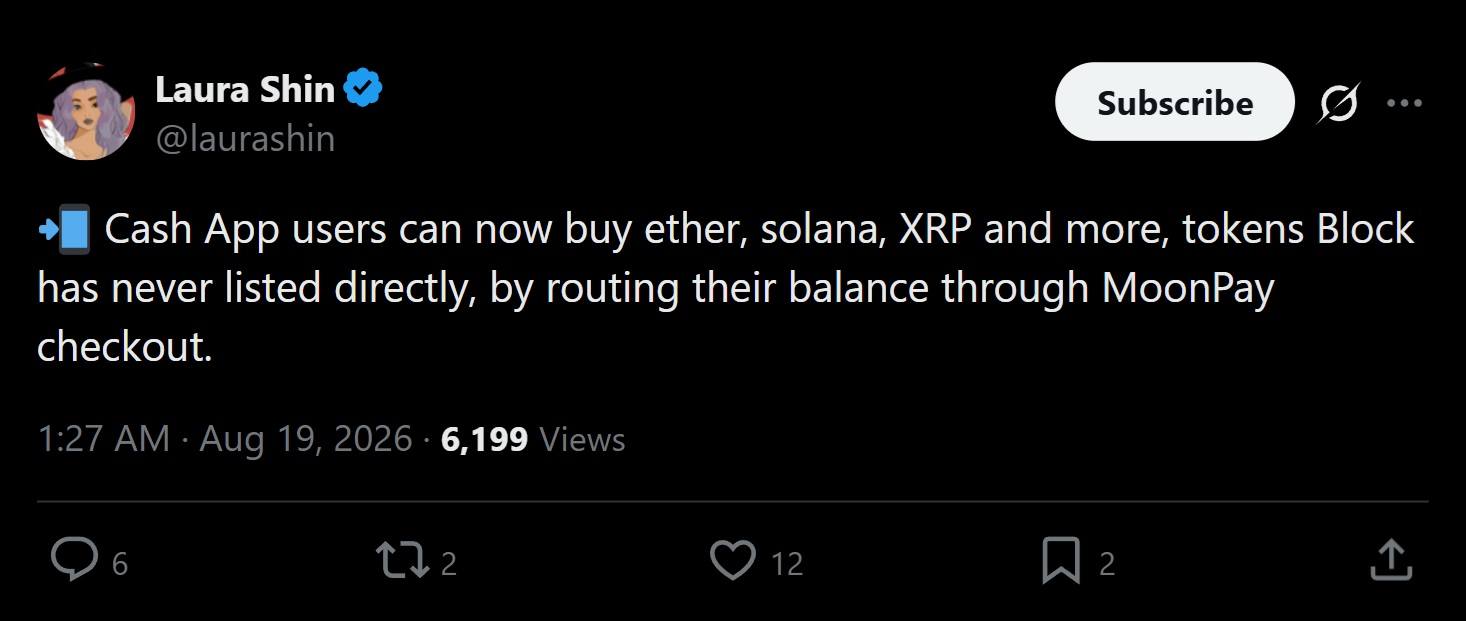
Fuente de la imagen: X

Bitcoin.com News ha estado siguiendo de cerca las funciones cripto de Cash App a lo largo de los años, desde el lanzamiento de la función de conversión de nómina "Paid in Bitcoin" hasta las herramientas de redondeo en BTC y la recepción de pagos a través de Lightning Network. Sin embargo, hasta ahora, la compra directa de criptomonedas en Cash App se limitaba a Bitcoin, y USDC solo se agregó a principios de este año.

Por lo tanto, la integración con MoonPay permite efectivamente a Cash App ofrecer una selección mucho más amplia de tokens sin la necesidad de construir su propia infraestructura para listar y custodiar cada activo.

Cash App Pay se une a la creciente lista de métodos de financiación

Cash App Pay es ahora la tercera opción principal de pago compatible con MoonPay para financiar compras de criptomonedas, sumándose a PayPal, agregado en 2024, y Venmo. Después de realizar una compra, MoonPay puede enviar los tokens a una serie de billeteras externas, incluyendo Trust Wallet, Bitcoin.com, Metamask, Moonshot, Ledger, Bitpay, Uniswap, Tangem, LOBSTR y Edge, brindando a decenas de millones de usuarios de Cash App acceso directo a billeteras de autocustodia, en lugar de mantener los fondos dentro de la propia aplicación Cash App.

El cofundador y CEO de MoonPay, Ivan Soto-Wright, describió esta integración no tanto como una actualización de producto, sino como un paso para expandir el mercado, añadiendo:

"Cash App es una aplicación donde decenas de millones de estadounidenses ya gestionan su dinero. Esta integración significa que esos usuarios tendrán acceso al ecosistema de activos digitales, financiando instantáneamente desde la aplicación que ya conocen y en la que confían".

Dado que, hasta junio, Cash App cuenta con 59 millones de usuarios activos, esta integración le brinda a MoonPay una de las mayores bases de usuarios de fintech del país como canal para compras de criptomonedas.

Una lista creciente de canales principales para acceder a $XRP

Esta novedad es también el último ejemplo de la expansión de la presencia de $XRP en aplicaciones financieras masivas durante 2026. A principios de este año, SoFi añadió soporte para depósitos de $XRP, mientras que Ripple posicionó este paso como parte de un esfuerzo más amplio para brindar a más usuarios acceso directo y utilidad práctica.

$XRP también ha llegado a Rakuten Wallet, lo que lo pone a disposición de más de 5 millones de comerciantes en Japón a través de esta integración. Cada nuevo canal de acceso añade una vía de distribución masiva e independiente de un intercambio de criptomonedas individual, una tendencia que, iniciada con la integración de MoonPay en Cash App, ahora se extiende a una de las aplicaciones de pagos entre pares más grandes de EE.UU.

Finalmente, vale la pena señalar que esta expansión ocurre después de un período que no fue el más tranquilo para Cash App en términos de cumplimiento normativo cripto. Hasta ese momento, la empresa Block había sido multada por reguladores de Nueva York con 40 millones de dólares por deficiencias en el monitoreo de transacciones con Bitcoin y moneda fiduciaria en Cash App, incluidos informes de que la empresa ignoró aproximadamente 169,000 alertas de incumplimiento.

end-content
Trending Cryptos

Related Questions

Q¿Qué permite la integración de Cash App Pay con MoonPay a los usuarios elegibles en Estados Unidos?

ALa integración permite a los usuarios elegibles en Estados Unidos adquirir $XRP, Solana (SOL), Ether (ETH) y USDT, enviando el pago directamente desde el saldo de su Cash App.

Q¿Cómo procesa MoonPay la compra de criptomonedas a través de esta integración con Cash App?

AMoonPay procesa la compra y puede enviar los activos a una billetera externa elegida por el usuario, en lugar de Cash App o Block (su empresa matriz) agregar o almacenar estos tokens directamente en su aplicación.

Q¿Qué otro método de pago principal, además de Cash App Pay, se añadió a MoonPay en 2024?

AEn 2024, PayPal se añadió como un método de pago principal para financiar compras de criptomonedas en MoonPay, junto con Venmo y ahora Cash App Pay.

Q¿Por qué el cofundador y CEO de MoonPay, Ivan Soto-Wright, considera importante la integración con Cash App?

AIvan Soto-Wright la considera un paso para expandir el mercado, ya que Cash App es una aplicación donde decenas de millones de estadounidenses ya gestionan su dinero. Esto da acceso instantáneo al ecosistema de activos digitales desde una aplicación que ya conocen y en la que confían.

QSegún el artículo, ¿qué acción regulatoria afectó a Block, la empresa matriz de Cash App, en relación con su manejo de criptomonedas?

ALos reguladores de Nueva York multaron a Block con 40 millones de dólares por deficiencias en el monitoreo de transacciones de Bitcoin y moneda fiduciaria en Cash App, incluida la omisión de aproximadamente 169,000 alertas de violaciones.

Related Reads

The Five Paradoxes of Artificial Intelligence

**Five Paradoxes of Artificial Intelligence** Artificial intelligence (AI) is an era filled with paradoxes, which we navigate as we advance. **1. The Prediction Paradox** AI experts, from pioneers like Marvin Minsky to contemporary figures like Geoffrey Hinton and Demis Hassabis, have a history of inaccurate forecasts regarding AI's capabilities and timelines, such as achieving human-level machine intelligence or surpassing radiologists. Predictions about Artificial General Intelligence (AGI) vary wildly between optimistic entrepreneurs and skeptical academics, highlighting the inherent unpredictability of technological futures. **2. The Employment Quantification Paradox** Despite numerous studies from institutions like the OECD, IMF, and McKinsey attempting to quantify AI's impact on jobs, estimates of affected employment range from 0.4% to 67%, revealing vast inconsistencies. This paradox arises because isolating AI's effect from other economic, social, and technological factors is virtually impossible, and forecasts depend on static assumptions about a dynamically evolving technology. **3. The Productivity Paradox** While AI is a transformative General Purpose Technology, significant productivity growth has not yet materialized in major economies like the EU and has only matched historical averages in the US. This disconnect between rapid innovation and slow productivity gains, reminiscent of the "Solow Paradox" from the computer age, is often explained by time lags. History shows it takes decades for such technologies to diffuse and trigger complementary innovations that boost productivity. **4. The Data Value Paradox** Data is hailed as the "new oil" and critical for AI, yet its economic value is paradoxical. Its worth is realized only in use, not in straightforward trade. Despite policy emphasis and initiatives for data asset recognition on corporate balance sheets in China, the monetized value remains negligible—accounting for only about 0.06% of major telecom operators' total assets—highlighting the gap between perceived utility and financial valuation. **5. The Industrial Revolution Paradox** For decades, nearly every major new technology, from the internet and nanotechnology to blockchain and now AI, has been proclaimed as the driver of a "Fourth Industrial Revolution." This constant reassignment suggests prior labels were premature. True industrial revolutions are typically identified in hindsight, not in real-time. Furthermore, the coexistence of such a proclaimed transformative revolution with ongoing economic crises would be historically anomalous. Whether AI truly defines a new industrial revolution remains a narrative for the future to decide.

marsbit2m ago

The Five Paradoxes of Artificial Intelligence

marsbit2m ago

Experts Warn of Mass Crypto Hacks Using AI Agents

Experts warn that AI agents could dramatically lower the cost and scale of attacks against cryptocurrency holders. Speaking at the Wyoming Blockchain Symposium, industry figures noted that automation allows malicious actors to simultaneously search for vulnerabilities in wallets, passwords, and networks across a vast number of potential victims. Ryan Kirkly, co-founder and CEO of Global Settlement Network, criticized the industry for often viewing autonomous agents only as beneficial tools while underestimating their offensive potential. Data from TRM Labs shows the crypto industry experienced a record 207 hacks in the first half of 2026, causing $972 million in losses, with the number doubling from the same period in 2025. Vice President of Technical Operations at Web3 Foundation, Bill Labun, agreed that the efficiency of autonomous systems also benefits attackers. While defenders like the Ethereum Foundation are using AI agents for security audits, the need for human verification remains high due to false positives. A major concern is granting AI agents direct access to financial tools and personal data. New services like MetaMask's Agent Wallet, which allows AI to manage assets within set limits, introduce risks such as prompt injection attacks. Panelists also highlighted risks from metadata leakage, which can compromise privacy even on private networks, and the unresolved issue of legal liability for an AI agent's autonomous and potentially irreversible actions. Lack of user trust, due to AI's tendency to "hallucinate" or generate incorrect information, was cited as a key barrier to widespread adoption.

cryptonews.ru3m ago

Experts Warn of Mass Crypto Hacks Using AI Agents

cryptonews.ru3m ago

American economic magazine Forbes stated that bitcoin could become a neutral reserve asset for the global economy!

American business and economic magazine Forbes has suggested that Bitcoin could potentially play a significant role as a neutral reserve asset in the global financial system. According to the publication, Bitcoin might offer an alternative to the growing debates surrounding the US dollar's status as the world's reserve currency and the current system's reliance on US government bonds. Forbes notes that the dollar's reserve status grants the US significant advantages but also highlights the inherent "Triffin dilemma," where the US struggles to balance its domestic economic needs with global demand for the reserve currency. The current system draws global capital to the US, allowing for cheaper imports but weakening domestic competitiveness and worsening the trade deficit. The post-gold standard system has been sustained by US bonds, yet fundamental contradictions remain. The magazine argues that stablecoins cannot fully address the reserve asset issue as they are largely backed by US Treasuries. While gold is a neutral reserve asset, it has limitations regarding mobility, verification, and transactional efficiency. In contrast, Bitcoin, with its fixed supply, lack of need for state credit guarantees, and ease of global verification and transfer, is presented as a potential next-generation neutral reserve asset. Forbes states that while the US dollar will continue to be used in international trade, Bitcoin could eventually assume the reserve asset role, reducing the global economy's dependence on any single country's debt instruments. The article also acknowledges that hurdles like price volatility and limited institutional adoption must be overcome. *This is not investment advice.

cryptonews.ru4m ago

American economic magazine Forbes stated that bitcoin could become a neutral reserve asset for the global economy!

cryptonews.ru4m ago

Trading

Spot

Hot Articles

What is XRP 2.0

XRP 2.0: A New Frontier in the Cryptocurrency Landscape Introduction to XRP 2.0 In the ever-evolving realm of cryptocurrency, new projects continuously emerge, vying for attention and adoption. One such promising initiative is XRP 2.0, a novel cryptocurrency project designed to leverage advanced blockchain technology and robust encryption methodologies. While the name draws parallels with Ripple’s XRP, it’s crucial to note that XRP 2.0 operates independently, focusing on enhancing transaction security, privacy, and scalability. As the digital financial landscape increasingly embraces decentralized solutions, XRP 2.0 aims to contribute meaningfully to web3 and the overall expansion of crypto projects. What is XRP 2.0? At its core, XRP 2.0 is a cryptocurrency project that aims to create a secure and decentralized digital currency ecosystem. Its foundational technology integrates sophisticated blockchain principles with cutting-edge encryption techniques. The overarching goal of XRP 2.0 is to establish itself as a reliable and efficient platform enabling swift transaction execution while prioritizing enhanced privacy protections for its users. The project is promoted as a solution to many limitations faced by existing cryptocurrencies, proposing a system that can handle a higher volume of transactions with improved speed and privacy. This versatility positions XRP 2.0 as a significant contender in a marketplace riddled with various digital currencies. Who is the Creator of XRP 2.0? The identity of the creator behind XRP 2.0 has been flagged as ‘Wilbur.’ However, comprehensive details regarding Wilbur or their associated entity remain elusive. The anonymity of many cryptocurrency creators is not an uncommon phenomenon in the industry, often designed to maintain a degree of privacy and security. Who are the Investors of XRP 2.0? As of now, specific information related to the investment foundations or organizations supporting XRP 2.0 is not publicly available. In the cryptocurrency sector, the backing by reputed investors can significantly influence a project's credibility and success, yet the transparency regarding the financial supporters of XRP 2.0 has not been established. How Does XRP 2.0 Work? XRP 2.0 stands out by employing a combination of blockchain technology and advanced encryption algorithms that ensures secure and decentralized transactions. Its innovative structure includes unique features designed to foster user engagement and broaden functionalities beyond conventional cryptocurrency transactions. Among these features, XRP 2.0 incorporates AI-powered capabilities, such as text-to-image and text-to-speech functionalities. These additions are designed to enhance the interactive experience for users, promoting broader applicability across various sectors. By bridging technological advancements with user-centered design, XRP 2.0 aims to capture the attention of a diverse range of individuals and enterprises looking to integrate cryptocurrency solutions into their operational frameworks. Timeline of XRP 2.0 Understanding XRP 2.0 requires examining the milestones that have defined its journey thus far: July 23, 2023: XRP 2.0 is introduced as a novel cryptocurrency project, aiming to revolutionize secure and decentralized transaction capabilities in the blockchain domain. September 8, 2023: The launching of another project, XRP20, occurs, marking the emergence of an ERC-20 token on the Ethereum blockchain that remains unrelated to XRP 2.0. November 13, 2023: The XRP Ledger undergoes a significant update with the release of rippled server software version 2.0.0. It is essential to note that this development is disconnected from the XRP 2.0 cryptocurrency project. Key Points About XRP 2.0 To distill the essence of XRP 2.0, several critical factors emerge: Unique Features: The inclusion of features like AI-powered text-to-image and text-to-speech further diversifies the potential applications of XRP 2.0. Blockchain Technology: The framework utilizes advanced blockchain mechanisms and encryption protocols, ensuring a secure and decentralized environment for transactions. Scalability and Privacy: XRP 2.0 prioritizes enhanced privacy protections in transaction processes and the scalability necessary to accommodate a growing user base. No Affiliation with Ripple: Importantly, despite its name, XRP 2.0 does not have any allegiance or collaboration with Ripple’s XRP, distinguishing its operational framework and objectives within the cryptocurrency ecosystem. Conclusion XRP 2.0 represents an ambitious venture into the cryptocurrency sphere, aiming to offer a combination of security, privacy, and efficiency in digital transactions. By integrating sophisticated technologies and user-friendly features, the project sets out to broaden the horizons of what cryptocurrency can achieve in today's digital economy. While the anonymity of its creator and lack of disclosed investors might raise questions for some, XRP 2.0's focus on advanced functionalities and decentralisation enhances its appeal amidst an increasingly crowded crypto market. As the cryptocurrency landscape continues to evolve, XRP 2.0 may yet emerge as a pivotal player in the expansion of secure and scalable blockchain solutions.

1.6k Total ViewsPublished 2024.04.01Updated 2024.12.03

What is XRP 2.0

Discussions

Welcome to the HTX Community. Here, you can stay informed about the latest platform developments and gain access to professional market insights. Users' opinions on the price of XRP (XRP) are presented below.

活动图片