Les indicateurs fondamentaux des cryptomonnaies redeviennent plus importants que les classements par capitalisation

cryptonews.ruPublished on 2026-08-16Last updated on 2026-08-16

Abstract

Les indicateurs fondamentaux des cryptomonnaies redeviennent plus importants que le simple classement par capitalisation boursière pour les investisseurs. Ceux-ci se concentrent désormais sur les revenus des protocoles, l'utilité réelle, l'économie du token et la capacité d'un projet à capturer de la valeur, plutôt que sur son rang dans les classements. Les experts de Bitwise, Wintermute et d'Arbitrum Foundation notent que le marché évolue au-delà de l'ère où le classement sur CoinMarketCap était un proxy de fiabilité. Si les prix restent influencés à court terme par les futures perpétuels et les flux de trading, l'analyse fondamentale gagne en importance pour les horizons d'investissement à moyen et long terme. Les investisseurs institutionnels, en particulier, examinent en profondeur l'adoption, les frais générés, la demande durable et les modèles économiques. L'analyse fondamentale évalue la logique commerciale sous-jacente : l'équipe, la technologie, la tokenomique, les partenariats, l'activité des utilisateurs et les revenus. Elle diffère de l'analyse technique, qui se concentre sur les graphiques de prix et les liquidités pour les trades à court terme. Des métriques comme les revenus de protocole, les utilisateurs payants et le capital verrouillé dans une blockchain sont considérées comme plus fiables que le nombre d'adresses ou la valeur totale bloquée (TVL), qui peuvent être artificiellement gonflés. Des projets comme Hyperliquid (évalué via l'activité de sa platef...

Les indicateurs fondamentaux des cryptomonnaies deviennent de plus en plus le principal filtre pour les investisseurs : ils regardent les revenus des protocoles, l'utilisation réelle, l'économie du token et la capacité d'un projet à retenir la valeur créée, et pas seulement la place dans le classement par capitalisation boursière.

Les acteurs du marché de Bitwise, Wintermute et Arbitrum Foundation notent que la cryptomonnaie sort progressivement de l'étape où les tokens étaient évalués selon le principe « plus on est haut dans le classement, plus on est fiable ». Sur les courtes distances, les prix restent largement dictés par les contrats perpétuels, la liquidité et les flux de trading. Mais à l'horizon de plusieurs mois et années, les investisseurs étudient de plus en plus attentivement si un réseau a des utilisateurs, des frais, une demande soutenue et un modèle compréhensible de capture de la valeur.
Principaux enseignements :

  • Les investisseurs évaluent de plus en plus les tokens à travers la taille du marché potentiel, l'adoption réelle et la capacité d'un projet à transformer l'activité en valeur.
  • Les gestionnaires d'actifs qui viennent tout juste d'entrer dans l'industrie crypto ne se limitent pas aux classements de CoinMarketCap et analysent plus en profondeur les réseaux et applications individuels.
  • Hyperliquid est devenu l'un des premiers exemples de cette approche : le token $HYPE est considéré à travers l'activité de la plateforme, ses revenus et ses paramètres économiques.

Qu'est-ce que l'analyse fondamentale des cryptomonnaies

L'analyse fondamentale des cryptomonnaies, en termes simples, c'est essayer de comprendre grâce à quoi un projet peut avoir de la valeur. Un investisseur ne regarde pas seulement le prix du token, mais aussi les utilisateurs, les frais, les revenus, la technologie, la tokenomie et la capacité du réseau à retenir la valeur créée.

L'analyse technique répond à une autre question : comment le prix se comporte sur le graphique à l'instant présent. Elle aide à évaluer les niveaux, la liquidité, les contrats perpétuels, les taux de financement et le comportement des traders. L'analyse fondamentale est plus adaptée pour évaluer un projet sur plusieurs mois et années, tandis que l'analyse technique sert à trouver des points d'entrée et pour les transactions à court terme.

Analyse fondamentale et technique : une brève comparaison

  • Critère : ce qui est étudié. L'analyse fondamentale examine la logique métier du protocole, les utilisateurs, les frais et l'économie du token. L'analyse technique examine le graphique des prix, les volumes, la liquidité et les produits dérivés.
  • Critère : horizon. L'analyse fondamentale est plus utile sur des périodes de plusieurs mois et années. L'analyse technique est plus souvent utilisée intraday et pour les transactions à court terme.
  • Critère : question principale. L'analyse fondamentale demande pourquoi un actif devrait avoir de la valeur. L'analyse technique demande où le prix pourrait aller dans un avenir proche.

Quoi vérifier avant d'évaluer un token

  • L'équipe de développement : expérience, visibilité publique, capacité à tenir ses promesses et à développer le produit.
  • La technologie et les innovations : quel problème le réseau ou l'application résout-il et le projet a-t-il un avantage notable.
  • La tokenomie : émission, distribution des tokens, incitations pour les participants et mécanisme d'accumulation de valeur.
  • Les partenariats et intégrations : aident-ils à attirer des utilisateurs, des capitaux et des cas d'utilisation réels.
  • L'activité des utilisateurs : transactions, utilisateurs payants, frais et rétention de l'audience.
  • Le modèle économique : y a-t-il des revenus, une demande et un lien clair entre l'activité du protocole et la valeur du token.
  • Les concurrents : en quoi le projet diffère-t-il des autres réseaux, échanges, applications ou solutions d'infrastructure.
  • La feuille de route et les plans de développement : à quel point les plans sont-ils réalistes et soutiennent-ils la croissance à long terme de l'écosystème.

Outils et métriques pour l'analyse fondamentale

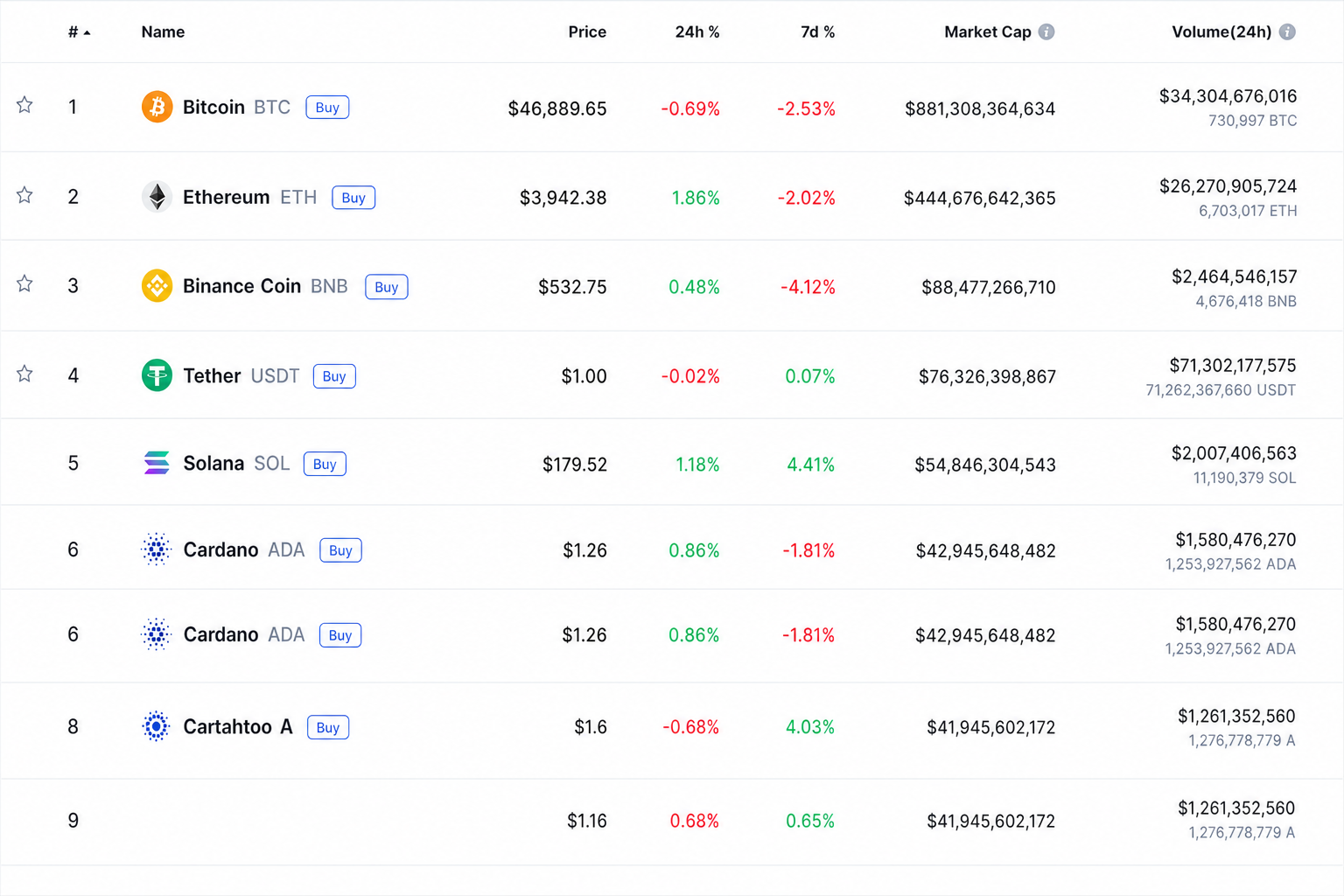
Pour l'analyse fondamentale, les investisseurs n'utilisent pas un seul indicateur, mais un ensemble de sources et de métriques. Le classement par capitalisation aide à comprendre rapidement l'échelle d'un actif, mais à lui seul, il ne répond plus à la question de savoir à quel point un projet est solide.

  • Les classements et agrégateurs comme CoinMarketCap aident à évaluer la place d'un token sur le marché et à comparer sa capitalisation avec d'autres actifs.
  • Les données on-chain montrent les transactions, les frais, l'activité des utilisateurs et le capital qui reste au sein du réseau.
  • Les rapports et analyses des gestionnaires et market makers, y compris Bitwise et Wintermute, aident à voir les flux institutionnels et l'évolution de la demande.
  • Les données sur les produits dérivés, les contrats perpétuels, les taux de financement et les liquidations aident à séparer le mouvement de prix à court terme de la valeur à long terme d'un projet.

La capitalisation boursière, c'est le prix du token multiplié par le nombre de tokens en circulation. Cet indicateur est important car il permet de comparer l'échelle des projets, mais il ne remplace pas l'analyse des revenus, des utilisateurs, de la tokenomie et de la durabilité de la demande.

Pour évaluer une équipe, il faut regarder qui développe le projet, si les membres ont une expérience pertinente, comment ils communiquent avec la communauté et s'ils respectent les plans annoncés. Pour évaluer la tokenomie, la distribution des tokens, les incitations, l'émission, la demande pour le token et le fait qu'une partie de la valeur créée revienne à l'écosystème sont importants.

La politique et la régulation gouvernementales influencent le marché à travers les règles d'admission des investisseurs, les exigences pour les échanges et les gardiens, le régime fiscal, ainsi que l'approche concernant les stablecoins, les actifs tokenisés et les outils DeFi. Plus les règles sont claires, plus il est facile pour les grands allocateurs de travailler avec les actifs numériques ; une incertitude brutale, au contraire, augmente le risque et peut peser sur la liquidité.

Pourquoi le classement par capitalisation n'est plus le principal point de référence

Le PDG de Bitwise, Hunter Horsley, décrit ce qui se passe comme la fin de l'ère du « classement CoinMarketCap ». Dans les cycles de marché précédents, les nouveaux réseaux de première couche étaient souvent évalués comme une version réduite des plus grands blockchains : si un projet était plus bas dans la liste, un rabais lui était automatiquement appliqué.

Maintenant, ce modèle fonctionne moins bien. L'analyse fondamentale passe au premier plan : quel marché un projet peut-il occuper, à quelle vitesse sa base d'utilisateurs croît-elle, quels frais collecte-t-il et combien de la valeur créée reste au sein de l'écosystème. La capitalisation boursière reste un repère notable, mais elle ne remplace plus une évaluation complète de l'activité métier du protocole.

Horsley cite l'exemple d'Hyperliquid. Pour évaluer $HYPE, les investisseurs peuvent regarder non pas sa ressemblance avec un autre réseau blockchain, mais l'activité de trading de la plateforme de dérivés, sa rentabilité et son économie interne. Au cours de la dernière année, le token a augmenté d'environ 20%.

Lorsque nous parlons avec des gestionnaires de capitaux dans des entreprises qui viennent tout juste d'entrer dans ce secteur, ils ne savent souvent même pas quelle place un actif occupe sur CoinMarketCap. Pour eux, ce n'est tout simplement pas l'essentiel, a déclaré Hunter Horsley.

Les contrats perpétuels font toujours bouger les prix intraday

Le trader du desk de gré à gré de Wintermute, Jasper De Maere, souligne : les indicateurs fondamentaux et les flux de marché sont importants, mais ils fonctionnent sur des périodes de temps différentes. Intraday, le prix est encore souvent déterminé par les contrats perpétuels, les taux de financement, le positionnement des traders et les liquidations.

Pour la plupart des grands tokens, les volumes des contrats perpétuels restent plusieurs fois supérieurs aux échanges au comptant. Par conséquent, l'analyse technique, les données sur la liquidité et le comportement du marché des dérivés gardent leur importance pour les transactions à court terme. Mais pour les investissements à plus long terme, les investisseurs reviennent de plus en plus aux revenus, à la demande et à la qualité de l'activité des utilisateurs.

Selon De Maere, au cours des 12 à 18 derniers mois, l'intérêt s'est nettement déplacé de la pure infrastructure vers les applications et les blockchains applicatifs. Ces projets sont plus proches de la logique habituelle de la fintech et du capital-risque : il est plus facile de les comparer par leurs clients, leur chiffre d'affaires, leurs frais et leur rétention d'utilisateurs.

Les métriques fondamentales deviennent particulièrement importantes dans la finance décentralisée, sur les échanges de contrats perpétuels et dans les réseaux décentralisés d'infrastructure physique. Le minage entre aussi dans cette catégorie, où les investisseurs ont depuis longtemps l'habitude de regarder le coût de production, les revenus et la durabilité du modèle, et pas seulement le prix de la monnaie.

Les indicateurs fondamentaux forment la limite inférieure de l'évaluation et aident à établir une liste restreinte d'actifs, et ce sont les flux de trading qui déterminent le prix spécifique, a noté Jasper De Maere.

Il ajoute que les revenus et l'utilisation réelle aident à comprendre quels tokens pourront survivre aux baisses et entrer dans les portefeuilles des grands allocateurs. Mais ces indicateurs décident rarement de la direction du prix précisément aujourd'hui.

Les flux institutionnels changent la structure du marché

Les données de Wintermute montrent que le principal changement n'est pas tant lié au passage du spot aux dérivés, mais à qui échange exactement. Au premier semestre 2026, les contreparties institutionnelles ont constitué environ 72 % du flux de gré à gré au comptant de l'entreprise. Un an plus tôt, leur part était d'environ 59 %.

Ces flux se concentrent sur les plus grandes cryptomonnaies et sur un ensemble limité de tokens capables de générer des revenus. De Maere appelle les actifs réels tokenisés une nouvelle catégorie distincte. Dans cette logique, le token est de plus en plus perçu non seulement comme un instrument spéculatif, mais aussi comme un actif en comptabilité, dont la valeur doit reposer sur des flux de trésorerie vérifiables ou du capital retenu.

Cependant, De Maere met en garde : il n'est pas toujours facile de comprendre où le marché récompense vraiment de solides indicateurs fondamentaux, et où il suit simplement un récit à la mode. Les tokens générant des revenus attirent l'attention précisément parce que le thème fondamental est actuellement demandé, et ces deux effets sont difficiles à séparer.

Un écart est également visible entre les cryptoactifs eux-mêmes et les entreprises publiques liées à l'industrie. Au premier semestre, les cryptomonnaies ont baissé de 36 %, alors que les actions des sociétés crypto ont augmenté de 23 %, selon l'analyse de Bitwise. Cela ne signifie pas que l'action en tant qu'instrument financier continuera à surpasser les tokens, mais cela montre que le marché des valeurs mobilières et celui des actifs numériques peuvent vivre selon des régimes différents.

Quelles métriques les investisseurs considèrent-ils comme plus fiables

Brendan Ma, responsable de la stratégie d'investissement chez Arbitrum Foundation, dit que les analystes comprennent mieux aujourd'hui qu'il y a un an la structure des revenus, l'activité transactionnelle et les mécanismes de capture de la valeur. Selon lui, les métriques les plus convaincantes sont celles qui nécessitent des dépenses pour être créées et sont vérifiables sur la blockchain.

Ma classe dans ces indicateurs les revenus de commission, les utilisateurs qui paient réellement des frais, ainsi que le capital restant dans le réseau. Il peut s'agir des soldes de stablecoins et d'actifs tokenisés. Ces données sont plus difficiles à imiter que le simple nombre d'adresses ou la valeur totale bloquée.

Le nombre d'adresses et l'indicateur de valeur totale bloquée peuvent être gonflés par des incitations ou des bots. Par conséquent, la croissance des transactions devient plus importante lorsqu'elle s'accompagne d'une augmentation des frais et d'une rétention des utilisateurs. En ce sens, l'économie en tant que science aide à regarder la blockchain non pas comme un tableau de cotations, mais comme un système d'incitations, de demande et de distribution de la valeur.

Ma cite Arbitrum comme exemple d'analyse au niveau d'un projet spécifique. Depuis sa création, le réseau a traité plus de 2,7 milliards de transactions, dont plus de 500 millions pour l'année 2026. Selon la fondation, Robinhood Chain génère environ 40 millions de dollars de revenus annuels. Dans le cadre du programme d'expansion Arbitrum, 10 % des revenus nets du protocole de ce réseau sont reversés à l'écosystème Arbitrum.

Quels actifs paraissent plus solides selon les signes fondamentaux

Selon la logique de Hunter Horsley, Jasper De Maere, Brendan Ma et Zac Pendl, ce ne sont pas simplement les tokens les plus visibles qui paraissent plus solides, mais les actifs ayant une utilisation réelle, des revenus, du capital au sein du réseau et un modèle compréhensible de capture de la valeur.

  • Bitcoin reste un actif macro à part, dont la demande est liée à la recherche d'alternatives aux monnaies fiduciaires.
  • Ethereum et les projets au-delà subiront un examen plus strict de leur modèle économique, de leurs utilisateurs et de leurs revenus.
  • $HYPE est évalué à travers l'activité d'Hyperliquid, la rentabilité de la plateforme et son économie interne.
  • Arbitrum montre comment les investisseurs peuvent examiner les transactions, les revenus des réseaux associés et le retour d'une partie des revenus dans l'écosystème.

Bitcoin, Ethereum et le nouveau chapitre des actifs numériques

Hunter Horsley pense que les produits indiciels peuvent donner aux investisseurs un large accès au marché crypto sans avoir à choisir des gagnants individuels. Bitwise propose de telles solutions, ainsi que d'autres gestionnaires d'actifs, dont 21Shares.

Le responsable de la recherche chez Grayscale, Zac Pendl, sépare Bitcoin du reste du marché. Selon son estimation, Bitcoin reste un actif macro, dont la demande est liée à la recherche d'alternatives aux monnaies fiduciaires. Ici, la macroéconomie, l'inflation et l'attitude des investisseurs face à la politique monétaire sont importantes.

Les autres cryptomonnaies, y compris Ethereum et les projets au-delà, subiront un examen plus strict de leur modèle économique de base. Les investisseurs regarderont si un réseau a des utilisateurs réels, des revenus durables et une logique compréhensible d'accumulation de valeur. Dans la finance traditionnelle, les états financiers jouent un rôle similaire : ils aident à comprendre dans quelle mesure un titre ou une entreprise est soutenu par des résultats réels.

Pendl s'attend à ce que les perspectives du secteur restent solides, car les stablecoins, les actifs tokenisés et les outils de finance décentralisée soutiendront la demande pour les actifs numériques au-delà de Bitcoin dans les années à venir.

Un petit nombre de tokens avec une base fondamentale solide jouera un rôle clé dans la prochaine étape de développement des actifs numériques. Les projets faibles avec de mauvais indicateurs resteront à la traîne, a déclaré Zac Pendl.

La principale conclusion pour le marché est simple : le capital est de moins en moins prêt à payer seulement pour une place dans le classement. Plus l'industrie mûrit, plus il est important pour les investisseurs d'avoir non pas un récit médiatique, mais une économie vérifiable, des utilisateurs réels et la capacité d'un projet à transformer l'activité en valeur à long terme.

end-content

Trending Cryptos

Related Questions

QPourquoi les indicateurs fondamentaux des cryptomonnaies redeviennent-ils plus importants que les classements par capitalisation ?

ALes investisseurs se concentrent de plus en plus sur les revenus réels des protocoles, l'adoption par les utilisateurs, la tokenomie et la capacité des projets à capturer de la valeur, plutôt que sur leur simple position dans les classements. Ce changement marque une maturation du marché, où la valorisation ne se fait plus uniquement sur la base de la taille, mais sur la viabilité économique et l'utilité concrète.

QQuelle est la différence principale entre l'analyse fondamentale et l'analyse technique des cryptomonnaies ?

AL'analyse fondamentale évalue la logique économique sous-jacente d'un projet (utilisateurs, frais, revenus, tokenomie) pour déterminer sa valeur à long terme (mois/années). L'analyse technique étudie les graphiques de prix, les volumes et les dérivés pour identifier des opportunités de trading à court terme (intrajournalier ou quelques jours).

QQuelles métriques spécifiques les investisseurs privilégient-ils désormais dans l'analyse fondamentale, selon l'article ?

ALes investisseurs privilégient les métriques vérifiables et difficiles à manipuler, telles que les revenus provenant des frais, le nombre d'utilisateurs payants, le capital restant dans le réseau (comme les soldes de stablecoins), et les modèles clairs de capture de valeur. Ils se méfient des indicateurs comme le nombre total d'adresses ou la valeur totale bloquée (TVL), qui peuvent être artificiellement gonflés.

QPourquoi le classement par capitalisation boursière n'est-il plus considéré comme le principal indicateur de fiabilité ?

ACe classement ne renseigne pas sur la santé économique réelle d'un projet. Des projets bien classés peuvent manquer d'utilisateurs actifs ou de revenus durables. Les investisseurs institutionnels, en particulier, effectuent désormais une analyse plus approfondie de la proposition de valeur, de l'adoption et des flux de trésorerie, au-delà du simple rang sur CoinMarketCap.

QComment l'exemple de Hyperliquid (HYPE) illustre-t-il le nouvel état d'esprit des investisseurs ?

AAu lieu de comparer le token HYPE à d'autres en fonction de sa capitalisation, les investisseurs l'évaluent en examinant l'activité réelle de sa plateforme de dérivés, les revenus qu'elle génère et les paramètres de son économie interne. Cela montre un passage d'une évaluation basée sur la comparaison à une évaluation basée sur les fondamentaux propres au projet.

Related Reads

The Bear Market Has Ended, A New Bull Cycle Has Begun

**Title: Bear Market Over, New Bull Cycle Begins** Bitcoin surged over 20% in just three days, from a low of $64,100 on August 19th to a high of $79,500 by August 21st, marking a dramatic shift in market sentiment. This rapid rise triggered massive liquidations exceeding $4 billion, with short positions accounting for $3.7 billion—the largest short squeeze since 2021. The rally was fueled by several key factors. Macroeconomic conditions improved as the US Treasury doubled its long-term bond buyback size, easing pressure. Significant regulatory developments included a White House meeting where former President Trump urged Senate action on the CLARITY Act and hinted at potential US Bitcoin reserves, followed by the CFTC Chairman stating the agency would establish crypto market rules if the bill stalls. On-chain data revealed a fierce battle: large whales faced substantial liquidations on short positions, while others took profits or doubled down on longs. Major altcoins like ETH and XRP also saw impressive gains. Analysts are divided but increasingly bullish. Many, including CryptoQuant's founder, declare the bear market over and a new bull cycle begun. Price targets range from $100k by year-end to ambitious long-term projections of $200k. However, some caution against immediate chasing, noting overbought conditions and viewing the move as a potential "trap" ahead of the crucial September 15th Senate vote on the CLARITY Act. The market's next test is sustaining the momentum with real buying pressure, holding above key resistance near $78k-$80k, and watching ETF inflows and the upcoming regulatory vote.

marsbit2m ago

The Bear Market Has Ended, A New Bull Cycle Has Begun

marsbit2m ago

Xiaomi Defended Its Smartphone Gross Margin, Yet to Find a Profit Successor

Xiaomi's Q2 2026 financial report reveals a company navigating a complex transition. While smartphone gross margin held steady at 8.5% through strategic product mix and a record-high average selling price (ASP), this came at the cost of a 26.5% year-over-year decline in global shipments, pressuring its core user acquisition engine. This illustrates Xiaomi's central challenge: managing the "timing gap" between its established and emerging growth engines. Its smartphone business is pivoting from scale to premiumization, but it's unclear if high-end models can fully offset the volume loss from more price-sensitive segments, especially in markets like India and Africa. Meanwhile, the electric vehicle segment has become a significant revenue contributor, delivering 104,200 units and generating ¥23.9 billion. However, its profit contribution remains unclear as it, along with AI investments, is still in a scaling and investment phase. The AI and humanoid robot initiatives, though strategically prioritized and tested in Xiaomi's own factories, are in early-stage validation with no near-term commercialization timeline. Financially, the company remains stable, supported by a robust cash position and its high-margin internet services business, which hit a new high in monthly active users. Management emphasized continued heavy investment in AI, chips, and robotics to fuel the next growth cycle. The key question is whether these new engines—cars, AI, robotics—can achieve commercial scale and profitability before the smartphone engine's growth slows further.

marsbit3m ago

Xiaomi Defended Its Smartphone Gross Margin, Yet to Find a Profit Successor

marsbit3m ago

Is RWA Still Meaningful Without DeFi?

The article "Would RWA Still Matter Without DeFi?" argues that tokenizing real-world assets (RWA) alone, like putting a barcode on a container, is not transformative. True value emerges when these tokenized assets are integrated into decentralized finance (DeFi) ecosystems, enabling valuation, financing, hedging, trading, and loss management in a programmable, automated manner. Tokenization provides digital representation, but DeFi provides utility through leverage, liquidity, and composability. The core challenge lies in aligning the different "time clocks" of blockchain (fast, 24/7), traditional markets (limited hours), and asset redemption (slow processes), which creates liquidation risks and gaps. Effective RWA integration requires more than a token; it needs a full stack: legally enforceable rights, reliable data oracles, clear transfer rules, executable secondary liquidity, appropriate collateral parameters, and credible loss resolution paths. Liquidity is defined not by total value locked (TVL) but by the ability to exit a position under stress within a required timeframe. Risk management for RWAs must be modeled as a dependency graph, monitoring interconnected nodes like issuers, custodians, oracles, and liquidity pools for early warning signs beyond just price data. While tokenized government bonds serve as an initial "ping test," the future lies in more complex assets like computing power and energy, which require bespoke risk models. Tokenized stocks paired with perpetual futures present a major test, combining global equity ownership with crypto-native leverage, necessitating robust architectural safeguards like isolation and dynamic collateral rules. The conclusion is that without DeFi, RWA tokenization offers limited value—improving distribution and transparency. The significant opportunity arises when tokenized assets become functional components within open, programmable capital markets, where they can be used as collateral and facilitate complex financial strategies. The token is merely the barcode; the market operating system is the real machine.

marsbit24m ago

Is RWA Still Meaningful Without DeFi?

marsbit24m ago

Government Intervention in the Bond Market: What Does It Mean?

On August 19, 2026, the U.S. Treasury unexpectedly announced it would at least double the size of its long-term Treasury buyback operations, starting September 9. The move triggered an immediate market reaction, with the 30-year yield falling 9 basis points. This intervention came against a backdrop of the 30-year yield hitting a 19-year high of 5.34% the previous day, driven by persistent inflation, high oil prices, deteriorating U.S. fiscal health with public debt surpassing $40 trillion, and a global "buyers' strike" for long-dated bonds. Treasury buybacks involve the government repurchasing older, less liquid bonds from the market via reverse auctions to improve market functioning, not to reduce overall debt. While the action provided tactical relief and signaled the Treasury's willingness to intervene, analysts caution it does not address core structural issues: massive fiscal deficits, high borrowing needs, and fading demand from traditional buyers like foreign central banks. For investors, the announcement offered short-term support for long-duration bond ETFs and boosted assets like gold, which rose 2.7%. However, it's unlikely to significantly lower mortgage rates or alter the challenging environment for long-term bonds. The key takeaway is the distinction between a tactical market operation and the unresolved structural pressures that continue to push yields higher, requiring close monitoring of upcoming economic data, Treasury auctions, and potential signals of more aggressive policy measures.

marsbit28m ago

Government Intervention in the Bond Market: What Does It Mean?

marsbit28m ago

After 'Bessent Put', How Far Is the U.S. from Restarting QE?

Following an unscheduled announcement from the U.S. Treasury Department on August 19th, investor discussions have intensified regarding the potential for future policy interventions in long-term bond markets. The Treasury increased the maximum size of its regular buyback operations for 10-to-30 year bonds from $2 billion to $4 billion, citing a desire to improve liquidity. This move came shortly after a surge in long-term yields, with the 30-year Treasury yield briefly touching 5.34%. Market analysts, rather than focusing on the modest operational size, have interpreted the timing—outside the normal quarterly communication window—as a significant signal. The move has been dubbed the "Bessent Put," implying the market's growing expectation that Treasury officials, led by Deputy Secretary Josh Bessent, may act to prevent a disorderly rise in long-term borrowing costs. This perception represents a potential shift in the market's view of the government's "policy reaction function." The underlying pressures on long-term bonds are multifaceted, including large fiscal deficits, increased Treasury supply, a rise in corporate debt issuance for AI infrastructure (creating a "crowding out" effect), and uncertainty around foreign holdings, particularly from Japan. Geopolitical risks in the Middle East further complicate the policy landscape, potentially creating conflicting pressures between fighting inflation and managing financing costs. However, the article clarifies that this Treasury buyback program is distinct from Quantitative Easing (QE). It is a debt management operation, not a Federal Reserve balance sheet expansion. While the announcement opens the door for market speculation about more forceful tools like Yield Curve Control (YCC) or a return to QE, analysts note that conditions would need to deteriorate significantly for such measures to be implemented. For now, the "Bessent Put" reflects a change in market expectations about possible policy boundaries, not an imminent launch of new monetary stimulus.

marsbit29m ago

After 'Bessent Put', How Far Is the U.S. from Restarting QE?

marsbit29m ago

Trading

Spot

Hot Articles

What is LINON

Linde plc Tokenized Stock (Ondo): Revolutionizing Traditional Equity Access Through Blockchain Innovation The emergence of Linde plc Tokenized Stock (Ondo), represented by the ticker $LINON, signifies a monumental shift in the fusion of traditional financial structures and decentralized finance (DeFi). This innovative financial instrument showcases the tremendous potential of blockchain technology to democratize access to traditional equity markets while ensuring the security and regulatory compliance necessary for institutional-grade financial products. Through Ondo Finance's pioneering tokenization platform, $LINON provides a seamless pathway for global investors to engage with one of the world's leading industrial gas companies, Linde plc, creating a blockchain-native representation of the underlying equity. Introduction to Linde plc Tokenized Stock The landscape of financial markets is witnessing a groundbreaking transformation through the tokenization of real-world assets. Linde plc Tokenized Stock (Ondo) epitomizes this revolutionary approach by bridging the gap between conventional stock ownership and blockchain-enabled financial infrastructure. The $LINON token allows investors to gain exposure to one of the prominent industrial companies worldwide through decentralized technology. Operating within Ondo Finance's comprehensive ecosystem, $LINON symbolizes a practical application of tokenization technology that enhances accessibility, efficiency, and global connectivity in traditional financial markets. By leveraging blockchain infrastructure, this tokenized stock enables international investors to participate in U.S. equity markets, overcoming traditional barriers associated with cross-border investing. The significance of $LINON goes beyond technological innovation; it represents a fundamental shift in asset structuring, distribution, and trading in the digital age. This tokenized stock maintains all the economic benefits associated with traditional Linde plc shares while offering improved liquidity, programmable compliance features, and seamless integration with decentralized finance protocols. The development of $LINON indicates a growing acceptance of blockchain technology as a viable means for traditional finance, exemplifying how even well-established assets like Linde plc can integrate into blockchain systems. This approach preserves the core attributes that appeal to investors while introducing advanced capabilities that enhance the overall investment proposition. Project Overview and Objectives Linde plc Tokenized Stock (Ondo) encapsulates a strategic effort to democratize access to traditional equity markets through advanced blockchain technologies. The primary objective of $LINON is to provide approved global investors seamless access to the economic exposure associated with Linde plc shares, furthering an effort to create a more inclusive financial ecosystem. Beyond the digital representation of traditional assets, $LINON endeavors to eliminate barriers of geography and time zones that limit investor participation. Its design ensures that blockchain technology can elevate traditional investment vehicles without undermining the security or compliance requirements expected by investors. Key goals of the project include enhanced liquidity provision, programmable compliance mechanisms, and interoperability with other blockchain networks. Each $LINON token is fortified by actual Linde plc securities housed at U.S.-registered broker-dealers, allowing holders to reap economic advantages akin to traditional stockholders, such as dividend reinvestment. Furthermore, $LINON aims to establish new industry standards for institutional-grade tokenized securities, paving the way for traditional assets to embrace blockchain technology while remaining compliant with regulatory frameworks. By associating itself with a company as reputable as Linde plc, the project opens avenues for exploring tokenized equities catering to both conservative institutional players and daring retail investors. Project Creator and Development Team The vision for Linde plc Tokenized Stock (Ondo) comes from Nathan Allman, founder and CEO of Ondo Finance. His background in traditional finance coupled with expertise in blockchain technology positions him uniquely to navigate the complexities of asset tokenization. Allman's academic journey began at Brown University, focusing on Economics and Biology, equipping him with valuable analytical skills. His time at Goldman Sachs in the Digital Assets division strengthened his understanding of the interplay between financial institutions and emerging technologies, laying the groundwork for his later endeavors in alternative investment strategies. Under Allman's guidance, Ondo Finance has emerged as a leader in asset tokenization, launching $LINON as a flagship example of the company's larger mission towards revolutionizing traditional financial systems using blockchain technology. His commitment to leveraging blockchain for creating institutional-grade financial products has shaped the landscape of real-world asset tokenization. Investment and Funding Structure The growth of Ondo Finance, the platform powering Linde plc Tokenized Stock (Ondo), is bolstered by robust financial backing from prestigious venture capital firms and strategic investors. This strong investment foundation underpins the development of the key infrastructure essential for compliant tokenized securities like $LINON. In August 2021, Ondo Finance secured $4 million in seed funding led by a major venture capital firm, which enabled the company to commence platform development and establish the necessary regulatory processes for tokenizing real-world assets. This early investment cemented Ondo Finance's credibility within the industry. The Series A funding round followed, garnering $20 million with participation from renowned firms committed to transformative technology companies. This backing demonstrated substantial institutional confidence in Ondo Finance's vision, allowing it to hone its approach to asset tokenization through mechanisms that ensure compliance and accessibility. Noteworthy contributors, including institutional investors and experienced partners, have added significant value to Ondo Finance’s development efforts. Their involvement underscores the confidence across sectors in Ondo Finance's approach to bridging traditional finance with blockchain innovations. Technical Infrastructure and Innovation The technical architecture that underpins Linde plc Tokenized Stock (Ondo) represents a sophisticated melding of traditional finance systems and cutting-edge blockchain technology. The architecture's foundation is built on the Ethereum network, renowned for its security and programmability—both critical for intricate financial instruments. The $LINON tokenization process comprises creating a blockchain-native representation of Linde plc shares that preserves economic benefits while augmenting investor capabilities. Each token corresponds to actual shares held at U.S.-registered broker-dealers, creating a compliant custody structure that legitimizes the asset's existence and value. Automated compliance systems are integrated into the tokenization process, managing critical components such as know-your-customer (KYC) verification and anti-money laundering (AML) protocols. This incorporation of programmable compliance empowers $LINON to uphold regulatory standards essential for institutional proliferation. Cross-chain interoperability characterizes the advanced technical features of $LINON. While initially deployed on Ethereum, the framework is designed for expansion to other networks such as Solana and BNB Chain. This adaptability enhances liquidity and accessibility, allowing investors to select their preferred blockchain ecosystems. Historical Timeline and Development Crafting the history of Linde plc Tokenized Stock (Ondo) unfolds in parallel with the evolution of Ondo Finance's tokenization platform. The timeline's inception dates back to March 2021 when Nathan Allman laid the foundations for creating institutional-grade financial products on blockchain infrastructure. The initial funding round in August 2021 provided crucial resources for developing the platform and establishing partnerships necessary for effective tokenization. By January 2023, Ondo Finance launched its tokenized treasury products, establishing mechanisms that would facilitate future tokenized equities such as $LINON. A pivotal milestone arose in February 2025 when Ondo Chain—a Layer 1 blockchain designed specifically for asset tokenization—was introduced. This infrastructure enhances capabilities vital for institutional markets, demonstrating Ondo Finance's long-term commitment to tokenization. Subsequently, the launch of Ondo Global Markets in September 2025 marked the official debut of $LINON. This milestone showcased the successful transition from development to active trading, enabling investors around the world to access American financial markets seamlessly. Ongoing development plans include a targeted expansion of available tokenized assets to over 1,000 by the end of 2025, pointing to a bright future for Ondo Finance's ecosystem and its mission to broaden tokenized equity accessibility. Regulatory Compliance and Legal Framework The legal architecture governing Linde plc Tokenized Stock (Ondo) emphasizes a sophisticated approach to regulatory compliance, allowing tokenized securities to be implemented within a blockchain-based framework. The legal structure governing $LINON spans multiple jurisdictions while maintaining a robust legal footing. Compliance systems ensure that only eligible investors can access the token, enforced through automated verification that aligns with international regulations. This innovative regulatory technology promises real-time enforcement of complex requirements, considerably enhancing efficiency in operating within the regulatory landscape. The custody framework undergirding $LINON ensures that the underlying shares are securely held at U.S.-registered broker-dealers, complying with necessary regulations while delivering blockchain-driven access to investors. The token maintains its economic equivalency and security through this carefully structured custody arrangement. KYC and AML compliance systems are embedded within the smart contract architecture, ensuring integrity and adherence to regulatory practices while fostering transparency for investors. The jurisdictional restrictions mark a commitment to navigating the evolving landscape of international securities laws. Market Impact and Industry Significance The advent of Linde plc Tokenized Stock (Ondo) holds profound implications for the broader financial landscape, symbolizing a clear shift towards blockchain-enabled markets. $LINON serves as a proof-of-concept for integrating traditional companies into blockchain ecosystems, showcasing the potential benefits such as broader accessibility and improved efficiency. The market's response to $LINON indicates a growing acceptance of tokenization among institutional investors, contributing to the emergence of an expanding sector wherein traditional assets can be interconnected with blockchain innovations. The success of $LINON further solidifies market confidence, indicating an overarching shift towards recognizing asset tokenization as a transformative force in finance. Future Development and Expansion Plans The future trajectory for Linde plc Tokenized Stock (Ondo) centers around the expansion of the tokenization ecosystem and enhanced infrastructure supporting blockchain-enabled financial services. Plans for cross-chain integration usher in new opportunities for liquidity and flexibility within the investment framework, with existing capabilities poised for continuous enhancement. With the introduction of Ondo Chain, Ondo Finance aims to transition $LINON to an optimized blockchain environment specifically designed for asset tokenization. This new infrastructure heralds exciting prospects for the development of institutional-grade financial products, ensuring ongoing compatibility with contemporary investment strategies. Further integration with decentralized finance protocols signifies a commitment to empowering $LINON holders through advanced financial strategies. The anticipated expansion of available tokenized assets promises to broaden investor access, enhancing the utility and appeal of the platform. In alignment with ambitions for regulatory expansion, ongoing efforts to secure approvals for new jurisdictions will enhance investor access, further positioning $LINON at the forefront of the burgeoning tokenization market. Conclusion Linde plc Tokenized Stock (Ondo), as represented by the $LINON token, stands at the intersection of traditional finance and blockchain innovation. It embodies a transformative milestone in how financial assets are structured, distributed, and engaged within modern investment ecosystems. The technical sophistication behind $LINON, combined with its regulatory compliance framework, illustrates that asset tokenization can improve financial infrastructure rather than simply digitizing existing products. This pioneering effort not only enhances investor access to U.S. equity markets but also signifies an evolution of how traditional financial services can integrate blockchain technology. As the asset tokenization market grows exponentially, with prospects suggesting significant valuation increases, $LINON paves the way for a future where tokenized securities become standard fixtures in the financial landscape. The trajectory of $LINON will undoubtedly influence how traditional finance adapts to a transformed, blockchain-powered world.

4.6k Total ViewsPublished 2025.12.05Updated 2025.12.05

What is LINON

What is CRMON

Salesforce Tokenized Stock (Ondo): Revolutionising Traditional Equity Access Through Blockchain Innovation The emergence of Salesforce Tokenized Stock (CRMON) marks a pivotal advancement in integrating traditional financial markets with blockchain technology. This innovative approach offers investors unprecedented access to equity exposure through tokenisation. Developed by Ondo Finance, CRMON provides tokenholders with economic exposure equivalent to holding Salesforce stock (CRM) while automatically reinvesting dividends. This effectively bridges the gap between conventional equity markets and decentralised finance (DeFi). Introduction and Comprehensive Overview of Salesforce Tokenized Stock In recent years, the financial landscape has dramatically transformed due to blockchain technology, fundamentally altering how investors access and interact with traditional assets. The development of Salesforce Tokenized Stock (CRMON) is a prime example of this evolution, representing a sophisticated fusion of conventional equity markets with cutting-edge distributed ledger technology. CRMON is a tokenised version of Salesforce stock, emerging from the innovative work of Ondo Finance, a leading platform in the real-world asset tokenisation sector that positions itself as a bridge between traditional finance and decentralised systems. Designed to provide tokenholders with economic exposure that mirrors the performance of the underlying Salesforce stock, CRMON incorporates automatic dividend reinvestment mechanisms. This eliminates many traditional barriers associated with international equity investment, such as complex brokerage relationships, currency conversion challenges, and restricted trading hours. The tokenisation process reimagines stock ownership as a blockchain-native asset while maintaining its economic equivalence with the underlying security, offering enhanced portability and integration capabilities within decentralised finance ecosystems. CRMON transcends its individual utility as an investment instrument to represent a fundamental shift in how financial markets can operate in an increasingly digital world. By maintaining full backing through U.S.-registered broker-dealers and implementing robust compliance frameworks, CRMON demonstrates that tokenised securities can achieve the regulatory standards necessary for institutional adoption while delivering the technological advantages of blockchain infrastructure. Understanding Tokenized Real-World Assets and CRMON's Strategic Position Tokenised real-world assets signify one of the most significant innovations in modern finance, fundamentally reimagining how traditional securities are represented, traded, and utilised within digital ecosystems. CRMON operates as a tokenised equity instrument correlating directly with Salesforce stock while optimising accessibility and efficiency. This aligns with Ondo Finance's broader mission to democratise access to institutional-grade financial products through innovative tokenisation strategies. The tokenisation process guarantees complete economic equivalence with the underlying Salesforce equity. Each CRMON token represents a proportional claim on Salesforce stock held by qualified custodians, with dividend payments automatically reinvested to maintain continuous exposure to total return performance. This structure simplifies dividend management and ensures that tokenholders receive the full economic benefit of their equity exposure, encompassing both capital appreciation and income generation. Ondo Finance's strategy in tokenising Salesforce stock demonstrates its expertise in creating compliant, institutional-grade products that meet traditional financial markets' stringent requirements. The platform’s focus on merging regulatory compliance with blockchain benefits positions it at the forefront of decentralised finance, captivating both institutional and retail investors seeking blockchain-native solutions. The Technology and Innovation Framework Behind CRMON The technological infrastructure supporting CRMON integrates blockchain technology with traditional financial mechanisms, delivering institutional-grade security and compliance while maintaining the operational advantages of decentralised systems. Built on the Ethereum blockchain, CRMON utilises robust smart contract capabilities to ensure transparent, secure operations. The smart contract architecture incorporates layered security and compliance mechanisms, enabling automated compliance checks and real-time asset backing verification. Integration with oracle services maintains accurate pricing and dividend information, ensuring CRMON reflects the underlying Salesforce stock's accurate performance. This architecture delivers automated dividend reinvestments and other corporate actions, eliminating manual processing requirements and directly enhancing tokenholder benefits. Ondo Finance ensures CRMON's security structure includes daily third-party verification of holdings, independent collateral agents, and a multiple-layer custody system through partnerships with established financial institutions. This framework safeguards tokenholder interests against operational risks while providing robust asset backing. The user interface enhances integration capabilities, allowing seamless interaction between CRMON and various decentralised finance protocols, as well as cryptocurrency exchanges. This interoperability enables users to leverage their tokenised equity across multiple platforms, creating sophisticated investment strategies that marry traditional equity characteristics with blockchain-native innovation. Leadership and Corporate Structure of Ondo Finance The leadership team behind CRMON and Ondo Finance blends expertise from traditional finance and blockchain technology, presenting a robust combination of skills essential for successfully bridging conventional markets with decentralised finance. Nathan Allman, the founder and CEO, emerged from a distinguished financial background before establishing Ondo Finance in 2021. Allman's experience includes notable roles at major financial institutions, including significant contributions to developing cryptocurrency market services. His insights into regulatory compliance were paramount in developing products like CRMON that successfully unify traditional securities with blockchain technology. With a team of professionals boasting substantial experience in both conventional finance and blockchain sectors, Ondo Finance's leadership comprises diverse expertise that covers every aspect of tokenised asset development. Justin Schmidt serves as President and COO, contributing unique operational expertise, while Chris Tyrell brings essential compliance knowledge. Investment Landscape and Funding History The investment landscape surrounding Ondo Finance reflects significant institutional confidence in its mission to tokenise real-world assets. The company has raised substantial funds through various investment rounds, attracting leading venture capital firms and strategic investors that recognise the transformative potential of tokenised securities like CRMON. Notably, Ondo Finance completed a successful Series A funding round in 2022, led by well-known venture capital firms. This funding success validates Ondo Finance's innovative approach to creating compliant, institutional-grade tokenised products. In total, Ondo Finance has successfully secured substantial funding, raising significant capital for product development and market expansion, including a noteworthy token sale that reinforced its governance structure through the establishment of the ONDO token. The diverse composition of investors reflects broad market confidence in Ondo Finance's business model, demonstrating support from both traditional and blockchain-native organisations. Operational Mechanics and Technical Implementation The operational framework supporting CRMON exemplifies sophisticated integration of traditional financial mechanisms with blockchain technology. The technical implementation introduces multiple layers of security, compliance, and operational efficiency to meet institutional standards while enhancing accessibility. The tokenisation process begins by acquiring actual Salesforce stock through U.S.-registered broker-dealers, ensuring each CRMON token maintains direct correlation with the underlying equity performance. Smart contracts automate operational processes, including dividend reinvestment and corporate action processing, facilitating a streamlined user experience. The Minting and redemption processes allow authorised participants to manage CRMON tokens effectively. During U.S. trading hours, institutions can mint new tokens by depositing stablecoins that are used to purchase corresponding Salesforce equity. This structure maintains a tight correlation with underlying assets, enhancing liquidity and price discovery. Additionally, the infrastructure supports twenty-four-hour token transfer capabilities, providing CRMON holders with operations outside traditional market hours. This represents a significant advantage over conventional securities ownership, thus promoting integration with decentralised finance applications. Plans for cross-chain compatibility through partnerships signal further ambitions for CRMON's market reach. By expanding to other blockchain networks, Ondo Finance aims to enhance accessibility and user engagement with tokenised equity products. Timeline and Historical Development of Tokenized Equity Innovation The timeline of CRMON's development and Ondo Finance's broader tokenised capabilities demonstrates a systematic innovation process beginning with the company's founding in 2021. 2021: Ondo Finance is founded by Nathan Allman and co-founders, launching initial products focused on structured vault offerings on the Ethereum blockchain. 2022: The company completes substantial funding rounds—both equity and token sales—totaling significant capital and launching initial tokenised U.S. Treasury products. 2023-2024: Ondo Finance experiences substantial growth, establishing partnerships with major financial institutions while expanding its product offerings beyond fixed-income securities. February 2025: Ondo Global Markets is announced, marking the transition into equity tokenisation with plans for accessing over one hundred U.S. stocks and ETFs. September 2025: The official launch of Ondo Global Markets includes CRMON alongside other tokenised equity offerings, marking a significant evolution in Ondo Finance's product ecosystem. This timeline highlights the organisation's rapid growth and its capability to adapt its technological and compliance frameworks to accommodate different asset classes effectively while maintaining security and regulatory integrity. Regulatory Framework and Compliance Approach Ondo Finance's regulatory framework showcases a sophisticated compliance strategy, essential for achieving institutional adoption in the tokenised securities market. The company's strong partnerships with U.S.-registered broker-dealers promote adherence to Securities and Exchange Commission regulations and apply robust investor protections. Acquisitions, such as Oasis Pro—a registered broker-dealer—significantly enhance Ondo Finance's compliance capabilities, ensuring thorough alignment with existing regulatory structures. The company employs independent verification procedures that foster transparency, aiming for a solid performance standards reputation. Furthermore, Ondo Finance's commitment extends to international regulatory compliance, ensuring token access remains restricted to eligible investors while adhering to pertinent cross-border securities regulations. Comprehensive attention to tax implications and reporting requirements fortifies the security and compliance landscape of CRMON, ensuring that investor obligations remain manageable. Future Prospects and Market Positioning The forward-looking landscape for CRMON and Ondo Finance illustrates substantial growth opportunities driven by institutional adoption of blockchain technology and escalating demand for efficient alternatives to conventional securities ownership. Market projections indicate the tokenised asset sector could value multiple trillion dollars by 2030. With plans to scale CRMON offerings significantly and integrate it with a dedicated blockchain infrastructure—Ondo Chain—Ondo Finance aims to elevate its institutional-grade tokenised asset operations. Additionally, the development of strategic partnerships enhances distribution capabilities while establishing the company's credibility in the financial market. Furthermore, the integration of tokenised equity with decentralised finance protocols offers new potential for innovative financial products and strategies previously impossible with traditional securities. These factors underscore CRMON's positioning to effectively capture increased market share and deliver innovative solutions for international investment exposure. Conclusion Salesforce Tokenized Stock (CRMON) symbolises a transformative development within financial markets, successfully bridging traditional equity ownership with blockchain technology to create unprecedented accessibility for global investors. Through Ondo Finance's sophisticated tokenisation framework, CRMON provides complete economic exposure to Salesforce equity performance while enhancing operational advantages that exceed traditional ownership. The launch of CRMON reflects the broader evolution of financial markets towards blockchain infrastructures that maintain regulatory compliance while delivering increased efficiency. Ondo Finance's extensive approach to regulatory adherence, institutional-grade security, and technological innovation solidifies CRMON as a model for future tokenised securities, delivering access previously unattainable in conventional brokerage structures. As the tokenised asset sector continues to develop, CRMON is well-positioned to address historical inefficiencies in capital markets while providing investors with innovative solutions for accessing traditional securities. The outlook for CRMON looks exceptionally promising, supported by ambitious expansion plans, technological innovations, and strategic partnerships, thereby representing a pioneering model of modern financial infrastructure evolving through blockchain integration.

4.7k Total ViewsPublished 2025.12.05Updated 2025.12.05

What is CRMON

What is SHOPON

Shopify Tokenized Stock (Ondo): A Comprehensive Analysis of Real-World Asset Tokenization in Web3 This article delves into the Shopify Tokenized Stock (Ondo), recognised by its ticker symbol $SHOPON, exploring its implications at the intersection of traditional finance and blockchain technology. As a part of Ondo Finance's tokenized securities platform, Shopify’s tokenized stock exemplifies advancements in democratizing access to global capital markets through innovative digital assets. Introduction and Overview of Shopify Tokenized Stock (Ondo) Shopify Tokenized Stock (Ondo), or $SHOPON, portrays a pivotal innovation in the realm of tokenized securities, allowing investors to gain economic exposure akin to directly owning shares of Shopify Inc. This token, developed under the umbrella of Ondo Finance, not only provides investors with the ability to hold digital representations of the company’s stock but also integrates features such as automatic reinvestment of dividends. This advancement represents a substantial shift in the landscape of decentralized finance (DeFi), linking conventional equity markets with blockchain solutions designed to enhance accessibility, transparency, and liquidity. By eliminating geographical barriers and enabling 24/7 trading capabilities, $SHOPON is positioned as a bridge connecting traditional financial instruments and the emerging Web3 ecosystem. What is Shopify Tokenized Stock (Ondo), $SHOPON? The $SHOPON token serves as a digital manifestation of Shopify Inc.'s shares, engineered to provide a direct correlation to the underlying asset's performance. Through the utilization of blockchain technology, the token gives holders a mechanism to participate in the economic benefits associated with equity ownership, including capital appreciation and dividend distribution. The unique aspect of $SHOPON lies in its automatic dividend reinvestment mechanism, which allows returns to compound without necessitating active management by the investor. This feature inherently enhances its attractiveness as an investment vehicle, particularly for individuals seeking passive income growth alongside exposure to high-performing equities. The tokenization process is facilitated by the custody of actual Shopify shares through regulated intermediaries, ensuring that every $SHOPON token is verifiably backed by real equity. This structure empowers investors with the dual advantages of both traditional financial characteristics and the innovative benefits tied to blockchain technology. Who is the Creator of Shopify Tokenized Stock (Ondo)? The creator of Shopify Tokenized Stock (Ondo), Nathan Allman, is an experienced figure in the finance sector, formerly associated with Goldman Sachs. His rich background includes significant expertise in digital asset development, bridging the gap between traditional finance and cryptocurrencies. Allman’s educational journey, marked by studies at Brown University, provided him with a deep understanding of economics and biology, equipping him with analytical skills that inform his strategic vision. In 2021, he founded Ondo Finance, committing to developing tokenized securities that meet institutional-grade standards while leveraging blockchain's transformative capabilities. Under Allman's leadership, Ondo Finance has focused on creating compliant and innovative financial products that empower a diverse investor base. Who are the Investors of Shopify Tokenized Stock (Ondo)? The investment landscape surrounding Shopify Tokenized Stock (Ondo) is notably robust, underpinned by significant institutional support. Primarily, Pantera Capital stands out as a strategic partner through the Ondo Catalyst initiative, a $250 million commitment aimed at accelerating the development of on-chain capital markets. This partnership not only signifies institutional confidence in the potential of tokenized assets but also reinforces Ondo Finance's operational capabilities and market positioning. The funding pathways have included earlier rounds that amassed millions in seed funding and further structural investments, solidifying relationships with both venture capital firms and private investors. Moreover, the financial framework is complemented by strategic partnerships with established financial institutions and technology companies, enhancing Ondo’s infrastructure and operational expertise. How Does Shopify Tokenized Stock (Ondo), $SHOPON Work? At the core of $SHOPON's operational framework is a sophisticated system integrating traditional finance mechanisms with blockchain technology. The custody of actual Shopify shares ensures that token holders retain authentic economic exposure, safeguarding their investments in line with recognized legal structures. The smart contracts employed in managing $SHOPON handle various functions, including automatic dividend reinvestment and ownership transfer, offering instant settlement and increased liquidity, marking a significant departure from conventional trading systems plagued by multi-day settlement delays. By providing interoperability with other decentralized finance applications, $SHOPON empowers holders with potentially lucrative opportunities for advanced investment strategies, including lending and automated market making. This complex integration presents a unique value proposition, catering to both traditional and crypto-native investors. The innovative structure of $SHOPON also allows for real-time settlements and transactions documented on the blockchain, delivering unparalleled transparency and security—a major advancement over standard equity trading practices. Timeline of Shopify Tokenized Stock (Ondo) March 2021: Nathan Allman establishes Ondo Finance, initially focusing on decentralized finance yield optimization. August 2021: Completion of a $4 million seed funding round led by Pantera Capital. January 2023: Launch of initial tokenized treasury security products, laying the groundwork for future equity tokenization. July 2025: Announcement of the Ondo Catalyst initiative, a strategic investment program valued at $250 million, aimed at propelling the development of tokenization in capital markets. September 3, 2025: Launch of Ondo Global Markets featuring over 100 tokenized U.S. stocks and ETFs, including $SHOPON. Technical Implementation and Blockchain Infrastructure Shopify Tokenized Stock (Ondo) operates on a technical architectural framework that marries blockchain protocols with traditional financial custody arrangements. The ecosystem leverages Ethereum's smart contract capabilities, providing seamless transaction management while ensuring compliance with regulatory standards through established financial custodians. Central to this architecture are security measures and transparent transaction records that affirm the legitimacy of each tokenholder's economic stake. With automated features managed by intricate smart contracts, $SHOPON not only streamlines ownership transfers but also allows for the tactical reinvestment of dividends—a hallmark of modern investment strategies. Moreover, the incorporation of LayerZero technology facilitates cross-chain interoperability, making $SHOPON accessible across multiple blockchain environments while preserving its functional robustness. This forward-thinking technical design positions $SHOPON as an adaptable asset within the larger DeFi milieu. Regulatory Framework and Compliance Architecture $SHOPON's regulatory framework is built upon the meticulous navigation of existing financial regulations that govern securities. The custody arrangements for the underlying Shopify shares are managed by U.S.-regulated broker-dealers, ensuring compliance and protection for investors. By maintaining a separation between the blockchain tokenization process and traditional custody, $SHOPON adheres to legal requirements while offering innovative functionalities that challenge conventional constraints. This dual-layered compliance approach enhances investor confidence and underscores Ondo Finance's commitment to regulatory integrity. Notably, the availability of $SHOPON is tailored to international investors from regions such as Asia-Pacific, Europe, and Africa, as regulatory parameters in the U.S. and U.K. present challenges in accessing tokenized securities. Market Access and Global Distribution Strategy The distribution strategy of $SHOPON is keenly designed to optimize global access while conforming to regulatory standards. The platform aims to establish comprehensive coverage for eligible investors across multiple regions, effectively dismantling traditional barriers through the implementation of blockchain technology. Integration with various cryptocurrency wallets and exchanges also promotes user-friendliness and accessibility, establishing a streamlined experience for investors to manage their holdings. Moreover, the 24/7 trading capabilities afforded by the tokenized model allow participants to react promptly to market shifts, fundamentally transforming how global equities are accessed and traded. Technology Integration and Cross-Chain Functionality The remarkable technological underpinnings of $SHOPON propagate its multi-chain functionality, set to expand its reach beyond Ethereum to networks such as Solana and BNB Chain. Such cross-chain capabilities allow users flexibility when navigating between blockchains, concurrently leveraging distinct network attributes to optimize their trading experience. LayerZero serves as the backbone for ensuring decentralized transfers between networks while providing the requisite security and speed, quintessential for maintaining investor trust. This comprehensive interoperability illustrates $SHOPON's commitment to being a versatile, user-centric asset in the evolving investment landscape. Ecosystem Integration and DeFi Compatibility Incorporating $SHOPON into broader DeFi protocols signifies its potential beyond traditional stock ownership. Token holders can leverage their holdings for various sophisticated strategies and applications, enhancing investment returns and liquidity management. By establishing a presence in lending protocols and automated trading systems, $SHOPON effectively democratizes access to advanced financial strategies previously limited to institutional investors. Such integration contributes to a more competitive and dynamic financial landscape, where individual investors can capitalize on tools typically reserved for larger entities. Risk Management and Security Framework Security remains paramount in the operational infrastructure of $SHOPON. The tokenization framework employs multiple layers of protection—beginning with regulated custody of the underlying Shopify shares. The operational protocols establish rigorous auditing, key management, and transaction monitoring standards, thus safeguarding against potential vulnerabilities. Moreover, meticulous adherence to evolving regulatory requirements provides an extra layer of security, fortifying investor protections and institutional compliance. Market Impact and Industry Implications The introduction of Shopify Tokenized Stock (Ondo) heralds a transformative shift in how financial markets operate, emphasizing the potential of tokenized securities to reshape traditional investment paradigms. The successful integration of $SHOPON encapsulates the efficiencies inherent in blockchain technology and opens avenues for new user demographics previously barred from extensive market participation. The impact extends beyond the immediate benefits to token holders, indicating broader trends that may challenge the status quo of investment services, particularly in addressing geographic restrictions and operational costs typically associated with traditional brokerage platforms. Undeniably, $SHOPON encapsulates the potential for traditional institutions to innovate further, leveraging the increasing demand for seamless blockchain access to complement existing financial infrastructure. Future Development Roadmap and Strategic Vision As Ondo Finance looks forward, the trajectory of $SHOPON rests on ambitious goals aimed at broadening the spectrum of available tokenized assets significantly. Over the next few years, plans are in place to expand to more than 1,000 tokenized securities, further enhancing market participation and investment options for individuals worldwide. Continued integration with traditional financial actors, development of specialized institutional products, and enhancements in automated trading capabilities will ensure that $SHOPON maintains its position at the forefront of financial innovation. Regulatory collaboration will also remain a focal point, establishing a framework that not only supports the compliance requirements but also promotes a healthy environment for tokenized asset proliferation. Conclusion and Market Significance In summary, Shopify Tokenized Stock (Ondo), represented by the ticker $SHOPON, is more than merely a tokenized equity offering; it embodies the innovation possible when traditional finance collides with modern blockchain applications. With a robust technical architecture, a commitment to compliance, and a clear strategic vision, $SHOPON exemplifies the potential for tokenized assets to enhance liquidity, accessibility, and functionality in capital markets. As the global investment landscape evolves, the transformative implications of $SHOPON extend beyond individual investors to revolutionize how financial instruments are perceived, traded, and utilized within both traditional and decentralized frameworks.

4.7k Total ViewsPublished 2025.12.05Updated 2025.12.05

What is SHOPON

Discussions

Welcome to the HTX Community. Here, you can stay informed about the latest platform developments and gain access to professional market insights. Users' opinions on the price of CAP (CAP) are presented below.

活动图片