Portofolio 13F Berkshire Mengalami Perubahan di Kuartal II: Tambah Google, Delta Air Lines, dan Terus Kurangi Bank of America untuk Dua Kuartal Berturut-turut

marsbitPublished on 2026-08-16Last updated on 2026-08-16

Abstract

Pergantian CEO Berkshire Hathaway pasca-pengunduran diri Warren Buffett masih berlanjut. Portofolio saham Berkshire pada kuartal II, berdasarkan laporan 13F yang dirilis 14 Agustus, menunjukkan perubahan signifikan dengan nilai total sekitar $299,3 miliar. Berkshire secara agresif menambah saham Alphabet (Google), dengan peningkatan 45,24% untuk saham Kelas A dan lonjakan 658,35% untuk saham Kelas C. Gabungan keduanya kini menjadi posisi ketiga terbesar dalam portofolio, di belakang Apple dan American Express. Sektor transportasi dan perumahan juga mendapat suntikan dana dengan penambahan saham Delta Air Lines (~44%) dan Lennar Corporation. Di sisi lain, Berkshire melanjutkan penjualan saham Bank of America untuk kuartal kedua berturut-turut, dengan pengurangan sekitar 5,89%. Perusahaan juga mengurangi kepemilikan di beberapa sektor lain seperti keuangan (Ally Financial, Capital One) dan ritel (Kroger). Saham produsen minuman Constellation Brands dibuang seluruhnya dari portofolio. Lima besar saham utama Berkshire tetap tidak berubah: Apple, American Express, Alphabet (gabungan), Coca-Cola, dan Bank of America. Satu-satunya tambahan baru adalah pembelian kecil saham D.R. Horton.

Penulis: Wall Street Insights

Setelah "Oracle of Omaha" Warren Buffett mengundurkan diri sebagai CEO, laporan 13F kedua Berkshire Hathaway telah dirilis.

Menurut dokumen yang diungkap pada 14 Agustus waktu AS, pada akhir kuartal kedua, nilai portofolio saham 13F Berkshire mencapai sekitar $299,3 miliar, meningkat 12,09% dari sekitar $263,1 miliar pada akhir kuartal pertama. Secara keseluruhan, di kuartal kedua Berkshire membuka posisi baru di 1 saham, menambah posisi di 7 saham, mengurangi posisi di 6 saham, dan menutup seluruh posisi di 1 saham.

Terlihat bahwa Berkshire di bawah kendali resmi Greg Abel, di satu sisi terus meningkatkan eksposur ke arah seperti Alphabet, perumahan, dan penerbangan, sementara di sisi lain, posisi di sektor keuangan tradisional dan beberapa konsumen sedang dikurangi secara bertahap.
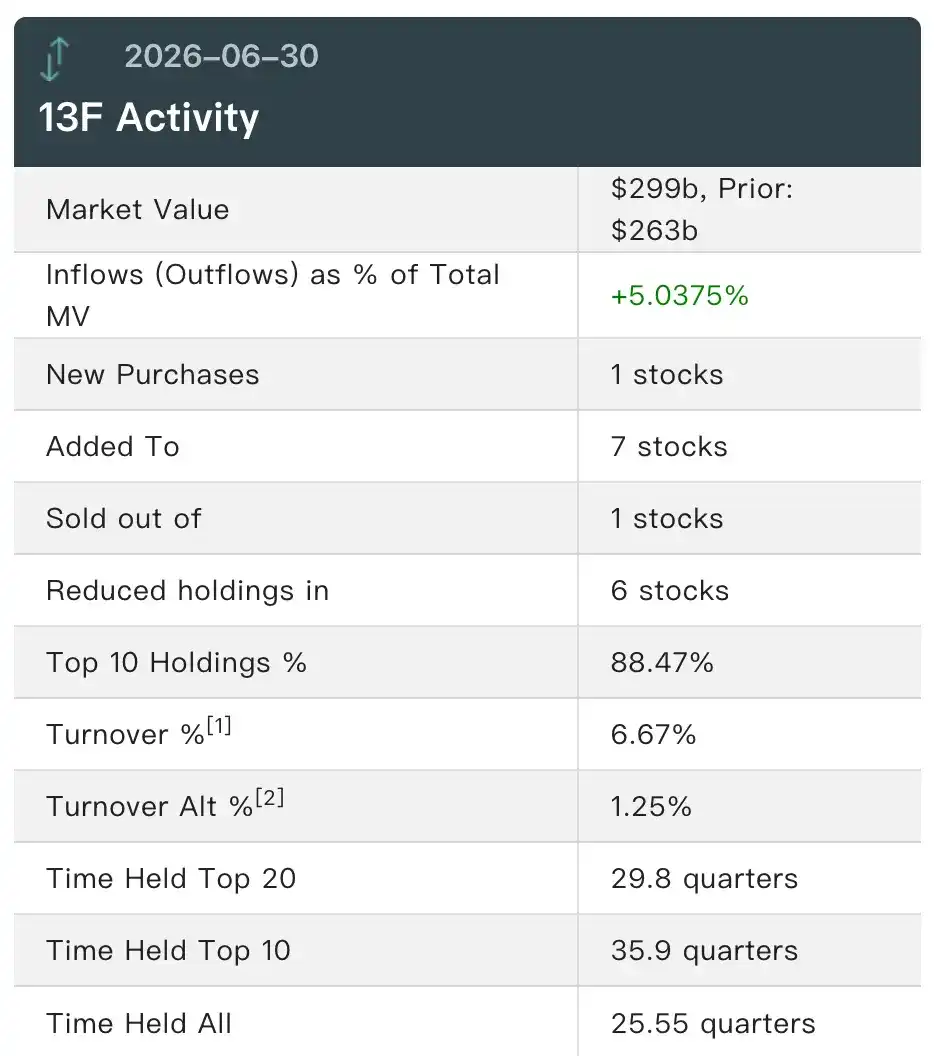
Jika dua kelas saham Alphabet digabungkan, sepuluh saham terbesar Berkshire saat ini adalah Apple, American Express, Alphabet, Coca-Cola, Bank of America, Chevron, Occidental Petroleum, Chubb, Moody's, dan Kraft Heinz.
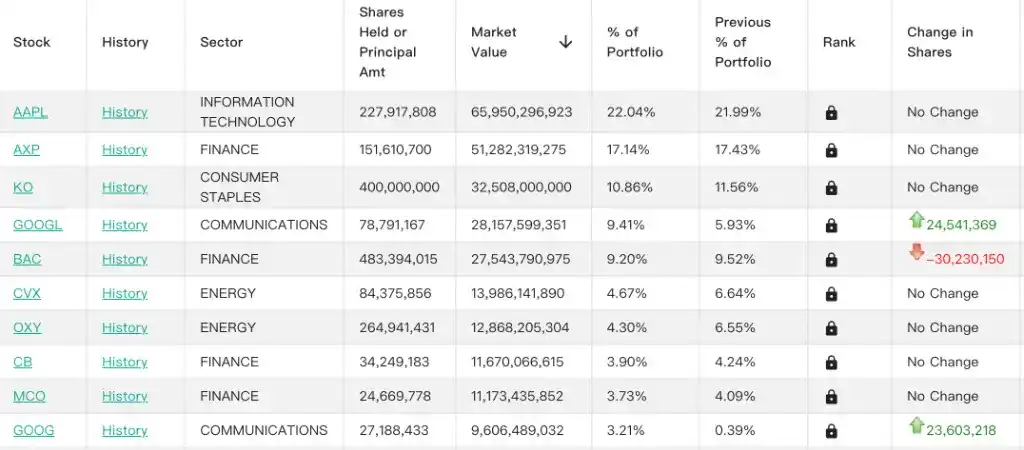
Apple tetap menjadi saham terbesar Berkshire, dengan nilai posisi sekitar $65,95 miliar, menyumbang sekitar 22% dari nilai portofolio saham 13F; American Express berada di posisi kedua dengan nilai sekitar $51,282 miliar, menyumbang 17,14%; Alphabet yang digabungkan berada di posisi ketiga; Coca-Cola dan Bank of America masing-masing di posisi keempat dan kelima.

Di antara sepuluh saham terbesar tersebut, satu-satunya yang dikurangi adalah Bank of America, dengan Berkshire mengurangi sekitar 30,2 juta saham di kuartal tersebut. Berdasarkan harga akhir periode, Berkshire mengurangi sekitar 30,23 juta saham Bank of America, penurunan 5,89%, setara dengan nilai pengurangan sekitar $1,72 miliar. Ini menjadi objek pengurangan terbesar Berkshire pada kuartal tersebut. Pada akhir periode, Berkshire masih memegang 483 juta saham Bank of America, bernilai sekitar $27,544 miliar, menyumbang 9,2% dari nilai portofolio saham 13F, menempati posisi sebagai kepemilikan terbesar kelima. Bank of America tetap menjadi investasi penting bagi Berkshire, tetapi telah dikurangi selama dua kuartal berturut-turut.

Selain itu, posisi di sembilan saham terbesar lainnya Berkshire tidak berubah pada kuartal kedua.

Di kuartal kedua tahun ini, Berkshire menambah posisi di Delta Air Lines sekitar 17,51 juta saham, peningkatan sekitar 44%, jumlah saham pada akhir periode naik menjadi 57,32 juta saham, bernilai sekitar $5,369 miliar; menambah saham Kelas A pembangun rumah Lennar sekitar 3,01 juta saham, peningkatan hampir 30%, sekaligus menambah sekitar 60.000 saham Kelas B Lennar; menambah Macy's sekitar 4,31 juta saham, peningkatan 141,82%; sedikit menambah The New York Times sekitar 550.000 saham.

Satu-satunya saham baru yang dibeli Berkshire di kuartal kedua adalah D.R. Horton, hanya membuka posisi kecil sebesar 3.564 saham, sekitar $580.000.

Selain Bank of America, Berkshire juga mengurangi kepemilikan di Ally Financial, Capital One Financial, penyedia layanan dialisis ginjal DaVita, retailer grosir Kroger, dan produsen baja Nucor. Produsen minuman beralkohol Constellation Brands, yang sudah dikurangi secara signifikan pada kuartal pertama, ditutup seluruh posisinya oleh Berkshire pada kuartal kedua.


Trending Cryptos

Related Questions

QApa portofolio saham terbesar Berkshire Hathaway pada kuartal kedua menurut laporan 13F?

AApel (Apple) tetap menjadi saham terbesar dengan nilai portofolio sekitar $659,50 miliar, mencakup sekitar 22% dari total nilai portofolio saham 13F.

QApa saja tindakan penyesuaian portofolio utama yang dilakukan Berkshire Hathaway pada kuartal kedua?

ABerkshire menambah saham Alphabet (Google) dan Delta Air Lines secara signifikan, sementara mengurangi kepemilikan saham Bank of America untuk kedua kalinya berturut-turut.

QBerapa total nilai portofolio saham 13F Berkshire Hathaway pada akhir kuartal kedua?

ATotal nilai portofolio saham 13F Berkshire pada akhir kuartal kedua adalah sekitar $2.993 miliar, meningkat 12,09% dari kuartal pertama.

QSaham apa yang dibeli pertama kali oleh Berkshire Hathaway pada kuartal kedua?

ASaham baru satu-satunya yang dibeli Berkshire pada kuartal kedua adalah D.R. Horton (perumahan), dengan pembelian kecil 3.564 saham senilai sekitar $580.000.

QSaham apa yang sepenuhnya dijual oleh Berkshire Hathaway pada kuartal kedua?

ABerkshire menjual seluruh kepemilikannya di Constellation Brands (produsen minuman beralkohol) pada kuartal kedua.
Related Reads

Anthropic, Dario Amodei, and "The Last Private Company"

The article explores the contrasting narratives surrounding Anthropic and its founder, Dario Amodei. He is portrayed as both a cautious "watchman" warning of AI's existential dangers and an ambitious driver racing to build that very future. The core tension lies in Amodei's belief that since powerful AI is inevitable, Anthropic must lead its development to ensure it's done "responsibly." Driven by personal tragedy—his father's death before a cure arrived—Amodei is obsessed with accelerating science. He co-founded Anthropic after leaving OpenAI over governance concerns, aiming to build top models while establishing safety standards. Anthropic developed "Constitutional AI" to align models and proposed risk-based policies, positioning itself as both creator and regulator. Amodei envisions AI bringing immense benefits, like curing diseases within years. However, his roadmap reveals a geopolitical vision: he argues the US and its allies must secure a dominant, "unipolar" advantage in advanced AI to lock in strategic supremacy before sharing benefits. The article critiques this logic. While Amodei eloquently warns of concentrated corporate power and influence, his solutions consistently grant Anthropic more authority. He disqualifies other actors—markets, the public, rival nations—as unfit to steer the future, ultimately positioning Anthropic as the necessary custodian. This culminates in an alleged, unconfirmed internal vision where Anthropic becomes "the world's only private company." The piece concludes that Amodei, sincerely believing he sees the dangers most clearly, has authored his own justification to hold the wheel.

marsbit12m ago

Anthropic, Dario Amodei, and "The Last Private Company"

marsbit12m ago

Trading

Spot

Hot Articles

What is $BANK

Bank AI: A Revolutionary Step in the Future of Banking Introduction In an era marked by rapid advancements in technology, Bank AI stands at the intersection of artificial intelligence (AI) and banking services. This innovative project seeks to redefine the financial landscape, enhancing operational efficiency, security measures, and customer experiences through the power of AI. As we embark on this exploration of Bank AI, we will delve into what the project entails, its operational dynamics, its historical context, and significant milestones. What is Bank AI? At its core, Bank AI represents a transformative initiative aimed at integrating artificial intelligence into various banking operations. This project harnesses the capabilities of AI to automate processes, improve risk management protocols, and enhance customer interaction through personalised services. The primary objectives of Bank AI include: Automation of Banking Functions: By leveraging AI technologies, Bank AI aims to automate routine tasks, reducing the burden on human resources and enhancing efficiency. Enhanced Risk Management: The project utilises AI algorithms to predict and identify risks, thereby fortifying security measures against fraud and other threats. Personalisation of Banking Services: Bank AI focuses on offering tailored financial products and services by analysing customer data and behaviours. Improving Customer Experience: The implementation of AI-driven solutions, such as chatbots and virtual assistants, aims to provide users with more human-like interactions, revolutionising the way customers engage with banks. With these goals, Bank AI positions itself as a crucial player in rendering banking more efficient, secure, and user-centric. Who is the Creator of Bank AI? Details regarding the creator of Bank AI remain unknown. As such, no specific individual or organisation has been identified in the available information. The anonymity surrounding the project's inception raises questions but does not detract from its ambitious vision and objectives. Who are the Investors of Bank AI? Similar to the project's creator, specific information regarding the investors or supporting organisations of Bank AI has not been disclosed. Without this information, it is challenging to outline the financial backing and institutional support that might be propelling the project forward. Nevertheless, the importance of having a robust investment foundation is pivotal for sustaining development in such an innovative field. How Does Bank AI Work? Bank AI operates on several innovative fronts, focusing on unique factors that differentiate it from traditional banking frameworks. Below are key operational features: Automation: By applying machine learning algorithms, Bank AI automates various manual processes within banks. This results in reduced operational costs and allows human workers to redirect their efforts towards more strategic activities. Advanced Risk Management: The integration of AI into risk management practices equips banks with tools to accurately predict potential threats such as fraud, ensuring that customer information and assets remain secure. Tailored Financial Recommendations: Through continuous learning from customer interactions, the AI systems develop a nuanced understanding of user needs, enabling them to offer tailored advice on financial decisions. Enhanced Customer Interactions: Utilizing chatbots and virtual assistants powered by AI, Bank AI enables a more engaging customer experience, allowing users to have their queries resolved quickly, thus reducing wait times and improving satisfaction levels. Together, these operational features position Bank AI as a pioneer in the banking sector, establishing new benchmarks for service delivery and operational excellence. Timeline of Bank AI Understanding the trajectory of Bank AI requires a look at its historical context. Below is a timeline highlighting important milestones and developments: Early 2010s: The conceptualisation of AI integration into banking services began to gain attention as banking institutions recognised the potential benefits. 2018: A marked increase in the implementation of AI technologies occurred when banks started using AI tools like chatbots for basic customer service and risk management systems for improved security handling. 2023: The sophistication of AI continued to advance, with generative AI being introduced for more complex tasks such as document processing and real-time investment analysis. This year marked a significant leap in the capabilities afforded to banks by AI technology. 2024-Current Status: As of this year, Bank AI is on an upward trajectory, with ongoing research and developments poised to further enhance capabilities in banking operations. Continued exploration of AI applications hints at exciting developments yet to come. Key Points About Bank AI Integration of AI in Banking: Bank AI focuses on adopting artificial intelligence to streamline banking processes and improve user experiences. Automation and Risk Management Focus: The project strongly emphasises these areas, aiming to shift the burden of routine tasks while enhancing security frameworks through predictive analytics. Personalised Banking Solutions: By harnessing customer data, Bank AI enables tailored banking services that cater to individual user needs. Commitment to Development: Bank AI remains committed to ongoing research and development efforts, ensuring its adaptability and ongoing relevance as technology continues to evolve. Conclusion In summary, Bank AI exemplifies a crucial step forward in the banking industry, leveraging artificial intelligence to reshape operational paradigms, enhance security, and promote customer satisfaction. Despite gaps in information surrounding the creator and investors, the clear objectives and functional mechanisms of Bank AI provide a strong foundation for its ongoing evolution. As AI technology continues to advance and merge with the banking sector, Bank AI is well-positioned to significantly impact the future of financial services, enhancing the way we understand and interact with banking.

397 Total ViewsPublished 2024.04.06Updated 2024.12.03

What is $BANK

Discussions

Welcome to the HTX Community. Here, you can stay informed about the latest platform developments and gain access to professional market insights. Users' opinions on the price of BANK (BANK) are presented below.

活动图片